11-7-18 Should I refinance and payoff my HELOC?
Question of the week: Should I refinance and payoff my HELOC?
Answer: My most frequent response to questions of the week definitely applies to this question: It depends.
There are several factors to consider when deciding if now is the time for you to refinance and fix the rate on you Home Equity Line of Credit (HELOC).
Before we get into various factors to discuss, let’s take a quick look at why the question is being asked. Your HELOC has three components that determine your current payment, the balance, the prime rate and the amount added to the prime rate (called the margin) that results in the rate you are being charged.
Of the three factors the only one you somewhat control is the balance; you can impact your payment by paying down the balance on the HELOC. Obviously, the more you pay towards the balance the lower your payment will be on a monthly basis. Most HELOCs have two periods of repayment. The initial payment period usually has a minimum payment requirement that is the interest accrued on the loan since the last payment. The next stage of payments is usually a fully amortized period for the remaining life of the loan; if you may have a HELOC that is a twenty year loan, in this case typically the first ten years of the loan have an interest only payment, at the start of the eleventh year the loan will be fully amortized based on the remain ten years of the loan.
Example: You have a $150,000 balance on your HELOC that you obtained in December 2008 and the current rate is the prime rate, currently 5.25% plus one-half of one percent (0.500%) for a payment rate of 5.75%. Your minimum payment for November is the interest on the balance, $718.75 (balance times rate divided by twelve months). Next month you begin your eleventh year and the loan payment is now fully amortized using the rate that month plus the remaining term of 120 months. The rate for the December payment is the same as November, since the prime rate has not moved, at 5.75%, since you paid the interest only payment in November balance is still $150,000 but now instead of interest only the payment is amortized to include principal reduction and the payment will be $1646.54. Since the Federal Reserve is expected to increase its funds rate by 0.25% in December that means the prime rate will increase by 0.25% as well so the January payment will be calculated at 6.00%** and your payment will be $1655.00 for the month. **Since the Fed will increase rates into the month the rate will only be for part of the month with the earlier part of the month being calculated at the 5.75% rate, but for demonstration purposes easier to show as one complete month.
The lower your balance when you enter the fully amortized payment portion of the repayment of your HELOC the lower your required payment will be.
If you have a HELOC for three years or more you have seen your rate increase by two percent since 2015 and one percent since last November. The chances are you will see at least another one percent increase in the next year, with a 0.25% in December when the Fed is expected to increase rates again. (To see why the Fed increasing rates impacts your HELOC rate here is link to WR&MU from a few weeks ago addressing the issue.)
With rates having climbed one percent or more in the past twelve months the decision to refinance is a lot harder than it was one year ago, or even two to three months ago and moving forward the decision might not get easier.
The first consideration is if you are risk averse or not. The risk averse individual would be more inclined to want to refinance to avoid future increases in rates on their HELOC as well as for long term fixed rate mortgages that would be used to refinance. The person more comfortable with risk might be less inclined to refinance. Why?
The person who is willing to accept more risk may take the stance that their underlying primary mortgage has an interest rate that is lower than the rate available to refinance their primary loan plus their HELOC and will accept the higher rates on their HELOC in the future and if need be make interest only payments with the hope that rates decline in the future so refinancing makes more sense, or to enable easier paying down of the mortgage.
The risk averse person does not want the uncertainty of not knowing how high their rate and payment will go on their HELOC and is more willing to trade off what would probably be a higher payment in the short term for what may be a lower payment in the long run. The risk averse person knows if rates do drop in the future they can likely refinance and lower their payment.
What are the factors in terms of payment that need to be considered? First and foremost is the payment differential between doing nothing and refinancing. There are four primary factors that will determine the payment at which the interest rate for your refinance will be calculated: balances, credit score, loan-to-value and whether the transaction would be considered cashout or not.
The first three factors are pretty elementary; the combined balances of your existing primary mortgage and your HELOC will determine the refinance loan amount, your credit score is determined when we pull a credit report, the loan-to-value is determined by the estimated value of your home and the refinance loan balance.
The fourth factor, whether the refinance transaction is considered a cashout transaction or a rate and term transaction. For conventional mortgages unless the HELOC can be proven to be part of the purchase price of the property the transaction is considered to be a cashout transaction, if your HELOC was used to purchase your property the transaction is considered to be a rate and term refinance, and will have lower costs than the cashout. If the loan is a jumbo loan we have several programs that will consider the refinance a rate and term transaction is you can prove you have not accessed any funds from the HELOC in the past twelve months.
Once we know the four factors we go to our rate sheets and determine the rate, and also your what your new payment would be after refinancing. With this information you can determine if you want to refinance and payoff your HELOC into a fixed rate mortgage, or continue as you are with your current primary mortgage and HELOC.
Since the minimum payment for most HELOCs is interest only even if you were able to refinance near what your current mortgage rate is the chances are you will see some increase in total payment as you move from interest only to paying down principal on your HELOC. With rates higher and most homeowners with rates closer to 4.00% than today’s rates the chances are that your payment will likely increase a few hundred dollars per month, or more, when refinancing to pay off your HELOC. And this is the basis for the hard decision, is the extra monthly payment worth it to remove future risk based on rising interest rates, or is the cost too much for you to want to remove the risk?
This is a question I am very willing to help you answer by running the numbers and options for you and your particular situation. For several years we have been encouraging homeowners with HELOCs to refinance to fix their rate and payment on their mortgage debt, while I still feel it is a good idea for most homeowners, it may not be your choice, however I encourage you to run the numbers and know the options. If your HELOC is converting from an interest only payment to fully amortized in the next few years you may want to give refinancing even more consideration due to the sharp increase in your monthly payment when that occurs.
If you, or someone you know, has a Home Equity Line of Credit please contact me to go through your information so you have the information needed for making a decision on whether to refinance.
Have a question? Ask me!
Better economy, higher rates. That correlation is something long time readers of the WR&MU have learned over the years. This week we have positive economic news released every day, some data a lot more positive than others. Here are the data releases that have the greatest impact on rates.
Households made more and spent more in September. Income growth for the month was slower than August but still positive at 0.2% matching the core inflation rate for the month. Holding back income growth was a slow down for self-employed businesses. Savings rates dropped as consumer spending increased in September by 0.4%, the seventh month in a row with spending increasing by 0.4% or more. The disparity in spending and income growth may have been impacted by Hurricane Florence. The very good news for the economy inside the data is that there was a sharp increase in the purchase of new cars and recreational goods—the sort of spending that occurs when the economy is strong and consumers are optimistic. The news is not good for interest rates, though tempered a bit as the year over year inflation index of 2.0% is in line with the Federal Reserve’s target.
My oldest was one the last time the American consumer was has confident as s/he was in September, as the consumer confidence rose to its highest level since 2000. The cutoff date for the survey was mid-October, before the stock market slump so the expectation is that the index will drop in November. This news also puts upward pressure on interest rates.
Continuing the short term historic gains was the Employment Cost Index which showed wage gains in the private sector reached their highest level in ten years in the third quarter, with wages, salaries and benefits increasing 0.8% for the period. The gains reflect the lowest unemployment rate since 1969. A very big concern for economists is wage inflation, higher prices driven not by demand but by the cost of production of goods and services being driven higher by employment costs. The ECI report puts that concern very much in the center of the inflation and rate conversation. While this news is good for workers it is bad for those wanting lower interest rates.
Today’s data just piles on. The jobs report was released by the Labor Department today showing the labor situation in September. The news shows a very strong labor market, stronger than expected. Nonfarm payrolls increased by 250,000 in September, well above the forecast of 208,000 jobs. Included in the report was year over year growth in wages of 3.1%, the highest gain in one year since 2009 when the recession ended, the average hourly pay is now $27.30. This report fully supports future rate hikes from the Federal Reserve and continued upward pressure on mortgage and other long term rates.
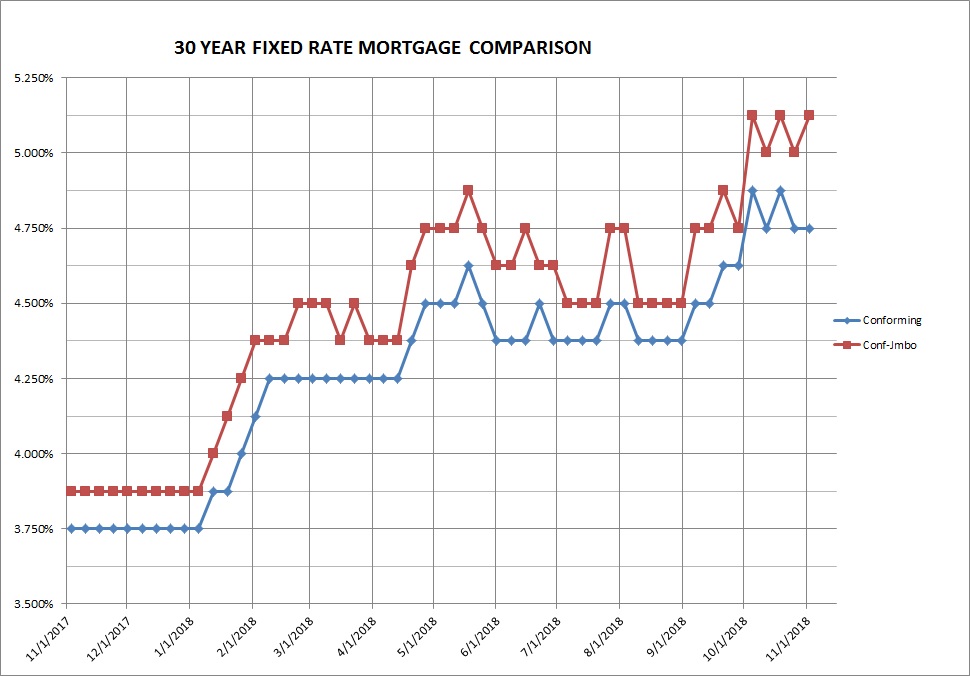
Rates for Friday November 2, 2018: Despite the quantity and quality of positive economic news conforming rates hold on from last Friday, high-balance loans ($453,101 to $679,650) increased from last week back to seven year high first reached in early October. The only reason I can see for rates to undergo a migration down would be a catastrophic event causing investors to flee to the safety of long term fixed rate returns available in U.S. Treasury bonds and mortgages.
FIXED RATE MORTGAGES AT COST OF 1.25 POINTS LOCKED FOR 45 DAYS:
30 year conforming 4.75% Flat
30 year high-balance conforming 5.125% Up 0.125%
Please note that these are base rates and adjustments may be added for condominiums, refinances, credit scores, loan to value, no impound account and period rate is locked. Rates are based on 20% down with 740 FICO score for purchase mortgages.
As many of you know I love baseball. During the season most afternoons I have the Phillies radio broadcast, or some other game back east playing on my computer and on weekends I listen to games from Philly or around the country while driving around or doing chores. Last Friday night’s game between the Dodgers and Red Sox that went 18 innings was pure heaven for me and I was thrilled the way it ended, not necessarily because the Dodgers won but that it was won on a great home run and not an error. Every inning was thrilling and had fans on the edge of their seats. While mildly upset the Red Sox won another championship and the Dodgers drought is now thirty seasons, I admire the Sox for the way they played this season and through the playoffs; the best team hoisted the trophy to end the season.
Now we wait until the end of February when Spring Training starts!
Have a great week,
Dennis
Past Weekly Rate & Market Updates can be found on my blog page at my website www.DennisCSmith.com