


How can we help our children purchase a home?
Question of the week: How can we help our children purchase a home?
Answer: This is a question we repeat every two or so years as parents and their children age and more of my clients now have children of home-buying age. As well, with the ever increasing, property values in the region, many young families need the help parents may be able to provide.
Many parents will do anything they can to help their children get a leg up, to get a strong start, to ensure a more comfortable life. Some parents do it by trying to help their kids get into certain colleges, some parents do it by helping their children with the purchase of their first home. We all want the best for our children, the question is how far are we willing to go, or for many parents how far can we go?
There are several ways parents can help their children purchase a home. Each has different consequences, short and/or long term. A primary factor I have parents consider when we are having these conversations is what will be the impact on their lives today, and in retirement, or if they are retired, their future.
Let’s explore the different ways parents can help their children obtain their own home.
SCENARIO ONE: One way some parents help is by purchasing the house themselves. They provide the down payment, they qualify for the mortgage, and they are the only ones on the title and mortgage. Their child moves in and the agreement is that at some point the parents will give the house to their son or daughter.
Typically, under this type of arrangement the child will make all, or some, of the payments for mortgage, taxes and insurance, either directly to lender, tax collector and insurance company. However, we have seen this situation where they do make the payments but pay their parents directly. If the latter, the parents can then claim the payments as rent and then, if eligible, write off certain expenses. In this set-up, the parents essentially purchased an income property and rented to their child.
If the agreement is that the child will make the payments for the mortgage, taxes and insurance it is advisable for the parents to add the children to the title of the property. If it can be shown they have made those payments then they should be able to deduct the mortgage interest and property taxes (checking with tax professional first). In this scenario, the parents purchase the home, but essentially turn the home over to their child. In the future, by showing they have been making the payments and living in the property it will be easier for the kids to refinance in the future, should it be beneficial, and remove the parents from a mortgage obligation and obtain full title.
A major reason against this option is since there are no owner-occupants on the mortgage, the loan will be non-owner occupied with a higher interest rate.
In my opinion, this is the least desirable way to help your children obtain home ownership.
SCENARIO TWO: A more desirable way to assist your children in the purchase of their own home is to co-sign for them on their mortgage application. Most loan programs will allow family members to co-sign for mortgages and not occupy the property, what we call “non-occupant co-borrowers.” In this scenario, the child cannot qualify for the mortgage, usually because their debt-to-income ratio is too high. Depending on the parent’s total income and debt obligations, including their own housing payment, they may be able to co-sign for their child and enable loan qualifying. The parents would be on the mortgage and on title to the property.
The parents are still liable for the loan payment, as they are in Scenario One above, however the child is also responsible and have a lot more control over the situation than they do in Scenario One. Some parents are concerned, rightfully, how their being on the loan may impact their ability to get a loan in the future; most loan programs have a guideline for such a situation, known as “contingent liability.” If the parents can show the child has made the last twelve payments in a timely fashion, then most mortgage programs will not count the payment for parents qualifying for another loan in the future.
In the future if it makes sense for the child to refinance then it is easier in this scenario than Scenario One as they are on title and on the loan so oan process is easier. As well, depending on their income situation, the child may be able to refinance without having the parents on the new loan, thereby releasing liability for the parents.
SCENARIO THREE: Show me the money! Or in this scenario, show your kids the money. Lack of funds for down payment is major reason many families wait to purchase a home.
Many parents help their children purchase their homes by giving them the funds needed for down payment and/or closing costs. Many families have the income to qualify for a mortgage, but are short in the amount of cash they need. Enter Mom and Dad who can provide a gift for the funds required.
The process is simple, we only need three items for this scenario: proof of funds to gift, proof funds have transferred to the child, a gift letter signed by donor and recipient.
There are loan programs that allow for gift funds for all of the down payment and closing costs, some programs as low as 3.5% down, other five or ten percent.
If the resources are available this is the easiest scenario to enable parental assistance, and the one that has no long-term consequences other than not having those funds available for the parents own use in the future.
If you are considering helping your children with the purchase of their home in the future, or you are wanting to purchase a home but may need parental assistance, please call me so we can develop a strategy that works the best for everyone in the family and results in that homeownership.
Have a question? Ask me!
What spike? May’s Consumer Price Index followed April’s CPI in showing there has been no spike, so far, as a result of President Trump’s tariffs; likely due to there being considerably less increases in tariffs than initially announced due to delays, suspensions and other changes as the administration negotiates with other nations. Consumer prices rose 0.1% in May, lower than expectations and April’s 0.2% increase. Year over year prices edged up from April’s four year low of a 2.3% increase to 2.4% from May 2024. Taking out energy and food prices, the core index was also up 0.1% for the month. Year over year, the core prices matched March and April’s 2.8% increase. The rather benign data did not put a near term rate drop on anyone’s likely-to-happen list, but increases chances of rate drop later in 2025 if economic data for the past few months continue in the same direction.
What moved? What was more interesting was what prices did not move—cost of goods paid by wholesalers, where tariffs should show higher prices, were flat in May. Household item price rose, especially appliances, which showed large increases two months in a row. Also pushing the index up were services, notably rent and housing costs, as well as auto insurance. Pulling the index down were new and used autos, airline tickets, and interestingly clothing—most of which is imported.
Moving equities but not rates, was the news overnight that Israel conducted bombing raids on Iran. No surprise that stock prices dropped, but no increase in prices for fixed rate investments, like mortgages, (higher prices lower rates) is a surprise. Typically, when an international incident involving armed conflict occurs a “flight to safety” mentality takes over the markets and investors sell their stock holdings and purchase the safer fixed rate investments. So far today, investors are selling stocks, but are not buying bonds and mortgages, instead holding funds in cash.
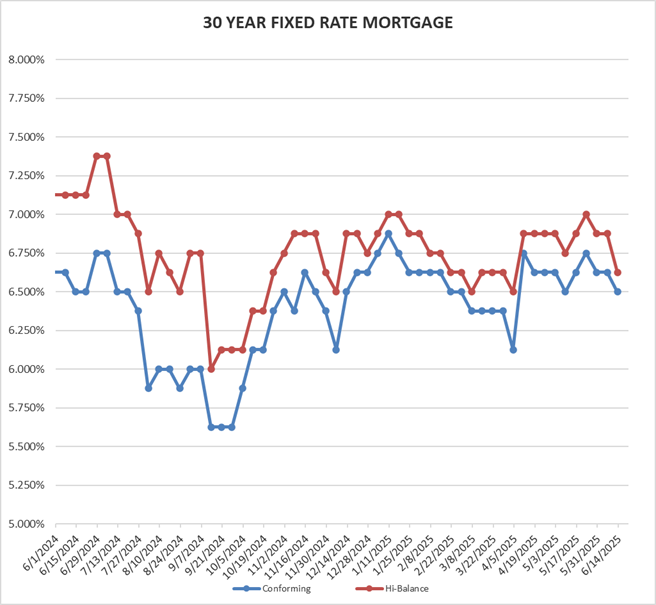
Rates for Friday June 13, 2025: Rates
FIXED RATE MORTGAGES AT COST OF 1.25 POINTS LOCKED FOR 45 DAYS FOR PURCHASE TRANSACTIONS:
30-year conforming 6.50% Down 0.125%
30-year high-balance conforming 6.625% Down 0.25%
Please note that these are base rates and adjustments may be added for condominiums, refinances, credit scores, loan to value, no impound account and period rate is locked for 45 day. Rates are based on 20% down with 740 FICO score for purchase mortgages.
Happy Father’s Day to all the dads. My Dad taught us many things, two of which I try to adhere to in all circumstances.
Treat everyone the same. No matter their job, their education, their race, sex, beliefs, politics, treat with respect and not better or worse than others just because of who they are.
It is better to lose a friend (or client) by telling the truth, than to gain or keep one by not.
Not always easy tenets to follow, but ones that served my Dad, and myself, well over our lifetimes.


