
What is the difference between an appraisal and a home inspection?
Question of the week: What is the difference between an appraisal and a home inspection?
Answer: This is a great question that comes up frequently with first time buyers, and some experienced homeowners purchasing for the first time in a long time.
The first difference is one is usually required and the other is optional.
Appraisal
If you are getting a mortgage to purchase the property the chances are very high the lender will require an appraisal. (In some instances, Fannie Mae or Freddie Mac may allow a “waiver” for the appraisal, this could happen for transactions with a low loan to value. Waivers are not rare, but are not common either.) The primary purpose of the appraisal is for an uninterested, licensed, professional to ascertain the value the property used as collateral for the mortgage on the date the offer from the buyer was accepted by the seller. The secondary purpose of the appraisal report is to notify the lender if there are any noticeable defects that could impact the value and/or salability of the property or present health and safety concerns for occupants.
Many people are surprised at how little time most appraisers spend at the actual property. They spend so little time because most of the work to prepare the appraisal report is done before the appraiser goes to the property for his/her inspection.
An appraiser will receive a copy of the purchase contract and any counter-offers for the transaction at the time the order is made. Before heading out to the property the appraiser, using the Multiple Listing Service and public records, will research the area looking for comparable properties. A comparable property is one that is similar to the subject property in type of dwelling, size, number of bedrooms and bathrooms and other amenities that impact value such as a pool. The appraiser will look at recent sales to determine prices for the closed sales, how long the properties were on the market, and the condition of the properties at time of sale. Properties that have been recently sold but have not yet closed escrow (called “pending sales”) will also be noted to determine if there is current activity for comparable properties to the subject. Finally, the appraiser will look at active listings on the market to determine what other options did the buyers have at the time they purchased the subject property and at what price and condition.
Once the appraiser knows the terms of the transaction and has an idea of the comparable properties in close proximity, s/he will inspect the subject property. The appraiser will measure the property’s interior room by room to make a sketch showing the overall size of the property and rooms. While measuring the appraiser will visually inspect the property to ascertain the overall condition, and not any noticeable issues that may impact value or the health and safety of inhabitants. Any noticeable water stains in the ceilings will be noted as they indicate a leak in the roof at some point, if there are missing window panes, flooring that is missing or has holes, missing sinks or toilets, anything that deters from the property being fully habitable or that could be evidence of a bigger issue is photographed and noted. In California the appraiser will also photograph and take note that the property meets state law by having smoke and carbon monoxide detectors properly installed and that the water heater has earthquake straps and is on a stand or platform so it is off the ground.
The appraiser will not test the plumbing or electrical systems, test windows for their ability to open, or otherwise perform a very close and detailed inspection.
The appraiser will drive by the comparable properties that are being used to establish value and take photos for them from the street.
After all the data is collected the appraiser will prepare the report. The report will compare the comparable properties and make adjustments to the sales price of those properties for size, condition of property, amenities, location (such as on a busy street), etc to arrive at an opinion of value.
Inspection
When you and the seller agree to a sales price one of the clauses you will likely agree upon is the opportunity for you, at your cost, to engage a professional to inspect the property, what the industry calls a “home inspection.” You may choose whomever you desire to perform the inspection, it is recommended that you choose someone certified by the California Real Estate Inspection Association (CREIA). In California there is not state licensing or regulations for real estate inspectors, CREIA a professional organization that has requirements for its members that include continuing education and following codes of ethics.
It is important to note that the inspector works for you. Not the seller or the real estate agents, but for you. The objective of the inspector is to perform as thorough and examination of the subject property as possible, the result of which will be a very detailed report.
The inspector will grade everything examined from needs replacing to estimated longevity to in fair-good-excellent condition. It is not the inspectors concern if the report “blows the sale” or “makes the sale” but to provide an objective, honest report of the property’s condition.
A thorough inspection will include inspecting the roof, and if possible the attic and/or crawl space below the roof. If on a raised foundation, crawling under the property. Inspecting the electrical panel and testing outlets and switches. Testing the plumbing by flushing toilets and turning on taps to gauge water pressure. Appliances that use gas will be tested to determine if they are functioning properly with appropriate hook-ups and safety features. These are the major areas of concern and cost to repair or replace, but all aspects of the property will be inspected and put into the report for the buyer.
Not included in the report will be the cost to correct any defects noted, and it is not ethical for an inspector to quote, bid on or complete any repairs noted as needed on the report.
Once completed the report will provide the buyer with a very good indication as to the condition of the property. It should be noted that there is not “perfect” home in regard to condition; even brand-new homes can have faults and issues that need to be corrected. The important issues to consider on a home inspection report are the major, “big ticket” items that may need to be replaced or repaired in a short period of time. If there are any such items listed, say the electrical needs to be updated, it is encouraged for the buyer to obtain a bid from a licensed contractor for the cost to correct, and then make a decision how to move forward.
It is highly recommended that you accompany the inspector when s/he visits the property for the inspection. Note that this inspection is much more thorough, and therefore time consuming, than the visit from the appraiser, in some cases a few hours. By attending the inspection you can learn a lot about your new home, where is the gas shut off valve, education on the electrical panel, where are the clear-outs for plumbing, and most importantly get a verbal report and detail form the inspector that will shed more light on the condition than just reading a formatted report.
The primary difference between an appraisal and an inspection is their purpose. While the appraiser will note some condition items the primary purpose is to let the lender know if the sales price is supported by the market in the area, the purpose of the inspection is to inform the buyer of the condition of the property and its components. Both are very important because of their purpose.
Next week what happens when appraisal is low or inspection shows major issues?
Have a question? Ask me!
“Well, that’s surprising.” This was the thought of many investors, analysts and watchers of the economy this morning when the government released the data for the Gross Domestic Product for the 1st quarter of 2019. Expectations at the end of the 4th quarter in 2018 was for growth this past quarter and as the quarter progressed and economic data was received for January, February and March the consensus expectation rose to 2.3%. Today, the first report for GDP growth in the 1st quarter was 3.2% growth, well above expectations. Besides strong economic growth in the quarter inflation eased from the prior quarter’s annualized rate of 1.9% to 1.4%. Of concern in the data was a slowing in consumer spending to 1.9% growth, the lowest in a year. The report should have no impact on the Federal Reserve’s decision to change its current policy to hold firm on rates through the year. Overall the report should be negative for rates as a growing economy leads to higher rates, however the tame inflation segment of the report and consumer spending data is positive for steady or lower rates.
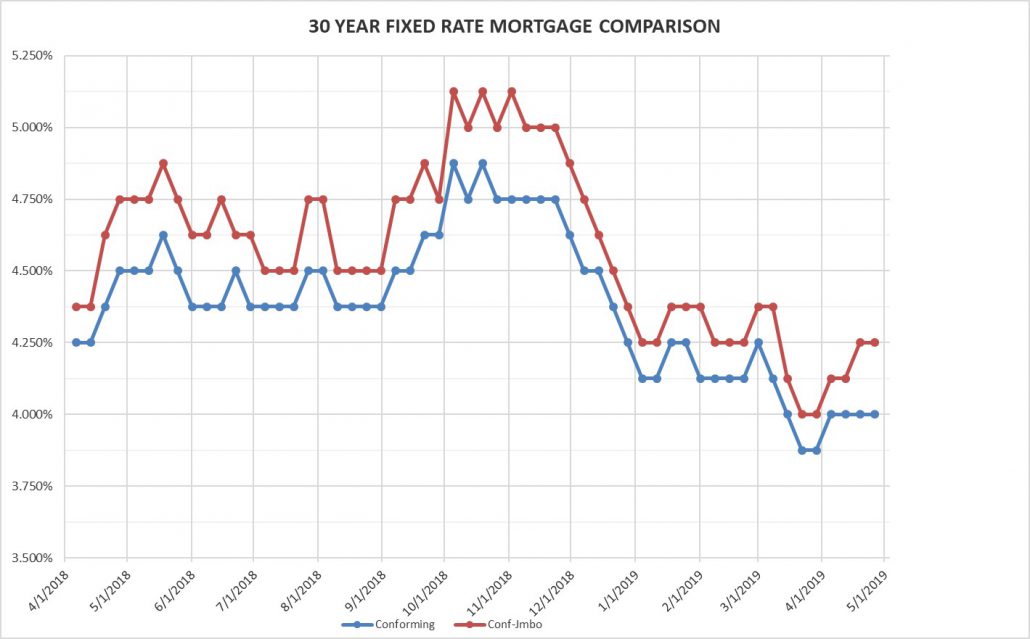
Rates for Friday April 19, 2019: Will the GDP report cool the speculation about a recession later in 2019? That is the major question investors will be analyzing moving forward as investors react on what they feel may happen, or what others may feel will happen directing their actions. For now rates remain flat from last week.
FIXED RATE MORTGAGES AT COST OF 1.25 POINTS LOCKED FOR 45 DAYS:
30 year conforming 4.00% Flat
30 year high-balance conforming 4.25 % Flat
Please note that these are base rates and adjustments may be added for condominiums, refinances, credit scores, loan to value, no impound account and period rate is locked. Rates are based on 20% down with 740 FICO score for purchase mortgages.
Earlier this week we began the Great College Search II with our youngest daughter. We spent a few days in Seattle seeing the sites with the primary site being University of Washington as a possible landing spot. A very successful trip on all accounts. I like Seattle a lot, similar in many respects to San Francisco, but a nicer, cleaner, seemingly safer place to visit the last several years, in my opinion.
Next week is back to regular schedule in the house as spring break ends and the grind to the last day of school begins. I like regular schedules…
Have a great week,
Dennis
Past Weekly Rate & Market Updates can be found on my blog page at my website www.DennisCSmith.com/my-blog