


What are your credentials?
Question of the week: What are your credentials?
Answer: This question was asked earlier in the week from an agent that is fairly new in the industry, licensed just before the pandemic, who was referred to me by a very veteran agent (25+ years) suggesting the newish agent refer his buyers to me.
It is a good question that many people never ask someone who will be handling very important transactions, especially those involving their most important purchase, or sale—their home.
A mortgage is the solution to a problem, which is needing money to purchase a home. Tangible credentials, such as licensing, alone do not provide that solution; intangible credentials do provide the solution. This is especially true for when the family in the market to get a mortgage has wrinkles in their financial credentials.
My credentials for the mortgage industry started to be built in my four years at Pitzer College, part of the Claremont Colleges, where I earned a degree in Economic and Political Studies in 1984. My course work developed analytical thinking and problem-solving skills.
After working at Farmers and Merchants Bank for a few years after graduation, and then a stint in personal finance company where I did collections, I entered the mortgage industry in 1987.
For the industry I have a California Department of Real Estate Broker’s license and registered with the National Mortgage Licensing System.
My start was challenging, it was hard to get business as the new guy in the industry—not many real estate agents were willing to refer me, thereby entrusting their commissions to me, no loan no pay. As result I worked seven days a week soliciting loans and working the few loans I could get, and held several part-time jobs from door man at Square Cow Fun Bar (the bar turned night club within several Black Angus restaurants), to pizza delivery, to house/dog sitting among others.
For a brief period I worked with partners, one ran a real estate company and the other opened a mortgage company. I sold and listed real estate and handled mortgages for clients of other agents. It took me just a few years to realize that I was much better suited to crunching numbers and helping clients determine the best price and mortgage option for purchasing a new home than I was at driving clients around looking at homes and deciding which one to buy and how much to offer.
In the early ‘90’s I left the real estate side of the business and devoted all my energy to the mortgage industry. It was about this time I started providing market updates to professionals in the real estate industry—it was also when I met Leslie McCormick who was working at the Long Beach Association of Realtors, in 1994 she made the big switch to change her name to Leslie Smith.
In 1999 my partners and I opened Stratis Financial, with offices in Huntington Beach and Torrance. When we were meeting about whether to open a new company, and then how it would look, our primary conversations were the type of business we wanted to do, the way we wanted to work with clients, referral sources, and most importantly our employees and loan originators.
In about 2002 I started this missive, the Weekly Rate and Market Update, to inform readers about the mortgage and real estate industries, provide economic information that impacts both markets, and to educate on readers about important matters. While I never stopped studying and learning about economics and markets after college, the WR&MU has allowed me to pull important data that impacts my industry from the news and distill it into information that can help homebuyers and owners, and professionals, make decisions.
For a long period of time, I felt I was missing an opportunity to further assist my clients. For a few decades, with over a thousand meetings and calls with clients to discuss their personal financial information, their plans for the future that should factor into their home buying decisions, options for their home purchase, as well as credit counseling and big picture what ifs, I learned that too many families were ill prepared for “what next.”
In 2014 I became a registered SEC Investment Advisor, passing my Series 7 and 66 exams, as well as exam for California Department of Insurance for life insurance.
I took this step to assist my clients with both sides of their balance sheets, their liabilities, i.e. mortgages, and their assets, mainly planning for their retirement.
While professional licensing and registration is very important as it shows required knowledge to transaction business and interact with consumers, more important are the thousands of meetings, conversations and transactions over the years, in addition to being an avid consumer of economic and political data and information, that have resulted in acquired knowledge, experience, and exposure to different problems to find solutions to provide options to families that result in homeownership.
What’s a mortgage other than a solution to a problem—you need money to purchase a home. My years of experience have seen many different solutions to that problem, resulting in helping families obtain homeownership since 1987.
To schedule an initial meeting by phone or Zoom, click here for my calendar, please feel free to forward to a friend or family member!
Have a question? Ask me!
Robust, strong, solid, some of the adjectives describing the American economy, supported by this week’s economic data. From the total economy (4th quarter 2023 GDP revised upward to 3.4% growth), to the labor market (fewer jobless claims last week), to inflation (PCE in February grew at .3% and up to 2.5% from last year), everything shows a growing economy.
The Federal Reserve entered into a tightening policy two years ago this month with the objective to lower inflation to 2%. Before the first rate hike of its benchmark Fed funds rate in March 2022, the prime rate (not controlled by the Fed, but follows the rate changes the Fed makes) was at 3.25%. Today the prime rate is 8.5%, where it has been since last July, during the eight month period the PCE (Personal Consumer Expenditures, the Fed’s preferred inflation index), has dropped from 4.2% to 2.5% and GDP has dropped from 5.2% to 3.4%.
Data does not support the Fed lowering rates if it want to achieve its objective. The economy is growing at a slower rate, and inflation is inching (millimetering?) down, but doing so with high rates. What happens to inflation if the Fed drops rates during a robust, strong, solid economic cycle?
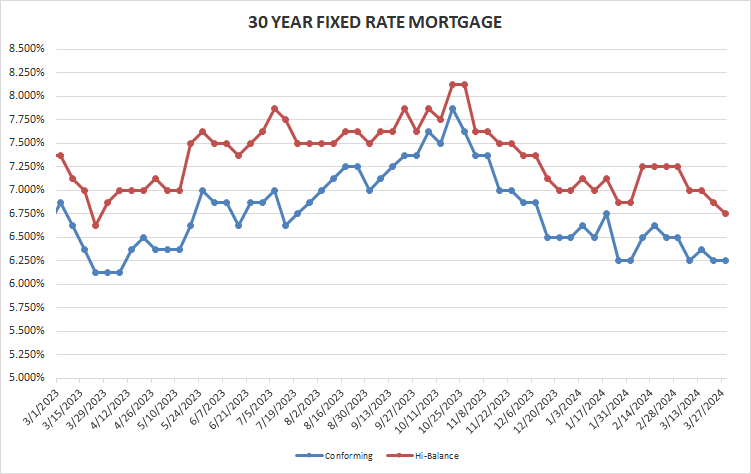
Rates for Friday March 29, 2024: Despite economic data that does not support a Fed rate cut, investors were on the sidelines all week and the conforming mortgage rate is the same as last Friday.
FIXED RATE MORTGAGES AT COST OF 1.25 POINTS LOCKED FOR 45 DAYS FOR PURCHASE TRANSACTIONS:
30-year conforming 6.25% Flat
30-year high-balance conforming 6.75% Down 0.125%
Please note that these are base rates and adjustments may be added for condominiums, refinances, credit scores, loan to value, no impound account and period rate is locked. Rates are based on 20% down with 740 FICO score for purchase mortgages.
A busy week for sports fans as the NCAA tournament providing its annual entertainment and major league baseball is officially underway. Spring is here! Except no one has told the Controller of Weather for Southern California!
Have a wonderful Easter weekend everyone.
Have a great week,
Dennis
Past Weekly Rate & Market Updates can be found on my blog page at my website www.DennisCSmith.com/my-blog


