

How do we handle physical issues with home we are buying?
Question of the week: How do we handle physical issues with home we are buying?
Answer: Last week we spoke about seller disclosures of known physical deficiencies with a the property they are selling; more specifically when a disclosure is not required.
As a buyer, what are your options when your home inspection report details some fairly significant* issues that need correcting?
*Significant being a key word. Every inspection will turn up some issues with all homes—even new construction. As a buyer, cracked swith plates, sticking windows, inoperable garage door opener, are fairly insignificant and should not stand in the way of your home purchase.
In the standard purchase contract, there are a series “outs,” also known as contingencies. The buyer has a certain number of days to remove contingencies for loan approval, appraisal-value, and physical inspection. During the contingency periods the buyer can cancel the transaction with no recourse due to failure to get loan approval, insufficient value, and/or issues with the property.
Most often, when a physical inspection report has somewhat serious issues with the property that causes a buyer to have some misgivings about continuing the transaction, a request is made to the seller to either correct the issue, or provide an adjustment to the transaction to cover the cost of the buyer to cure the defect. If the seller is unwilling to do so, the buyer can then decide to continue the transaction, or cancel and have the initial deposit refunded.
“Adjustment to transaction” can mean adjusting the sales price, or providing a credit to the buyer at closing. Typically, a credit is more advantageous when it comes to freeing up cash for using later for repairs.
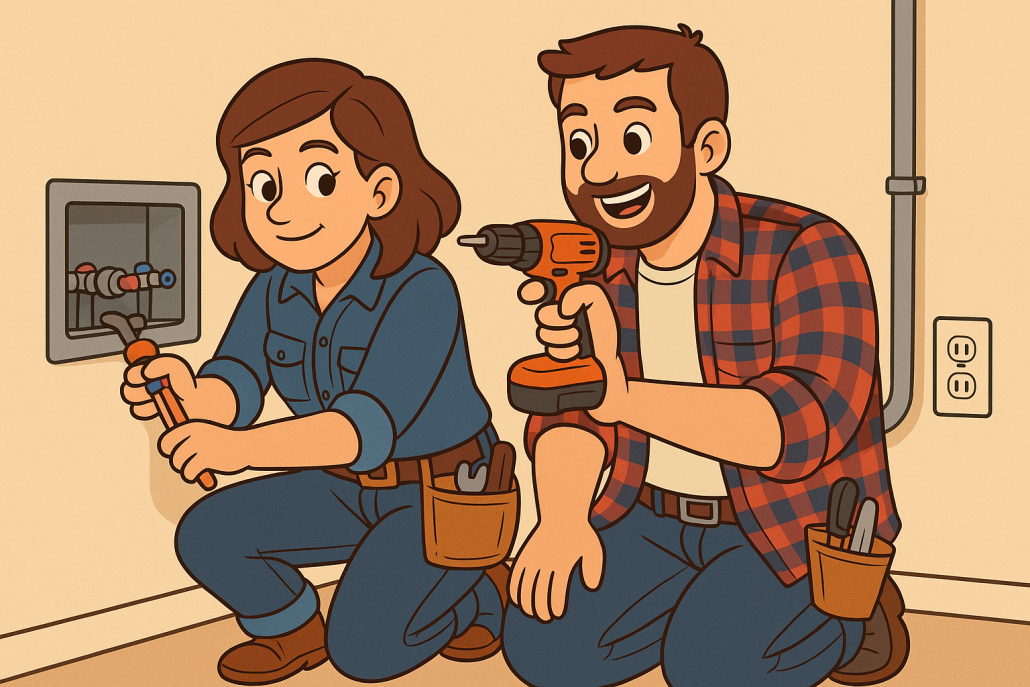
Physical inspection shows shoddy plumbing from prior owner’s DIY work to replumb part of the property, that is not only up to code, but on the brink of major failure and leaks. The buyer gets an estimate from a plumber for $15,000.
Buyer can either continue the deal and pay to fix plumbing themselves, ask the seller to lower the sales price $15,000, ask for a credit of $15,000, ask the seller to use buyer’s plumber to correct the plumbing, or cancel the transaction.
Seller can either accept one of the curative options, or say no and cancel the sale.
Property is in escrow for $1,000,000. Buyer is purchasing with 20% down.
If seller agrees to lower the price $15,000, the new sales price is $985,000.
Buyer was putting down $200,000 at a million-dollar sales price; 20% of $985,000 is $197,000. The reduction in sales price saves the buyer only $3,000 in cash.
If the seller credits $15,000 to the buyer, the buyer saves $15,000 in cash. Clearly, this is the better option for the buyer.
How the credit is worded is very important.
If the escrow amendment for the credit states that the credit is for the repair of plumbing, the lender will very likely require an inspection of the plumbing and the appraiser to address the impact on value. As well, if the lender accepts the credit, it will most likely require an estimate from a licensed plumber for the cost of repair, and the funds be held in escrow to be paid to the plumber once the work is completed and signed off by the appraiser or inspector of the lender’s choice.
If the credit is for buyer’s closing costs, within limitations, the lender will accept the credit.
What are the limitations?
The credit cannot exceed the actual closing costs (including pre-paid costs for taxes, insurance, HOA dues, etc).
Second, depending on the loan-to-value (LTV), the credit cannot exceed a certain percentage of the sales price. For loans that are 90% or greater, the credit cannot exceed 3% of the sales price, 90.1% to 75% limit is 6%, if 75% or less LTV the limit is 9% of the sales price.
In our above scenario the $15,000 credit for a $1,000,000 purchase with an 80% LTV is well within the limits.
What if the cost were higher? What if the seller agreed to a 6% credit, $60,000? But the buyer’s costs were only $30,000?
The seller would not get full cash value for the additional $30,000 credit, but the buyer can use the funds to buy down their interest rate, say from 6% to 5.125%, which would cost $30,000 in points for the rate buy-down.
At 6% for an $800,000 30-year mortgage, the payment is about $4800 per month, at 5.125% the payment is about $4350 per month, a savings of $450 per month, $5400 per year.
Yes, it will take about five and a half years to recoup the entire $30,000 credit with the lower payment. However, there is additional costs savings that will likely accrue as the buyer will not be paying the costs to refinance once, or twice, possibly three times to get down to a 5.125% rate in the future. With the estimated “hard” cost for refinances at around $5000, takes almost another year off the time to recoup the $30,000 credit in cash.
If you are buying a property that has some issues that need to be addressed, it is almost always better to get a credit for closing costs from the seller rather than a reduction in sales price. That said, before requesting a price reduction or credit, do the math with your loan originator (me) to ensure the best value for covering your future repair costs.
Have a question? Ask me!
A week of positive economic news:
- The estimate for the 2nd quarter GDP was revised upward from 3.3% to 3.8% as consumer spending was much higher than originally estimated; as well very strong investments in software and hardware for artificial intelligence and spending on intellectual property research and development surged. The growth was the strongest quarter in two years.
- The Fed’s preferred gauge of inflation, the Personal Consumption Expenditures index (PCE) rose slightly in August, within expectations, up 0.3% for the month and 2.7% for the year. Core inflation (absent energy and food) was up 0.2% monthly and 2.9% annually. The numbers show continued resistance of inflation to meet the Fed’s 2% annual inflation objective. A good sign for the Fed, and consumers, is that the cost of goods most impacted by tariffs rose only 0.1% last month after dropping in July. Pushing inflation is cost of services, which continue to rise month after month.
- Personal incomes increased 0.4%, once again outpacing inflation, while consumer spending increased 0.6%, far outpacing inflation (spending is based on dollars spent not units, so 0.3% inflation would increase spending by about 0.3% if economic transactions were the same month to month in regards to units purchased in goods and services).
What’s it all mean? Stronger economic growth and consumer spending may put a damper on Fed rate cuts in the future. Inflation has not bent towards the Feds target, but has not been increasing significantly. While the general consensus leans to two more rate cuts this year, economic data for the coming months may result in only one rate cut this year with a second in 2026. Key word “may.”
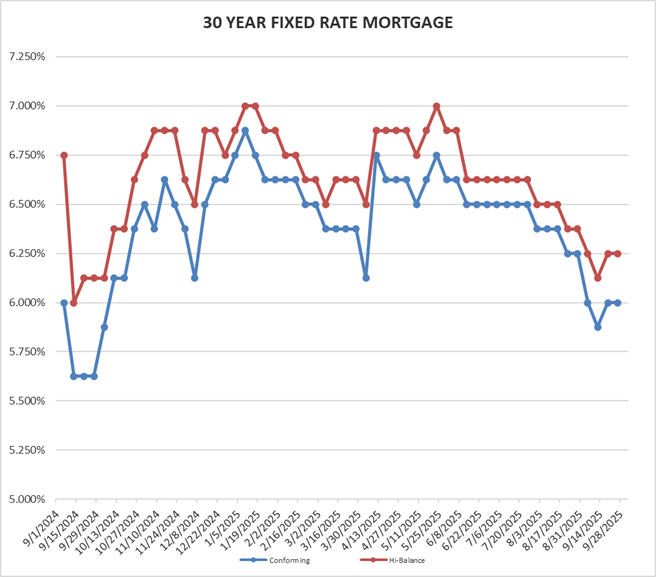
Rates for Friday September 26, 2025: Rates are flat from last Friday as economic data did not supply and reasons for buying or selling enough in the markets to have any impact.
FIXED RATE MORTGAGES AT COST OF 1.25 POINTS LOCKED FOR 45 DAYS:
30 year conforming 6.00% Flat
30 year high-balance conforming 6.25% Flat
Please note that these are base rates and adjustments may be added for condominiums, refinances, credit scores, loan to value, no impound account and period rate is locked. Rates are based on 20% down with 740 FICO score for purchase mortgages.
Enjoying a quick get-away weekend in the desert. It’s a dry heat, but still, it is heat. Thankfully “cool” enough to not be overly oppressive by the time we are off the course by noon after early morning tee times!
Anecdotally, have noticed more For Sale signs on houses lining courses and throughout the valley than in previous visits in the past year or so.


