


What is a “piggyback” and should we get one?
Question of the week: What is a “piggyback” and should we get one?
Answer: Between prices climbing and sellers reluctant to accept offers with contingencies for a buyer’s home to sell, many home buyers are utilizing a financing strategy that was very popular in the early to mid-2000’s, the piggyback.
When we were kids, we would often play piggyback games, a smaller kid would climb on the bigger kids back and we would race, have “chicken” fights trying to pull the kid off another’s back, or just run around. (Note, I was rather small in stature growing up so I was almost always on someone else’s back).
Piggyback financing is somewhat similar. Substitute a primary long-term mortgage for the big kid and a smaller mortgage or equity line for the smaller kid; the smaller mortgage rides on top of the bigger mortgage.
For example, you own your current home and have about $150,000 in equity. You have available for a purchasing a new home about $90,000 and want to offer $750,000 on a new home without having a contingency that your current home sells to obtain down payment and closing costs. Your income is such that you can qualify for the new home without selling your current home.
Using a piggy-back, your offer shows your intended financing is to obtain a new 30-year mortgage for $545,000 and a Home Equity Line of Credit for $130,000. If you have already done the math, you see that your down payment will be 10% of the purchase price, $75,000.
You purchase your home with a conventional mortgage, instead of a higher rate high-balance conforming mortgage, have a minimum payment of interest only for the HELOC, and when you sell your home, you use the proceeds to payoff the HELOC. As a bonus, when all the financial dust is settled you have an equity line in place that you can use in the future to obtain funding for projects or emergencies.
Note that we also use piggyback financing for homebuyers who are expecting to receive a very large sum of cash in the future from a settlement from a lawsuit or divorce, an inheritance, sale of a company or large bonus. When the settlement comes payoff or down the HELOC and you have the lower primary mortgage for the remainder of your homeownership.
Other opportunities where we have used piggybacks in the recent market are to avoid “jumbo” financing, generally mortgages above the high-balance conforming rate of $822,375, to avoid stricter underwriting standards.
Client Smith wants to purchase a new home in the $1.1 to $1.2 million dollar range and has about $250,000 for down payment. Because of some financial challenges several years ago, Smith filed Chapter 13 bankruptcy. Almost all jumbo lenders require that a bankruptcy be discharged for 7-years before an applicant is eligible for financing. Fannie Mae and Freddie Mac however have a 2-years since full discharge on Chapter-13 bankruptcies for eligibility. This same guideline is also used by some lenders that fund HELOCs.
Smith writes an offer for $1,150,000 with $250,000 down payment, a mortgage at the high-balance limit of $822,375, and a HELOC for $77,625.
Home Equity Lines of Credit piggyback transactions became very popular starting in the late 1990’s and early 2000’s as a way to leverage purchases and avoid paying mortgage insurance, which is required on mortgages over 80% of the sales price (aka loan-to-value, or LTV). For instance, purchase price was $500,000 (high price in 1998) and buyer had $50,000 for down payment. Traditionally, until then, the buyer would get a mortgage for $450,000 and have mortgage insurance payments. When the HELOC piggyback products became available, the buyer would put down $50,000, obtain a loan of $400,000 at 80% of the home value and therefor have no mortgage insurance, and get a HELOC of $50,000.
Because the standard regulation for mortgage insurance is that it can be removed after twenty-four consecutive on time payments and showing the property has equity of 22% or more, in retrospect many home buyers who funded HELOCs just to avoid mortgage insurance would have been better off paying mortgage insurance for two years as property values were climbing.
The same is true in our current market, we have had clients who purchased homes in 2018 and 2019 with mortgage insurance instead of using piggyback transactions, have been able to show their homes have increased in value and dropped their mortgage insurance payments.
Piggyback financing is an important tool for home purchases that many lenders do not use due to lack of experience and knowledge. Not every buyer needs to use piggyback financing, but it is available for those who can benefit from a lower long-term rate, to bridge the sale of their current home to new home, or to obtain easier funding guidelines.
Have a question? Ask me!
The Federal Reserve has seven governors, this week two of them had comments that are of interest to those who follow interest rates. The New York Fed governor said that inflation will drop back down to 2% in 2022 and that the feeds tapering of its purchase of U.S. Treasury debt and mortgages (known as Quantitative Easing) is way off. The Feds QE activity is a major factor in interest rates remaining as low as they are, when they start purchasing less that will put upper pressure on rates, when the Fed, if the Fed, starts selling its inventory of Treasuries and mortgages, that will definitely put upward pressure on rates. These comments are in line with those released last week by the Fed from its committee that determines its interest rates.
“Way off” to many would mean six months or a year. The Fed governor for San Francisco this week said that she feels in the Fall the Fed will start to talk about tapering. Is this statement from San Francisco at odds with the statement from New York? It would seem so, depending on a) which if either is correct and b) how long the Fed talks about tapering its purchases before actually doing. Neither comment seemed to impact investors or rates, however it is a sign that at least tapering by the Fed is on the horizon.
May economic data shows the economy is very strong. With reduced stimulus payments consumers have been a little less eager to make purchases, as seen by consumer spending being flat from April’s spending. Personal incomes for the month declined by 2%, not due to lower wages so much as fewer Americans collecting unemployment benefits that were elevated with federal stimulus funds. Spending may have flattened out, but it has done so with total spending in May above pre-pandemic consumer spending levels—in some part due to the higher prices, 3.9% higher, than the costs of goods and services a year ago. The news is negative for low rates, but with the Fed’s QE gobbling up mortgages there was little impact on rates.
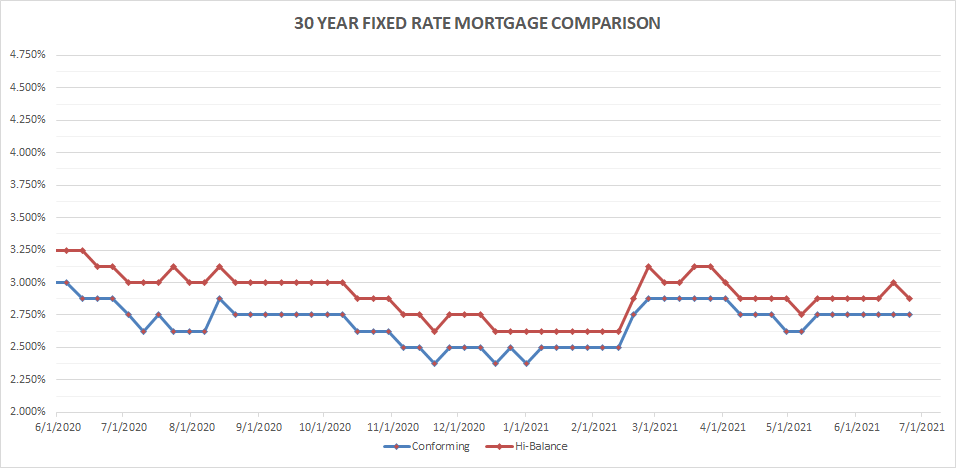
Rates for Friday June 25, 2021: Conforming rates for the sixth week in a row, high-balance conforming rates have floated down after last week’s spike.
FIXED RATE MORTGAGES AT COST OF 1.25 POINTS LOCKED FOR 45 DAYS FOR PURCHASE TRANSACTIONS:
30 year conforming 2.75% Flat
30 year high-balance conforming 3.00% Up 0.125%
Please note that these are base rates and adjustments may be added for condominiums, refinances, credit scores, loan to value, no impound account and period rate is locked. Rates are based on 20% down with 740 FICO score for purchase mortgages.
As I have been transitioning back to the office, increasing the number of days each week I am there, I notice I am not alone when I head home in the evening. After over a year of our local freeways having the same amount of traffic during rush hour as they usually do at 6:00 a.m. Saturday and Sunday mornings (the other golfers know this wide open traffic pattern) that we had gotten used to, we now need to factor in increased commute times to get to and from our destinations.
Bittersweet is the reaction to this increase in traffic, bitter because we once again spend more time in our cars, sweet because pre-pandemic normalcy is returning.
Have a great week,
Dennis
Past Weekly Rate & Market Updates can be found on my blog page at my website www.DennisCSmith.com/my-blog


