


What are recession and stagflation?
Question of the week: What are recession and stagflation?
Answer: Recession and stagflation are terms that define economic activity. Economic activity in a country is measured using Gross Domestic Product (GDP), which represents the value of all goods and services produced within a period of time. In the United States two bureaus within the Department of Commerce are responsible for collecting the data (Bureau of Labor Statistics) and using the data to estimate GDP (Bureau of Economic Analysis).
Historically, the technical definition of a recession is two consecutive quarters of economic decline, i.e., GDP is a negative number. For instance, if the GDP for the first (January through March) and second (April through June) are both negative, the country is in a recession.
In more recent times the National Bureau of Economic Research (NBER), a non-government entity that officially declares recessions, defines a recession as a significant decline in economic activity for more than a few months as seen in GDP, real income (income adjusted for inflation), employment, industrial output, and wholesale and retail sales. For the latter definition, it is possible for GDP to be negative, but if employment and sales are strong the NBER may not declare a recession. “More than a few months,” may not cover two quarters, or six months, as required in the historic definition for the NBER to declare a recession.
Stagflation a period of inflation with declining GDP.
As we have seen in the past year, inflation is combated by a central bank (the Federal Reserve) by raising interest rates and pulling money out of the economy. High interest rates stifle economic growth as it is more costly to borrow money.
As we have also seen in very recent history, recession is combated by a central bank by lowering interest rates and putting money into the economy.
These actions by the central bank are known as monetary policy.
The federal government can also take steps to combat inflation or recession. To combat inflation the government can take steps to take money out of the economy but decreasing spending and/or raising taxes. To combat recession the government can put more money into the economy by increasing spending and/or lowering taxes. The former is general called “stimulus.”
How is stagflation combated? There is no definitive economic theory as to how to effectively combat stagflation. If prices are high, the historic cure of higher interest rates and reducing the amount of money circulating in the economy will exacerbate the decline in GDP. If GDP is declining, lowering interest rates and increasing the amount of money in circulation will push prices higher.
It should be noted, in modern times, every recession, with the exception of a period during the Great Recession that started in 2008, inflation is present during periods of slow or negative growth of the GDP. Stagflation has a more significant increase in prices during the period of slow or negative growth.
The most common consensus for exiting a period of stagflation is increasing productivity such that GDP grows without an increase in prices, or a very small increase in prices.
In the 1970’s the term “stagflation” became part of the lexicon when the OPEC oil embargo threw Western economies into spiraling inflation and significant decline in production and employment. Today the term is making a comeback on news and opinion outlets due to our high inflation and concern that with rates at their highest in over a decade and slowing retail sales having the potential to put our economy into a period of stagflation.
With the Federal Reserve having laid out a plan for raising its benchmark interest rate at a faster than normal pace in the coming year, economic growth slowing, inflation continuing to increase, our bright spot is a strong employment base that has reduced unemployment and increased the labor participation rate. However…with the labor market tightening, higher employment costs will make it difficult for inflation to cool down.
What is the overall impact on mortgage rates? Unfortunately, not a significant drop in rates in the near-term, nor likely in the medium-term. Having enjoyed historically low rates for several years, the next cycle of rates when they settle down will likely be in the high 4’s to low 5’s.
For those of us over the age of 50 (55?) this range of rates are considered a good range for economic growth, relatively low cost for borrowing, and supportive of home ownership and growth of individual or family wealth.
Have a question? Ask me!
The Commerce Department released its first estimate of 1st quarter GDP data this week and it showed a 1.4% contraction (negative 1.4%) following a 6.9% increase in GDP for the last quarter of 2021.
Consumer spending, after inflation, grew 0.2% in March. With wages increasing 5% from the 1st quarter of 2022 from the 1st quarter of 2021, workers are not keeping up with inflation. This is the primary reason why the savings rate for Americans dropped from 6.8% to 6.2% as families dip into savings to purchase higher priced goods and services.
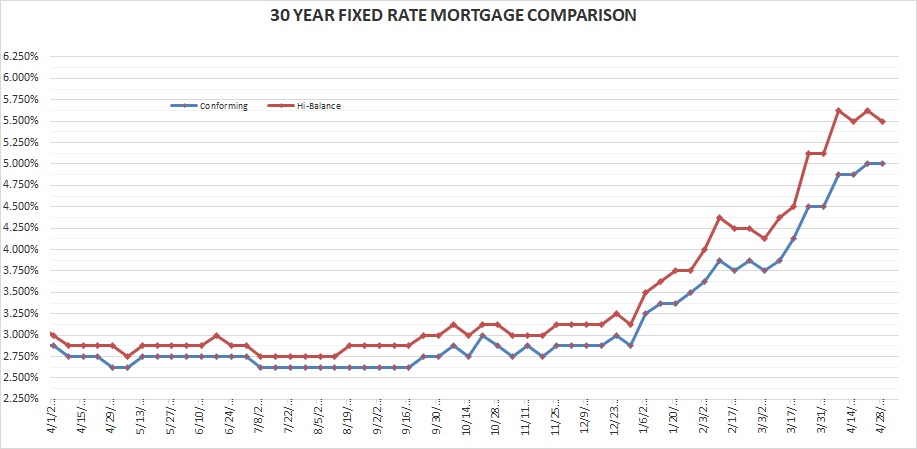
Rates for Friday April 29, 2022: Another volatile week in the markets, the price chart for Mortgage-Backed Securities (determine mortgage rates) looks like a ride at Magic Mountain with the peaks and drops. As we end April, the conforming rate is flat from last Friday and the high-balance rate dips for the week.
FIXED RATE MORTGAGES AT COST OF 1.25 POINTS LOCKED FOR 45 DAYS FOR PURCHASE TRANSACTIONS:
30-year conforming 5.00% Flat
30-year high-balance conforming 5.500% Down 0.125%
Please note that these are base rates and adjustments may be added for condominiums, refinances, credit scores, loan to value, no impound account and period rate is locked. Rates are based on 20% down with 740 FICO score for purchase mortgages.
Long time readers of the WR&MU may recall our daughters went to camp in Minnesota, a camp three generations of Smith’s attended as campers, and a few as counselors. The boy’s camp is a wilderness camp a few miles from the Canadian border. Like many employers they are looking to fill job openings. If you know of a college age young man who would like to be a counselor for the summer developing leadership skills while getting paid, please contact me for information.
Dennis
Past Weekly Rate & Market Updates can be found on my blog page at my website www.DennisCSmith.com/my-blog


