
Can we keep our current home as a rental and buy a new home?
Question of the week: Can we keep our current home as a rental and buy a new home?
Answer: Perhaps, let’s look at the factors involved.
First and foremost, you need to be absolutely certain you are ready to be a landlord. Like any investment there are risks involved and since rental property is an active, not a passive, investment, there are more risks than loss of value.
The upside to being a landlord is having great tenants who always pay their rent on time, absorb occasional increases in rent, take great care of the property and rarely contact you with any issues. The downside is the opposite of each of these.
If you are going to convert your current residence into a rental you need to also shift your mindset that the property is no longer your home but an investment, which means you need to release emotion and accept your former home is now a business. I had a couple who had spent a lot of time and money over the years creating a beautiful home. When we had the conversation about converting it to a rental when they purchased a new home I looked at the wife, who was rightfully very proud of their home and the work they did, and said, “are you okay knowing strangers will live in your home, they will damage some of it, may paint rooms different colors and not maintain and care for as you have?” She looked at me with a pained expression and after a few moments said, “I don’t think I can do that.”
She may have been ready to be a landlord, but not for the home she created. They ended up selling the home to buyers who loved it, and over the years cared for it as I notice when I drive by from time to time. The couple ended up purchasing a different property after they purchased their new home and still retain that property as a rental.
Are you ready, as a landlord, for the expenses that may not be covered by the rental income? One big benefit of converting your property to a rental is the tenant will be paying off your mortgage. When considering the possibility of conversion, the first math that is performed is how much rent can we charge and what is our monthly payment for mortgage, taxes and insurance. What also needs to be factored into the equation is maintenance, loss of rent and time. Will you retain a gardener, or if appropriate the pool service? Who will trim trees and bushes? How much longer before you need to replace the roof, the water heater or the garage door opener? Are the kitchen appliances warranties running out soon?
What happens when your tenant leaves the property? Will their one month deposit cover painting, re-carpeting, major cleaning and damage repair if they were particularly harsh on the home? What about the lack of rent income between their departure and the next tenant moving in, do you have funds for that?
Most importantly, can you absorb the expenses if you have a tenant who stops paying rent that you need to evict which can take up to a year and cost you a lot of money?
Now that I have painted a wonderful picture of being a landlord…there are many advantages. As mentioned above, you have someone else paying for your investment—sort of like an employer contribution to your retirement plan. Depending on your situation you may have some tax advantages due such as depreciating the asset and expenses through the year that exceed income that can be deducted. As well, depending on your timing and how long you have had the property, you might be able to mitigate or eliminate capital gains with the two-in-five rule, if you live in the property two of the previous five years you can sell and not pay capital gains. (I am not a tax expert or CPA, before making any decisions regarding tax advantages or costs please consult your tax professional.)
Perhaps the biggest advantage of the conversion is you have an asset that can, probably will in Southern California and other areas, increase in value over time. For which someone else is paying the holding costs.
Our question of the week was not “should we….” but, “can we…” I have covered some of the questions regarding should you consider converting your current home to a rental, now let’s look at the can you.
If you are not purchasing your new home with all cash then your ability to qualify for a mortgage to purchase your new home with the expenses of your existing home remaining.
Here are the basic guidelines used by most mortgage programs for qualifying when converting your home to a rental:
- Borrower must supply a rental agreement and proof of deposit from tenant into borrower’s bank account
- 75% of the rent will be considered for qualification purposes (i.e. if rent is $2000 per month, qualification rent will be $1500 per month)
- Borrower must have up to six months PITI in reserves for each property owned, this includes property that is being retained and the new home being purchased (i.e. if your current mortgage, taxes and insurance are $2500 per month and your these payments on your new home are $3500 per month, you will need $2500 x 6 months, plus $3500 x 6 months, you will need $36,000 in reserves after the close on your new home). Depending on the program retirement accounts may be considered in this calculation.
Some loan programs, especially “jumbo,” or non-conforming have additional guidelines:
- Borrower must have at least 25% equity in conversion property as determined by an appraisal
- In addition to the rental agreement and deposit, borrower must provide a rent survey for the area that supports the rent on the rental agreement
- Reserves could be as much as twelve months PITI for all properties owned and retirement accounts may not be considered
A big factor for many families considering the conversion of their current home to a rental is if they have the funds to purchase their new home without selling their current home. If your intention is to access funds from you current home through a refinance or obtaining an equity line your loan rate and amount of funds available can be impacted by the occupancy guidelines by lenders.
I am a big supporter of those who wish to retain their current home and convert it to a rental property when they purchase their new home. There are challenges in qualifying for the new home, from funds available for down payment, closing and reserves and debt-to-income ratios. However, going through all the options will determine the purchase price and payments on your new home for which you will qualify and from there you can decide how to move forward.
If you, or someone you know, is considering purchasing a new home and would like to retain your current home please give me a call so we can go through your situation and all the options available.
Have a question? Ask me!
Maybe, if, but…The Federal Reserve Open Market Committee (cleverly known as the FOMC) met this week. This is the group that determines if the Fed is going to change their fed funds rate or not. Going into the meeting the consensus was that the Fed would leave rates alone at this meeting in June and increase the rates at their meeting in July. The first part was correct, the Fed left rates alone. The second part is no longer a consensus based on the comments following the meeting.
Quick primer on the Fed and rates: if inflation is growing and the economy is running really hot the Fed will increase rates to slow things down and put a damper on inflation—the Fed likes inflation to be very close to 2% on an annual basis. If the economy is slowing and inflation is too low the Fed will lower rates to stimulate investment and growth. Last year the speculation was that the Fed would increase rates three times in 2019. As the year progressed and economic data showed inflation lowering, labor market growth being very tight but slowing, and concern about impacts from the trade and tariff dispute with China, statements from the FOMC meetings made it pretty clear that there would be no rate increases in 2019. After a few months the mummers from the FOMC were that a rate cut or two might occur.
Yesterday the information from the meeting was mixed. Yes, labor markets are tight with wages increasing which could result in higher inflation, and the economy is still strong—both of which support raising rates. Yes, inflation has declined and the Fed predicts it to drop to 1.5% for the year and the trade issues that could impact the economy still exist—both of which support lowering rates. With the FOMC members somewhat split on what’s next, with nine predicting no rate cut this year and eight predicting one or two rate cuts.
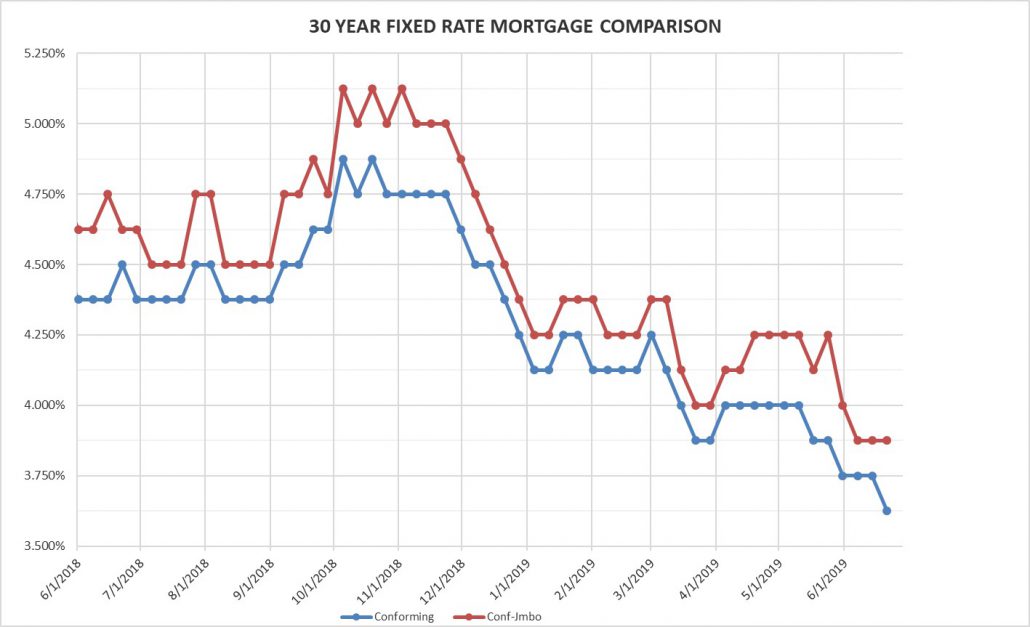
Rates for Friday June 21, 2019: Despite the Fed not lowering rates and a split within the Fed as to whether they will drop rates lower in the month, conforming rates have dropped from last Friday to the lowest they have been since October 2017. It feels like we are within sight, if not at or very near the bottom for this cycle—but I felt that way in April when we were at 4% for several weeks.
FIXED RATE MORTGAGES AT COST OF 1.25 POINTS LOCKED FOR 45 DAYS:
30 year conforming 3.625% Down 0.125%
30 year high-balance conforming 3.875% Flat
Please note that these are base rates and adjustments may be added for condominiums, refinances, credit scores, loan to value, no impound account and period rate is locked. Rates are based on 20% down with 740 FICO score for purchase mortgages.
Historically the summer blockbuster has been “must see.” Certainly, “Jaws,” “Top Gun,” “Raiders of the Lost Ark” captured huge audiences across many demographics. So far this summer it looks like a cartoon, “Toy Story 4” is out today, it may be this summer’s blockbuster—we are seeing it Sunday.
One movie that will not be considered a blockbuster that I saw with my daughter last week is “Late Night.” She is a big fan of actress Mindy Kaling, who is one of the movie’s stars, and also wrote and produced the film; and could not wait to see it. We went up to Hollywood last week for an early screening before the film is widely released. I went thinking it would be okay and was more interested in spending time with her than watching the movie. About halfway through the show I leaned over and whispered, “This is really, really good.” And it is, in fact it is much better than really, really good in my opinion. Wonderful script, casting, acting and story. It is not on many people’s radar for “must see” summer movies, but I put it on mine.
Have a great week,
Dennis
Past Weekly Rate & Market Updates can be found on my blog page at my website www.DennisCSmith.com/my-blog