


When will rates start to go up?
Question of the week: When will interest rates start to go up?
Answer: As soon as I say they won’t, or a significant time before I say they will—Murphy’s Law of predictions and Dennis’ jinx abilities*.
Long time readers of the WR&MU know there are several factors that impact the movement of interest rates, as well that mortgage rates do not necessarily move in the same direction, or the same magnitude of other interest rates.
The main rates that garner media attention, and therefore consumer attention, are the Federal Reserve’s target federal funds rate, the Prime Rate, the United States Treasury 10-year Note, and the conforming 30-year mortgage rate as sold by Fannie Mae and Freddie Mac.
Note that each of these rates has different factors that determine the rate. The Fed rate is a target set by the Federal Reserve Open Market Committee and is the rate banks charge each other to borrow money.
The Prime Rate is a rate set by banks, and is the rate that they charge their best clients and credit risks. Contrary to popular opinion, there is no “official” Prime Rate, but rather it is usually set based on the targeted federal funds rate set by the Federal Reserve. If the Fed raises the target by 0.25%, the Prime Rate will increase by 0.25%, and vice-versa. Banks use the Prime Rate as the basis for other rates, such as Home Equity lines, auto loans, and credit card charges.
The 10-year Treasury rate is set by the Treasury, but its effective rate is established on the open market by investors bidding to purchase the notes, when investors purchase notes from the Treasury they are lending money to the U.S. government for operations. Those notes then become assets that can be bought and sold on the open market. You may read, or hear, that Treasury yields are rising or falling, meaning the rate of return an investor receives when purchasing is higher or lower than the day, week, month before. While not directly tied to mortgage rates, Treasury debt does have an influence on mortgage rates as they are an alternative, and theoretically safer, investment than residential mortgages.
Like Treasury debt, mortgage rates and costs are set by investors. By far the largest issuers of residential mortgages are Fannie Mae and Freddie Mac. Quick flow of money: Bill and Maria buy a home, getting mortgage from DCS Lending. DCS Lending sells the mortgage, with many others to make up a bundle of $15 million, to Fannie Mae. Fannie Mae packages the DCS Lending bundle with bundles from other lenders and issues Mortgage Backed Securities (MBS) with an average yield (interest rate of return to buyer) of 3%.
Rates for the next set of buyers is then set by the open market for MBS. Keep in mind the higher the price an investor is willing to pay for a bundle of mortgages in MBS the lower the rate of return, or interest rate; the lower they are willing to purchase the higher rate.
For example, an investor bids to purchase the MBS on the market and due to the sales price has yield of 2.95% as the $5 million bundle cost the investor $5.084 million—selling at a premium.
Because the MBS bundles are selling for higher than their value, mortgage rates drop for buyers. Conversely, if the investor paid $4.8 million for the bundle of mortgages, collecting $150,000 per year, the rate of return would be 3.125%, mortgage rates would be increasing.
Investors determine what to bid for MBS based on the alternative investments they have for their funds. These include stocks, other long-term fixed assets, such as U.S. Treasuries, corporate bonds, municipal bonds, or just leaving funds in cash (called “dead money”). If Treasury yields are dropping then chances are that investors will be bidding higher for MBS to try to capture a higher yield.
Currently both the Treasury and Mortgage Backed Securities markets are subject to some outside influence as the Federal Reserve, as part of its Covid-19 pandemic strategy, is purchasing $40 billion of both Treasury and mortgage debt every month. This creates artificial demand and leaves less available product for investors to purchase should they want secure long-term investments. The purpose of this buying strategy by the Fed, called Quantitative Easing, is to create low interest rates to stimulate investment.
Looking ahead, what will need to happen for investors to start bidding less for fixed assets, thereby increasing yields, which results in higher mortgage rates?
The primary factor will be very positive signs for economic growth throughout the economy. Positive economic growth portends higher interest rates and successful investors don’t make their money-making decisions after an event, but making decisions ahead of events based on their expectations of activity (see Trading Places, one of the best primers on investor behavior and expectations).
Investor reaction to the expectation of a growing economy and therefore higher rates, will occur before the Fed changes its policy of lower rates and slowing, hopefully, its Quantitative Easing actions of buying Treasuries and mortgages. This is a good thing as when rates do begin to increase, they should do so in a somewhat easy pace, for instance increasing one-half of one percent (0.5%) over several weeks, hopefully, instead in a very short time frame, such a week or two.
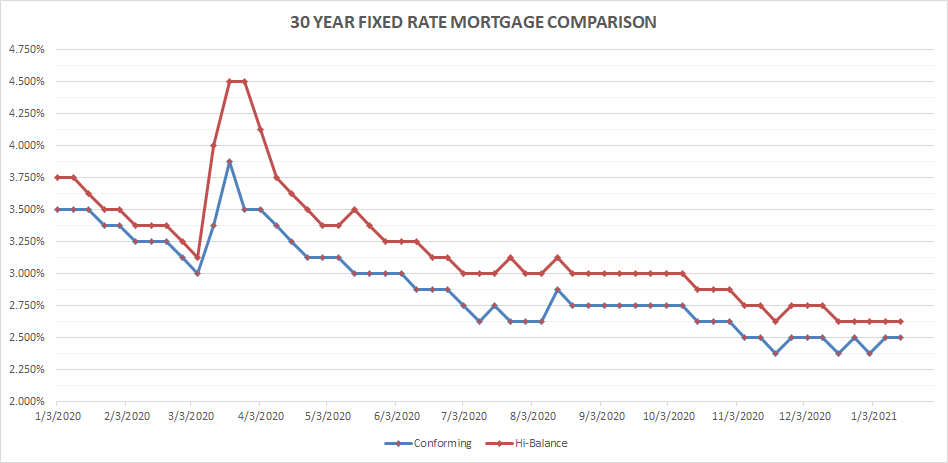
When will such good news start to put upward pressure on rates? We have already had news that should be putting upward pressure on rates with the distribution of Covid-19 vaccines to communities across the country. The larger the number of people vaccinated the more the economy will open up, the faster it will grow towards pre-Covid levels. We saw a little blip up in the fall when the announcement was made that Pfizer had viable vaccine and received approval for distribution.
We have not seen a lot of upward pressure on rates at this point, largely due to investors nervous about political factors; but also, because as vaccines are delivered across the country, we have seen that there are some serious distribution and policy issues that need to be worked out, especially in California which has received the greatest number of vaccines, to get the shots into the arms of the public. The delays in the first round of recipients receiving the vaccine raises concerns on how long it will take to vaccinate a large percentage of the population that will lead to widely opening businesses in all industries. By “large” I mean at least 60-65% of the population.
So, a lot of words and still no answer to the question, when will rates start to rise?
In my opinion we should see a strong upward pressure on rates in the late spring, possibly increasing rates up to a half-percent (0.5%). By fall I expect the 30-year conforming rate to be in the mid- to high-3% range as the Fed will have ceased Quantitative Easing, the economy should be growing, a second round of vaccines for Covid should be available for the winter flu season and while many will rightfully be cautious, gatherings and mobility will be closer to January 2020 than January 2021.
To many 3.5% to 3.75%, seems high for a residential mortgage. Some perspective on that range, since 2009 mortgage rates have been above that range considerably more than at or below that range.
Keep positive thoughts that I have not jinxed the international rate markets….
Have a question? Ask me!
One factor the Fed uses to determine rates is inflation. It has a target rate of about 2% for consumer price growth. In December, driven by higher gasoline and food costs, the Consumer Price Index increased 0.4%. For the year, CPI increased 1.4% in 2020, the lowest increase in five years. A big factor in CPI is consumer spending, the more consumers buy the more upward pressure on prices. The news is mortgage rate friendly.
In December retail sales dropped 0.7% from November. It was the third month in a row that retail sales decreased, which is a tremendous financial hit to retailers since the holiday season is a when they make or break their year. In a bit of a twist in the decline is that online retailers saw a drops in sales, whereas in the previous months in-person sales dropped and on-line sales remained fairly strong, or less weak. This news is also mortgage rate friendly.
Rates for Friday January 15, 2021: After moving up through the last week, and on Monday, rates have drifted back through the week and we end up where we were last Friday. I appeared that we may have moved out of the range of 2.375-2.5% as the week started, but with the drift back down it looks like we will stay in this range for conforming rates.
FIXED RATE MORTGAGES AT COST OF 1.25 POINTS LOCKED FOR 45 DAYS FOR PURCHASE TRANSACTIONS:
30 year conforming 2.50% Flat
30 year high-balance conforming 2.625% Flat
Please note that these are base rates and adjustments may be added for condominiums, refinances, credit scores, loan to value, no impound account and period rate is locked. Rates are based on 20% down with 740 FICO score for purchase mortgages.
*Regarding my jinx abilities, in gambling it is knows as being a “cooler.” William H. Macy stars in a film, The Cooler, in which his character works for a casino as “the cooler.” He is a walking jinx and the casino pays him to go play at tables where someone is on a hot streak. Macy shows up and instantly the dice go cold or the cards go bust. Some friends of mine from college have had the same NFL football pool for close to thirty years. We each draft five teams at the start of the season and those are our teams all year with various “games” based on weekly and season records, playoffs etc. I am the tally-keeper and have our annual records back to 2004, which show that cumulatively I am very far on the bottom of the back. I pick teams which are favored to win divisions, make the playoffs and great players—only to see injuries, career worst performances and kicks hitting the uprights. I am The Cooler. NFL teams should pay me not to pick them. So, take my predictions on rates and the economy with a grain of salt. Oh, and watch The Cooler, streaming on several platforms.
Stay safe and have a great week. For those in Southern California enjoy the return to shorts-weather…
Dennis
Past Weekly Rate & Market Updates can be found on my blog page at my website www.DennisCSmith.com/my-blog


