


What is difference between homeowners, hazard and fire insurance?
Question of the week: What is the difference between homeowners, hazard and fire insurance?
Over the past few weeks I have had several questions regarding the various insurances involved in a real estate transaction. I have decided the best way to address the questions for the next several weeks to have a series on insurance in the Weekly Rate and Market Update, this series will cover home warranty, homeowners’, title, mortgage, and finally mortgage life/disability insurances.
Answer: Nothing. Well, technically there are separate policies that cover loss due to fire, other hazards and protection of personal property. Less technically, in our industry any of these can refer to the insurance that covers your home, and possessions, and if you have a mortgage is required.
Since your home is the collateral for your mortgage the lender will require that the collateral is insured to protect the loan. Because of this, as part of the closing of your mortgage you must have sufficient coverage with a homeowners’ policy to either payoff the mortgage or rebuild the property if it burns down.
Most homeowners’ policies besides protecting for property damage or loss also have liability coverage, in case the neighbor’s kid climbing your orange tree to pilfer fruit falls and breaks his leg, and personal property such as furniture and jewelry, covered should it be damaged or stolen.
Insurance carriers tend to offer discounts on premiums if you bundle policies; when calling for quotes and coverage options also ask what the premiums will be if the insurer also handles your auto insurance.
Before calling your insurance agent and saying, “I need a homeowners’ policy…” make sure you are asking for the right amount of coverage. There is a formula that is used for the minimum required coverage based on the appraisal of the property and the “cost to rebuild new” amount located in the report. It is also important to note that you do not want your policy to cover the purchase price of your home. A very large percentage of your home price is the land, dirt does not burn so you should not insure it.
Two other property protection coverages that are available are flood insurance and earthquake insurance. Do you need them? Should you get them?
It is important to note that standard homeowners’ policies do not cover “water from below,” i.e. rising water, flood policies do. Flood insurance is required for borrowers with mortgages in designated federal flood zones. Flood insurance is very expensive, because of this most homeowners do not get flood insurance unless it is required. Some winters in Southern California we get a lot of rain and flooding occurs. If you are in an area that is prone to flooding and is not in a flood zone you may consider obtaining a policy if abnormal amounts of rain are forecast for any particular winter, and then cancelling the policy once the rain season is over.
Earthquake insurance is not required by lenders. This means that if you have earthquake insurance you should not put your lender on the policy as loss payee—meaning that the lender has no input on what you do with the proceeds from your earthquake policy if you need to collect on the policy. Earthquake policies have very high deductibles, and premiums. If you do not have a lot of equity in your home you may not benefit from an earthquake policy—your deductible could be more than the equity in your home. If you have a lot of equity in your home you should give serious consideration to obtaining an earthquake policy to protect your equity.
Next week we will discuss title insurance and what it covers.
Links for prior posts in our insurance series:
Have a question? Ask me!
Home sales were mixed in August, per the monthly housing report released by the California Association of Realtors. Statewide the median price is up 1.5% from July and up 3.6% from last August at $617,400. The increase in price was partly responsible for sales volume to be down in the state 1.3% from July, but overall sales were up 1.6% from 2018. In Southern California, the two major counties showed mixed results in August. In Los Angeles County sale were down 0.8% from the prior month and down 1.5% from last year. The median sale price in LA County of $627,690 in August was 2.7% higher than July and 3.3% from last August. In Orange County, the median sales price was down 3.5% from July and 3.4% for the year at $810,000. Sales in the OC dropped 7.0% from July, but were up 2.1% from 2018. Prices and sales are choppy in the region from one neighborhood to another, one city to another and one price range to another, showing no clear market direction one way or the other.
Looking for direction, C.A.R. released its 2020 housing forecast for the state, and it is a bit optimistic predicting home sales to increase 0.8% statewide for the year and the median home price to increase 2.5%. This forecast is consistent with estimates of GDP growth in 2020 to be less than 2% for our national economy—continuing the consistent but not booming growth of the past decade.
Which leads to Thursday’s release of the final estimate of our national economic growth for the 2nd quarter of the year, also known as the Gross Domestic Product. The final revision of GDP was unchanged from prior estimates with 2% growth for the quarter. Consumer spending was strong in the quarter, up 4.6% from the prior quarter, but the household spending activity was dampened by the trade conflict with China and reduced investment from businesses. Overall the news had little to no impact on rates as the 2.0% growth was the expected estimate.
Digging into the economy, today data on personal income and spending was released along with inflation figures, for August. Consumer spending increased 0.1% in August, the lowest increase in six months. The almost zero growth in spending can be partly attributed to the spending spree consumers went on in July, or it could be a signal that they are wary for the future; we will know when September spending data is released in a month and how much was spent on back to school supplies. Spending was definitely not impaired due to paychecks. Income increased in August by 0.4%, matching the gains in five of the past six months. With incomes far outpacing spending it is no surprise that there was a surge in the savings rate, up to 8.1% for the month. Also not posing a barrier to consumers was prices as the Fed’s benchmark inflation metric, the PCE (Personal Consumption Expenditures) rose a scant 0.1% for the month and prices have gone up only 1.4% from last August—well below the 2.0% target for the Fed. Overall the news is mortgage rate neutral, the spending and inflation data are positive for rate decreases and the income increase is slightly negative.
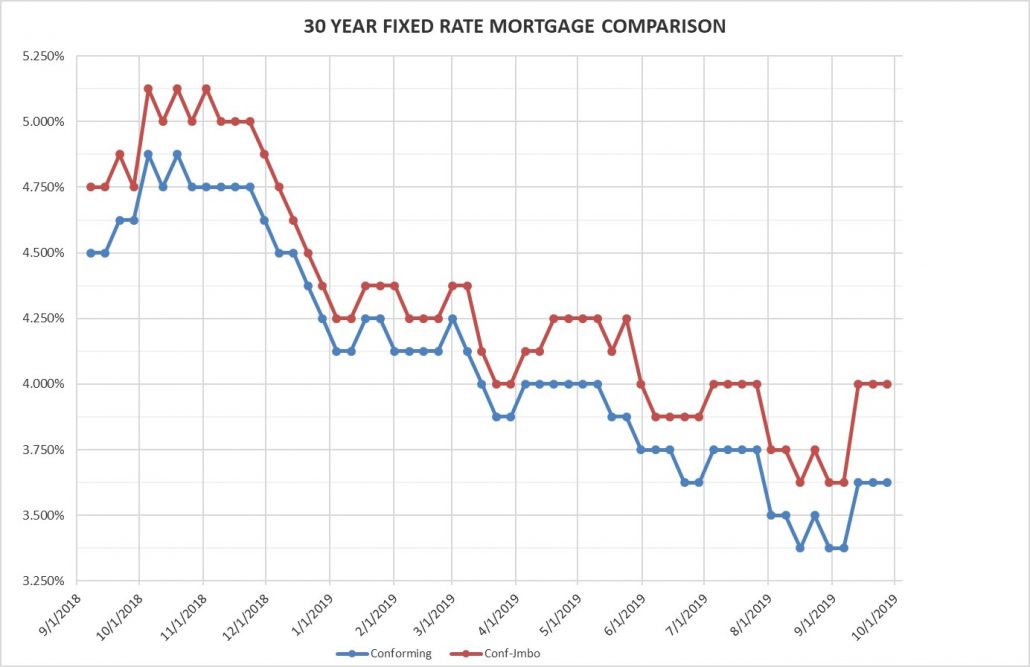
Rates for Friday September 27, 2019: Several factors impacted rates this week, among them the Federal government selling $133 billion in debt this week—increasing supply of fixed rate investment opportunities which compete with mortgages, thereby if not pushing rates up some at minimum not enabling them to drift down. Politics influences rates and the circus in Washington has investors wondering which way the market winds will blow adding uncertainty to the stocks or bonds decision, resulting in many sitting on the sidelines. Despite all this, once again, we finish the week flat from the prior Friday after gyrations through the week in the rate markets. Since rates popped up a quarter of a percent (0.25%) three weeks ago they have tried to go lower, and higher, with neither direction showing any momentum.
FIXED RATE MORTGAGES AT COST OF 1.25 POINTS LOCKED FOR 45 DAYS:
30 year conforming 3.625% Flat
30 year high-balance conforming 4.00% Flat
Please note that these are base rates and adjustments may be added for condominiums, refinances, credit scores, loan to value, no impound account and period rate is locked. Rates are based on 20% down with 740 FICO score for purchase mortgages.
I love fall, or autumn if you prefer. Growing up in other parts of the country and abroad fall was a bit more noticeable than it is in Southern California—after all palm tree fronds do not change color with the season and our fall temperatures rarely call for more than a light jacket. I like the cooler temperatures, I like the foliage, I like the late afternoon sunlight and I really like that until the end of next month all the major sports are in action! Playoff baseball and the college and pro football seasons hitting their stride make for great opportunities to get together with friends and neighbors on the weekends to root for your teams and enjoy each other’s company over crocks of chili and perhaps an adult beverage.
Are you a fall person? Summer? Spring? Winter? There is a season for everyone!
Have a great week,
Dennis
Past Weekly Rate & Market Updates can be found on my blog page at my website www.DennisCSmith.com/my-blog


