


Are the courts making new residential construction cheaper?
Question of the week: Are the courts making new residential construction cheaper?
Answer: Yes.
Going back to the late 1980’s, Federal Circuit courts, and the Supreme Court, have backed individuals in their suits against government agencies that have agreed to permit building in exchange for fees or extraction of land.
In 1987 in Nollan v California Coastal Commission, the Supreme Court ruled in Nollan’s favor when they disputed the CCC demand that Nollan give approximately one-third of their beach front property to the State of California in exchange for their approval for Nollan to remove a small bungalow on the property and build a single-family residence.
Seven years later, SCOTUS ruled in the plaintiff’s favor in Dolan v Tigard (OR) when the City of Tigard was requiring Dolan to cede property along a creek that bordered the property and make a greenbelt for public use in exchange for permitting Dolan to expand their store and pave their parking lot.
Last year, SCOTUS ruled in favor of the plaintiff in Sheetz v El Dorado County when Sheetz wanted to build a small pre-fabricated home on his property, but the County wanted Sheetz to pay $23,240 for “traffic mitigation” due to increased traffic on the road due to his property.
In the first two causes, the Court based its decisions on the Takings Clause of the Fifth Amendment, “Nor shall private property be taken for public use, without just compensation.” Approving the building permits do not reach the bar of “just compensation” as the costs for the permits were not roughly proportional to the costs imposed on the community for the new development.
For Sheetz, the question was if there is a distinction between legislative and administrative land-use conditions. The Court ruled there is no distinction, in either case whether permit conditions are imposed by legislation or individual administrators, the conditions must meet the “just compensation” bar, which the court defined as “roughly proportional.” El Dorado County could not show the single-family residence Sheetz built would cost the County $23,240 in road degradation and excess traffic.
Two weeks ago, Yu v. City of East Palo Alto was filed in the U.S. District Court for Northern California. Yu is challenging East Palo Alto’s housing ordinance, which requires developers to either pay a large fee or designate units as affordable housing—requiring the designated units be rented to those deemed qualified for affordable housing.
The Ye family resides in a home in East Palo Alto and own a vacant lot next door. They applied for permits to build a single-family unit, as well as an Accessory Dwelling Unit (ADU); their intention was to use the three dwellings on the two properties for extended family housing, including their daughters and parents.
Because the permit is for the building of multiple units, the City requires the Ye’s to either rent their ADU to non-family tenet eligible for low-income housing, in which case the property cannot be left vacant as East Palo Alto has an ordinance that rental units cannot be vacant for more than six months; or pay a $54,871 fee to the City’s affordable housing department. The latter, ironically, is meant to increase the amount of housing available in East Palo Alto—where the median sales price in June as $1.2 million.
The Ye’s are basing their case on the rulings in Sheetz, which was based on Nollan and Dolan. Regardless of the District Court’s ruling, the chances are fairly strong the loser will appeal to the Ninth Circuit Court of Appeals, and then case could then be appealed again to the Supreme Court.
Depending on the Ninth Circuit’s decision the Supreme Court may once again hear a case that has as its basis private property rights versus government’s ability to take property, or money, without just compensation. If that is the case, the probable decision will be in Ye’s favor.
Cities, Counties and States are on notice that their extraction costs for permits, beyond what is reasonable and normal, are subject to litigation, and possibly losing court cases resulting in loosing fees and possibly property they have acquired due to proportional costs imposed on developers, and individuals, that are in excess of just compensation.
With so many ADUs, major home remodels, and additions having been built, and that are going to be built, the cases above could result in the costs to add more homes, apartments, condos and rental units to our housing stock a lot less expensive to build.
Ironic to those who do not fully grasp economics, lower costs to build, regardless of where those funds are designated, will increase the number of units available to own and rent. More supply leads to lower housing costs, or in worst case slower increases in prices.
I have mentioned the Sheetz and Ye cases to a few people in the past couple of weeks who are undergoing some construction. One example are friends Craig and Melanie who own a second home in San Luis Obispo County. They recently had their permits cleared to build a 600-foot addition and make some exterior changes to patios and balconies. In order to get the permit, they paid a reasonable fee to the building department for inspections, etc; however, they also had to pay over $3000 to the County for their library fund. This does not seem to be proportional to the construction they are doing, nor does it seem like just compensation for a permit as how is the connection made between adding square footage to an existing dwelling and libraries?
If you, or anyone you know, is going through a construction product, be aware of these cases to mention to any agency looking to extract unjust compensation for the permission to build!
Have a question? Ask me!
Is the shoe dropping? Every week, month since the beginning of the year with almost every economic report there is commentary, “it appears the impact of President Trump’s tariffs have not yet hit….” This week the Consumer Price Index for July showed that overall inflation was steady from June, up 0.2% for the month, are rising 0.3% from May to June, and matching June’s year-over-year inflation of 2.7%. The first shoe dropping possibly showing tariffs impacting consumers was the 3.1% year over year increase in “core” inflation (energy and food extracted from data), last month the annual increase was 2.9%. With the core index rising so much it shows other goods and services purchased rose as a whole rose over 3%–significantly higher than the Fed’s 2% target.
Was that the other shoe? The Producer Price Index, costs for wholesalers goods pass through before getting to consumers, jumped 0.6% in July and rose 3.3% for the year, one-percent higher than June’s 2.3% annual increase. With such an increase in prices wholesalers are paying, how much can they retain and not pass along to consumers? Next month’s data will let us know.
Still moving, though. Retail sales are still steady, increasing 0.5% from June’s healthy 0.9% growth, with auto sales being a big contributor to the increase—again. Auto sales are approximately one-fifth of retail sales, and they increased a very strong 1.6% in June. A notable decrease in retail sales were big box and electronics stores, as well as restaurants. The latter is seen as a gauge of consumer sentiment as going out to eat is a luxury that won’t be had if in, or foreseeing, tough times. So far this year restaurant sales have been up and down with no clear trend—consumers are confused as to what is coming.
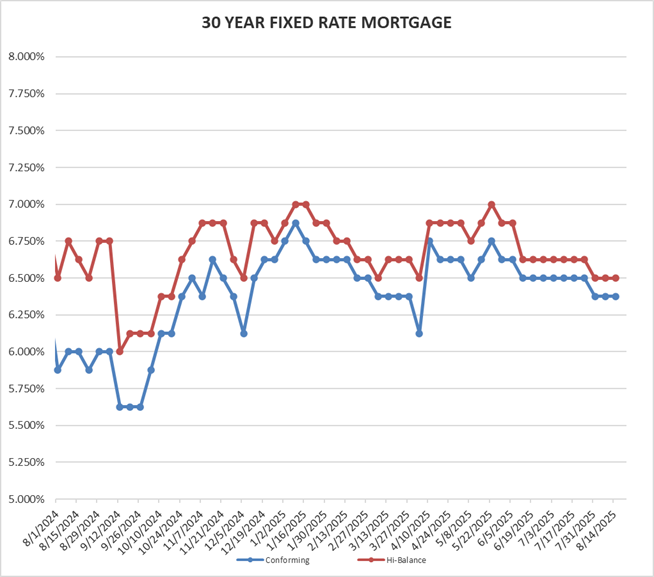
Rates for Friday August 15, 2025: Rates were trending lower this week, but bumped today on the high PPI data. That said, we are flat for the second week in a row.
FIXED RATE MORTGAGES AT COST OF 1.25 POINTS LOCKED FOR 45 DAYS:
30 year conforming 6.375% Flat
30 year high-balance conforming 6.50% Flat
Please note that these are base rates and adjustments may be added for condominiums, refinances, credit scores, loan to value, no impound account and period rate is locked. Rates are based on 20% down with 740 FICO score for purchase mortgages.
There may be some major market movement on Monday, depending on what happens in Alaska today and over the weekend as President Trump is meeting with Russian President Putin to discuss ending the war between Russia and Ukraine. If positive, the talks can lead to Trump bringing Ukraine President Volodymyr Zelenskyy into negotiations, hopefully leading to an end of hostilities.
The world has its eyes on Alaska, and these leaders, with the hope in the near future peace will be had.


