

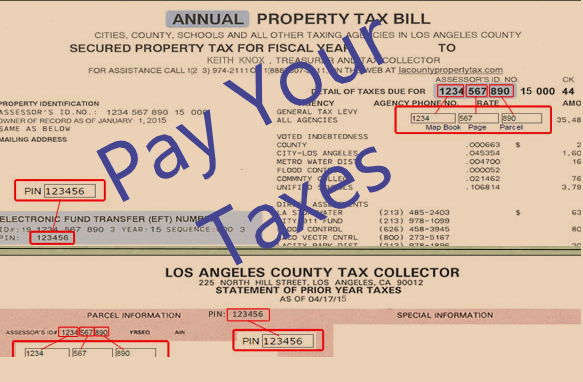
What are supplemental taxes?
Question of the week: What are supplemental taxes?
Answer: This is a question many buyers ask, whether first time buyers or someone purchasing for the first time in a long time. Usually when they receive a supplemental tax bill from the county asking them to pay the tax.
Before we talk about supplemental property taxes, we need to review property taxes. To keep this discussion simple, we are only addressing taxes when a home is purchased.
Your property taxes are established when you purchase your home and are based upon the purchase price. The base tax rate in California is 1% of the purchase price. On top of the 1% are additional assessments as established by the voters or elected officials in the county and/or city where the property is located. For instance, in Long Beach there are additional taxes assessed for water district, the county for parks, school district and community college district among other assessments.
The rule of thumb for property taxes is the amount is 1.25% of the purchase price of the property. If you purchase a property for $500,000, we estimate your taxes to be $6250 per year.
In California, the fiscal year is July 1st to June 30th. Tax bills are mailed in October with the first half taxes due by December 10th and the second half taxes due by April 10th. With our $500,000 price example, you would need to pay $3,125 in December and $3,125 in April.
If you are purchasing a home and close on the last day of February the escrow company will make sure the second half taxes, due by April 10th, are paid as part of the closing. The taxes that will be paid will be those currently due; i.e. the current owner’s tax bill. As well the escrow company will collect from you and reimburse the seller for four months of taxes since you will own the property the final four months of the tax year—March, April, May and June.
On the property you are purchasing for $500,000 that will have property taxes of $6,250 the current owner’s annual taxes at the time of the sale are $3,850 per year. At closing you will be charged $1283.33 to cover the four months between your purchasing the property and the end of the tax year on June 30th.
In October your property tax bill will state that you owe a total of $3,850, half due by December 10th and half by April 10th.
But…your tax basis is supposed to be $6250, why is your tax bill smaller? Because if you purchase your property between January and May the prior owner’s property taxes will continue through the next fiscal year.
You will also receive a supplemental tax bill in the amount of $2400 with half due by December 10th and half by April 10th. The supplemental taxes cover the difference between the amount you were billed based on the prior owner’s tax obligation and your tax obligation based upon the transfer price.
If you are paying your taxes directly this causes little difficulty, you are paying the total amount that is owed, just off of two different bills, the regular tax bill and the supplemental.
If you have your taxes impounded as part of your monthly mortgage payment then it gets a little tricky. Your lender will be collecting every month based upon what your taxes should be, $520.83 per month, and will be prepared to pay $3,250 in December and $3,250 in April. However, in October the lender will receive a tax bill totaling $3,850 with two installments due.
This is where it can, and does, get tricky and one reason I encourage people to avoid having their taxes and insurance impounded and paid by the lender if it is an option. In this scenario, with an impound account, you will have paid your lender $520.83 per month based on what tax obligation will be, and then your lender will pay the taxes owed on the tax bill. The result will be a balance of the excess between what was collected and what was paid. At some point the lender will refund this money to you, as they must by law.
However, the refund will most likely come after you will need to pay your supplemental tax bill totaling $2400. If you are impounded and have paid the full amount to the lender for the taxes why is the lender not paying the supplemental tax bill? They have the money to pay it.
Because the county assessor does not send the supplemental tax bill to your lender, and you are responsible for the payment. Essentially you will end up paying the supplemental amount twice, once to the lender—which eventually gets refunded—and once to the county.
If you have an impound account there is the possibility that your payments will be adjusted a few times over the following year or more. Because the tax bill sent to the lender was significantly less than the amount collected, the lenders automated billing process may reduce the amount owed every month as part of the tax collection and will send you a notice to this effect.
It is very important if you do get this notice that you contact the lender and inform them that you do not want your impound collection to be lowered due to the one-time tax bill that was paid at the prior owner’s tax rate, because if you do then you will be underpaid when the next tax bill is sent and the lender will end up sending you a notice that the account is short and your payment must be increased to account not only for the real tax amount due but the shortage created by them adjusting their collections.
Confusing, isn’t it? This happens not infrequently as the lender tries to catch up to the actual taxes owed. So, if you get a notice after the first tax bills have been paid by the lender, and you have paid your supplemental taxes that significantly lowers your tax collection for your impound account contact your lender immediately and have them adjust the collection back to the necessary amount.
As with any mortgage or real estate related question or problem you can contact me if you are having an issue regarding the supplemental taxes or impound account, I can help walk you through the process and steps to take.
Have a question? Ask me!
Economic data released this week shows a slowing economy, higher prices and wages. It is a mixed bag of numbers that is reflective an economy in flux with external pressures impacting employers, workers and consumers.
In the 3rd quarter GDP grew by 2%, well below the 6.7% growth seen in the 2nd quarter. A large reason for the slower growth was consumer spending increasing by 1.6% in the 3rd quarter, as opposed to 12% the prior three months. Not only did spending slow down, but there was a marked shift in where the spending took place. Spending on services increased 7.9% for the quarter, but purchases of durable goods (autos, refrigerators, lawn mowers) declined 9.2%. A lot, all?, most?, of the decline in durables purchases are due to the supply-chain issues you have been hearing and reading about. Causing delays in order deliveries, manufacturing abilities and higher prices, purchases of durable goods are being delayed by consumers.
The data shows that inflation is rising faster than wages. Reports for September show that inflation (4.4%) is outpacing wage growth (3.2%) by 1.2%. Employers are increasing wages and benefits to attract workers, the employment cost index (wages, benefits and other employment related costs) is up 3.7% from last September. The result is non-government employees saw wages and salaries increase at a historic 1.5% in the 3rd quarter. Even so, with the increase in inflation more than the increase in wages, the result is essentially a pay cut.
With the slow down in spending and increase in prices, it is apparent that demand is not the prime driver of inflation. Back to the supply chain and the huge increase in shipping, warehousing and delivery of goods, plus the higher wages to attract workers, that are putting higher costs on manufacturers, retailers and employers who must pass along the higher costs to buyers. The reduction in demand may, should, relieve some of the supply issues as fewer products need to be delivered, however this will take time to work through the regional, national and global economies.
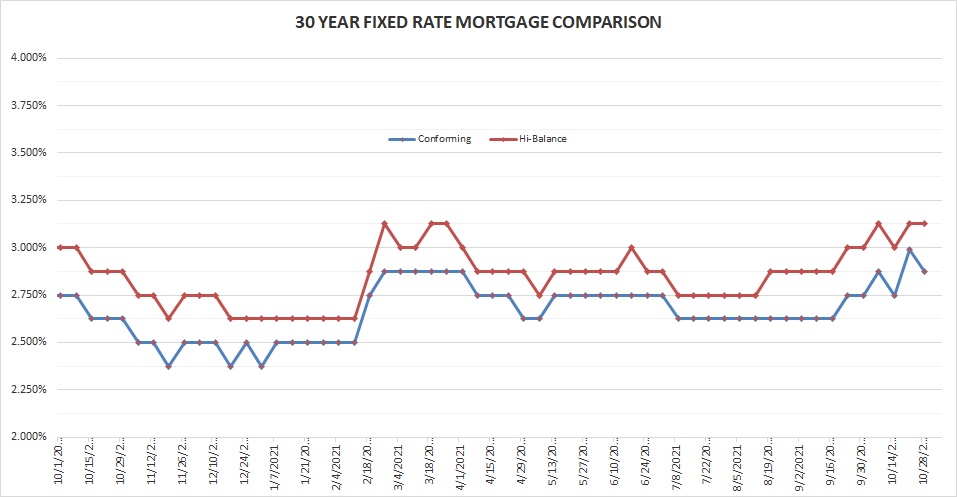
Rates for Friday October 29, 2021: The mixed bag of economic news has investors changing their direction for fixed income investments, like mortgages. The result is we see the 30 year conforming rate slip back down from last week’s increase, the high-balance rate remains the same.
FIXED RATE MORTGAGES AT COST OF 1.25 POINTS LOCKED FOR 45 DAYS FOR PURCHASE TRANSACTIONS:
30 year conforming 2.875% Down 0.115%
30 year high-balance conforming 3.125% Flat
Please note that these are base rates and adjustments may be added for condominiums, refinances, credit scores, loan to value, no impound account and period rate is locked. Rates are based on 20% down with 740 FICO score for purchase mortgages.
We are looking forward to seeing the little superheroes, princesses, cartoon characters and other costumes this Sunday. Last year our street set up sidewalk trick-or-treating (with beverage “treats” for parents) and while fun, it was sad due to the reduced number of children and families out and about. This year’s Halloween is yet another sign of the pandemic being further behind us and “normal” returning to our homes and neighborhoods.
We are also looking forward to having enough visitors to blow through the goodies that Leslie has on hand to pass out. Otherwise, the holiday weight gain struggle begins on Monday instead of the third Thursday in November!
Have a great week,
Dennis
Past Weekly Rate & Market Updates can be found on my blog page at my website www.DennisCSmith.com/my-blog


