


Is there a tax advantage to owning rental property outside of California?
Question of the week: Is there a tax advantage to owning rental property outside of California?
DISCLAIMER: I am not an accountant, CPA, or licensed tax preparer. Please consult with your accounting/tax professional for your particular situation.
Answer: No.
In 2015 the U.S. Supreme Court ruled that two states cannot tax the same income. This was a big case for the Northeast as it is not uncommon for people to live in one state and work in another due to the proximity of major cities to other states. Consider Washington D.C. which is on the border of Maryland and Virginia, New York City has workers that regularly commute from Connecticut and New Jersey, and Philadelphia that draws workers from New Jersey and Delaware.
Prior to the Supreme Court decision, someone who lived in New Jersey and worked in New York City would pay city, county and state income taxes for each of the tax jurisdictions where they worked and lived.
After the ruling, most states altered their income tax laws to tax residents’ income earned out of state by off-setting the taxes they had paid on their out-of-state income against their in-state income.
If you live in California and have taxable income of $150,000, this puts you in the 9.3% tax bracket. You own investment property in Arizona that nets taxable income of $25,000 per year; this income is taxes at 2.59% in Arizona.
In addition to your federal income and State of California tax returns, you will need to file a non-resident tax return in Arizona.
On the Arizona return you will file $25,000 net income from the property and pay $647.50 in income taxes ($25,000 x 2.59%).
On your California return you would file your return showing the $25,000 net taxable income, and the $647.50 paid to Arizona. Your income tax payable to California would be $1677.50:
$25,000 income x 9.39% CA tax rate = $2325.00
CA tax $2325 – AZ tax paid $647.50 = $1677.50
Your total taxes would be the same as if you owned a rental property in California that had net taxable income of $25,000.
Another wrinkle for investment property owners is selling investment property in California executing a 1031 tax differed exchange with the purchase of an investment property in another state.
A 1031 exchange enables an investor to sell an investment property and transferring the net proceeds to the purchase of another property. This enables the property owner to differ the capital gains on the sale of the property to a future sale. There is no limit on how many times you can execute a 1031 exchange transferring capital gains to another investment. Note this is over-simplified and should not be used as a basis for your decision to exchange property to differ capital gains; consult your tax professional.
In 2015, you sold a property in Long Beach, California that was initially your primary residence you had purchased in 2008 and converted to a rental property in 2012. At the time of the conversion in 2012 the property was worth $400,000. The property sells in 2015 for $750,000, your net proceeds after paying off the mortgage and closing costs are $400,000. Going through the required process, you transfer the $400,000 to a duplex in Denver that you purchase for $800,000.
In 2022 you sell the Denver property for $1,200,000.
Each year you have included the Denver property on your California income tax return, to report the income and taxes paid in Colorado, as well to show that you have not sold the property
When you sell the property in 2022, you decide to take the proceeds, i.e. you are not executing another 1031 exchange.
Because you are taking the proceeds, California is going to “claw back” the capital gains tax owed on the gains realized in California between when you converted the property to a rental and sold it to transfer the proceeds to purchase the property in Denver. The basic calculation is to deduct the cost basis from the net proceeds. In this case $750,000 less $400,000 is non-adjusted capital gains subject to tax in California.
There are many reasons people have for purchasing rental properties in other states, know that by doing so you are not avoiding the California State Franchise Tax Board by doing so.
One more time, all the above is for purposes of providing examples in a broad and general sense. Tax laws, both federal and state, are very complex and to properly calculate your tax obligations it is strongly suggested your work with a tax professional to prepare your returns. None of the above statements should be used as a basis for you to prepare taxes or make decisions that have tax implications, they are intended to provide basic information and a basis for questions and discussions you may want to have with your tax preparer before making any final decisions to buy, sell, exchange real estate.
Have a question? Ask me!
Inflation is not going away, soon nor not-so-soon. Prices in February jumped 0.8% for the month (note that is 9.6% annualized) and were up 7.9% from last February. Looking back a few months, at this stage the Federal Reserve, and many Wall Street economists, felt inflation would be plateauing and begin to ebb as we enter spring.
Deflection on this week’s data showing the continuing rise in the Consumer Price Index to the Russian invasion of Ukraine is a distraction. Russian troops entered Ukraine on February 23rd. To imply that Russia starting a war at the end of the month was responsible for prices increasing 0.8% for the month is misleading and deflection from the issue.
The war in Ukraine will add to the many issues pushing consumer prices higher each month as the resulting spike in oil prices works its way through the economy for higher prices for any goods requiring transportation. The expectations from the Fed, Secretary of Treasury, Wall Street economists, me, is that inflation will stay at its current rate or higher through 2022 absent some significant event(s) that loosen up supply lines, lower oil and gas prices, flatten labor demand, and slow consumer consumption and demand.
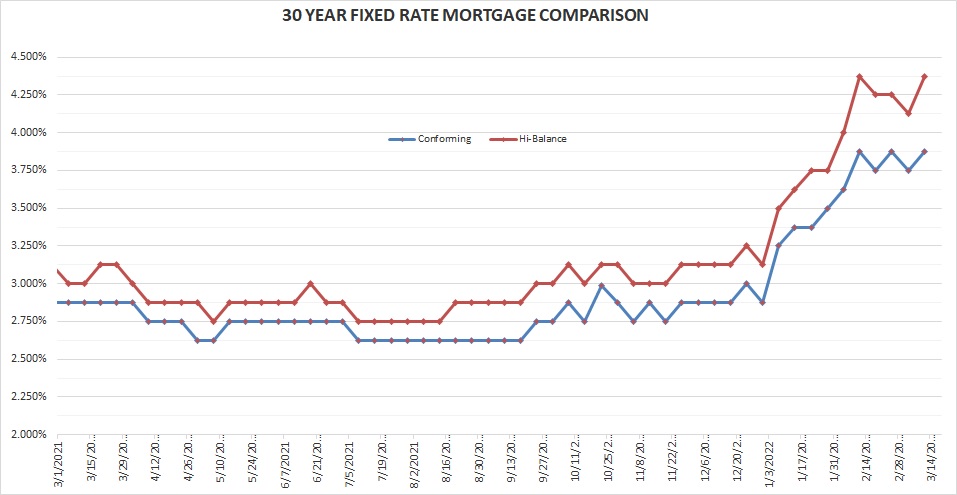
Rates for Friday March 11, 2022: I am surprised the conforming rate is not higher than it is. It is barely clinging to only a 0.125% bump from last Friday. High-balance rates spiked this week as lenders look to slow applications for high-balance mortgages and try to capture more conforming loans.
FIXED RATE MORTGAGES AT COST OF 1.25 POINTS LOCKED FOR 45 DAYS FOR PURCHASE TRANSACTIONS:
30 year conforming 3.875% Up 0.125%
30 year high-balance conforming 4.375% Up 0.25%
Please note that these are base rates and adjustments may be added for condominiums, refinances, credit scores, loan to value, no impound account and period rate is locked. Rates are based on 20% down with 740 FICO score for purchase mortgages.
Finally! The owners and players have agreed to a contract and baseball will have a season. I am one of those people who need some background noise while I work. Most people play music, I play sports, and nothing is better for me than a baseball game on the radio. Thanks to our modern technology, and a subscription fee, I can listen to the home or visitor’s radio broadcast of every MLB game. Once the season starts, my day begins by looking at the schedule of games to see who is playing a day game in the East, for a 10:00 start time in California; I don’t care if it is Baltimore playing in Toronto, or the Pirates hosting the Reds, I’ll listen.
Our empty nest is getting unempty as our youngest flies in today for her Spring Break week—no more Jeopardy every night, thank goodness for the DVR!
Have a great week,
Dennis
Past Weekly Rate & Market Updates can be found on my blog page at my website www.DennisCSmith.com/my-blog


