


How can a mortgage deferment impact me in the future?
Question of the week: How can a mortgage deferment impact me in the future?
A quick note, payment deferment and forbearance are synonymous. Each refers to the delay of a payment due, not the same as forgiveness of a payment due. For terms of this commentary we will use deferment.
Answer: This is a question I have been getting a lot lately. Most major mortgage lenders have been announcing that due to the COVID-19 pandemic they are offering their mortgage clients deferments on their mortgage payments. For many families this is very welcome relief due to loss of income, other families may be considering using the opportunity to save some money and start back with their mortgage payments in the future.
Back to our question, what is the impact on a borrower who enters into a deferment program with their mortgage company?
The answer to this question varies depending on the lender and what is being deferred.
First, approving a deferment a lender may request proof that you and your family have been economically impacted by COVID-19, either through loss of income, loss of a family member to the virus, increased medical bills, etc. Some lenders may not require any proof, but from what I have seen most are trying to verify those who are getting deferments are in need of one to avoid going into foreclosure.
Before signing a deferment agreement here are some of the questions you may want answered:
- What will be the impact on my credit? Will the lender report the deferred payments to the credit bureaus? Will every payment made until the deferred amount is paid current? Some lenders are stating they will not report deferred payments to the credit agencies, this protects your credit scores and also does not show mortgage late payments over a prolonged period of time which can impact your ability for a home loan in the future to either refinance your current mortgage or purchase a new home. If you are in such economic hardship that if you do not obtain a deferment you will have to go into foreclosure then future credit considerations are not as big of a concern; if you are considering a deferment for some cash-flow advantage then this is an important issue for you to explore. Check with the lender as to their credit reporting policy on deferments.
- What is the nature of the deferment? There are many variations lenders may offer to their clients, before agreeing to a deferment be very clear on what is being deferred, for how long and what are the terms of repayment.
- The simplest deferment plan is the lender agrees to add any missed payments to the end of your loan term. For example, if you have a loan that is due in December 2030 and the lender defers your April 2020 payment, your loan will now be due in January 2031. If the lender defers three payments your loan will end in March 2031. For every month deferred your loan is extended a month.
- Another form of deferment is to add the amount of missed payments onto future payments, spreading out the repayment of the deferment over a period of years. Sometimes this deferment is done when a payment is lowered and not completely postponed for the period of deferment. In this example, let’s assume you have a $2000 monthly payment. The lender may agree to alter, or modify, your payment to $1500 per month for the next twelve months. After that the payment will increase back to the $2000 per month payment for twelve months, and after that the lender will re-amortize your mortgage for the remainder of the loan term to make up for the $6000 not paid due to the modification and your loan term will remain the same.
- Some lenders allow borrowers to catch up missed payments with lump sums at a future date. In the above example, a borrower may pay the lender $6000 to payoff the deferred amount to reduce future interest charges.
- Will there be any charges to establish the deferment? Will there be an accrual of late charges for the payments that are deferred? This is important as if the lender is rolling the missed payments instead of adding them to the back of the loan, they may still assess the late fee of 5% of your payment. This goes back to how your loan is being reported to credit agencies if you enter a deferment agreement. Verify if there are any charges for the deferment and any late fees assessed during the deferment period.
From what I have been reading about the various deferment programs from different lenders, 90 days seems to be a popular deferral period. As well, many of the lenders are adding deferred payments to the end of the mortgage terms, not charging late fees and not reporting to credit agencies.
Key words, “most” and “many.” Every lender is different, do not assume your lender is going to be as borrower friendly as no costs or dings on your credit report. Before making an agreement for deferment make sure you fully understand the long-term consequences and if they are such that your current situation is such that the immediate benefit of a deferral is worth any future consequences.
If you have any questions please feel free to contact me.
Have a question? Ask me!
Unemployment surged in March, more than expected. The economy shed over 700,000 jobs in March and the unemployment rates jumped from 3.5% to 4.4%. By far the largest job losses were in the leisure and hospitality industry, which accounted for 65% of lost jobs. A large impact on the labor statistics for March that were reported by the Department of Labor today was provisions in the stimulus package that went into law last week. Due to the more generous benefits than traditionally paid to unemployed workers through CARE Act, and looking to avoid paying sick-pay to workers, many employers have laid workers off. As well, many workers have reportedly asked to be laid off due to the amount of benefits being received, some then volunteering to assist in relief and recovery efforts in their communities. This not to discount the tremendous amount of workers who find themselves out of a job due to the virus, but understanding that Congress and the President have greatly eased the traditional transition to unemployment that has altered the employer-employee decision process.
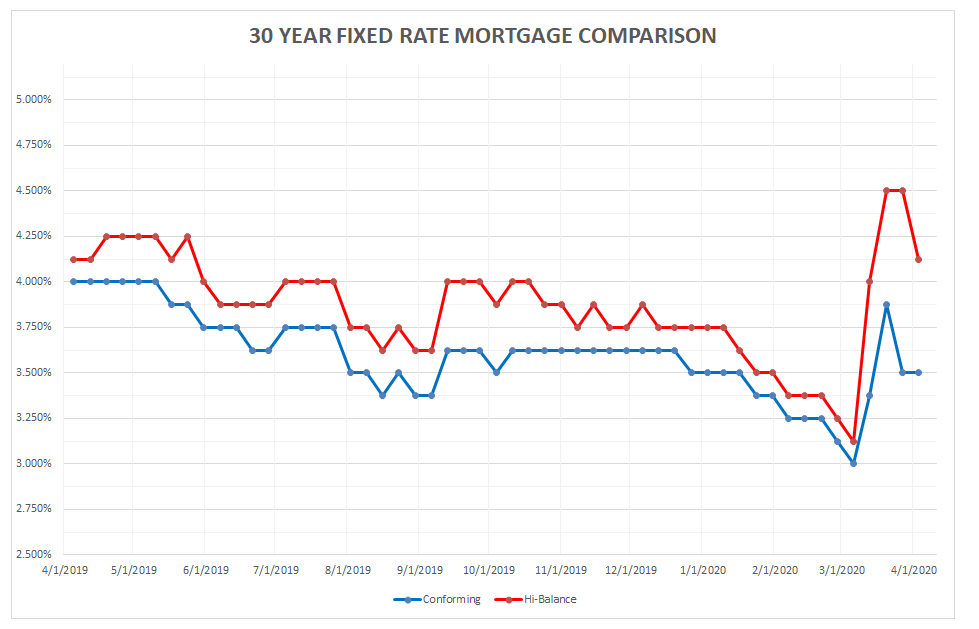
Rates for Friday April 3, 2020: Rates continue to be volatile, as mentioned above. Rates below are quoted for 45 day locks for purchases only, refinance rates will vary.
FIXED RATE MORTGAGES AT COST OF 1.25 POINTS LOCKED FOR 45 DAYS:
30 year conforming 3.50% Flat
30 year high-balance conforming 4.125% Down 0.375%
Please note that these are base rates and adjustments may be added for condominiums, refinances, credit scores, loan to value, no impound account and period rate is locked. Rates are based on 20% down with 740 FICO score for purchase mortgages.
Thank you for those who logged-in for my Lunch and Learn on how money flows through the mortgage industry. I recorded the session and am working on how to edit the file to eliminate the first minute or two of dead time. Once edited I will post on my website or elsewhere and provide a link.
My deepest apologies for subjecting everyone to my ineptness as scheduling and communicating! You did not deserve to receive three emails on the topic and I will do my best to prevent these errors in the future. Let me know if there are any topics you would like me to cover in the future, or re-cover one of our questions of the week with a bit more depth and ability for live Q&A.
Smith household is holding up well during our stay-at-home. Leslie, whose company has always been home based is looking forward to getting her office back—i.e. me going back to an office. The girls are trying to stay active and engaged through on-line classes and chats with friends. I am trying to get in my workouts via on-line sessions. And the dog is thrilled everyone is home and no one is visiting (he is not a fan of strangers in the house).
Stay safe, stay sane and treasure these unique times we have with our families!
Have a great week,
Dennis
Past Weekly Rate & Market Updates can be found on my blog page at my website www.DennisCSmith.com/my-blog


