

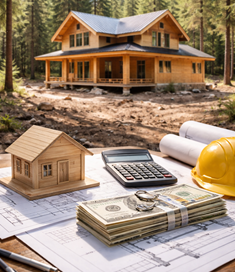
We want to build on our property…
Question of the week: We want to build on our property…
Answer: There are a lot of questions that can finish this sentence.
What kind of building?
Where?
How?
What?
Last March we covered changes in California laws for property owners building accessory dwelling units (ADU) on their properties. That is one type of building that has become a lot more common around the state, and nation.
What has come up more often in conversations I have had with clients is building on vacant lots or pieces of land—not just those impacted by wildfires, but land obtained through inheritance, a purchase for future second home or retirement, and other circumstances. In these cases the objective is to construct a home on the property.
If building on a vacant lot or parcel, perhaps the first step is to ascertain if the property has electricity, water, and sewage; the latter may take the form of pipes to a utility network, or an on-site septic tank.
If the property does not have any electrical or water supply to the property, construction will be more challenging until these systems are operational. As well, obtaining the connections can be time consuming and expensive.
Moving forward, the next question is “what do we want to build?” Which raises the question, or should, “how are we going to use this dwelling?”
Will it be a permanent home, a vacation home, a hunting cabin, a rental, short or long term, will we retire there, entertain…?
How the dwelling will be used is paramount to conversations with architects, contractors, landscapers, designers. As well, it can determine how you build the home.
If for yourself and family, you will like want higher quality fixtures, finer details and design, than if the dwelling will be used more by non-family members/tenants.
Construction is, obviously, the highest cost of the project. What type of material you use for everything from roofs, to flooring, to plumbing fixtures, to landscaping, can quickly increase your costs from budgeted to “what the heck?”
For most families, the primary driver of building, whether an ADU, a get-away cabin, to a family compound with multiple dwellings, is “how much can we afford?”
Ideally, before meeting with any professional to start the process, you meet with a lender to determine your financing options and capabilities. From this conversation you will then be able to determine how “grand” you can make your new property.
Increasingly, many families are bringing their costs down considerably, whether for ADUs or traditional built houses, using manufactured housing.
We will pause here while some readers roll their eyes, become immediately resistant, put on the banjos from “Deliverance” and tell their favorite joke about Okies or West Virginians*.
For too many, their image of manufactured homes is mobile homes from the park by the river. Those dwellings are indeed manufactured homes. However, over the past several decades, the manufactured housing industry has re-labelled many of their dwellings “modular homes,” or “prefab(ricated) homes.” These homes can have style, elegance, and comfort, for considerably less cost than building a new home from the ground up on site with new materials. (Google “upscale manufactured homes” and take a gander.)
Prior prejudices about manufactured homes aside, consider the total costs project time can be up to 40-50% less.
There are several options to finance building projects, depending on the total funds needed.
If you own developed property, depending on your equity, you can refinance or get an equity line for funds.
Construction financing is available in a few different forms, the basics being the same for most programs.
Completed plans and costs from a contractor will be needed as an appraiser will do a before-and-after assessment of the property. The lender will then lend up to a certain loan-to-value of the finished project.
If there is a loan on the property it will need to be paid off as part of the loan.
Simplifying the numbers.
You have purchased a one-acre parcel of land in Plumas County for $80,000 using your equity line on your primary residence that has a small cabin with electricity and water to the dwelling and a septic tank. You want to build a vacation home that will be used by you and your family.
You have plans for a 4-bedroom, 3-bathroom, 3500 square foot home. The cost is approximately $500,000 to complete the project. The after-value appraisal is $750,000.
The underwriter has reviewed your financial information, calculating your debt-to-income ratios, including your total housing payment for current and new properties, funds in reserve and credit report for a $500,000 loan.
You qualify for the transaction, the underwriter then reviews the costs to build and the after-value appraisal, and approves the loan.
The loan is funded, with some funds being disbursed to cover costs incurred or needed to start the project. Moving forward, the lender will release more funds at different stages of completion and inspection to ensure those stages were complete.
When the project is finished and a certificate of occupancy is issued, the lender releases the final amount of funds required, and if any funds remain are applied to the principal balance of the loan. At this time the loan converts to a 30-year fixed, or whatever terms for which you applied.
There is more paperwork and steps for a construction/renovation loan, however, the lender also acts as an accountability factor in that the contractor cannot get paid until work is complete and signed off by the lender’s inspector.
If putting an ADU on an existing property, construction/renovation financing may also be available; an option to consider vis-à-vis a cashout refinance or equity line options.
*What’s the difference between a tornado in Enid, Oklahoma and a divorce in Wheeling, West Virginia? Someone is losing a mobile home.
Have a question? Ask me!
Want to schedule and appointment? Click Here
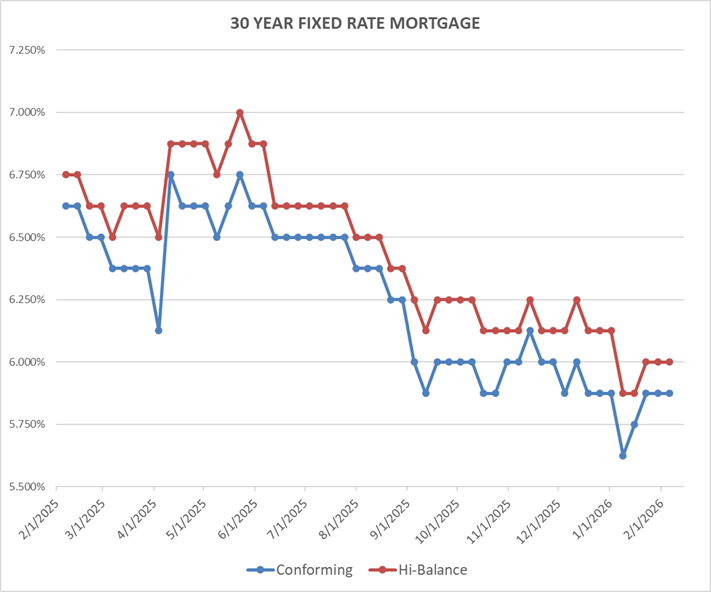
Rates for Friday February 6, 2026: First Fridays are always great here in Bixby Knolls neighborhood of Long Beach as the restaurants and stores have special deals that align with a monthly theme, and the sidewalks and businesses are full of happy people. They are also the scheduled release date for employment data for the prior month from the Department of Labor. This Friday the theme in Bixby Knolls is Black History Month. The Labor Department data was not released due to the partial government shutdown, data is expected on Wednesday. Rates flat, again, which is nice.
FIXED RATE MORTGAGES AT COST OF 1.25 POINTS LOCKED FOR 45 DAYS FOR PURCHASE TRANSACTIONS:
30-year conforming 5.875% Flat
30-year high-balance conforming 6.00% Flat
Please note that these are base rates and adjustments may be added for condominiums, refinances, credit scores, loan to value, no impound account and period rate is locked. Rates are based on 20% down with 740 FICO score for purchase mortgages.
For the first time in a decade (Broncos, Panthers 2016) that I have very little interest in the Super Bowl. I would like to see Sam Darnold win, not because he went to the school up the freeway from us, but because of his NFL journey. I also would like to see the Patriots win with their first year coach and seemingly great guy quarterback—however would not like to feed the millennial and Gen-Z Patriots fans who grew up with winning teams and have an arrogance and smugness about them (apologies, no-apologies to Patriot-Red Sox-Bruin-Celtics fans reading this).
Since I am wanting the Seahawks more than the Patriots, the Patriots will win as I am 1-6 for teams I want to win in the playoffs winning this season.
Patriots 24 – Seahawks 21


