

What do you mean my interest rate is lower than my interest rate?
Question of the week: What do you mean my interest rate is lower than my interest rate?
Answer: Disclaimer, I am not a tax professional, this week’s WR&MU is for informational purposes using example that may not (probably not) reflect actual values and dollar amounts. Please consult your tax preparation professional to determine the impact on your finances when owning or purchasing a home.
Now that we have that out of the way…
What if I told you that the 6.75% interest rate this keeping you from purchasing a new home is effectively 4.93%? Would you remove the interest rate barrier from your home buying decision?
For over three decades, when working with home buyers I give an example of how their “effective” mortgage payment is less than their actual mortgage payment. Which in essence is paying your mortgage at a lower rate.
You and your spouse earn $175,000 dollars per year and before any other deductions your federal income tax is $28,328, or 16.2% of your income.
The calculation using the 2025 federal income tax table is as follows. Income taxed in tiers of 10%, 12% and 22%; for $175,000:
$2385 on first $23,850 earned
$8772 on amount from $2380 to $96,950
$17,171 on amount from $96,050 to your total income of $175,000
You purchase a new home for $1,000,000 with 20% down and a loan amount of $800,000. You obtain a 30-year fixed rate loan with a rate of 6.75% and have a monthly payment of $5189.
How?
The federal tax code allows deduction from income for interest paid up to $750,000 in loan amount for mortgages on primary residences. Note this deduction is dollar for dollar from your income.
The interest on $750,000 at 6.75% is $50,625, thus lowering your taxable income to $124,375. Running $125,375 through the income tax tiers your federal income tax is $17,191, or 9.8% of your income.
This is a savings of $11,370 in federal taxes, or $928 per month.
If you apply that tax savings to your monthly mortgage payment, you essentially lower your payment to $4261 per month, which in an effective interest rate on a $800,000 mortgage of 4.93%.
Your federal income tax deduction has lowered your effective interest rate from 6.75% to 4.93%.
That is just the deduction for mortgage interest, if you have a $1,000,000 your property taxes are $12,500 or more. The federal tax code lets you deduct up to $10,000 for SALT (State and Local Taxes). This $10,000 deduction lowers your income to $115,375, saving another $2200 per year ($183 per month).
If you and your spouse each contribute 10% of your income to your employer sponsored retirement plan, the is another $17,500 deducted to your income, lowering your taxable income before any other deductions to $97,975; just $925 above the 2nd income tier limit of $96,950—the $925 will be taxes at 22%.
I will not calculate tax savings and new effective mortgage rate using the SALT and retirement account savings as you are very likely taking that anyway. What adding those deductions do so is that with just those three deductions, mortgage interest, SALT and retirement contributions, you likely lowered your top tax tier from 22% to 12%.
*If you live in California, the maximum residential interest that can be deducted is interest on $1,000,000. For above example the deduction for California is $54,000. Running the numbers, lowering taxable income to $121,000 your tax is $3311 less per year than it would be on $175,000, a savings of $275 per month. With your federal tax savings, your monthly payment is lowered to $3986, a savings of $1203 per month, your effective interest rate is 4.36% on your mortgage.
I have always approached home ownership as a math problem that breaks down to what is the monthly payment and how much cash is needed to close the transaction.
The biggest variable is the interest on the mortgage, which is also the figure that has the most emotion around it as many people draw a line in the sand, “I won’t buy until rates drop below X%.” But if they do the math the will be paying less than X%, significantly so.
What is your stance is you will not buy a home until rates are under 5%? In the scenario above, effectively the rate is where you are ready to buy a home.
What are you waiting for?
To schedule an initial meeting by phone or Zoom, click here for my calendar, please feel free to forward to a friend or family member!
Have a question? Ask me!
Normally, a monthly surge in retail sales would push interest rates higher on concerns economy is getting hot and inflation pressures will increase. These are not normal times, which is why Wednesday’s data on retails sales in March was largely unimpactful. Sales jumped 1.4% from February, following February’s large 1.2% increase. Most of the surge in sales were consumers consuming in front of impacts on prices ahead of tariffs hitting the market. The biggest factor in the jump in sales were seen in auto dealerships, as seen by only a 0.5% increase in retail sales if auto sales are stripped by the data.
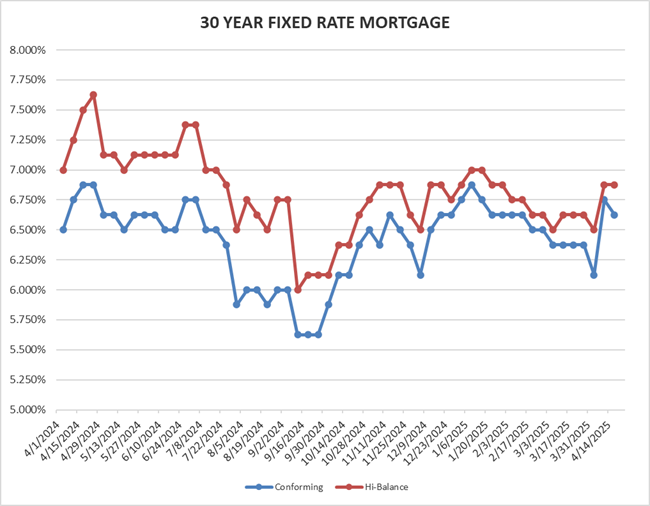
Rates for Friday April 18 2025: Money flowed into fixed rate assets, including mortgages for most of the week, resulting in a dip in rates following last week’s spike.
FIXED RATE MORTGAGES AT COST OF 1.25 POINTS LOCKED FOR 45 DAYS FOR PURCHASE TRANSACTIONS:
30-year conforming 6.255% Down 0.125%
30-year high-balance conforming 6.875% Flat
Please note that these are base rates and adjustments may be added for condominiums, refinances, credit scores, loan to value, no impound account and period rate is locked. Rates are based on 20% down with 740 FICO score for purchase mortgages.
Tuesday was an important historical date in America, and not just because of the April 15th tax filing deadline. On April 15th the following happened.
In 1865 Robert E. Lee surrendered his Army of Northern Virginia to General Ulysses S. Grant at Appomattox, essentially ending the civil war.
In 1912 the most luxurious, and one of the largest, ocean liners sank on its maiden voyage on its way from Southhampton, England to New York City. Eighty-five years later the movie “Titanic” was released, telling a somewhat fictionalized tale of the famous ship.
In 1947 at Ebbets Field in Brooklyn the first baseman trotted out to his position at the top of the first inning, becoming the first Black man to play in the modern major leagues. At the end of the season, Jackie Robinson won the inaugural Rookie of the Year award and would go on to have a Hall of Fame career.
One more historical note, on this date 250 years ago an event happened that gave Henry Wadsworth Longfellow the subject of one of his most famous poems, perhaps the most famous.
For those who are history buffs, or those who really like the month of April, I highly recommend “April 1865: The Month That Saved America” by Jay Winik. In it Winik chronicles all the events that occurred in that month that could have radically changed our nation’s history.
Finally, a personal note in the personal note section to my very good friend Alex; pursuant to our conversation last night and use of AI, I did use it to verify some of my calculations above—confirming that AI can do math.
To others not Alex, in our discussion I mentioned that the most ardent WR&MU readers know that AI is not used to compose any of the writing, as evidenced by the spelling, grammatical and usage mistakes that some of you are very kind to point out from time to time.
Happy Easter, find all your eggs.


