

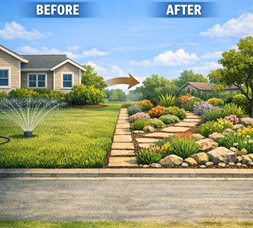
A walkway and shrub can improve my home value?
Question of the week: A walkway and shrub can improve my home value?
Answer: Very early in my career, around 1987 or 1988, when my territory was Fullerton and Yorba Linda, I was visiting open houses on a weekend to meet real estate agents to build my referral network. I saw a sign for an open house that was being held by an older agent I had met earlier in the week in his office. I was 25 or 26 at the time, so “by older” I mean in his late 50’s or early 60’s, as well he had told me when we first met he had been in the industry for almost thirty years.
The house was a very nice, traditional white wood siding, two-story, in a neighborhood with similar, what I called then “Midwest homes.” As I was walking in the door the agent said, “would you like to buy it?”
“Hi ____,* I can’t afford this house. My name is…”
“Yes, Dennis we met earlier, I figure you cannot afford it, but would you like to buy it?”
“No, I don’t think I would.”
“I ask everyone who walks into a house if they want to buy it, it’s my three-step rule. Three steps into a house you know if you want to buy it or not. Over the years, I have found this to be true almost always.”
*I regret I do not remember his name, as I have spoken with hundreds of clients over the years about the three-step rule, and like him, it is almost always true. Think about your home, and previous homes you have bought, does the three-step rule hold true?
If you are selling your home, before most potential buyers get three steps in they have a sense of if they wish to purchase your home or not. Before they take those three steps, they must walk to your front door from the street.
What are they seeing, how does it make them feel? Special? Ordinary?
In Southern California distinguishing between the end of mild winter and spring is rather vague. That said, Spring officially begins in a few weeks, so now is the perfect time to engage in landscaping that can improve your homes value, possibly save you money, and perhaps, more inviting, or appealing to see.
You have very likely seen more and more homes in your neighborhood and throughout the region that have converted their yards from traditional grass and bushes to low-water, native, grasses, plants and bushes. Often with walkways and paths that are decorative with flagstone or other materials instead of concrete. When well maintained, which I can say from over a decade of experience it not very challenging, homes with this type of landscaping tend to sell faster and for higher values than similar homes nearby with traditional grass and bush front yards.
The change-over from traditional to native, low-water, does not have to be complete, there can be different areas with bushes or plants through the lawn with connecting paths or borders. Some start this way with a plan to slowly convert the entire space away from grass.
Crushed gravel, stone pathways, low water ground covers, can all be used as accents and filling space between plants and bushes to create a new look for your home to increase value.
Regarding saving money, keeping grass green and lush in Southern California takes a lot of water—which is becoming more and more expensive. Selecting the right flora for your yard can greatly reduce water usage for your home.
Besides saving water, using less water can also be beneficial for your home’s structure. Our neighborhood, like many in the region, is built on expansive clay soil. It gets wet, it expands, it gets dry, it contracts. The result is a continual cycle of push and retract against foundations or slabs. This movement results in cracks in walls and ceilings over the years.
To minimize this impact, it is important to try to keep as much water as possible as far from possible from the side of your house. This is done with gutters to direct the water away from your foundation, ideally a concrete skirt around the home slanted away from the home—more ideally having French drains that collect the run off and directs the water further from your home towards the street and the back of the property.
Most money for home improvements are made to interiors, kitchens (the most), bedrooms, bathrooms, living areas. Exterior improvements are typically done several years between projects, painting, new roof, windows. Other than paying a gardener to mow-and-blow, and replacing a bush or replanting flowers, less attention is typically paid to the area of your home that is seen the most by the most people.
A full redo of your landscaping, and hardscaping, can be expensive. Most water districts and departments, across Southern California has budgets to provide property owners with funds to convert their lawns from high-water grass to low-water plants and vegetation.
To answer our question, yes, a walkway and shrub(s) can improve the value of your home!
To schedule an initial meeting by phone or Zoom, click here for my calendar, please feel free to forward to a friend or family member!
Have a question? Ask me!
Labor Department data today showed the economy lost 92,000 jobs last month, well short of the 126,000 jobs gained in January and a big miss from the 50,000 gain in jobs economists expected. With the job drop, the unemployment rate increased to 4.4%. Aided by strikes by healthcare workers in California, the sector, which had been propping up job gains, saw a significant drop in jobs. Overall, the private sector saw a drop of 86,000 jobs across the country. With a soft labor market, drops in five of the last nine months, strikes, bad weather, and increasing use of artificial intelligence and technology to replace workers—or not replace workers who leave, Americans are finding fewer opportunities for employment.
The Director of the White House’s National Economic Council attributed the large downturn in jobs to “one-offs,” citing a change in how the Department of Labor’s Bureau of Labor Statistics accounts for businesses opening and closing, along with some of the reasons above. For this to be so, a one-off, we will need to see rebounds in hiring in the coming months.
Positive, or not negative news for those working, wages rose 0.4% in February, which kept pace with December’s rate of inflation. Not as rosy, was the 0.2% decline in retail spending in January, the largest decline since May. Less spending by consumers, 65-70% of our economy, leads to fewer jobs.
Today’s news would normally give fuel to a Fed rate cut, but…while the economy lost jobs, the unemployment rate increased only 0.1%, not enough to cause concern for many Fed watchers. As, or more, importantly, the spike in oil prices due to the conflict with Iran, carries a lot more weight as oil is a primary impact on prices. Higher fuel costs lead to higher wholesale prices lead to higher consumer prices, which is inflationary. Keep in mind, the Fed’s charter is maximum employment with the lowest level of inflation.
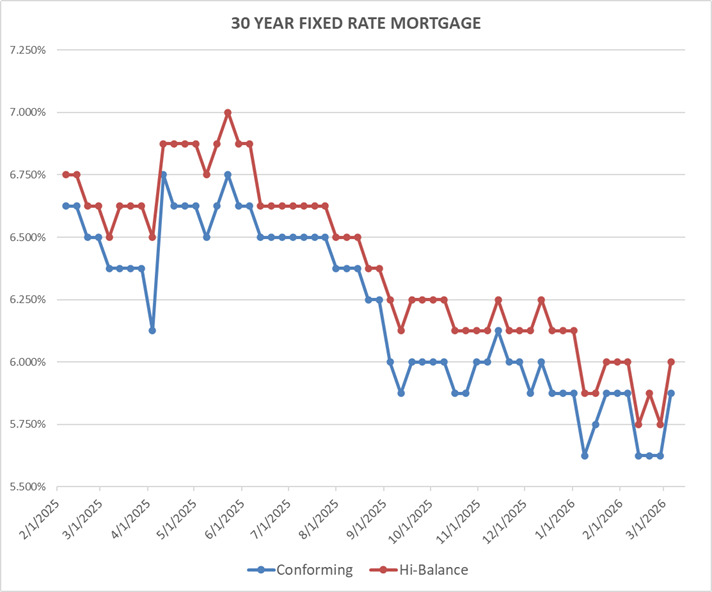
Rates for Friday March 6, 2026: Economics gets pushed aside in times of armed conflict. Historically, international conflict results in lower rates as investors engage in “flight to safety.” As mentioned, investors are more concerned with oil prices and inflation, apparently feeling the conflict with Iran will not extend to other nations. Rates spike this Friday, the most in one week since last April.
FIXED RATE MORTGAGES AT COST OF 1.25 POINTS LOCKED FOR 45 DAYS FOR PURCHASE TRANSACTIONS:
30-year conforming 5.875% Up 0.25%
30-year high-balance conforming 6.125% Up 0.25%
Please note that these are base rates and adjustments may be added for condominiums, refinances, credit scores, loan to value, no impound account and period rate is locked. Rates are based on 20% down with 740 FICO score for purchase mortgages.
Don’t forget to set your clock ahead tomorrow night or you will be late for church, or your golf tee time, or brunch appointment. Or will you be late? I can never remember which way makes us late and which makes us early. Either way, I’ll be awake just before sunset regardless what the clock tells me!


