


Is now a good time to buy a home?
Question of the week: Is now a good time to buy a home?
Answer: This is an easy follow up to last week’s question of the week, Should we buy a property with a friend or family member?
It is a great question that a lot of families have been asking the last few months. With interest rates down home affordability is up, for example in LA County the median price for a single-family home was up 3.9% from April 2019 to April 2020, but the monthly payment on a purchase of the median priced home with 20% down is lower by 5.3%. In plain numbers the median house price is $21,000 higher but the mortgage payment on the median home is $111 lower per month.
Based on interest rates alone, the answer to our question is yes, now is a good time to buy a home.
But…..
What is prompting the question for most families is the sub-question, “will prices fall in the near future due to the Covid-19 pandemic?” To answer this, we move from pure mathematics to some conjecture.
This week the Mortgage Bankers Association reported that 8.4% of home loans in the United States are in forbearance, i.e. have suspended payments, that represents 4.2 million mortgages. While the number of mortgages in forbearance has increased, the increase has slowed considerably.
What impact will the large number of mortgages with no payments being made have on real estate values? Part of that answer will depend on what the property is located.
A recent study by the Kroll Bond Rating Agency ran an analysis on 22,000 mortgages looking at factors such as geography, interest rate, credit scores and employment status to determine which factors would likely determine the likeliness a borrower would go into forbearance. The base-line, or benchmark, borrower was a wage earner (i.e. not self-employed), with a 750 credit score, has a fixed rate mortgage of 4.25% and does not live in New York, New Jersey, Texas, Nevada, or…California.
Being a California homeowner is the fifth likeliest attribute for a forbearance (the first four are property in New York, property in New Jersey, borrower is self-employed, borrower’s rate is 200 basis points).
There are about 11.5 million households in California, the homeownership rate, which has been declining, is just under 55%, so there are about 6.3 million homes that are owner-occupied. Nationally approximately 65% of homes have mortgages, which would mean about 4.1 million homes in California have a mortgage. If California is in line with the national forbearance rate of 8.4%, there are 345,000 homes in forbearance in California.
Our guesstimation is that about 5.5% of owner-occupied homes are currently behind on their mortgages. Statistically, most of these homes would be in areas that have lower median incomes and are below the median price.
At the beginning of April we discussed how a mortgage deferment, or forbearance, worked and its impact on the borrower. The short answer is that when the forbearance period ends you have to pay the lender the full amount of money owed that was deferred. If you have a $2000 monthly mortgage payment and you defer payments for six months, you have to pay the lender $12,000. Some lenders will then provide a payment plan for the funds owed; others want the full amount due.
What this means is that many homeowners in forbearance may not be able to re-pay the deferred payments. This will leave them with few options. Because of the increase in real estate values over the past several years and reduction in cash-out refinances over the same period, many homeowners have decent equity in their properties. This means the best option for borrowers who are unable to make up their deferred payments will be to sell their homes, payoff the mortgage and back payments and ideally still have some money after the sale. The other options would be going through the foreclosure process and receiving no funds from the sale, or negotiating with the lender for a short-sale on the property.
This is all very reminiscent of the real estate crash in 2008. Which is why many families are asking, “is now a good time to buy a home.” They do not want to purchase a home in June if the value of the home is going to drop significantly by December.
Back to our mathematical analysis. In some areas with high incidents of forbearance, lower wages and income and lower home values and appreciation, there will likely be some softening of real estate values. Values depend on the most basic economic principle of supply and demand. If several houses in a neighborhood, or region, are put on the market due to homeowners having entered into forbearance agreements that they cannot repay, supply increases which dampens prices.
However, if the affordability rate is higher in those areas, some families will be able to purchase homes they could not afford before, which increases demand. Will the demand exceed, meet or be less than the supply?
Overall, I do not foresee a significant drop in real estate prices in the major markets of Southern California, by significant I mean 10% or more. Some areas, as mentioned above, may see strong drops while the markets sort out the end of the forbearance era, but most should see no, or slight, drops in values.
Currently, through the first two months of the pandemic real estate market, prices in Southern California are only down slightly from March to April, and up from 2019. With the economy opening back up, more people going to work and consumers spending more, we can expect stability in all markets in the near future.
I don’t think I have answered the question, is now a good time to buy a home.
In my opinion, yes now is a good time, a very good time, to buy a home. Will there be an increase in distress sales, short-sales and foreclosures in the state? Yes, but it appears that perhaps as few as 500,000 homes or less, across the state, may be in delinquency as a result of C-19. Yes, that is a lot of homes, but should the rest of the market retain the strong fundamentals that existed prior to March then those properties should have minor impact statewide and in most major markets.
Not only do I think it is a good time to purchase your new home, but as I have been counseling many first-time buyers, perhaps your “next” home. With the lower rates many families can afford to buy-up, instead of purchasing a starter two-bedroom home than can look to purchase a three-bedroom home in the same area. The way I put it is instead of buying the home for your new, or soon to be new, family that will be sufficient into or through elementary school, you may be able to buy the home that will be sufficient through your children’s high school years.
What is your purchasing power in the current market? Give me a call and let’s discuss your financial situation and home buying options.
Have a question? Ask me!
More detail on April home sales in California show that year over year sales were down in April 30.1% from 2019 and 25.6% from March, while the median price was almost the same from last year and down only 1% from March. More locally, as mentioned above in LA County the median home price is up 3.9% for the year and was down 0.5% from March while total sales dropped 30.6% for the year and 15.5% for the month. In Orange County sales were down 36.7% for the year and 27.1% for the month, with the median price down 2.4% from March and up 4.4% year over year.
Earlier in the week Redfin reported that 43% of homes sold nationwide sold above list price. The California Association of Realtors reports that statewide the sales-price-to-list-price ratio was 100% in April, which means a significant number of sales in the state also were over asking price. With total active listings declining for ten straight months, and prices going up through that period, the math indicates there is still very strong demand for homeownership. The total inventory in April would cover 3.4 months of sales, flat from a year ago, which supports higher prices if demand stays constant.
It appears that unemployment is leveling off as the number of first-time filers for unemployment insurance grew only slightly from last week. Thanks to the government transfer payments, i.e. the stimulus check you received, personal income climbed 10.5% in April, taking out the stimulus checks and personal income dropped 8% in April after a 3.5% fall in March.
Consumer spending fell for the month, not a big surprise given the loss of jobs across the economy and the lockdowns hindering purchases small and large as reflected by a 16.4% drop in retail sales in April.
Showing that Americans are ready to spend once freed from home, the savings rate in April surged to 33% from a very high rate of 12.7% in March. Between higher unemployment checks, stimulus checks and lack of big ticket purchasing, the American consumer has stowed away cash to wait out the pandemic. It is safe to say that once all restraints are lifted that cash will transfer from bank accounts to cash registers.
With the second estimate of Gross Domestic Product showing a 5% decrease in the 1st quarter (ended in March), the increase in savings is very good news. Sixty-five to seventy percent of our GDP is consumer spending. While the 2nd quarter GDP will also be negative, officially signaling a recession, the depth and length should be shallow and short if consumers quickly resort to prior pre-pandemic spending—which that WR&MU readers with good memories will recall showed robust spending but also higher than normal savings rates.
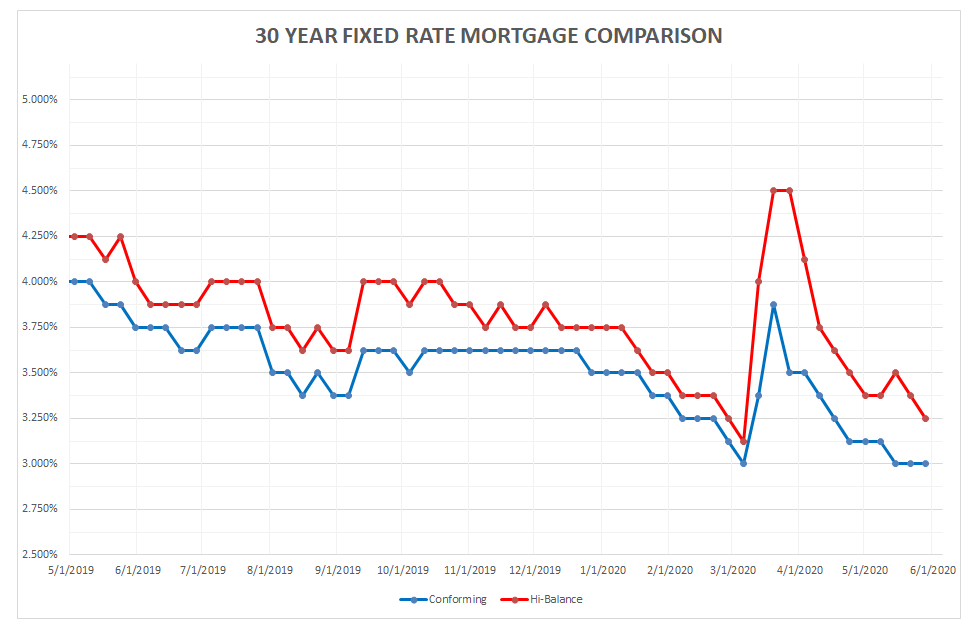
Rates for Friday May 29, 2020: Rates are softer from last Friday, while the 30 conforming fixed is that same as last week, it does have slightly lower costs; the high-balance rate drops for the second week in a row. Note, these rates are for purchase transactions and refinance rates vary greatly depending on many variables for loan amount, loan to value, FICO scores, purpose of loan, etc., call for quotes.
FIXED RATE MORTGAGES AT COST OF 1.25 POINTS LOCKED FOR 45 DAYS:
30 year conforming 3.00% Flat
30 year high-balance conforming 3.25% Down 0.125%
Please note that these are base rates and adjustments may be added for condominiums, refinances, credit scores, loan to value, no impound account and period rate is locked. Rates are based on 20% down with 740 FICO score for purchase mortgages.
How nice it was to spend some time in the chair yesterday talking to my friend Erick as he cut my hair for the first time in ten weeks. Leslie was tire of my shaggy-dog look and was very happy with Erick’s skills returning me to my pre-C-19 somewhat-respectable look. Rumor has it there is a run on hair dyes in salons across the state as bookings for Erick and others in the industry have solid bookings for the next few weeks.
Former client Dennis B. sent an interesting email this morning. The theatre producers (they are called theater producers in the U.S.) in London have agreed to release archive recordings of musicals, plays and shows so we can stream them for free. Great shows from the West End district in London are now available to you, from Lion King to Henry V to Hairspray to Cirque du Soleil are a click away. Certainly they are better options than Tiger King or Cheers re-runs. Here is the link to the London theatre (er) shows that are available to stream. Cheerio!
Have a great week,
Dennis
Past Weekly Rate & Market Updates can be found on my blog page at my website www.DennisCSmith.com/my-blog


