


Why are rates spiking?
Question of the week: Why are rates spiking?
Answer: Heinz ketchup, Carly Simon…actually that is Anticipation, which is being excited about what is coming.
Rates are going up because of expectation, which is a song but not used for a condiment commercial.
As has been discussed many times of the years in the WR&MU, mortgage rates are determined by the open market and the demand for fixed return investments, such as mortgages, bonds and government securities. Mortgages are bought and sold as Mortgage Backed Securities (MBS). Your mortgage is packaged by the lender into a bundle with other mortgages and sold to Fannie Mae or Freddie Mac. Fannie or Freddie packages that bundle with bundles of mortgages from other lenders and sell them as Mortgage Backed Securities. Investors purchase the MBS to have a guaranteed return on their investment, guaranteed because MBS sold by Fannie and Freddie have the backing of the United State Treasury.
If there is a lot of demand for MBS then the prices increase, which results in lower rates. If demand is low then prices decrease, which results in higher rates.
Why would demand for mortgages increase or decrease? Same reason stock prices increase or decrease, investors expect, or anticipate, a future event or economic environment that would impact stocks.
DC Smith Manufacturing Inc manufactures and sells hypodermic needles. The current price for DCSMI is $50 per share. However, deep inside a huge government spending plan on healthcare is language that the DC-30M syringe must be used to deliver a vaccine for measles, mumps and rubella (MMR). Since almost every child born in America receives two MMR vaccines this means that millions of DC-30M hypodermic needles will be used every year until there is a change in government regulations.
As soon as this language is inserted in the spending plan DCSMI sees its stock price jump to $65 per share. When the spending plan passes the House with the mandated use of the DC-30M still in the plan the price jumps to $80 per share, and it jumps to $150 when it passes the Senate with no changes as it is assured to be signed into law.
At this point DC Smith Manufacturing Inc has not sold one more syringe than it had before the spending plan was proposed. So why the tremendous jump in the stock price? The expected sales of millions of DC-30M syringes due to the government requirement guarantees revenue, and profits, for the company for several years. Anticipating higher stock prices because of the higher sales, investor demand for the stock is high, pushing up prices.
A year later there is an issue with the DC-30M that has caused health issue in children injected with the MMR vaccine using the syringe. There is talk of litigation and government hearings. Expecting a change in the government mandate that DC-30M syringes be used to deliver the vaccine investors no longer demand the stock, in fact they look to unload what they have. Prices drop with demand.
Is he going to tell us why rates are going up so fast?
What is the information, or anticipation, that investors see that would cause demand for fixed-income assets to increase or decrease?
In normal economic environments a growing economy results in higher interest rates and a stagnant or shrinking economy results in lower interest rates.
But investors want to react before the economy enters a period of boom or bust, therefore demand for assets that are based on interest rates, such as mortgages, will increase or decrease before the economy grows or shrinks. Through the years regular readers of the WR&MU have read my economic round-up section with notes that some economic data is positive or negative for mortgage rates (denoting lower rates or higher rates). When there is economic data that is positive, such as more people employed, rising prices, economic growth, this is negative for rates as investors expect higher interest rates to result. Because of this they either do not buy, or they sell the fixed-income assets they own. This results in lower prices, which in turn pushes rates higher. Investors leave investment such as mortgages and bonds and purchase stock in private companies who are expected to see increased sales, revenues and profits in a growing economy.
On the flip-side of the economic expectation coin, poor economic news, such as growing unemployment, stagnant prices, little to no economic growth, creates a demand for fixed-income assets as investors look for guaranteed returns and leave the losses they expect to occur in stock markets.
There has been some positive economic news that in normal times would put some upward pressure on mortgage rates, but not positive enough to push rate higher by one-half of one percent (0.500%) in two weeks.
If economic data has not been the primary cause of the rate hike, why have investors walked away from fixed-income assets? Because they expect inflation, they expect economic growth and they expect interest rates to increase—which they are doing as a self-fulfilling prophecy.
What is pushing rates higher is investors seeing the Federal Reserve continuing stimulus from the Fed and major stimulus coming from Congress and the Biden Administration and anticipating economic growth as the country pulls out of the pandemic that is much stronger than previously expected.
Last March Washington pushed $2.2 trillion into the economy for Covid relief. In December another $900 billion was authorized by Congress and signed into existence by Trump. Now there is a $1.9 trillion stimulus package working through Congress. If passed that will be $5 trillion added to the economy in twelve months.
For context, the federal budget in 2019 was $4.448 trillion; this includes all spending, social security, Medicare, military, every federal employee salary, interest on debt, everything. In 2019 the total United States economy was valued at $21.43 trillion; $5 trillion in stimulus money from Washington is equivalent to 23% of our economy in the last full calendar year before the pandemic—and it was a positive economy.
Investors see one additional year’s federal budget, almost 25% of the economy in a very good economic year, being shoved into the economy and they think, “hey, this is a lot of money, it is very likely going to lead to rapid economic growth, rising prices, growing revenues, we should get out of investments paying us 1, 2, 3% and when inflation will likely be that much or higher and buy stocks in companies that will see large profits when the economy bounces out of the pandemic.”
Mathematically, if you are getting a 2% return on an investment that is potentially locked in over 30-years and you expect inflation to exceed 3%, your investment is losing money to inflation. You demand a higher return, ergo demand for higher rates from investors results in higher rates.
Why are interest rates rising, because the expectation in the private sector is that perhaps too much money is leaving Washington, enough so that interest should be, and will be, higher sooner than previously anticipated.
Most investments be they stocks, bonds, mortgages, houses, react to supply and demand. Demand is most often driven by what buyers think will, or expect to, happen that will positively or negatively impact prices. Be it hypodermic needles or residential mortgages. Currently the expectation is higher rates and investors are behaving accordingly.
Have a question? Ask me!
More supply in the fixed-income market this week is not helping to stem the tide of higher rates. The U.S. Treasury sold over $180 billion in debt this week. With investors already looking for higher returns on the supply of MBS and other Treasury debt on the market, the flood of more supply was not interest rate friendly and helped exacerbate the climb in rates.
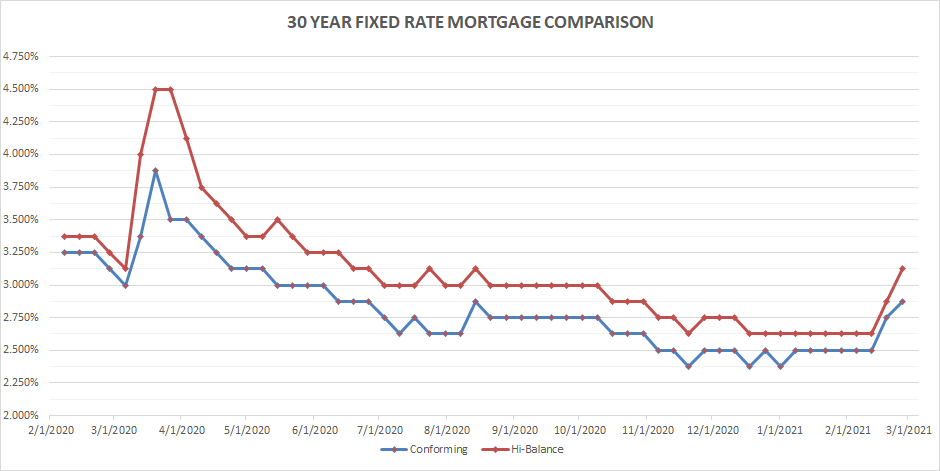
Rates for Friday February 26, 2021: As mentioned in last week’s WR&MU, rates started to climb on Friday February 12th, ahead of the three-day weekend, and continue to climb through the week. This week, rates started off climbing and then stayed relatively flat on Tuesday and Wednesday before spiking again on Thursday. Personal income and spending both climbed in January—almost solely do to a round of stimulus checks hitting American bank accounts has put more upward pressure on rates. Today there has been a slight rally that has checked the rate of increase in rates, not enough to say the upward movement has been halted.
The industry is looking to see if there will be a bounce back down in rates, which will indicate rates jumped too high too quickly. With today’s early trading seeing some retrenching of rates, the true test will be next week’s activities.
FIXED RATE MORTGAGES AT COST OF 1.25 POINTS LOCKED FOR 45 DAYS FOR PURCHASE TRANSACTIONS:
30 year conforming 2.875% Up 0.125%
30 year high-balance conforming 3.125% Up 0.25%
Please note that these are base rates and adjustments may be added for condominiums, refinances, credit scores, loan to value, no impound account and period rate is locked. Rates are based on 20% down with 740 FICO score for purchase mortgages.
I am very excited.
I grew up with baseball games on the radio. My mom was a big baseball fan, specifically the Giants, and when I was growing up (obligatory old-guy statement for younger folks) there were not many games on the television, so there was often a game on the radio in the kitchen. When we lived in Brussels while I was in high school, the Armed Forces Network was always on and we listened to games from across the country.
To this day I love listening to baseball on the radio. Thankfully through sites like Sirius/XM and MLB.com, the home and away teams’ radio broadcasts for every game major league game is available.
My favorite team since 1970 has been the Phillies (my first in-person MLB game a few months after we moved to the Philadelphia era and stayed for about five and a half years). Because of this I tune in on my laptop or phone to as many games as I can. Some people have music for background noise, I have baseball.
When I garden or do chores on the weekend during the season I am listening to a game, if the Phillies are not on, I will find a close game or one that may be of interest. Throughout the season I will listen to almost every team’s radio broadcast team for at least part of a game.
I am excited because this Sunday the Phillies start their spring training season when they take on the Tigers. First pitch 10 a.m. local. Passers by Sunday mid-morning to early afternoon will likely find me doing yard work and listening to the Phils as they start their road to winning the World Series! Hope rings eternal in all baseball fans when spring training starts.
Ring the Bell.
Have a great week,
Dennis
Past Weekly Rate & Market Updates can be found on my blog page at my website www.DennisCSmith.com/my-blog


