

What about mobile homes?
Question of the week: What about mobile homes?
Answer: After reading last week’s WR&MU How can we help our children purchase a home?, weekly reader Leslie (besides wife Leslie, I know a lot of Leslie’s) asked me, (at least think this was the question as we were at Long Beach Rotary President’s Party with a steel band playing in the background) “what do you think about getting a mobile home for our son?”
I replied that it wasn’t a very good time to talk about it because I couldn’t hear very much.
So, Leslie, here is what I think.
I think it is a very good option for those looking for homeownership and priced way out of the market in their current areas.
Television and movies have created a very negative perception of mobile homes in our culture. A joke I tell about my fellow Okies is, “what do a tornado in Oklahoma and a divorce in West Virginia have in common?”
“Some one is losing a mobile home.”
Jokes, and depictions of “tailer trash” neighborhoods filled with dealers, pimps and addicts, aside, Southern California has many mobile home parks in very desirable locations that are clean, safe, and very affordable.
While in common parlance they are called “mobile homes,” in lending and real estate they are manufactured housing.
Manufactured housing comes in different variations. In some areas manufactured homes are the prevalent building style for whole neighborhoods, not in parks but in what could be considered “normal” with driveways, mailboxes at the street, etc.
These are pre-fabricated homes that are either delivered almost fully constructed and then placed and secured onto foundations. In some instances, the pieces of the home are delivered and then put together on site.
For those looking to rebuild after a major fire or other event, manufactured homes can be a much lower cost alternative than traditional home construction. I have been in a few manufactured homes that I did not know they were pre-built until the owners told me. Like mobile homes, there is a negative connotation as to what they are that are not aligned with reality in the overwhelming majority of cases.
For financing manufactured homes, the primary factors in the type of loans available are if the dwelling is permanently attached to a foundation; i.e. not “mobile,” and if the space where the unit is located is leased or owned by the owner of the dwelling.
For those attached with land ownership, many of the loan programs available for traditional homes are available for manufactured housing; Fannie and Freddie, VA, FHA, many jumbo products.
For dwellings in parks with leased land and non-permanent attachment, the unit is considered “chattel.,” for our purposes, mobile homes.
There are lenders that specialize in these loans, which can have higher down payments, shorter loan terms, and higher interest rates. While the total cash to close and monthly payment may be higher for a mobile home versus a traditional home with the same price, because the price is significantly lower, even with the monthly park fee, the cost of ownership can also be significantly lower.
A quick glance at the market shows some mobile homes up to 1400 square feet priced at the mid-$200,000s with the nearest traditional homes for sale in the $900,000 to over $1 million ranges, and condos at $600,000 or over.
Many of the mobile home parks in the region are 55+ (I won’t say “senior”) restricted, making for very affordable housing for those downsizing, retiring to much lower income, or wanting the convenience of less to maintain and a close-knit neighborhood with, in most cases, gated entry.
What about mobile homes? Worth a strong look and putting possibly ingrained prejudices aside to obtain very affordable home ownership.
Have a question? Ask me!
It was quiet in May for retailers as spending dropped 0.9% in May from April, the second month in a row, retail sales declined. With inflation for the month only 0.1%, the drop in units was even more than the 0.9% decline (retail sales calculated in dollars transacted). The decline was led by restaurant sales, down 1% for the month despite Mother’s Day and graduation celebrations, and new auto sales down 3.5%–the biggest drop in car sales in about two years. Much of the drop in auto sales was the spike in March ahead of potential tariffs causing a four year high in sales. The drop in sales is good news for inflation and rates, but perhaps not so great new for the economy as consumer spending accounts for 65-70% of our economy.
No change. That was the news from the Federal Reserve Open Market Committee, the group that determines the Fed’s benchmark interest rate. As expected, the FOMC did not change the rate at its meeting this week, taking a wait and see position for more data on inflation and employment. Which is the tight rope the Fed is walking. If it zeros in on inflation and lowers rates as prices cool further it risks heating up the economy and restarting a new cycle of inflation. If it zeros in on employment and raises rates as unemployment drops to cool a heating up economy it risks pouring water an economy that is not that hot and cause a move towards recession. At this point the consensus among the “experts” has moved from one rate cut in 2025 to two rate cuts totaling 0.5%.
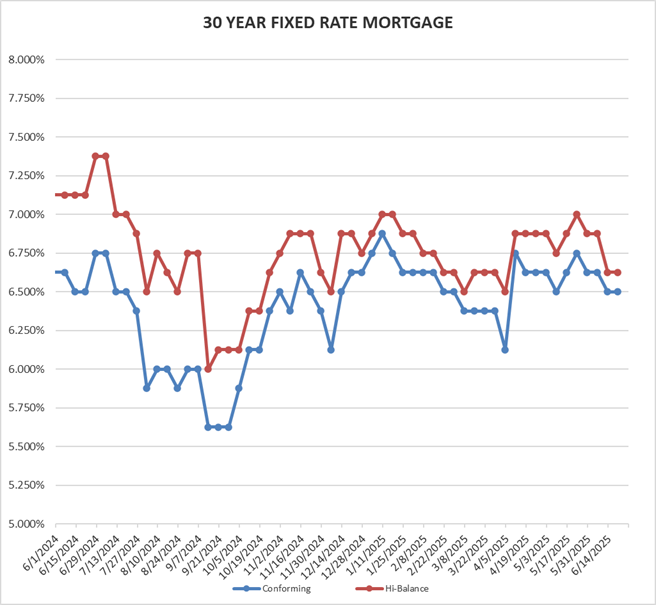
Rates for Friday June 20, 2025: Rates are flat from last week as investors try to not react to the economic and global events to see what is next.
FIXED RATE MORTGAGES AT COST OF 1.25 POINTS LOCKED FOR 45 DAYS FOR PURCHASE TRANSACTIONS:
30-year conforming 6.50% Flat
30-year high-balance conforming 6.625% Flat
Please note that these are base rates and adjustments may be added for condominiums, refinances, credit scores, loan to value, no impound account and period rate is locked for 45 day. Rates are based on 20% down with 740 FICO score for purchase mortgages.
I don’t completely recall the exact circumstances, but I believe that 50 years ago this week, as I was exiting 7th grade and about to become 13, my brother Michael, our neighbor Dick Mackey, myself and maybe another kid or two, road our bikes the four to five miles to the theater at King of Prussia Mall to see the original summer blockbuster, “Jaws.”
I had read the book and was excited to see the movie—which was considerably better for a kid given the presence of the shark throughout not visually, but through John Williams’ simple two-note duuun-dunn….duunn-dunn…dunn-dunn dunn-dunn….
Roy Scheider’s line when utters, “You’re going to need a bigger boat,” after seeing the shark for the first time was an ad lib, and one of the most iconic lines in movie history, still used by many people in many circumstances.
Not sure about you, but I think it is time to re-watch this great movie—last last time being many years ago when girls were in 5th and 7th grade having a sleep over.


