


Should we move to another state?
Question of the week: Should we move to another state?
Answer: This was a question a neighbor said they asked their tax preparer last week. The impetus for the question, of course, was the amount of taxes they were paying to the California Franchise Tax Board.
It is a question that thousands, tens of thousands, of families have asked over the years, and many have answered, “yes.”
Taxes are burdensome in the state with the, or near the, top of all states in individual income tax, sales tax, gas tax, utility taxes, and fees for licensing and registrations for those in the many businesses for which they are required. Ignoring that insurance is not a tax, but due to its necessity is like a tax, even before paying for groceries, clothes, dining out, dry cleaning, etc, Californians pay a lot of their incomes to the State of California, and the various counties and cities charging their own taxes.
So the questions become, would we be better off financially if we moved to another state, can we adjust to wherever that may be in regards to culture, weather, activities and entertainment available and general quality of life, can we leave family and friends we live near (the former may be harder than the latter in some instances)? If the answers are “yes,” the final questions are when and how.
Ignoring the non-financial factors in such a decisions, math can be our friend in determining the basis for getting to yes, or no.
Instead of comparing all the 49 other states (and ignoring Washington D.C. as an option), I looked at the ten states with the lowest personal income tax levels, since the highest amount of taxes most of us pay is income tax. Note that nine of the ten states have no (zero, zip, nada, none) personal income tax.
Besides income tax, I looked at property and sales taxes, to cover the three common taxes for every state. No income tax is a great advantage, but that generally means tax revenue for the state, and counties and cities, are coming from other sources.
One tax that many California transplants are shocked by is the property tax for their new state. The shock is generally not immediate, but builds over the years as only a few states have a Prop 13 type cap on property taxes to prevent extreme increases in the tax as property values grow. Prop 13 caps our property tax increases each year at 2% of the prior year’s taxes, regardless of the increase in value.
Consider the almost 50% increase in property prices we have seen in Southern California over the past six to seven years (see chart in last week’s WR&MU). Because of Prop 13 while your property may have increased in value almost $300,000, your property taxes only increased about twelve-and-a-half percent (12.5%)—if you were paying $5600 per year, your taxes went up to about $6300 per year.
Most states do not have caps on property tax increases, they reassess the property ever year, either using trending statistics or actual value assessments, and adjust property taxes accordingly. If in Nashville you purchased a home in 2020 for $565,000 your property tax to the state (not including county, city taxes, special assessments, etc), the tax would be $2825 per year. Assuming the property increased as the median price in LA County did from 2020 to September 2024, when the median value was $960,400, your property tax would climb to $4800 per year.
Is that enough to make a difference, doubtful since your income tax will go from, likely, almost 10% of your income to 0% of your income.
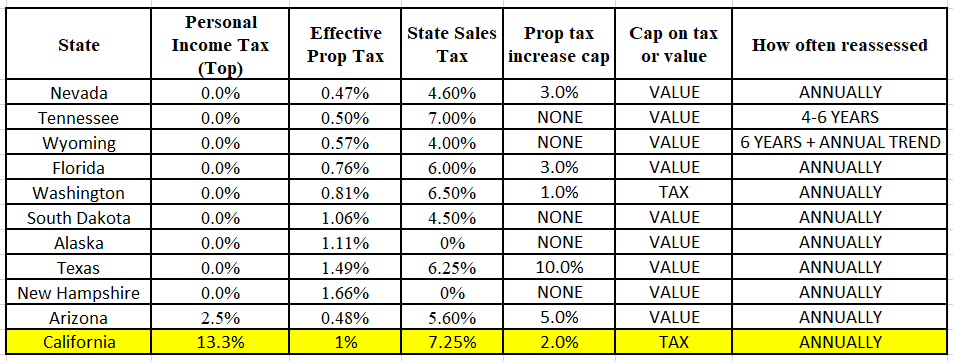
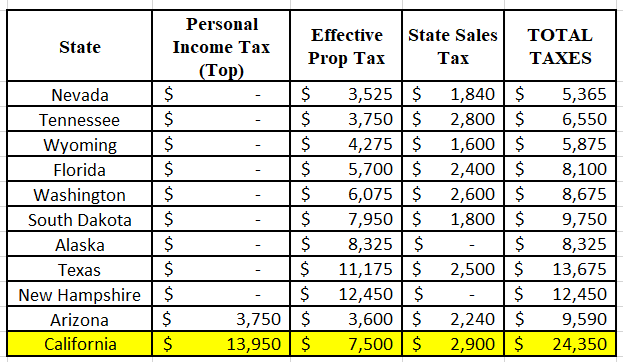
Below are charts that show the taxes the ten states with the lowest personal income rates, with the rates for property and sales taxes; as well as a chart that shows tax calculations based on:
- $150,000 in personal income
- $750,000 property value
- Spending $40,000 per year on taxable transactions
Note that Alaska and New Hampshire are the only states that have no income nor sales taxes.
Based on the tax rates and assumptions I made, the lowest amount of taxes you will pay for states with no income taxes is Nevada. The highest, due to high property taxes, is Texas.
For those who have never lived anywhere but Southern California with its near perfect weather twelve months a year, after year, after year…there are other expenses you may not know about when moving to states with seasons that are distinctly different.
Two of the states with no income tax, Alaska and South Dakota, have very severe winters, others have various degrees of winter, from bitter cold and major snow storms, to very cold, freezing rain and fog. Winter has costs that come to bear on your household. Winter clothing, storm windows, snow tires, salted roads eroding car parts, cost to clear snow and ice, heating costs—often oil, and other “winterizing” actions add costs that we are fortunate not to bear in our Mediterranean climate.
Quality of life, weather, friends, family, how you spend leisure and entertainment time, cannot be assigned monetary values, they do have psychological and emotional values that would need to be weighted against the financial savings you may benefit from a move to another state.
IMPORTANT NOT REGARDING RELOCATING!
For the several times relocating to different states has been a topic in the WR&MU, a strong bit of advice has been included: unless you have to, do not sell your current California home for at least one, and preferably two or more, years after you move.
You may have visited your new state and area several times over the years and think you know all you need to know about living there, but until you spend all day every day through every season you do not really know as much as you may need to. Take the above information about costs due to weather, have you lived through a major winter storm, a spring storm with severe thunderstorms, tornado warnings/sightings, 95% humidity, and the costs to endure the weather conditions? Visting an area is a lot different than living there. Shopping, entertainment, neighborhoods, religious centers, schools, medical care, are all factors you learn more about the longer you live there.
If you sell your home, move to Other State, relish that you can purchase the same, or bigger/better, home for less than what you sold your home for, and will be saving money on taxes and other expenses, your ability to return to California and buy a similar home that you sold will likely be very difficult, and expensive.
You purchased your home in 2000 after the crash with three kids in elementary school, for $400,000. One of your children has children and moved to Other State a few years ago.
You sell your home for $1.1 million and purchase your new home near your child for $500,000, with no mortgage. You have retired and your income is social security, retirement savings, and of course the “windfall” from the sale of your home.
It’s not working for you. You miss your friends, the weather is more than you expected, for major medical care you have travel and hour each way, you feel like you just don’t fit in.
A home in the neighborhood you sold in will cost $1.2 million. You have funds for down payment, but that reduces funds you were counting on for retirement. You cannot qualify for a conventional mortgage, but you can buy using a reverse mortgage with a large down payment. Adding to the issues, your property tax bill when you sold was $6,000 per year due to Prop 13, for the new home the bill is $21,000 per year with the assessments added to the base tax.
If you had not sold your home, and rented it out, earning some additional income, and rented when you first moved, if you want to move back you can and it will only cost you moving costs, and carpet, paint, etc after your tenants move. As well, you retain your property tax base.
Keep in mind, if you move to Other State and really like it, you can sell your home in California and buy a new home, or pay off any mortgage you may have, at a later date. Note: be in touch with your tax preparer to make sure you are within the time frame that enables you to sell your California home and retain your capital gains exclusion (must live in home two of the previous five years).
If you are considering relocating to Other State, call me to run your scenarios and options—we are licensed in most states.
To schedule an initial meeting by phone or Zoom, click here for my calendar, please feel free to forward to a friend or family member!
Have a question? Ask me!
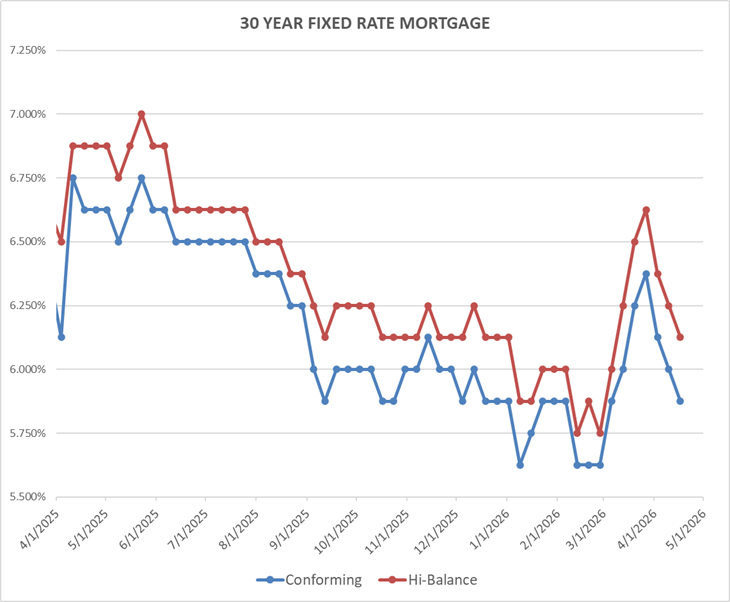
Rates for Friday April 17, 2026: Not a lot of rate moving data this week, we see rates drop for the third straight week.
FIXED RATE MORTGAGES AT COST OF 1.25 POINTS LOCKED FOR 45 DAYS FOR PURCHASE TRANSACTIONS:
30-year conforming 6.00% Down 0.125%
30-year high-balance conforming 6.25% Down 0.125%
Please note that these are base rates and adjustments may be added for condominiums, refinances, credit scores, loan to value, no impound account and period rate is locked. Rates are based on 20% down with 740 FICO score for purchase mortgages.
Long time readers of the WR&MU know that I am an avid reader and an amateur American history buff. Being the month of April, I am reminded of an excellent book by Jay Wink, April 1865: The Month That Saved America.
Since reading the book several years ago, I have become very observant, perhaps too much so, as to the number of major historical events that have occurred in the month of April. Besides those detailed in April 1865, in no particular order:
- The first battles of the Revolutionary and Civil Wars
- NATO was created
- First modern Olympic games
- Martin Luther King assassinated
- The Pony Express began
- First handheld mobile phone call
- The Titantic sank on its maiden voyage
- Thomas Jefferson, William Shakespeare, Leonardo da Vinci, were born
- Apollo 13 launched
- The internet was born
- The 1906 San Francisco earthquake struck
I got a bit caught up in making my list—there are many other events that I find fascinating, but in deference to your time and patience I shall refrain from continuing the list!
Dennis


