

Do we need Prop 45?
Question of the week: Do we need Prop 45?
Answer: The last two Fridays we asked and answered Do we need Prop 37, and Do we need Prop 1? Both of the propositions are written to entice voter approval for more spending and regulations for “affordable” housing, and, in this writer’s opinion, neither proposition will have the intended results and we encouraged a “No” vote.
Proposition 45 is officially titled the “Expedited Environmental Review Process for Certain Projects Initiative.” If passed it will change the California Environmental Quality Act (CEQA) and permit streamlining of certain projects. Deemed “essential projects,” those impacted with include building projects for housing, clean energy, water supply, transportation, medical facilities, education infrastructure, wildfire risk reduction, and broadband internet access.
If Prop 45 does not pass the existing procedures and policies will remain in place for construction in the state.
As discussed in the WR&MU links above, and in earlier WR&MU’s Why isn’t more housing being built? and More costs that limit new housing construction… building new housing in the State of California is a large barrier to new construction, CEQA plays a fairly significant part in creating some, a lot, of those barriers.
The main results of the proposition, if passed, is that it accelerates construction for housing and infrastructure by enforcing strict timelines for public agencies and courts to complete environmental reviews and resolve legal challenges, thereby reducing the delays, which can take years, decades, that are too inherent in construction of major housing developments, water projects, renewable energy infrastructure and distribution and development of transit lines.
Time is money, and by reducing the amount of time it takes from plans to completion costs are exponentially lower for developers. Filing lawsuits and appeals to courts and bureaucratic departments are a primary tactic to slow down projects; with the hope the expenses and delays will ultimately kill developments.
Prop 45 will result in targeted remediation instead of wholesale cessation of development. Under the new policies put in place by Prop 45, if a court finds a CEQA violation in a project, the court can only halt the non-compliant portion of the project, whereas current law allows the court to shut down the entire project. This avoids cancelling a full project over local disputes and enables construction to continue within the guidelines of the court and CEQA ruling for a specific issue being eliminated or remediated.
Very importantly, and used as an argument against Prop 45, is that the proposition maintains existing state environmental quality regulations. Developers will be required to comply with existing environmental standards, these are not in any way amended or cancelled by the measure, what is changed is the administrative and litigation timelines that are so costly, and project killing, in the current system.
There will be higher costs for government agencies and the courts as they have to create frameworks for the expedited decision processes. However, will those administrative costs outweigh the savings, and benefits, for completing essential projects?
Opponents of the proposition are claiming that passing Prop 45 will open the door to unscrupulous development with loopholes and backroom deals (which by the way have been going on since the Pyramids—look at the number of elected officials and government administrators convicted every year for project approvals).
Another argument is that expedited court and admirative decisions will limit the ability of local communities and advocacy groups to evaluate potential hazard and provide public comments. The current system has no limit on how long opponents of any project can bring claims and issues, often delaying with one issue after another so each is taken individually, purposefully dragging out review processes and decisions, rather than presenting a list of issues at one time.
Ironically, opponents are stating the court and administrative costs will potentially exceed $100 million annually to process applications and litigation on expedited schedules. Missing from this argument is how quickly the state and local governments will receive revenue and benefits from the completed projects, and for public projects that are expedited under Prop 45, the reduction in costs to taxpayers.
As you have already deduced, the answer to our question, “do we need Prop 45” is an emphatic “Yes.”
Have a question? Ask me!
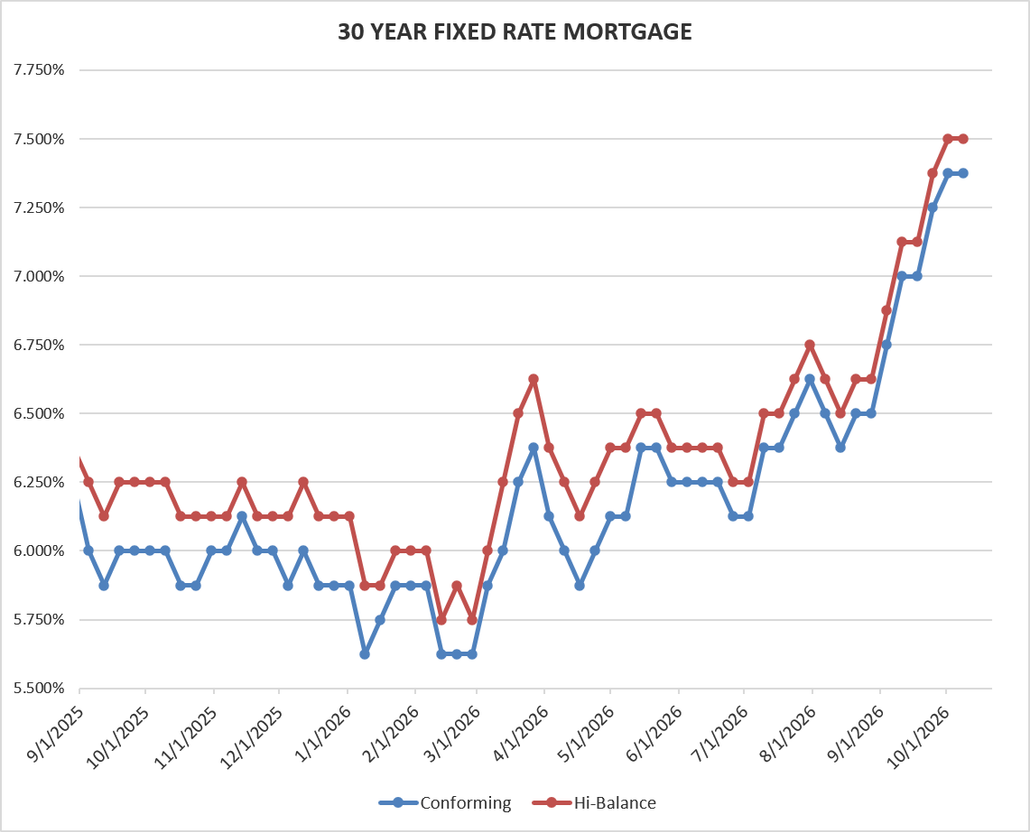
Rates for Friday October 9, 2026: Phew! We have a Friday where rates are the same as the week before. Is this a signal that rates will stay flat, possibly drop?, in the near future? That is the trillion dollar question.
FIXED RATE MORTGAGES AT COST OF 1.25 POINTS LOCKED FOR 45 DAYS FOR PURCHASE TRANSACTIONS:
30-year conforming 7.375% Flat
30-year high-balance conforming 7.50% Flat
Please note that these are base rates and adjustments may be added for condominiums, refinances, credit scores, loan to value, no impound account and period rate is locked. Rates are based on 20% down with 740 FICO score for purchase mortgages.
I appreciate the inquiries and conversations the series on ballot propositions have generated. It is always dicey putting out opinions and recommendations on ballots, however since the three propositions covered directly impact housing I feel it is important to provide my opinion.
For those that care, note that Prop 45 is one of only four of the thirteen (!!) propositions on the ballot which I will be voting for, the other nine get an emphatic no. The four are 41, 42, 43, which limit ability for state and local government’s ability to increase taxes, and of course 45.
Study, research, consider implications, vote!


