

Is 2% inflation a reasonable goal?
Question of the week: Is 2% inflation a reasonable goal?
Answer: This week’s question comes from an interesting conversation I had with a few friends, my age (63) who have, like me, closely followed economics, politics, and have a pretty good historical knowledge base.
In January 2012, the Federal Reserve under Chairman Ben Bernanke explicitly stated that the Fed’s objective was 2% inflation (using the Personal Consumption Expenditures index, PCE) for the economy. Prior to this the Fed saw 2% or below as a desired rate of inflation but not a hard target.
The mission of the Fed is to support maximum employment, stable prices and moderate long-term interest rates, referred to as the “dual mandate.”
Historically, meaning prior to, up to, and a bit beyond my 1984 graduation with a degree in economics, the relationship between inflation and employment have an inverse relationship; i.e. lower employment drives up price as employers must pay higher wages which results in them charging more for their goods and services. Higher inflation results in fewer sales which leads to higher unemployment.
With this in mind, the Fed’s dual mandate is a balancing act of the highest employment that can be achieved in the economy with the lowest amount of inflation.
With that in mind, is 2% the right target for “maximum” employment?
This may get a bit wonky, as long time WR&MU readers are used to. Note that “nominal” rates, prices, etc are the actual price, rate, etc; “real” rates, prices, etc are adjusted for inflation. If a wage increase is from $10 to $11, that is a 10% nominal increase; if inflation is 2%, the real increase is decreased by 2%, so 7.84%. Confusing but “nominal” is the real price and “real” is the adjusted for inflation price.
There are several arguments for the “hard” target of 2% inflation. It anchors expectations. A defined target, in theory, enables businesses, households, and governments, to make plans for the long-term. Negotiations for wage increases can, should, center around the 2% target. If the 2% target is trusted, or believable, the expectations for higher prices are reduced, which decreases chances of spiraling costs.
Inflation does not just increase current prices, it also erodes value for savers, retirees and investing in fixed incomes. If $100 today is worth $82 in ten years at 2% inflation, that slow erosion of value is manageable; at 5% inflation, $100 is worth $61 in 2036.
The 2% rate is believed to be high enough to avoid deflation risk (falling prices), in which case consumer delay spending, debt costs are higher in real terms, and risk of long-term recession or depression.
As with 2% being the right target, the are several arguments that the 2% target may be too low.
One argument is that a hard 2% target is too restrictive, it requires nominal rates to be lower, and limits how far the Fed can cut rates during recessions. The lack of flexibility on downturns necessitates other actions by the Fed to drive economic growth, which have consequences in the future. If it lowers its benchmark rate to zero, which creates subsequent issues for growth, as it did between December 2008 to December 2015 and from March 2020 to March 2022.
Since the pandemic, we have seen fewer cheap imports, labor shortages in some industries and abundance in others, an aging population with many retiring younger than in past years due to explosion of growth in wealth and personal assets, and energy costs pushing prices up for all goods and services. Pushing a hard target against these forces creates false expectations for outcomes and future costs and rates of return; i.e. investors and markets anticipating moves to get to 2% inflation when several forces/influences are extremely resistant.
Government spending and debt decisions are independent of Fed policy and actions. What does happen, is the Fed reacts to these decisions and their consequences.
Government spending, and resulting borrowing, pumps money into the economy that is “empty.” Yes, it creates employment in the private and government sectors, and purchases of goods and services from the private sector. But…every dollar the government spends is either paid for with taxes from the private sector (government employees tax payments ultimate are derived from the private sector), printing money, or borrowing money. Adding money to an economy creates inflation as more cash is available to chase the same goods and services. The national debt is closing in on $40 Trillion, for fiscal 2025, the federal government collected $5.23 Trillion and spent $7.01 Trillion (I capitalize Trillion on purpose, many people have a hard time fathoming the size of the number).
Back to “other actions” the Fed must take to stimulate the economy if its benchmark rate is at zero. Adding money to the economy stimulates it, more money to spend, more money spent, more goods and services purchase, more companies and businesses hiring workers, who have more money to spend… The action to take is to purchase debt; which since the Great Recession began in 2008 involved purchasing mortgages and U.S. Treasury debt to lower rates in those markets. Once that money is in the economy, the only way it slows growth is growing inflation reducing spending and borrowing power.
For the past two years, PCE has been between 2.6-2.9% (core rate taking out volatile fuel and food costs has been from 4% to 2.6% up to 3.0% as the price of oil has gone up and down and up). During that period the Fed was lowering its benchmark rate as inflation cooled.
The cost to the economy to push inflation down that final one- to a half-percent can be very costly in terms of higher employment, slower growth and even higher borrowing costs. The cost to go lower may be more than the benefit of getting there.
My opinion is that the 2% target is too low, or instead of a hard target, the 2% value should be a value to trend towards enabling flexibility to make decisions.
Mortgage rates have been dropping, slowly, since they peaked in 2024 and 2025 (after spiking due to inflation caused in large part—soft terminology—due to excessive and unnecessary government spending). The decline in mortgage rates has been much lower than the drop in the Fed’s benchmark interest rate, and looking forward, this is likely the case for the rest of 2026 and into 2027, absent an event that creates a recession or major economic event, such as the pandemic.
For those planning for future home purchase or refinance, my advice is to do so based on rates between 5.5% to 6.00%–I hope I am wrong and we see rates between 5.0-5.5%, but my tea leaves are not lining up that way.
Positive, not positive, however, as demand slows and supply increases, housing prices should slow, likely decline, off-setting the current rate environment and what it has done to affordability.
To schedule an initial meeting by phone or Zoom, click here for my calendar, please feel free to forward to a friend or family member!
Have a question? Ask me!
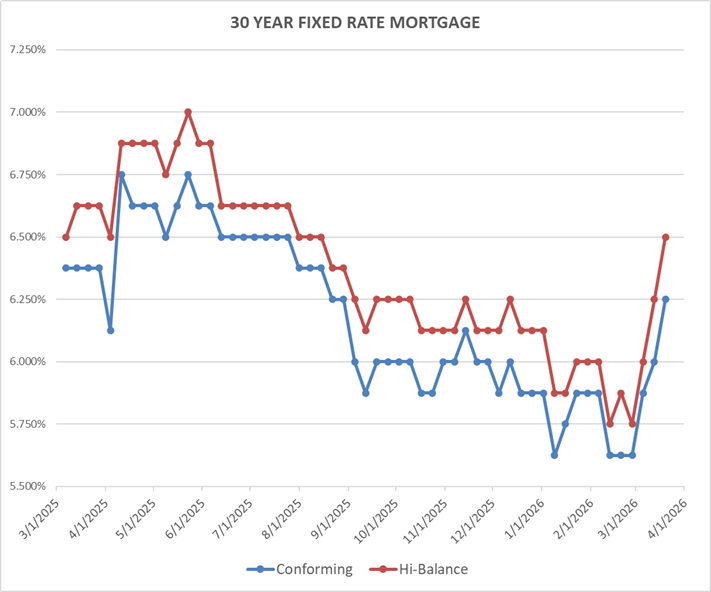
Rates for Friday March 20, 2026: As expected the Fed held its benchmark rate steady at its meeting on Wednesday. In comments post-announcement, the chances of a rate cut this year is looking a lot less likely than it did coming into the year due to concerns of inflation rising due to higher oil prices moving through local, national and global economies. Rates have their highest one week jump since last April when President Trump announced his tariff agenda. The conforming rate is at its highest since last August.
FIXED RATE MORTGAGES AT COST OF 1.25 POINTS LOCKED FOR 45 DAYS FOR PURCHASE TRANSACTIONS:
30-year conforming 6.25% Up 0.375%
30-year high-balance conforming 6.50% Up 0.375%
Please note that these are base rates and adjustments may be added for condominiums, refinances, credit scores, loan to value, no impound account and period rate is locked. Rates are based on 20% down with 740 FICO score for purchase mortgages.
For many years I loved the NCAA March Madness basketball tournament for the games, the trips to Las Vegas, trying to beat my friends in our annual pool. For the past several years, decades?, my enjoyment comes from not only the games and competition, but the guaranteed connection with friends from across the country at least once a year.
In college we started our first pool on the tournament, when there were 48 teams. After we graduated, my friends would mail their brackets to me, with the post mark having to be the day before the first games. I would make copies of everyone’s picks and mail them out so they could keep track. At that time the five of us in the pool would see each other somewhat regularly and depending on timing some, or all, of us would get together to watch games.
Fast forward to fax machines and getting and sending brackets and updates, and moving time stamp to before first tip-off of first game. As well, growth in disposable income resulting in annual trip to Las Vegas for the first rounds, before it became too crowded.
Now, forty-years after we first started our little game, we are married, have kids out of college, and have grown to seven players in six states and unfortunately gather mostly for weddings and funerals. Of the seven, four are original members and the two were added to replace two who have passed away.
Watching Georgetown throw away the ball with seconds left in the 1982 final after freshman Michael Jordan hit the shot to put his North Carolina Tarheels in a dorm room in Claremont, California, I had no idea how much the tournament would mean to me through the years, keeping me connected to many of the people watching and yelling with me.
For those interested my Final Four is Michigan State, Houston, Arkansas; then Houston beating Arkansas in the finals. My records of our pool going back to 1995 show that I am the biggest overall loser…but given what the tournament brings together, am I really losing?


