


Is rate drop a blip or a trend?
Question of the week: Is the drop in rates a blip or a trend?
Answer: I think it is more of the latter than the former; but that does not mean that there will not be some spikes with higher rates during the trend.
Before we look at what has happened this week that has resulted fastest drop in the conforming rate since the outset of the pandemic, a light pat on the back.
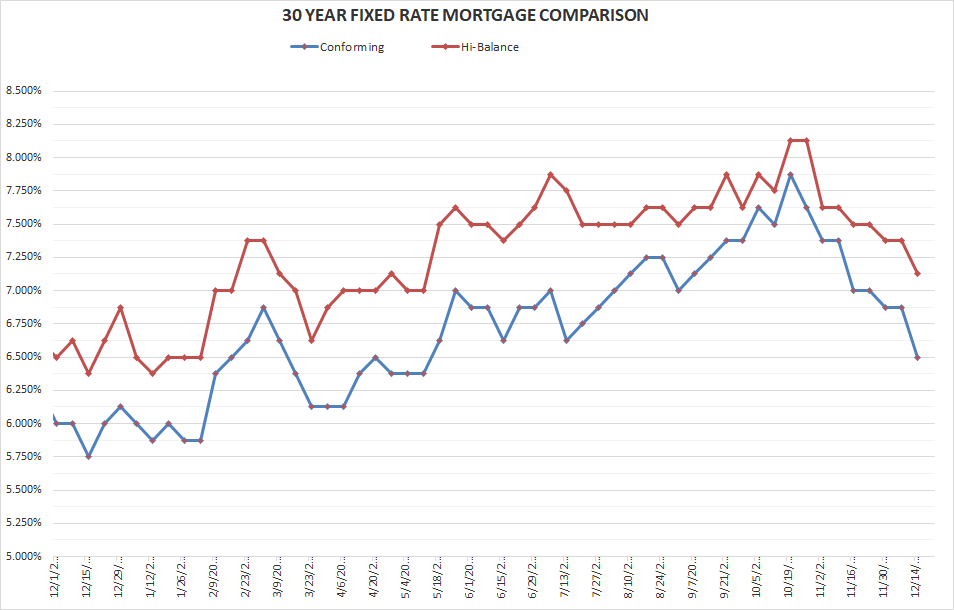
The QoW for August 25th was, “When will rates go down?” After my typically verbose explanation of what was happening, I wrote that rates should be between 6.75% to 7.00% at the end of the year. With two weeks to go I was close, but currently on the high-side as you can see below that our 30-year fixed rate conforming rate is 6.50% this Friday.
For the second time in the past five weeks the conforming rate dropped 0.375% (three-eighths of one-percent) from Friday to Friday. As well, the rate drop from 7.875% on October 20th to 6.50% today is the fastest rate drop quoting the same rate parameters (conforming loan amount, 20% down, 740 credit score, cost 1.25 points) in my records going back to 2005.
How did we get here so fast?
Rates have been dropping since their peak on October 20th, when they had jumped 0.375% from the Friday before.
As related in each Friday’s WR&MU, cooling inflation, cooling job markets, cooling consumer spending, and comments from the Federal Reserve, all created momentum for rates to slowly, and steadily, drop.
Investors are mostly data driven. They collect economic and market data, use that to form an idea of where the market(s) may be going and buy or sell based on that data and their interpretation of what the price of what they are buying or selling will be in the future.
Historically, the rules are that good economic data pushes stock prices and interest rates up, poor economic data pushes prices and rates down. Key word, historically.
This past week the consumer price index for November was released that showed all prices in the CPI increased a very modest 0.1% in November—good news for rates as it showed inflation cooling and supported the Fed holding steady on rates, possibly putting a rate decrease on the table in the future.
Digging further into the data we saw that the “core” rate, food and gas prices are stripped from the index, showed that prices jumped 0.3% for the month. The core rate is the focus of the Federal Reserve when making decisions on interest rates, because of this the sharp increase was not good news for lower rates.
On a year-to-year basis inflation ticked down to 3.1% from 3.2% in October, however core rate remained at 4%, a level that CPI has had difficulty dropping below. This sticking point at 4% is concerning as the Fed’s target rate for inflation is 2%; if the rate stays this high how long will the Fed hold off on another rate increase?
On Tuesday the sentiment was not interest rate friendly, but investors made no major moves waiting for Wednesday to learn what the action, if any, the Federal Reserve Open Market Committee (FOMC—the body that decides on the Fed’s rate moves) will take on interest rates; and more importantly what comments come out of their meeting regarding future action, or inaction.
The initial news was that the Fed was standing pat, no increase interest rates. In September the speculation, fed by the Fed, was possibly two more rate increases in 2023; here we are at the last meeting of the FOMC and there were no increases from September on. Also in the release was that the Fed was penciling in three rate cuts in 2024, up from the two cuts previously considered. That pushed stock and bond prices higher (lower rates).
Then Fed Chairman Jerome Powell had his press conference. While stating that the Fed still holds the line to increase rates if economic data shows the economy is not responding to higher rates in the markets, he said that the Fed feels that it is likely we are at or near the top rates for their current cycle of quantitative tightening.
Very importantly, and what really pushed markets and the plummet in rates, was his confirmation of possible rate cuts, “the question of when it will be appropriate to begin dialing back the policy restraint was a discussion for us at our meeting today.” Translation for “dialing back the policy restraint” means “cutting rates.”
These 30-45 minutes on Wednesday caused investors to completely ignore the strong economic data from the day before. So strong was the sentiment that the Fed will be dropping rates in the near term that it over-rode the economic news from Thursday as well.
After staying away from retail purchases in October, when sales dropped 0.1%, consumers were back in force in November. Overall sales were up 0.3% from October, held down by lower sales for gasoline and cars*. Taking cars and gas out of the data and sales shot up 0.6% from the prior month. A big part of the jump came at bars and restaurants, sales up 1.6% in November and up 11% since last year—almost three times the rate of inflation. *Retail sales are actual dollars spent not units sold so inflation impacts the data.
This news following Tuesday’s inflation data, should have pushed rates higher that last Friday—were it not for the Federal Reserve non-action and comments on future rates.
Looking forward, the downward trend in rates should continue into next year, perhaps through the 1st quarter. The markets have already priced in a Fed rate cut in March, making rates a bit stickier in coming down.
The danger ahead is if inflation climbs and the Fed sees the need to intervene with another, more, rate increase(s). Inflation is sticky, the economy is strong, consumers are spending money showing they are not worried about the economy or their future paychecks. The Fed is willing to let these factors play out to see if they can achieve a “soft landing” as inflation cools—have inflation drop without the economy going into recession and unemployment spiking.
In the meantime, how low will rates need to go before current homeowners loosen up the markets by deciding it is time for them to sell their current homes and buy up, or down. Is 6.5% low enough?
The four-year run, kicked off by the pandemic, of “interesting” years will continue in the rate and real estate markets in 2024.
To schedule an initial meeting by phone or Zoom, click here for my calendar, please feel free to forward to a friend or family member!
Have a question? Ask me!
Rates for Friday December 15, 2023: As mentioned above, conforming rates are down 0.375% from last Friday, the high-balance rate is a bit stickier, down 0.25%
FIXED RATE MORTGAGES AT COST OF 1.25 POINTS LOCKED FOR 45 DAYS FOR PURCHASE TRANSACTIONS:
30-year conforming 6.50% Down 0.375%
30-year high-balance conforming 7.125% Down 0.125%
Please note that these are base rates and adjustments may be added for condominiums, refinances, credit scores, loan to value, no impound account and period rate is locked. Rates are based on 20% down with 740 FICO score for purchase mortgages.
Our holiday season kicks off tomorrow when our youngest comes home for four weeks before returning to New York to start her senior year. Her working sister comes home next Saturday for a week, putting the family together. The best presents parents can receive.
Have a great week,
Dennis
Past Weekly Rate & Market Updates can be found on my blog page at my website www.DennisCSmith.com/my-blog


