
What is a lease-option and can it benefit me?
FOR THOSE LOOKING FOR THE WR&MU ON FRIDAY, APOLOGIES, TECHNOLOGICAL ISSUES DELAYED GETTING IT OUT.
Question of the week: What is a lease-option and can I benefit?
Answer: With interest rates going up, property value increases looking to slow down, changes in tax regulations, lease-options may be coming back to the real estate industry.
What is a lease option? When a property owner enters a lease with a tenant that includes an option for the tenant to purchase the property at a later date for an agreed upon price.
Example, Larry and Mollie own a property at 1234 Main Street. Matt and Loara want to purchase the property but not sure if Matt’s job will not transfer him in the next six months. The two couples agree that in six months Matt and Loara have an option to purchase the property for $700,000 and this option will expire in twelve months. In the mean time they agree to pay $3500 towards rent and a $15,000 fee for the option. If they exercise the option the fee will be credited to the purchase, if they decline the option, i.e. Matt’s employer transfers him, the fee is forfeited to Larry and Mollie.
Why would either party do this? In part, they are each hedging the future market.
Larry and Mollie are locking in a sales price on their property in an uncertain market, and receiving income during the option period. If values are flat or decline, they have a contract for the current value. If values do and Matt and Loara decide not to exercise the option they receive $15,000 to partially compensate for the decline in value. If property values increase, they have received at least $18,000 in rent to partially compensate for the value increase.
Matt and Loara benefit from locking in a sales price for the home as well as securing a place to live. The $15,000 fee will benefit them if they exercise the option in the six-to-twelve-month period if prices have remained the same or increased. If Matt is not transferred and property values have dropped they can weight the cost-benefit of what the value of the property is at that time versus the $700,000 contract, the $15,000 they will lose if they do not exercise the option and other properties on the market. If Matt is transferred and they cannot exercise the option, thereby losing the $15,000 fee, the premium they paid for the potential of securing homeownership at a known price.
All the variables above are negotiable, option fee, time frame to exercise option, obviously the price, and the rent.
One clause that we have seen added to lease-option contracts over the years has a credit from rent payments towards the purchase price, which can create problems when it comes to loan approval when the option is exercised. For instance, in the above scenario, Larry & Mollie credit $750 each month towards the purchase price until the option is exercised. If the option is exercised in six months the credit would be $4500.
Underwriting guidelines will only allow credit from monthly rent payments that are in excess of market rents, and will require a rental survey as part of the appraisal to show what market rents are for the property. In our above example, the $750 per month towards the purchase price can be a credit if market rents are $2750 per month ($3500-750); if market rents are $3000, guidelines would allow a $500 per month credit.
More often than not, lease option transactions result in a re-negotiation during the option period if property values have declined below the contract sales price. Factoring in the option fee, rents paid, current market value, interest rates, the tenant may be in a position to request a lower sales price and risk the loss of the fee, and the property owner may be willing to accept a reduced price instead of the option fee.
Lease options have always been rare in the marketplace, but in some market conditions they are less rare than normal.
Have a question? Ask me!
Words matter. It appeared that mortgage rates were leveling off earlier in the week. Then in a presentation at the University of Missouri yesterday, the President of the St. Louis Federal Reserve Bank, James Bullard, said that he would like to see the Fed increase its benchmark interest rate by three percentage points by the end of the year. Boom.
In response to the Covid-19 pandemic and crashing economy with the government shut down of businesses, the Fed lowered its benchmark rate to near zero, and began buying mortgages and U.S. Treasury debt (known as quantitative easing) to push rates down. Towards the end of last year the Fed acknowledged that with employment firming up and inflation entering the economy it would increase its rate through 2022. In March the rate was increased 0.25%. The expectation was more rate increases this year, for perhaps 1.5 to 1.75% total.
As has been mentioned many times in the WR&MU, investors react on what they think will happen. When the Fed raised the rate in March there was little reaction in the mortgage markets because the increase had been priced in. In recent weeks it appeared that the Fed would increase its rate in May by 0.50% instead of the traditional increase of 0.25%, and mortgage rates rose.
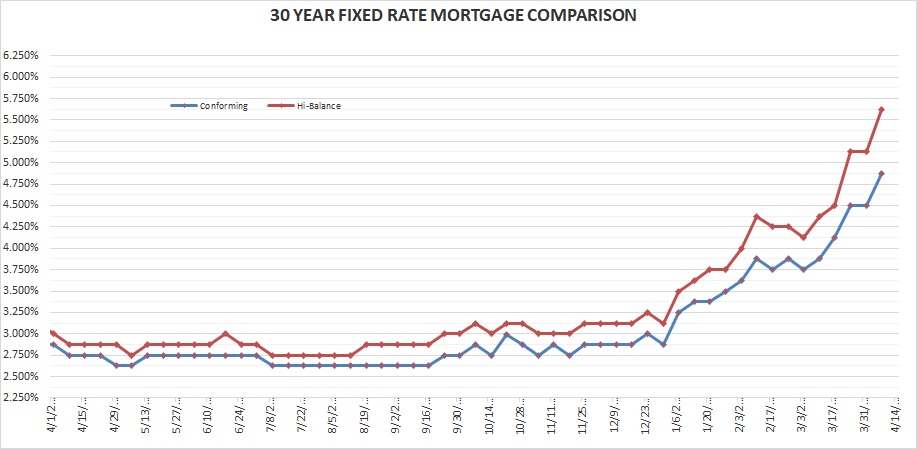
Hearing the President of a Federal Reserve Bank state publicly that he wants the rate to increase by 3% in the remaining nine months of the year, investors reacted accordingly and sold bonds and mortgages. As a result, we have seen rates jump from Friday to Friday by the most since March 2020, and rates to be the highest they have been since the summer of 2009.
Rates for Friday April 8, 2022: Rates go up on rockets and float down on feathers. The immediate impact of this spike in rates will be a slow down in home sales as buyers recalibrate their qualifying ability, and proposed monthly payments based on the new rates.
FIXED RATE MORTGAGES AT COST OF 1.25 POINTS LOCKED FOR 45 DAYS FOR PURCHASE TRANSACTIONS:
30-year conforming 4.875% Up 0.375%
30-year high-balance conforming 5.625% Up 0.50%
Please note that these are base rates and adjustments may be added for condominiums, refinances, credit scores, loan to value, no impound account and period rate is locked. Rates are based on 20% down with 740 FICO score for purchase mortgages.
Great weekend to be a couch potato with major league baseball starting and The Masters with Tiger in the hunt. Also a great weekend to adventure out, especially if you like motorsports with the Grand Prix running in Long Beach, with qualifying on Saturday and races on Sunday—not to mention the events, booths and food surrounding the event.
It being April, I am extremely optimistic (delusional?) that this is the season that the Phillies will not only win their division, but make it to the World Series. Hope springs eternal for Phillies phan in April…reality usually sets in by June.
Have a great week,
Dennis
Past Weekly Rate & Market Updates can be found on my blog page at my website www.DennisCSmith.com/my-blog