


Is it harder to get a mortgage today than a few months ago?
Question of the week: Is it harder to get a mortgage today than a few months ago?
Answer: It depends on your definition of “harder.”
Fundamentally nothing has changed in mortgage approvals for traditional mortgages since the passage of the Dodd-Frank Act that was passed in 2010. Borrowers must show an ability to repay their mortgage, i.e. show income that supports a monthly payment. Borrowers must have credit history that shows timely payments and obligations that are such that they can support their new monthly housing payment, i.e. have decent credit scores and debt-to-income ratios below 43-50% depending on mortgage product. Borrowers must have sufficient assets for down payment and closing costs and reserves if required for the applied for program.
Income, credit, cash, the three legs to the mortgage approval stool need to be verifiable. That has not changed.
What has changed? Income verification. Especially for self-employed borrowers.
Two months ago, income verification essentially happened twice, when the file was being put together in processing for submitting to underwriting and again before the loan is funded.
In the first step, verification depends on type of income being verified. For the vast majority of applicants who have hourly or salaried jobs we use recent paystubs and W2’s, for self-employed we use tax returns.
In the second step, before we can fund a mortgage, we need to confirm the applicant is still working and being paid. This is mainly for W2 earners, and we call the employer and verify the client is still on the payroll.
That was two months ago. Today, due to the ever-increasing numbers of workers being laid off and furloughed, there is an additional verification. As well, most lenders are requiring third-party verification for self-employed borrowers.
The first verification is the same as before, we verify proof of income using paystubs, W2s, tax returns, etc. during processing. The second verification is before loan documents are drawn, why draw loan documents if a borrower is no longer employed and cannot show income sufficient to repay the mortgage? The third verification is right before the loan is funded, usually the same day.
Why the duplication of verification between drawing loan documents and funding? For refinances in California it might be as long as a week between when loan documents are drawn and when a loan can fund due to mandatory three-day rescission period. Let’s say your refinance loan documents are drawn on Tuesday. Your employment verification was completed the day before on Monday. You sign the loan documents on Tuesday, and we have to wait three days before we can fund your mortgage. Wednesday, Thursday and Friday pass, so we are set to fund your mortgage on Monday. One week has passed since the last employment verification. On Friday the company announced that it was cutting everyone’s hours or income by 20% to avoid layoffs. We call to verify employment, ask if you are still employed and if there have been any changes to your income. The answer is yes, we now need to recalculate your income, determine if you still qualify, and go back to underwriting for an updated approval.
For self-employed individuals verifying that income is still consistent and at the same rate as the income used to qualify you for the mortgage. How is this done? There are a variety of methods. Some lenders are asking for most recent bank statements and daily transactions showing deposits for your business that are consistent with the income on the application. Other methods of self-employed income verification are requiring a letter by your CPA or tax-preparer stating your income is consistent with the application, copies of invoices to clients showing you are actively billing and, in some cases, accompanying letters from the clients stating your are actively engaged in business. Every lender has a slightly different requirement, some more strict than others, for self-employed income verifications right before funding.
All lenders are requiring some form of attestation by borrowers stating that their income has not changed since their mortgage application.
The challenging on our side of the transaction, the origination and funding side, is that seemingly daily we are being presented with new forms for borrowers to complete, and/or with new guidelines that are added by lenders that result in new conditions for the borrower to meet after we have been given loan approval and a clear-to-close (when we can draw loan docs).
This is what is making loans harder to get from application to funding today from two months ago, the additional requirements at the end of the process so lenders are assured borrowers are still generating income and they are not funding mortgages to borrowers who will not, or may not, be able to repay their new mortgages.
What is also harder is the stretching of time frames due not only to the volume in the pipelines throughout the industry, but also due to the number of people working from home which impacts communications and file flow. The “harder” part of this impact is the patience needed as files are moved along from point A to B to C to D.
Last week I listed many of the people involved in the mortgage process. Like many/most of you, many of them are working from home with kids, dogs and spouses in their place of work. If they are working from an office they are concerned about kids home from school with no day-care, or parents in a retirement community that may be prone to C-19 infections, what they need from the store for dinner, etc. Concerns and challenges most of us are facing, the difference is mortgage applicants will never interact with these individuals, they just need them to do their jobs so their mortgages will fund.
As I mentioned above, patience is one of the harder aspects of the loan process these days. Thankfully, one benefit that I have noticed of the stay-at-home policies has been that most people are showing more patience, and compassion for others, and hopefully for themselves as well.
Stratis Financial and the mortgage industry are open for business and ready to help you with your mortgage needs. While some aspects of the process may be a bit more challenging we are meeting those challenges as we have always met challenges, with clear and open communication with our clients and business partners to ensure everyone is working in the same direction—the direction to fund our clients mortgages are quickly and efficiently as possible.
Have a question? Ask me!
Economic data I found interesting this week, not the continuing climb of unemployment claims being filed as those were to be expected, but retail sales in March. The total decline in retail sales was down a historical 8.7% in March, a huge number. What interested me was the inside numbers. Stripping out auto sales and total retail volume dropped 3.1%, a very big drop in sales but not a large as I thought it would be. The two of the biggest segments of retails sales are automobiles and gasoline, which were down 27% and 17/% respectively. Other major categories were clothing stores down 50%, restaurants down 26.5% and department stores down 20%. Lifting retails sales numbers were grocery stores increasing sales by 27%, health and personal stores up 4.3%, internet sales up 3.1% and home centers (Lowe’s, Home Depot) up 1.3%.
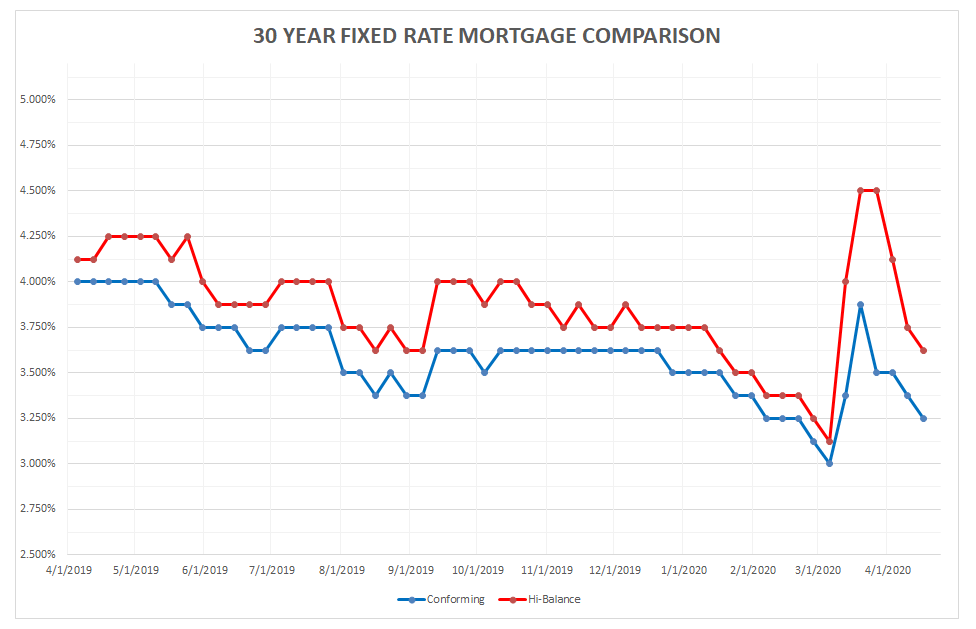
Rates for Friday April 17, 2020: We continue to see a disconnect between the “vanilla” 30-year fixed mortgage for purchase and rate and term refinances and other products, but the gap is slowly shrinking.
FIXED RATE MORTGAGES AT COST OF 1.25 POINTS LOCKED FOR 45 DAYS:
30 year conforming 3.25% Down 0.125%
30 year high-balance conforming 3.625% Down 0.125%
Please note that these are base rates and adjustments may be added for condominiums, refinances, credit scores, loan to value, no impound account and period rate is locked. Rates are based on 20% down with 740 FICO score for purchase mortgages.
Raise your hand if you knew what “Zoom” was two, or even one, month ago. For most of us it was “ZOOM!” inside a graphic in an animation or comic book. Today, Zoom is a verb, not describing going really, really fast, but an action of meeting with an individual or group using video on your phone or computer. One year ago, share of Zoom, the company not the verb, was selling at $62 per share. As I write this the company is trading at about $150 per share.
Perhaps no technology, or software application, has impacted and changed the world in a few weeks as much as Zoom has since early March. It went from a primarily business application for meetings to discuss budgets and proposals to grandmothers’ birthday parties, families gather for Seder during Passover and Happy Hour meet ups with friends and families. Our daughter is on Zoom several mornings a week taking her classes given by her professors in Grenoble, France, another student is logging into the classes from Indonesia.
I am very interested to see how the stay-at-home policies requiring a tremendous segment of the workforce to work from home, combined with Zoom and similar applications, will change the commercial real estate industry. Does your company still need 6,000 square feet of office space in a high rise in Irvine, Long Beach or Century City when productivity remained high during four, five, six, seven…weeks of 80% of your company working remotely? Maybe when the lease renewal comes up moving into 2,000 square feet makes more sense on the bottom line without compromising revenue.
COVID-19’s impact on the world will be long lasting in how we shop, dine, work and especially with how we interact with others near and far. A big benefit is the adaption of new video technology for the members older generations who previously had challenges texting or using applications on their phone or other devices.
From decay comes growth, from adversity comes solutions that have positive impacts on current and future generations.
Have a great week,
Dennis
Past Weekly Rate & Market Updates can be found on my blog page at my website www.DennisCSmith.com/my-blog


