
Why did you advise us to retain our home in California when we are moving out of state?
Question of the week: Why did you advise us to retain our home in California when we are moving out of state?
Answer: Last week we looked at options if you are purchasing a new home and wish to retain your current residence as a rental (link here). This week we take the question a bit further, what if the new residence is out-of-state?
It is no longer news that hundreds of thousands of Californians annually have been moving out of the state. Whether they are retirees or wage earners who have re-located when their employer moved out of state or have sought new employment outside of California, the primary factors for most of those relocating are cost of living and taxes.
When I am speaking with clients who own their homes in California who are relocating out of state a common refrain is, “you should see how much house we get for so much less…” Or, “we can sell our home here and buy one in fill in a state with no mortgage.” That is an attractive lure, especially since the greatest expense most families has is housing. What if your housing costs were eliminated, and your taxes were lower, and the costs of other goods and services were lower than what you are used to paying in California? How much more financial freedom and less stress would you have?
But should you sell your home in California to finance your new life in your new state?
Maybe, maybe not.
California is surrounded by states that have lower tax rates and lower property values. One popular destination is Nevada. There is no personal income tax in Nevada, its property tax is among the lowest in the nation, and while the sales tax is near or over 8% in most cities, that is offset by the other low tax rates.
There are many other states around the country with lower taxes, lower cost of living and much lower costs for homes. For those who are retired the ability to stretch retirement income and savings to live more comfortably financially, and use their equity from the sale of their home in California to purchase a comparable home in another state with a very small, or no, mortgage significantly helps stretch their retirement dollars.
For those still in their working years, with or without children, the lower cost of living and often lower congestion and density is enticing. Yes, their wages may be lower, but comparable when all other costs of living are factored into their home economics. If they are not homeowners, they see the opportunity to purchase a home that is out of reach in California. If they are homeowners they see that they too can sell their home in California and have a significant down payment for their home in their new state.
But what happens if you sell your home in California, move to Nevada, Washington, Texas or some other state, and you feel you made a mistake, you miss California and want to return?
We have had many clients of the years where this has happened. They sell their home in California, net a nice amount of cash from their home and purchase their new home with 30-40-50% down, or more. Be it the culture, the climate, their employment not being satisfying, or missing friends and family, after a few years they decide they want to return to California.
Then they do the math. Their home in Nevazonaexas has not appreciated much. It will cost them 7-8% to sell their home and are looking at netting about what they put into the home for down payment and closing costs—maybe.
Meanwhile, back in California, they find out they are having a hard time qualifying to purchase a home comparable to what they sold, or if they do they are paying a higher price and have a higher mortgage than they had when they sold their prior home.
It is a difficult conversation we have going through the math and telling past clients looking to move back to the state that what they qualify to purchase is smaller than the home they sold not too many years ago, or the same size home in a different neighborhood.
We have had clients who have moved out of state and retained their homes in California and converted them to rentals. Perhaps refinancing before they left the state to obtain some funds to purchase a home in their new state, or waiting to purchase until they know they are in Nevazonaexas to stay. If they do make the decision to stay they can either continue to rent their former home and retain as an investment, or they can sell the home and take the proceeds to either purchase a new home in their new state, or payoff their mortgage, or invest the money and perhaps shorten their time until they retire.
If they decide they do not wish to live in Nevazonaexas any longer, they simply need to give their tenants notice they are returning to California and need them to vacate their home. They gave relocation a shot, it did not work out for them and they are able to return to their former home without having to worry about if they can afford to purchase a home in California.
If you own your home in California and are moving out of state my advice is that you seriously consider the option of retaining your current home for a period of time after you move just in case it does not work out and you want to return to California in the future.
If you want me to help you with the math of relocation please do not hesitate to contact me.
Have a question? Ask me!
Is it needed? It appears to be a foregone conclusion that the Fed will lower its benchmark interest rate in July. The reasoning is to get ahead of a potential slow-down in the economy, as primarily shown in inflation numbers—data for May shows the annual rate of inflation dipped to 1.5% on a year over year basis, which is well below the Fed’s inflation target of 2.0%. But is the economy in need of any boost? Personal incomes in May grew 0.5% from the prior month, continuing a steady upward trend, consumer spending grew at a good rate for the third month in a row, up 0.4%. Since consumer spending is 65-70% of our economy, consumers are maintaining a foundation for continued, steady growth. Helping future economic growth, is personal savings growth, no surprise since income growth outpaces spending growth, which is at 6.1%. In a normal environment the data would support upward pressure on rates, but the Fed’s desire to lower rates based on their assumption the American consumer will slow consumption in the future takes that pressure off.
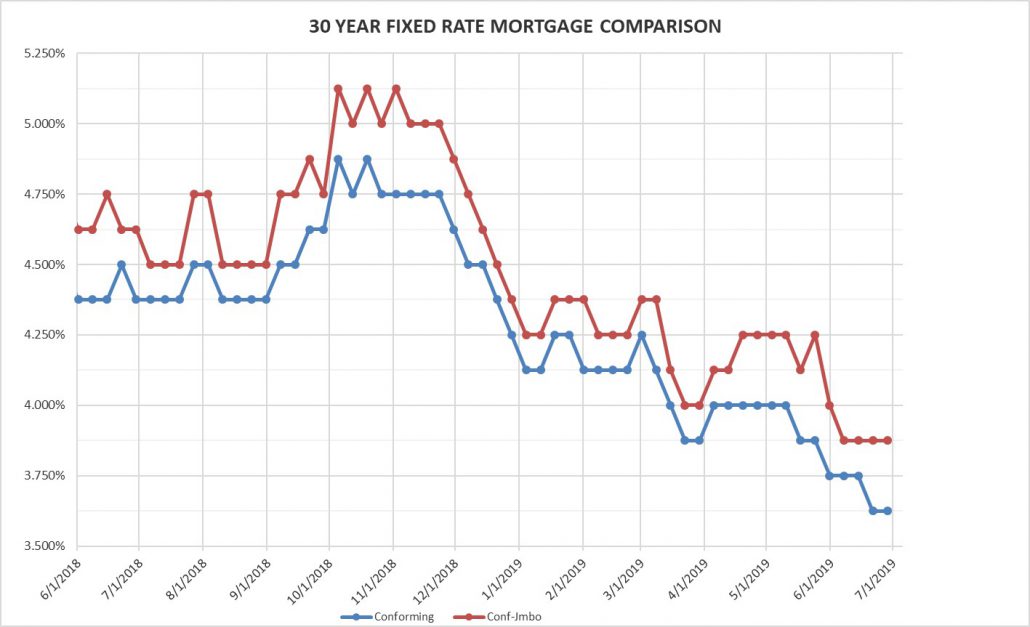
Rates for Friday June 28, 2019: As mentioned above, data supports rates not being at multi-year lows but the sentiment and actions of quasi-government organizations are keeping rates low. Looking forward, there is little room to the down side and markets have priced in a rate cut in July from the Fed. Now is a great time to get a mortgage!
FIXED RATE MORTGAGES AT COST OF 1.25 POINTS LOCKED FOR 45 DAYS:
30 year conforming 3.625% Flat
30 year high-balance conforming 3.875% Flat
Please note that these are base rates and adjustments may be added for condominiums, refinances, credit scores, loan to value, no impound account and period rate is locked. Rates are based on 20% down with 740 FICO score for purchase mortgages.
When is Independence Day? July 4th is when we celebrate. John Adams, in a letter to his wife Abigail** dated July 3, 1776 described the events of the prior day in the Continental Congress during which the delegates from twelve of the thirteen colonies approved a motion for independence from England presented by Richard Henry Lee. In the letter he writes,
“The Second Day of July 1776, will be the most memorable Epocha, in the History of America…I am apt to believe that it will be celebrated, by succeeding Generations, as the great anniversary Festival. It ought to be commemorated, as the Day of Deliverance by solemn Acts of Devotion to God Almighty. It ought to be solemnized with Pomp and Parade, with Shews, Games, Sports, Guns, Bells, Bonfires and Illuminations from one End of this Continent to the other from this Time forward forever more.”
We celebrate July 4th as Independence Day, as that is the day the Declaration as we know it was adopted by the Continental Congress after two days of debate and revisions to Thomas Jefferson’s historic document. The next day, July 5th a printer made hundreds of copies that were then given to messengers to deliver throughout the colonies.
We all know the image of the Declaration of Independence, with the large header “In Congress, July 4, 1776” and adorned with signatures on the bottom, the most prominent being that of John Hancock, the President of the Congress. There is some dispute as to when the signatures were affixed to the document. July 4th is the commonly learned and believed date members of Congress signed, but later statements from those present brought up that not all the signatories were in Congress on that date, either as officials or physically. There is a strong argument that the document was signed by most members of Congress on August 2, 1776. One part of this argument being that it took some time for the adopted declaration to be clearly written in a steady hand on parchment.
Regardless of the dates, in 1870 Congress declared July 4th to be a national holiday as part of a bill that included other national holidays, including Christmas. And so it is, a wonderful national day to celebrate the humble beginnings of our great nation.
Two final thoughts, first I encourage everyone to read the actual text of the Declaration of Independence, it is a wonderful read, especially if you are able to consider that many of the sentiments have never been expressed before as a basis for creating a purpose of not only independence but governance. Here is a link to the Declaration of Independence.
**Second, the John Adams biography by David McCullough is a wonderful book on a fascinating man. One of my favorite parts of the book are the letters between John and Abigail Adams. Separated for much of their marriage, the letters show us not only the history of the era, but the love they had for each other and their family. I strongly recommend the book.
Have a great week and Happy Independence Day!
Dennis
Past Weekly Rate & Market Updates can be found on my blog page at my website www.DennisCSmith.com/my-blog