
Should we have our mortgage lender pay our property taxes?
Question of the week: Should we have our mortgage lender pay our property taxes?
Answer: Most property owners who have a mortgage have the option of including in their monthly payment to their lender to include funds for their property taxes and property insurance. This is called “impounding” or “escrowing” those funds for the lender to later disperse to county tax collectors and insurance companies. For the purposes of this article, I will use the term “impound” as that is the most common within the industry.
First, above I mentioned “most property owners…have the option.” For those obtaining either FHA or VA mortgages there is no option, you must have your taxes and insurance impounded. Similarly, for conventional mortgages if your mortgage is greater than 89.9% of the value of the property. Some lenders require an impound account if your credit score is below a certain level or if the type of mortgage you are receiving is of the non-traditional, or Non-QM type.
How does it work? It is pretty simple, yet not, and those who are frequent readers of the WR&MU know I will get into the weeds for those who like details so read on.
The simple aspect is, when you have an impound account your lender will put on your monthly mortgage statement for the principal and interest due for the month plus and amount equal to your annual property taxes and annual insurance premium broken down to a monthly amount, i.e. the total due divided by twelve. If your annual property taxes are $6000 and your annual homeowners’ policy is $600 then a line item on your monthly statement will read: Impounds due $550.
Each month your statement should include the prior balance on your mortgage, the amount of the last payment and the amount of funds currently held in your impound account for the payment of taxes and insurance.
When your property taxes are due (next week by the way—I will send a reminder on Monday!) the lender sends the amount due to the county tax collector, when your insurance renewal is due the lender sends the amount due to your insurance company.
Pretty simple.
Less simple is setting up the impound account. When closing on your mortgage, either purchase or refinance, if you want to have the lender impound your taxes and insurance you will need to provide the funds for establishing the account at closing. The formula used to determine how much you need to bring is when the math you learned in school that you never thought you would need kicks in.
The first thing to understand when determining how much you will need to bring in to fund your impound account is that in the twelve months after closing your loan you will make only ten mortgage payments before your insurance is due. Huh? If you close a loan on April 15, 2019 your insurance will have to be renewed before April 15, 2020 so it is likely the premium payment will need to be sent before the end of March to ensure no lapse in coverage. With and April 15th closing your first payment will be due on June 1st. By next the following March 31st you will have only made ten payments (use your fingers—I did) and twelve payments will be needed to make the full annual renewal. So at closing the first year premium will be collected, plus the two months needed to ensure the lender has a complete year of premiums despite your only having made ten payments.
It gets more “mathy” when it comes to how much to collect for property taxes because the payments are due before December 10th and April 10th to avoid late fees. Depending on when you close, your first payment due date, and if the taxes due in December or April have been paid yet or not, the amount collected to set up the impound account varies from one to nine months of taxes. Further complicating the math is that you will notice that between December 10th and April 10th only four mortgage payments will be made, if made on the first of each month. Four payments made and only four payments collected between December and April, so an additional two months need to be accounted for in the annual collection calendar.
For those purchasing a home and establishing an impound account it gets a bit more less simple. If you purchased your home between January 1st and June 30th there is a decent chance the tax bill prepared and sent out in October will be based on the value of the property determined by your purchase. If you purchased your property after June 30th then the tax bill used by the lender to pay the property taxes will show the taxes based on the seller’s assessed value. This means the lender will likely have over collected the amount needed for the property taxes, assuming the seller’s assessed value is lower than your purchase price. Which will trigger the lender to refund you the amount that was collected above what was owned, and often the lender will decrease the amount collected so as not to over collect again.
You may see where this is going, in a year the lender will receive the tax bill showing what is really owed, which is more than collected since the lender reduced the amount owed in your monthly payments. Which will necessitate your sending funds to the lender to make up the difference, or an over increase in your payment to cover the real amount due for taxes as well as the make-up amount for the underfunded impound account and subsequent tax payment.
Confused? This is one of the reasons why I encourage borrowers who have strong financial discipline to not impound taxes and insurance with their lender but to self-impound the amount for taxes and insurance monthly into a separate account to pay those fees when due.
If you have purchased a property and when you receive the tax bill and it is less than what it should be then you will receive a supplemental tax bill (explained in detail in this WR&MU form October), this is your responsibility and the lender will not pay—you can use the refund from the lender for the over collected impound account to help pay this bill.
If your lender sends you a notice regarding lowering the monthly tax collection contact the servicing department and ask if they can retain the tax collection so you are not faced with an adjustment the following year when the “true” amount owed needs to be paid. Some lenders will retain the current payment and some will stand by the adjustment based on the artificially low tax bill. If the latter is the case then I strongly advise you put aside monthly the difference between what the lender is collecting and what you know you should be paying so when the lender receives the higher tax bill and informs you the impound account is short you have the funds saved to make up the difference.
Many borrowers like the convenience of including their property taxes and home owner’s insurance payments with their mortgage payment. It is convenient, and you do not have to worry about paying Governor Newsom in the same months you pay Santa Claus and Uncle Sam. That convenience does have some inconvenient aspects that can occur in the first year or so of your mortgage, particularly after you purchase your home and set up an impound account.
If you have any questions about impounding taxes and insurance, or the math above or other scenarios, please do not hesitate to contact me and we can walk through the issues together so you have a full understanding of the process.
If you do not own property and do not have the option of having an impound account please contact me so we can discuss helping you purchase a home so you will have that option!
Have a question? Ask me!
Unexpected drop and shocking increase, such was the retail sales report issued on Monday. The front-line news was that retail sales dropped for the second time in three months in February, really big news because one of those months was December. The 0.2% decline in sales could have been a bigger drop but gas and auto sales propped up the sluggish month, which was perhaps impacted by the severe weather in much of the country. The shock in the report was that the sales for January, previously reported as increasing 0.2% for the month, were revised upward to a very robust 0.7%. Overall the news was mortgage friendly since consumer spending is 65-70% of our economy and slow sales typically forebode slow economic growth which leads to lower rates.
While consumer activity is slow on the spending side, it certainly is not on the labor side. Yesterday the weekly report for unemployment claims filing was released and it was the lowest number of filings on a weekly basis since 1969, as a point of reference I was in the first grade in Mrs. Tacker’s class at Paul Revere Elementary in Tulsa. Today, the Labor Department released more detailed employment data for March showed a very strong labor market. The number of news jobs added, 196,000, was not that spectacular, but the year over year increase in wages of 3.2% is close to spectacular. With the Consumer Price Index core value (less food and energy) up 2.1% on an annual basis in February workers’ wage growth exceeds inflation. This leads to the question, why is spending slowing if real wages are growing? The labor news is interest rate unfriendly as a very strong labor market and rising wages could lead to inflation, which would result in higher rates.
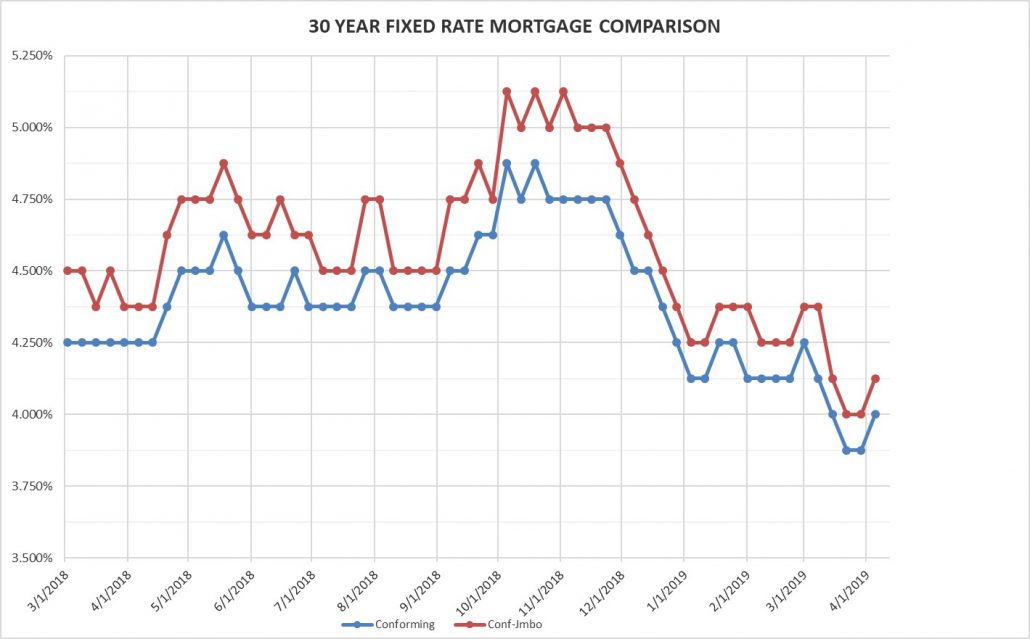
Rates for Friday April 5, 2019: Spending slowing, employment very strong, which way is the economy going? The economy is slowing. Economic growth is measured by output and spending not by wages and slower spending shows that, as it has almost every year since the recession, we start the year with another slow start. Looking ahead the estimates are for economic growth in the 2% range for 2019, not great but constant. Rates slip up this week after being at long-time lows for the past two weeks.
FIXED RATE MORTGAGES AT COST OF 1.25 POINTS LOCKED FOR 45 DAYS:
30 year conforming 4.00% Up 0.125%
30 year high-balance conforming 4.125 % Up 0.125%
Please note that these are base rates and adjustments may be added for condominiums, refinances, credit scores, loan to value, no impound account and period rate is locked. Rates are based on 20% down with 740 FICO score for purchase mortgages.
Since most of the readers of the WR&MU are looking at tax bills this week now is a good time for a reminder. If you are looking at the tax bill and it does not say the owner of the property is your family trust you need to change that. There are many reasons to have a trust, and no reasons not to if you own real estate and especially if you have children. Everyone gets hit by The Big Bus, we just don’t know when. I hear too many stories of The Big Bus striking unexpectedly and a family left in disarray because the victim did not have a plan for their estate nor themselves.
If you own property and do not have a trust please contact me for a quick lecture on why you should and a referral for a qualified professional who will work with you to develop a plan for your estate. Yes, you can likely do it yourself with some on-line program, however as I constantly say, you will never know if that lower priced on-line service properly protected your estate and your family. Be sure, use a professional.
Have a great week,
Dennis
Past Weekly Rate & Market Updates can be found on my blog page at my website www.DennisCSmith.com/my-blog