

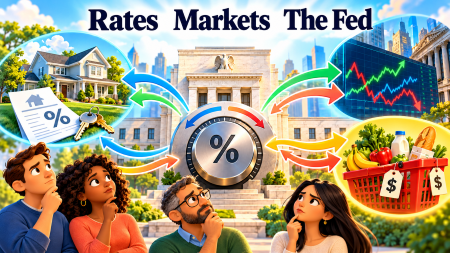
How much do the rate changes by the Fed impact the market?
Question of the week: How much do the rate changes by the Fed impact the market?
Note in the bottom section of last week’s WR&MU when I listed the California ballot propositions I am voting “Yes”, I inadvertently omitted Proposition 39 (require voters to show identification).
Answer: This was asked by friend and client Harvey last week, and it is a question debated from casual having a beer conversation to economic think tanks at places like the University of Chicago. How much impact does the Federal Reserve have when it moves its benchmark interest rate.
Wonky-alert…as is typical, once I started on the answer to the question, I could not help myself in getting pretty granular in my commentary. Some may want to see the pretty chart then scroll down to the summation before the economic update! Fellow economic, and political, nerds, I hope you appreciate the commentary.
Important to the conversation is the reason the Fed moves its rate, much of which was covered in the WR&MU “Is the Federal Reserve’s 2% inflation target realistic?”
“Markets” is a word that covers a lot of ground, flea markets, bond markets, grocery markets, equity markets, real estate markets, any system, venue, place where buyers and sellers exchange goods, services, and remuneration for such.
As relates to our question of the week, for “markets” we will look at the mortgage rate market and the Dow Jones, one of the most familiar gauges of the United States equity, or stock, markets.
Here is a chart that shows the Federal Reserve federal funds rate, what banks charge each other for overnight borrowing, i.e. “the benchmark,” the 30-year conforming mortgage rate as listing in the WR&MU every Friday, and below, the Dow Jones Index, and the Core Personal Consumption Expenditures (PCE), the primary gauge of inflation used by the Federal Reserve.
Fed rates, mortgage rates, stock market values and inflation from January 2020 to the most recent data to September 1, 2026 are shown below.
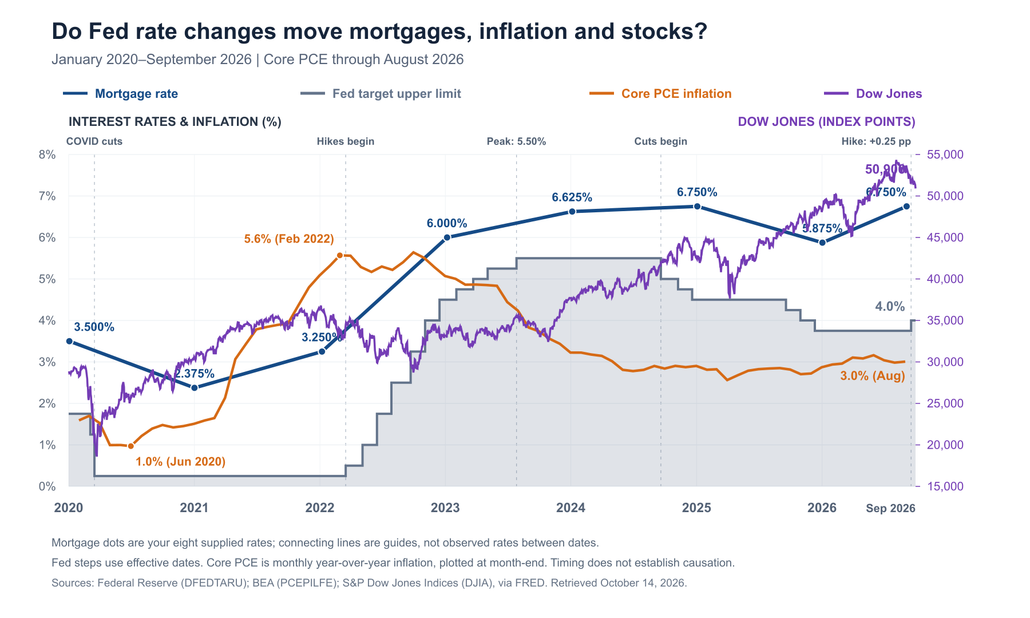
The chart starts just prior to the Covid-19 pandemic in 2020, and we see the Dow Jones (purple) drop precipitously from about 30,000 to about 18,000 as government shut downs brought the economy to a near halt. As well, the PCE (orange) dropped quickly from 1.6% to a low of 1% inflation in June 2020. Mortgage rates (dark blue) already below 4% drifted down to a low of 2.375% at the end of 2020 and start of 2021.
Our focus in on the Federal Reserve’s rate (shaded light blue). Prior to Covid, the rate target was 1.5-1.75% (as explained in prior WR&MU the Fed sets a one-quarter of one percent range for its rate, i.e. 3.00-3.25%, or 0.00-0.25%). As can be seen, in early March 2020, the Fed quickly reacted to the economic slowdown by lowering its rate 0.50% (one-half of one percent),then two weeks later lowered its rate to near zero, 0.00-0.25%.
The intention was to lower interests rates to stimulate borrowing and investment by individuals and businesses to stimulate the economy.
As you, can see, the Dow Jones rebounded very quickly in March 2020, in part due to the Fed rate change, but primarily as Zoom, home delivery of goods, and work from home caused the economy go from shut-down to operational.
After the first few months of the pandemic, inflation bottomed out at 1%, then began to climb as consumers spending increased and more and more businesses opened “as normal.”
While the Fed rate was near zero to stimulate the economy, the Fed also purchased hundreds of billions of U.S. Treasury debt and mortgage bonds pushing money into the economy.
Besides the Fed money flowing into the economy, the Federal government passed, and the President signed, the CARES Act, a $2.1 trillion stimulus package that included the Paycheck Protection Program for small businesses, direct checks to Americans and expanded spending on unemployment benefits and funds for the healthcare system.
From mid-2020 to early 2021, inflation slowly to around 1.5%.
With the Federal Reserve purchasing mortgages, and U.S. Treasuries, mortgage rates declined to a low of 2.375% in late 2020, early 2021. The ultra-low rates spurred record home prices, and number of refinance transactions, across the country.
The economic activity, and company profits, saw the Dow Jones steadily increase from March 2020 to early 2022.
In December 2020 Congress passed, and Trump signed, the Consolidated Appropriations Act (Coronavirus Response and Relief Supplemental Appropriations Act) which called for $900 billion for additional stimulus checks, unemployment payments from the federal government, and more PPP loans for small businesses. It should be noted the $900 billion was part of a $2.3 trillion omnibus bill.
With the additional spending, the Fed still purchasing bonds and mortgages, inflation began to climb from 1.4% in December 2020 to 1.9% in March.
In March 2021, the new Congress passed, and President Biden signed, the American Rescue Plan Act of 2021 the called for $1.9 trillion that included another round of stimulus checks to individuals, expanded the Child Tax Credit, and provided hundreds of billions in funds to state and local governments.
Inflation spiked from 1.9% in March, to 3.1% in April 2021 and continue to rise until it peaked at 5.6% in February 2022, staying elevated over 5% into 2023.
Mortgage rates, very reactive to inflation, climbed rapidly from 3.25% in early 2022 to 6.00% by the end of the year.
Also concerned about inflation, as well as government spending, the Dow Jones turned down from early 2022 to the middle of the year.
During the period of rising inflation the Fed, and many commentators, stated they felt the that increase in prices was “transitory,” caused by supply-chain issues and other short-term factors. Since the price increases were temporary, in their view, so prices would fall back down and there was no need for any action.
In March 2022, after the Fed’s target rate limit had been at 0.25% for two years, it raised the rate target to 0.50%. Followed by rate increases in May, a half-percent increase to 1.00%, June to 1.75%, July 2.50% and throughout 2022 finishing the year with a hike in December to 4.50%.
While the Fed was increasing rates to combat inflation, and mortgage rates were rapidly increasing, in August 2022 Congress passed, and Biden signed, the Inflation Reduction Act of 2022 totaling almost $500 billion in spending and tax breaks.
As the chart shows, by July 2022 inflation had declined from 5.6% to 4.6%. Inflation was dropping and rather than wait to see how much and how fast inflation would decline, the Fed continued to raise its rate, and Congress poured more money into the economy.
The higher rates, and other factors, either caused, or coincided, with inflation dropping steadily through the rest of 2023 and through 2024.
After dipping in 2022, the Dow began a steady upward trend through 2023. Mortgage rates, showed investors were still concerned about inflation continuing to rise, seemingly following increases in the Federal Reserve rates, disconnecting from the rate of inflation in late 2022.
In July 2023 the Fed increased its rate one more time, reaching a peak of 5.50%. Inflation had slowed to 4.4% and continued to trend downward through 2024.
While the Fed maintained it rate through all of 2024, mortgage rates and the Dow continued to climb.
During the period 2020 to 2022, the Fed was inactive as inflation spiked. In 2022 the Fed reacted to inflation and rapidly raised its rate. As inflation began to drop, the Fed continued to raise its rate, finally pausing in 2023.
After inflation had been dropping for over 18-months, the Fed began to lower its rate in September 2024 as the target inflation rate was nearing the 2% target rate. Through the rest of 2024 and all of 2025, in continued to lower its rate until it was 3.375% in December 2025.
In early 2025 President Trump announced his tariffs across a broad spectrum of goods with most of our trading partners. Inflation remained fairly steady, staying below 3%.
In early 2026 Trump initiated the conflict with Iran, which result in the Hormuz Strait shutting down, impacting the most important commodity in the United States, and world, economies, oil. The Dow Jones dropped precipitously, inflation rose towards 4% and mortgage rates, after dropping, began to rise.
Citing inflation concerns, the Federal Reserve increased its rate in September to 4%.
Does the Federal Reserve interest rate impact markets? Yes and no.
Markets react, “reading the tea leaves” of economic indicators and adjust their investment decisions, therefore markets, before the Fed acts. Many pundits and analysts say “this economic data will impact the Fed’s decision to raise/lower rates…” but before the Fed does act, markets already have—so the Fed decisions are often fulfilling prophecies.
It would be helpful to general economic education if analysts, commentators, and politicians, focused more on the Federal Reserve’s balance sheet activity of buying, selling, holding trillions of dollars of government and mortgage debt instead, and federal spending and deficit, instead of the federal funds rate.
Have a question? Ask me!
Reading above, you will think, “this will result in a rate increase…” The Consumer Price Index rose 0.6% in September, matching expectations, after rising 0.4% in August. Year over year, CPI increased 3.7%, with the core rate (taking out energy and food prices) rose 2.4%, the indexes rose 3.4% and 2.4% respectively in August.
Retail sales rose 0.8% in September, much higher than the 0.4% expected by Wall Street. Sales were heavily influenced by the 6.4% increase in spending for gasoline, driven by the spike in prices we have all experienced at the pump. Taking out gas, food services, auto sales and building materials, retail sales rose 0.2% in September, well below inflation. The number of sales dropped for the month when accounted for inflation.
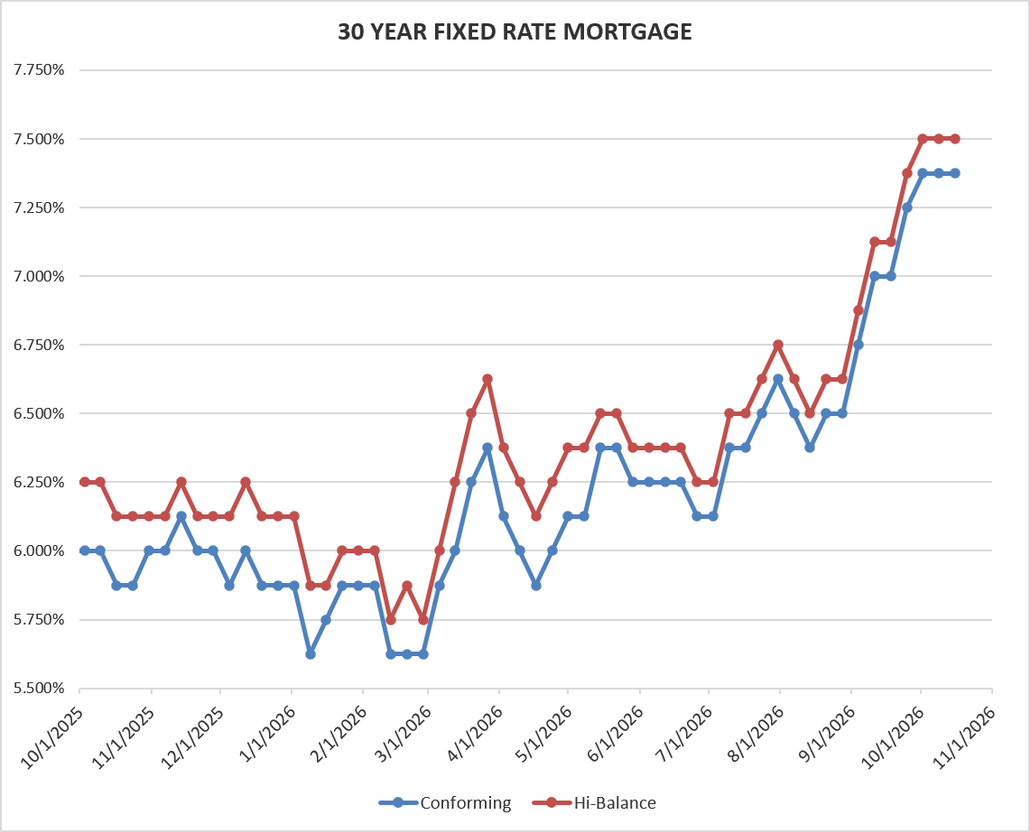
Rates for Friday October 16, 2026: Rates remain flat from last Friday, despite the inflationary CPI data. It could signal a ceiling on the current rate market. “Could.”
FIXED RATE MORTGAGES AT COST OF 1.25 POINTS LOCKED FOR 45 DAYS FOR PURCHASE TRANSACTIONS:
30-year conforming 7.375% Flat
30-year high-balance conforming 7.50% Flat
Please note that these are base rates and adjustments may be added for condominiums, refinances, credit scores, loan to value, no impound account and period rate is locked. Rates are based on 20% down with 740 FICO score for purchase mortgages.
Baseball fans, taking away team loyalties, are not surprised the Dodgers lost to the Brewers for a chance to play in the World Series. They are surprised that Milwaukee swept Los Angeles, after being behind in every game. As I communicated with many Dodger fans, including my bleed-Dodger-blue daughter in New York, they know how we Phillies phans have felt watching too many games this season and in the playoffs.
Wait ‘til next year!


