


What is dual agency and does it affect me?
Question of the week: What is dual agency and does it affect me?
Answer: This question has been asked a few times over the past few weeks from clients entering the home buying market; evidently there have been a few articles circulating on dual agency creating the inquiries.
Before we explain dual agency, let’s take a look at the structure of real estate agencies in California.
To represent a buyer or seller in the purchase or sale of real estate a license from the California Department of Real Estate (DRE). The DRE issues two licenses, a salesperson license and a broker license.
The salesperson license is the entry level license, there are education requirements that must be met before you can sit for the exam. Once you pass the exam you cannot immediately begin representing clients, to do so your license must be under the license of a broker.
To obtain a broker license there are requirements that must be fulfilled, including, with some exceptions, having had a salesperson license, before sitting for the exam.
Every real estate company, or brokerage, has one individual who holds a broker license who is the designated officer. This individual is responsible for the company and all the licensees who work for the company—essentially the DRE does not enable a corporate shield for liability.
If an individual has a broker license, but works for a company with many agents and a designated officer, their actions are the responsibility of the designated officer. Therefore, the professional actions of every agent in the company, brokerage, whether holding a salesperson or broker license, is the responsibility of the designated officer, and every transaction is legally conducted by the designated officer with the subagents working on his or her behalf.
The vast majority of real estate agents active in the market hold salesperson licenses, therefore they are working under someone else’s license—the designated officer holding a broker license. Henceforth we will use “agent” when referring to real estate agent.
When you sign a contract with an agent to represent you in the sale or purchase of property agency has been created. Agency is a legally binding relationship between the agent and the client. When agency is created the agent has a fiduciary relationship with their client.
As a fiduciary, the agent must act in the client’s best interest, with the highest degree of trust, confidence and responsibility that avoids conflict of interest or benefiting at the expense of the client’s best interest.
When agency is created with a real estate agent working for a brokerage, the agency is created with the broker, the designated officer, with the agent working directly with the client have sub-agency. The requirements of the relationship are the same for the designated officer and the agent.
Dual agency is when an agent represents both the buyer and seller of a property. Because multiple agents can work in the same company with the same designated officer, if two agents in the same company are in a transaction with one working with the buyer and the other with the seller, this is also a dual agency relationship.
Several states have made dual agency illegal as they do not feel an agent, or two agents in the same company, can fulfill the fiduciary requirement when they are representing a buyer and a seller.
Fred is a licensed agent and has obtained a listing agreement with the Smith’s to represent them in the sale of their home at 9876 Cleary Street. The listing puts the home on the market for $675,000. The Smith’s are moving out of the area to be closer to their grandchildren and let it be known to Fred that while $675,000 would be nice, they might be willing to take less if it means they can close quickly and cleanly.
Fred holds an open house and meets the Ortega’s. They love the house and tell Fred they would like to write an offer. Fred asks if they have a relationship with an agent, they state they do not, and Fred agrees to represent them and write the offer. Having seen other people going through the open house, the Ortega’s tell Fred they are willing to pay up to $700,000 for the home to ensure their offer is accepted. As well, they let him know they are pre-approved and will be putting 50% down at closing.
Fred is now representing a seller and a buyer. As the seller’s agent, his duty is to try to get the home sold for the highest possible price with a credit worthy buyer. As the buyer’s agent, Fred’s duty is to try to get the seller to accept the lowest price offer possible from his client.
Acting as a fiduciary, Fred must keep the knowledge of the Smith’s willing to take less and the Ortega’s willing to pay more to himself due to the requirement of confidentiality. When the Ortega’s, who can close relatively quickly, ask what Fred thinks they should offer for the property, what should be his advice?
Is Fred’s duty to ensure there is a transaction so the Smith’s can move on and the Ortega’s can move in, or is it to maximize the Smith’s net proceeds and minimize the Ortega’s purchase price?
This is a bit more complicated than most dual agency transactions actions, but it displays the challenge to meet the fiduciary obligation when one person is representing both parties in a negotiation. Whose best interest comes first to the agent?
Absent from this discussion is the commission being paid by the seller as part of the listing agreement. When a listing agreement is signed the seller agrees to pay a certain percentage of the sales price to the agent(s), with it being split between the agent representing the seller and the buyer. Will an agent recommend a buyer he is working with to a seller in order to be paid a higher commission?
There are many scenarios that can playout with dual agency that support disallowing dual agency in real estate transactions. Because of the possible conflicts of interest, the ability to fully represent both clients’ interest, to not act base on confidential information in negotiations, several states have made dual agency relationships illegal.
The argument in favor of dual agency is that having one agent, or two agents in the same office, for a transaction makes communication and the process more efficient, and less prone to any personal or professional issues between competing agents that could create issues during the escrow. As well, most agents agree to a lower commission if they are representing both clients—this is more likely to happen when dual agency is with one agent and not two agents from the same office.
Regarding dual agency with two separate agents in the same office, in most instances the agents act independently from each other and their broker when negotiating for their clients.
While there are some agents who would take advantage of the ability to represent both the buyer and seller in a way that benefits neither client, or benefits one a lot more than the other, most agents do a very good job of compartmentalizing their clients and provide advice and guidance to their clients.
In California dual agency must be disclosed and approved by the buyer and seller before an offer can be presented. This allows either party to request another agent to represent them if they do not feel comfortable with their agent also representing the other party.
This being my 35th year in the industry I have worked with agents over the years where I have been suspect of their representing both clients equally, or in some cases even one. I have also worked with many, many more agents who represent their clients with integrity and professionalism fulfilling their duty, whether representing one party in the transaction or both.
Back to our question, can dual agency affect you? Yes, it could, depending on the agent representing you and the seller (or buyer if you are selling) however the impact could be positive in making for a less contentious and smoother escrow period. When there are issues with dual agency, I have found it has little to do with the dual representation and very much to do with the agent doing the representing of both parties.
Have a question? Ask me!
As expected, retail sales slowed in February. After a surge in retail sales in January, consumers slowed their purchases last month, data showing a 0.3% increase in sales from the prior month. Digging into the data, sales at gas stations jumped 5.5%. Subtracting auto sales and gas from the numbers and retail sales shrank by 0.4%. Take out 0.8% inflation and sales were down 1.2%. Inflation is slowing consumer activity, which represents 65-70% of our economy. The news is mortgage rate neutral.
As expected, the Fed raised its benchmark rate yesterday by 0.25%. The immediate impact of the rate increase is that by the end of today most banks will have increased their prime rate by 0.25% to 3.50%; which means if you have a HELOC your rate has gone up. Mortgage markets had little reaction to the announcement as it was already priced into the market.
Looking ahead, with the rate increase the Fed also laid out their expectations for rates. They expect their benchmark rate, which was essentially zero yesterday morning and 0.25% in the afternoon, to be 1.9% by December, they indicated a possible 0.5% increase later this year, perhaps sooner than later. In 2023 they expect the rate to rise to 2.8% and remain there through 2024. They predict GDP growth to slow with the rate at 2.8%. The Fed’s original projection for inflation in 2022 was 2.6%, it has increased the projection to 4.3%, which means it would have to slow considerably from its current rate of 7.48%.
The challenge for the Fed is to increase rates to slow inflation and slow economic growth. Regarding how to slow growth without pushing economy into recession, former Fed vice-chair and current professor of economics at Princeton Alan Blinder said, “You’ve got to be both lucky and good.” Sounds like my golf game trying to get a par.
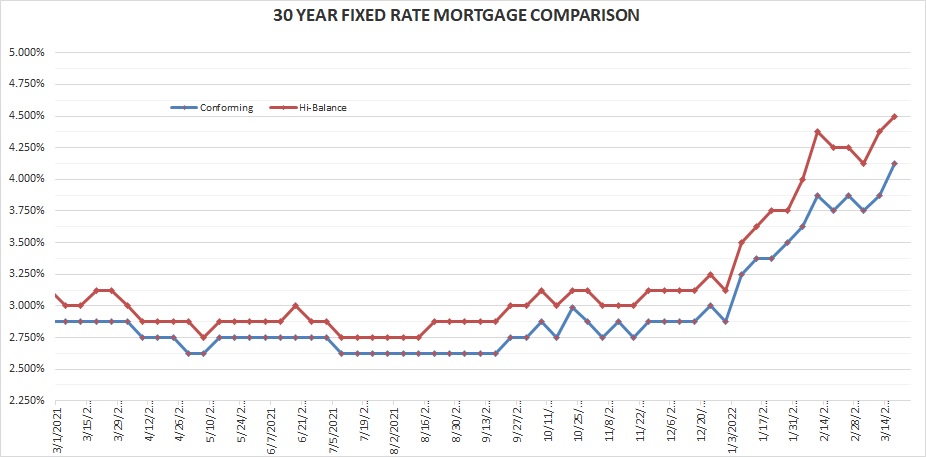
Rates for Friday March 18, 2022: Rates opened the week spiking ahead of the Fed announcement, mainly on concerns the increase would be 0.50%, hence the lack of movement yesterday and today after the announcement. We are approaching a range where I felt rates should be a month or so ago. If we maintain somewhat stable rates well into next week we should see them stay within this range until some major economic news or outside event.
FIXED RATE MORTGAGES AT COST OF 1.25 POINTS LOCKED FOR 45 DAYS FOR PURCHASE TRANSACTIONS:
30 year conforming 4.125% Up 0.25%
30 year high-balance conforming 4.50% Up 0.125%
Please note that these are base rates and adjustments may be added for condominiums, refinances, credit scores, loan to value, no impound account and period rate is locked. Rates are based on 20% down with 740 FICO score for purchase mortgages.
There are few, if any, more exciting events in sports than the NCCA basketball tournament, aka March Madness. Small schools that play in 5,000 seat gyms, maybe on regional cable, upsetting powerhouses. Teams trading baskets and great plays in the closing minutes, with on team sinking the final shot as the buzzer sounds. The thrill and agony for those of us who fill out our brackets we have entered in pools with our friends as teams we have going far, or all the way, eek out a win or lose to a much lower seeded team.
There are 67 games in the tournament, may 10-15 could be considered blowouts. The rest have lead changes, buzzer beaters, overtime, and ecstasy and agony as the young players advance or go home–some leaving a basketball court and ending their careers.
This happens over three weeks, letting us catch our breath at the beginning of each week as the next round approaches.
I hope you enjoy the games and the tournament as much as I do!
Have a great week,
Dennis
Past Weekly Rate & Market Updates can be found on my blog page at my website www.DennisCSmith.com/my-blog


