
Should we buy a property with a friend or family member?
Question of the week: Should we buy a property with a friend or family member?
Answer: Most questions of the week are the result of a topic coming up in conversations over the course of several weeks. This week’s question came up several times this week; which is not that unusual, especially if there is a big mortgage, real estate or interest event or news that week. This topic, owning property with someone other than your spouse, is a bit off-beat so it was surprising to me that I received several calls this week on the topic.
Back to our question, should you buy, or own, property with someone other than your spouse?
My short answer is “No.”
When consider most issues concerning real estate and mortgages, I look long-term as owning real estate is very rarely a short-term proposition. When looking at anything long-term a factor to consider is that no one lives forever, not you nor the individual(s) with whom you may own property.
Another long-term factor is that people’s lives undergo changes, some good and some bad. This is true for you and for your potential real estate partners.
Let’s dig into why I am not in favor of co-owning real estate.
The three most prevalent scenarios for co-ownership are purchasing a vacation home to share with a sibling’s family or close friends, purchasing investment property to share the acquisition and carrying costs, and inheriting property as a co-owner with your siblings or other relatives.
Each of these has some positive characteristics. Enjoying a mountain, beach or desert retreat with your family can create wonderful memories for siblings and cousins. The ability to purchase an investment in real estate with less cash out of your savings and less downside on months where expenses exceed revenue. Sharing legacy real estate owned by your parents, grandparents or other deceased relative can benefit you and other descendants.
One purpose of how title to real estate is held is what happens to ownership of the property when one of the title holders dies. Because of this there are several ways title to property can be held.
Self-explanatory is taking title as an individual. When the individual title holder passes away disposition of the property will depend on if s/he has a will, if not the property will go through probate and a judge will decide who receives the property.
If the property is held in trust and the trustee(s) pass away the disposition of the property is completed according to the instructions in the trust.
If the property is held by one or more individuals it gets a bit trickier. If title is held as joint with right of survivorship, when on owner dies the other owner gets full title to the property and will own as an individual. This is most common with married couples. With joint title ownership neither party can sell or encumber without the other party’s consent.
Title can also be held as tenants in common. Under this form of ownership does not have to be equal. For instance, Bill and George can own a condo in Mammoth as tenants in common each with a fifty percent interest, or as tenants in common with Bill having a seventy percent interest and George having a thirty percent interest. (Sidebar, I had a married couple purchasing their first home several years ago and the wife wanted title to be tenants in common with her having a 95% interest and her husband a 5% interest since her parents were gifting some of the down payment. As I recall they ended up owning as joint tenants…I am not sure if they are still married.)
Another aspect of tenants in common is that each owner can sell their interest without the consent of other owners, as well each owner can encumber their portion of the property.
Most partnerships to purchase property take title as either tenants in common with percentages of ownership, or form an LLC or S Corporation to own the property and the partners each have a certain number of shares in the corporation.
Back to our condo in Mammoth. Because they are pooling money Bill and George do the math and see they can buy a $450,000 three bedroom condo together, a bigger and better condo than either could buy individually. Bill and George buy the property as tenants in common each with a fifty percent share. They agree to a schedule to use the property themselves. Because of the desirability of condos in the area for short-term rentals (i.e. AirBnB), and the higher rental rate for a three-bedroom unit, they agree to have a schedule segmented into three weeks divided between Bill, George and renting the property. If either Bill or George decide to not use the condo on their week and rent the unit, they get credit for the rental revenue. They set up a checking account to handle the income and expenses and each agree to put in $10,000, if account runs below $5000 if rental revenue does not cover expenses they agree to each put in another $2500.
Bill is married with two children, one almost out of college and the other out of school and working. George, his best friend since grade school, has been divorced twice and has two kids from each marriage.
Being responsible, Bill puts his portion of the property in the living trust he has with his wife.
Possible scenarios, actually realistic as I have seen many of these occur:
- George is killed in an accident driving home from Mammoth. He had no will or trust so his estate, which includes a fifty percent ownership of a condo in Mammoth, goes to probate. During the time it is in probate Bill has to maintain the property and has to stay in constant communication with the probate attorney for accounting for expenses and income. Eventually the probate is completed and George’s four children, who do not get along, are all given a share of the property, 12.5% each. Bill is now partners with four adults he barely knows, who do not all get along. Does/can Bill buy them out? What about being able to use unit, who gets to use it when? When will it be rented? Will all four new partners agree to share in expenses? What if Bill sees the light and wants to sell, but two of the children do not?
- Bill passes away from a heart attack. His wife, Sally, is surviving trustee and is now partners with George. They have been cordial through the years but not real close. She does not want to be partners with George, but he does not want to sell the unit because he likes being able to spend time up there with his kids or his latest girlfriend. Because of some financial issues after his and Bill’s purchase of the property he cannot qualify for a refinance to buy Sally’s share. Sally makes inquiries to see if she can sell her portion of the property but any potential buyers want to pay a lot less than half market value. Sally is partners with George and then the above scenario occurs, George dies and Sally is partners with four others.
- George has some financial challenges with his company. He has committed underhanded accounting and ends up in court on criminal charges, including unpaid taxes to the county, state and federal governments. George’s assets are seized by the IRS. The IRS investigates to see if Bill is somehow involved, if the 50-50 ownership was part of George’s financial scheming and Bill spends a lot of money, tens of thousands to pay for accountants and attorneys to prove his innocence. Bill is now partners with the IRS on a condominium in Mammoth.
- Bill and Sally get divorced. It is ugly and the division of assets results in Sally getting half of Bill’s share of the condo. George now has two ex-spouses who cannot speak to each other as partners. He proposes the sell the condo. Sally, to be spiteful, says she does not want to sell. Bill goes back to his attorney to open up the divorce to see if judge will force Sally to sell. Result is Sally gets a larger portion of Bill’s retirement accounts in exchange for her portion of the condo.
What about inherited property where siblings inherit one or more properties from their parents? The same issue above can occur, and do. Exacerbating the potential issues are the spouses of the brothers and sisters. While the inherited property is exempt from community property, that does not prevent any person from deeding their share into community property or a living trust—the result of which is that the other siblings can/will become partners with their brother/sister in-law or nieces and nephews.
Inherited property typically comes with some emotion. Attachment to the family home, a vacation home with happy memories from summers and holidays. In many instances even investment properties can carry positive emotions wanting some family members to retain them.
Other factors that cause some family members wanting to retain inherited property are financial. The step up in basis for tax purposes that can minimize future capital gains taxes. In California the retention of very low property taxes. And of course, the possibility of monthly income from rental properties.
Before deciding to enter into a co-ownership relationship you need to consider the what-ifs regarding title should one of the co-owners passes away, or gets divorced, or other major life event, but also some financial considerations.
One such consideration is that real estate has very expensive exit costs. Depending on real estate commissions, transfer taxes and other potential costs in your area, the cost can be as high as 8-10%. Add in acquisition costs, which depending on the price and loan amount can add another two, three or four percent, and you will need your property to increase in value ten to fifteen percent just to break even if the partnership is not working out and all parties agree to sell.
As for buying another party out, you will need to agree to the amount of the buyout. Is it based on market value for closed properties, which include commissions? Once an amount is agreed upon you need to qualify for a cash-out refinance transaction, which has higher rates and costs than a rate and term refinance.
One suggestion I have for those who do enter into a co-ownership relationship is both parties pay for an attorney to draw up a partnership agreement that spells out what happens if one party wants to sell, a time frame which the agreement is revisited and if one party does not agree to continue the relationship the property is put up for sale or one party can buy out another with the formula for calculating the price entered in the agreement.
I have not painted a real rosy picture for those interest in co-owning property, which was my intention. Before entering any co-ownership relationship, or continuing one if property was bequeathed to you and others, consider the possible negative consequences. There are many variables that can go wrong that can be very costly in time, money, energy and relationships.
All that said, if you are interested in entering a co-ownership transaction please give me a call to run through numbers and what-ifs for the costs, payments and prices.
Have a question? Ask me!
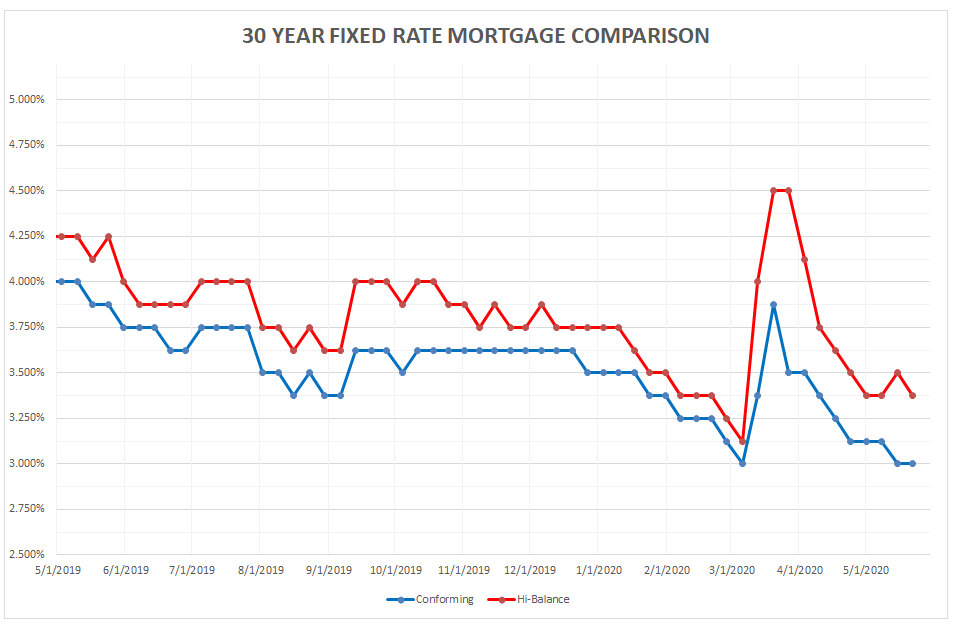
Rates for Friday May 22, 2020: Rates are barely impacted by any economic news, everyone anticipates bad news so bad news is already priced into the markets. With tensions heating up between China and the United States we have seen some instability in equity markets, enough that I anticipated rates to drop today ahead of the three-day weekend. This did not happen and rates were flat for the day. For the week the conforming rate for purchases is flat from last Friday and the high-balance rate is down a tick. Note, these rates are for purchase transactions and refinance rates vary greatly depending on many variables for loan amount, loan to value, FICO scores, purpose of loan, etc., call for quotes.
FIXED RATE MORTGAGES AT COST OF 1.25 POINTS LOCKED FOR 45 DAYS:
30 year conforming 3.00% Flat
30 year high-balance conforming 3.375% Down 0.125%
Please note that these are base rates and adjustments may be added for condominiums, refinances, credit scores, loan to value, no impound account and period rate is locked. Rates are based on 20% down with 740 FICO score for purchase mortgages.
Just because we cannot have parades or ceremonies does not mean we honor and respect those who have lost their lives wearing the uniforms of our nation’s military. For those who have lost a parent, child, sibling or close friends, I have greater sympathy for you this year as you may be impeded from visiting a grave site or attend a special memorial.
Having many of our freedoms restricted these past several months has given a greater appreciation for the freedoms we are so used to enjoying. Monday let’s all take a moment to honor those whose lives have been lost to protect those freedoms and the rights we enjoy that have always been, and will continue to be, a beacon for others who desire the same freedoms and rights.
Have a great week,
Dennis
Past Weekly Rate & Market Updates can be found on my blog page at my website www.DennisCSmith.com/my-blog