


Why are some homeowners not able to renew their insurance policies, or get new ones?
Question of the week: Is it true homeowners are not able to renew their insurance policies, or get new ones?
Answer: Yes, it is true many homeowners, and buyers, are having difficulty obtaining homeowner insurance policies in the State of California.
Quick background. California has a Department of Insurance (CDI). The Insurance Commissioner, currently Ricardo Lara, is an elected position. The CDI regulates and oversees over 1400 companies, licenses almost 500,000 individuals from agents to bail bondsmen, and regulates the industry. Part of this regulation is approving rates charged by insurers, investigate insurance fraud, and intervening for consumers in need of assistance with claims or complaints.
For the past few years, insurance companies have seen their costs in the State of California skyrocket due to claims paid on auto, and property and casualty policies. On the auto policy side of the industry, in March 2020 the CDI put a freeze on rate increases for auto policies in response to the pandemic and people driving fewer miles due to stay-at-home quarantining mandated by the state.
The auto rate freeze ran from March 2020 to October 2022, despite claims and costs soaring in the state during this period. Almost every major insurer in the state reported loss ratios over 100% in 2022 (claims paid exceed rates collected). Contributing to high claim payouts were the spike in catalytic converter thefts, $4-8,000 per incident, the higher costs of used cars impacting payout values when totaled in an accident, higher costs and scarce availability of parts to repair older vehicles.
Speaking to my friend Eric Lenahan, a State Farm agent in Seal Beach, he indicated that on the homeowners’ policy side of the business, claims costs have also increased due to costs to repair damages, and to cover replacement value of homes lost to fire or other catastrophes. As you are likely aware, during the pandemic there was a home remodeling boom, which led to a shortage of construction materials. Costs for lumber, cement, drywall, roofing materials, spiked, as did cost for contractors who were booked months in advance. If you had major damage to your home due to a falling tree, fire in the kitchen, broken pipes flooding your home, or other incident, the cost for the final repairs completed several months after you filed your initial claim could have increased, up to 20% due to higher costs for material and labor.
A major factor impacting home insurers are the wildfires in the state, and regulations preventing cancellations or non-renewals in or near those areas due to state regulation.
This convergence of market and regulatory forces has resulted in many companies writing no new policies, and/or not renewing existing policies, for auto or homeowner coverage.
Some major insurers have told their agents they can no longer write new policies in approximately two-thirds of the state. Homeowners in some areas that are renewed as seeing substantial increases in their rates.
What are your options if you are buying a home and need a new policy, or you are notified your current policy will not be renewed?
If you are buying a home, the process for obtaining a policy needs to be accelerated. Traditionally, home buyers would seek out a homeowners policy, usually from whoever covers their current home and/or automobiles, after their offer has been accepted and they are in escrow—too often at the very end of the process.
In today’s environment, I strongly encourage you to contact your current agent, whether you are a current homeowner or a first-time buyer, as soon as you start looking for a new home. Find out if they are writing new policies in the areas you are looking for your new home, estimate of what the premiums may be, and any issues you may need to be aware of as part of the process.
If you are current homeowner and you are notified your policy will not be renewed, you need to start shopping for a policy; if you own, or are buying, in a high-risk area, i.e. high wild fire risk, chances you will have to obtain a policy from the California FAIR Plan Association, a fire insurance pool of all licensed insurers. The FAIR Plan only covers property, so you will also need to get a separate liability policy. Note that FAIR Plan premiums are significantly higher than “normal” homeowner policies. Note this higher premium may impact your ability to qualify for a mortgage.
I asked Eric for advice he would give WR&MU readers, he said, “go with A-rated, established insurance companies and stay with them.” Essentially, shopping for lower rates every year, not having a history with one company for several years showing you are not a high risk, reduces the chances your policy may not be renewed. Saving a few dollars every year looking for the lost-cost carrier can very likely harm you in the future when you are unwillingly in the market for a policy.
With many insurers leaving the state, fewer writing new policies and renewing, means less competition for policy seekers. Lower supply means higher prices. Take Eric’s advice, insure with a major, A-rated, company, stick with them, and reduce your future risk to protect against risk.
Have a question? Ask me!
Inflation is slowing. December’s Consumer Price Index dropped 0.1% from November, the first decline in prices month-to-month since before the pandemic. Declining oil prices in December were the primary factor in the decline in prices. Year over year, inflation dropped from prices increasing 7.1% in last month to 6.5%. Not all the news was positive. The “core” rate (stripping energy and food from the data), increased 0.3% for the month as we up 5.7% year over year. It is still a lot more expensive to eat, whether in a restaurant or at home, grocery prices are up 11.8% from last December. Also keeping upward pressure on prices are housing costs, rents rose 0.8% in December and are up 7.1% for the year, the highest increase in 40-years.
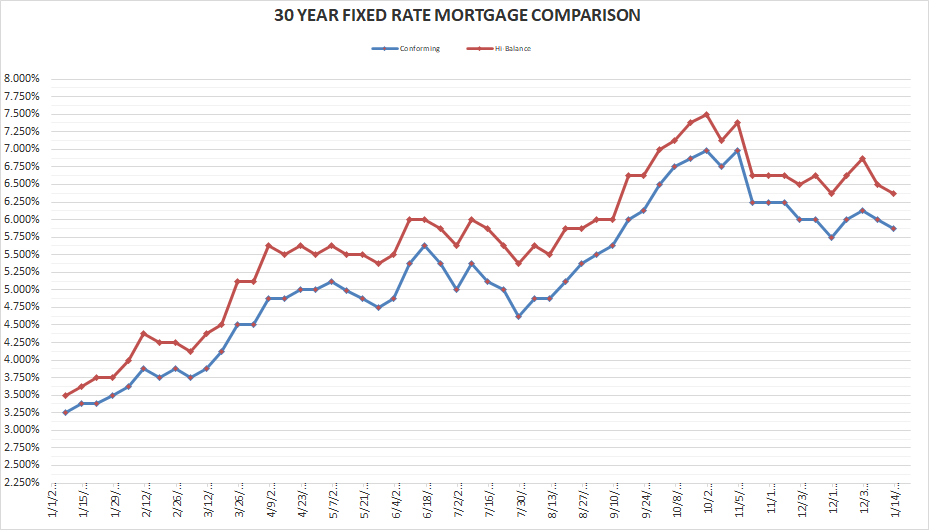
Rates for Friday January 13, 2023: The CPI news was positive for mortgage rates as they support the Federal Reserve slowing increases to their benchmark rate, investors seeing perhaps 0.25% increases in the near future as opposed to the 0.5% or higher over the past several months. We start this year with the rate chart going the opposite direction from last January; are we building momentum for lower rates?
FIXED RATE MORTGAGES AT COST OF 1.25 POINTS LOCKED FOR 45 DAYS FOR PURCHASE TRANSACTIONS:
30-year conforming 5.875% Down 0.125%
30-year high-balance conforming 6.375% Down 0.125%
Please note that these are base rates and adjustments may be added for condominiums, refinances, credit scores, loan to value, no impound account and period rate is locked. Rates are based on 20% down with 740 FICO score for purchase mortgages.
More rain over the next several days. When we have winters filled with storms, snow in the mountains and rain everywhere else, it angers me that yet again the opportunity to capture millions of gallons of water has been wasted due to the failure of our elected leaders in California. Decade, after decade, after decade…snow melt and rain water are not captured by cisterns or other storage projects. Voters have approved several bonds for billions of dollars for such projects and there has been no progress on building such infrastructure.
Knowing we will go from the current deluges of winter to droughts in the future, think of this when next we are told we have to cut our water usage. Until voters not just pass bond measures but hold elected officials accountable for acting on those measures will we see proper water management for our state.
Off my soap-box.
Have a great week,
Dennis
Past Weekly Rate & Market Updates can be found on my blog page at my website www.DennisCSmith.com/my-blog


