How much do the rate changes by the Fed impact the market?

Question of the week: How much do the rate changes by the Fed impact the market?

Note in the bottom section of last week’s WR&MU when I listed the California ballot propositions I am voting “Yes”, I inadvertently omitted Proposition 39 (require voters to show identification).

Answer: This was asked by friend and client Harvey last week, and it is a question debated from casual having a beer conversation to economic think tanks at places like the University of Chicago. How much impact does the Federal Reserve have when it moves its benchmark interest rate.

Wonky-alert…as is typical, once I started on the answer to the question, I could not help myself in getting pretty granular in my commentary. Some may want to see the pretty chart then scroll down to the summation before the economic update! Fellow economic, and political, nerds, I hope you appreciate the commentary.

Important to the conversation is the reason the Fed moves its rate, much of which was covered in the WR&MU “Is the Federal Reserve’s 2% inflation target realistic?”

“Markets” is a word that covers a lot of ground, flea markets, bond markets, grocery markets, equity markets, real estate markets, any system, venue, place where buyers and sellers exchange goods, services, and remuneration for such.

As relates to our question of the week, for “markets” we will look at the mortgage rate market and the Dow Jones, one of the most familiar gauges of the United States equity, or stock, markets.

Here is a chart that shows the Federal Reserve federal funds rate, what banks charge each other for overnight borrowing, i.e. “the benchmark,” the 30-year conforming mortgage rate as listing in the WR&MU every Friday, and below, the Dow Jones Index, and the Core Personal Consumption Expenditures (PCE), the primary gauge of inflation used by the Federal Reserve.

Fed rates, mortgage rates, stock market values and inflation from January 2020 to the most recent data to September 1, 2026 are shown below.
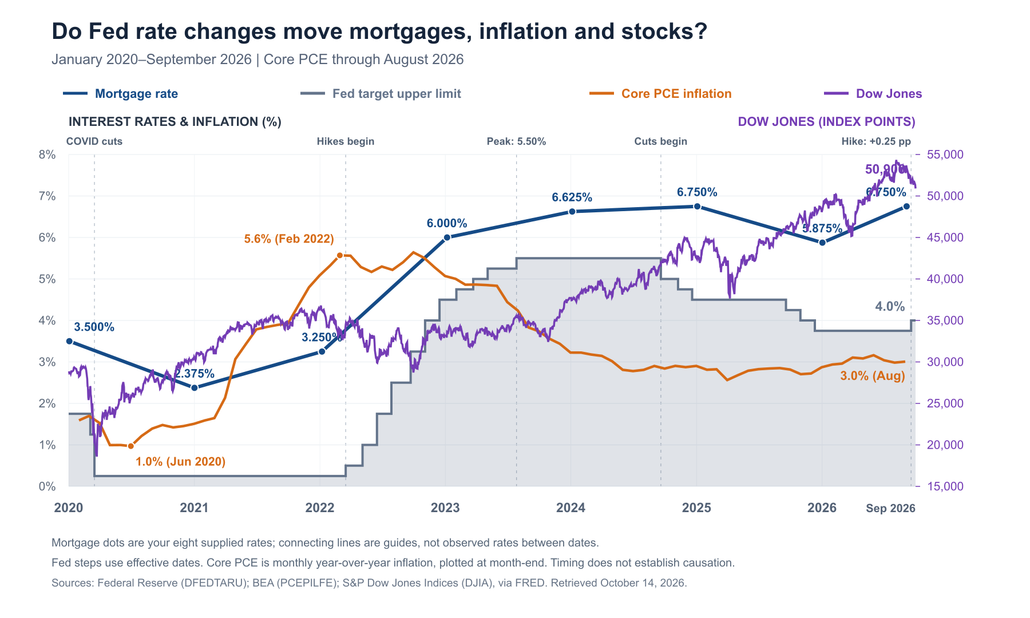
The chart starts just prior to the Covid-19 pandemic in 2020, and we see the Dow Jones (purple) drop precipitously from about 30,000 to about 18,000 as government shut downs brought the economy to a near halt. As well, the PCE (orange) dropped quickly from 1.6% to a low of 1% inflation in June 2020. Mortgage rates (dark blue) already below 4% drifted down to a low of 2.375% at the end of 2020 and start of 2021.

Our focus in on the Federal Reserve’s rate (shaded light blue). Prior to Covid, the rate target was 1.5-1.75% (as explained in prior WR&MU the Fed sets a one-quarter of one percent range for its rate, i.e. 3.00-3.25%, or 0.00-0.25%). As can be seen, in early March 2020, the Fed quickly reacted to the economic slowdown by lowering its rate 0.50% (one-half of one percent),then two weeks later lowered its rate to near zero, 0.00-0.25%.

The intention was to lower interests rates to stimulate borrowing and investment by individuals and businesses to stimulate the economy.

As you, can see, the Dow Jones rebounded very quickly in March 2020, in part due to the Fed rate change, but primarily as Zoom, home delivery of goods, and work from home caused the economy go from shut-down to operational.

After the first few months of the pandemic, inflation bottomed out at 1%, then began to climb as consumers spending increased and more and more businesses opened “as normal.”

While the Fed rate was near zero to stimulate the economy, the Fed also purchased hundreds of billions of U.S. Treasury debt and mortgage bonds pushing money into the economy.

Besides the Fed money flowing into the economy, the Federal government passed, and the President signed, the CARES Act, a $2.1 trillion stimulus package that included the Paycheck Protection Program for small businesses, direct checks to Americans and expanded spending on unemployment benefits and funds for the healthcare system.

From mid-2020 to early 2021, inflation slowly to around 1.5%.

With the Federal Reserve purchasing mortgages, and U.S. Treasuries, mortgage rates declined to a low of 2.375% in late 2020, early 2021. The ultra-low rates spurred record home prices, and number of refinance transactions, across the country.

The economic activity, and company profits, saw the Dow Jones steadily increase from March 2020 to early 2022.

In December 2020 Congress passed, and Trump signed, the Consolidated Appropriations Act (Coronavirus Response and Relief Supplemental Appropriations Act) which called for $900 billion for additional stimulus checks, unemployment payments from the federal government, and more PPP loans for small businesses. It should be noted the $900 billion was part of a $2.3 trillion omnibus bill.

With the additional spending, the Fed still purchasing bonds and mortgages, inflation began to climb from 1.4% in December 2020 to 1.9% in March.

In March 2021, the new Congress passed, and President Biden signed, the American Rescue Plan Act of 2021 the called for $1.9 trillion that included another round of stimulus checks to individuals, expanded the Child Tax Credit, and provided hundreds of billions in funds to state and local governments.

Inflation spiked from 1.9% in  March, to 3.1% in April 2021 and continue to rise until it peaked at 5.6% in February 2022, staying elevated over 5% into 2023.

Mortgage rates, very reactive to inflation, climbed rapidly from 3.25% in early 2022 to 6.00% by the end of the year.

Also concerned about inflation, as well as government spending, the Dow Jones turned down from early 2022 to the middle of the year.

During the period of rising inflation the Fed, and many commentators, stated they felt the that increase in prices was “transitory,” caused by supply-chain issues and other short-term factors. Since the price increases were temporary, in their view, so prices would fall back down and there was no need for any action.

In March 2022, after the Fed’s target rate limit had been at 0.25% for two years, it raised the rate target to 0.50%. Followed by rate increases in May, a half-percent increase to 1.00%, June to 1.75%, July 2.50% and throughout 2022 finishing the year with a hike in December to 4.50%.

While the Fed was increasing rates to combat inflation, and mortgage rates were rapidly increasing, in August 2022 Congress passed, and Biden signed, the Inflation Reduction Act of 2022 totaling almost $500 billion in spending and tax breaks.

As the chart shows, by July 2022 inflation had declined from 5.6% to 4.6%. Inflation was dropping and rather than wait to see how much and how fast inflation would decline, the Fed continued to raise its rate, and Congress poured more money into the economy.

The higher rates, and other factors, either caused, or coincided, with inflation dropping steadily through the rest of 2023 and through 2024.

After dipping in 2022, the Dow began a steady upward trend through 2023. Mortgage rates, showed investors were still concerned about inflation continuing to rise, seemingly following increases in the Federal Reserve rates, disconnecting from the rate of inflation in late 2022.

In July 2023 the Fed increased its rate one more time, reaching a peak of 5.50%. Inflation had slowed to 4.4% and continued to trend downward through 2024.

While the Fed maintained it rate through all of 2024, mortgage rates and the Dow continued to climb.

During the period 2020 to 2022, the Fed was inactive as inflation spiked. In 2022 the Fed reacted to inflation and rapidly raised its rate. As inflation began to drop, the Fed continued to raise its rate, finally pausing in 2023.

After inflation had been dropping for over 18-months, the Fed began to lower its rate in September 2024 as the target inflation rate was nearing the 2% target rate. Through the rest of 2024 and all of 2025, in continued to lower its rate until it was 3.375% in December 2025.

In early 2025 President Trump announced his tariffs across a broad spectrum of goods with most of our trading partners. Inflation remained fairly steady, staying below 3%.

In early 2026 Trump initiated the conflict with Iran, which result in the Hormuz Strait shutting down, impacting the most important commodity in the United States, and world, economies, oil. The Dow Jones dropped precipitously, inflation rose towards 4% and mortgage rates, after dropping, began to rise.  

Citing inflation concerns, the Federal Reserve increased its rate in September to 4%.

Does the Federal Reserve interest rate impact markets? Yes and no.

Markets react, “reading the tea leaves” of economic indicators and adjust their investment decisions, therefore markets, before the Fed acts. Many pundits and analysts say “this economic data will impact the Fed’s decision to raise/lower rates…” but before the Fed does act, markets already have—so the Fed decisions are often fulfilling prophecies.

It would be helpful to general economic education if analysts, commentators, and politicians, focused more on the Federal Reserve’s balance sheet activity of buying, selling, holding trillions of dollars of government and mortgage debt instead, and federal spending and deficit, instead of the federal funds rate.

Have a question? Ask me!

Reading above, you will think, “this will result in a rate increase…” The Consumer Price Index rose 0.6% in September, matching expectations, after rising 0.4% in August. Year over year, CPI increased 3.7%, with the core rate (taking out energy and food prices) rose 2.4%, the indexes rose 3.4% and 2.4% respectively in August.

Retail sales rose 0.8% in September, much higher than the 0.4% expected by Wall Street. Sales were heavily influenced by the 6.4% increase in spending for gasoline, driven by the spike in prices we have all experienced at the pump. Taking out gas, food services, auto sales and building materials, retail sales rose 0.2% in September, well below inflation. The number of sales dropped for the month when accounted for inflation.

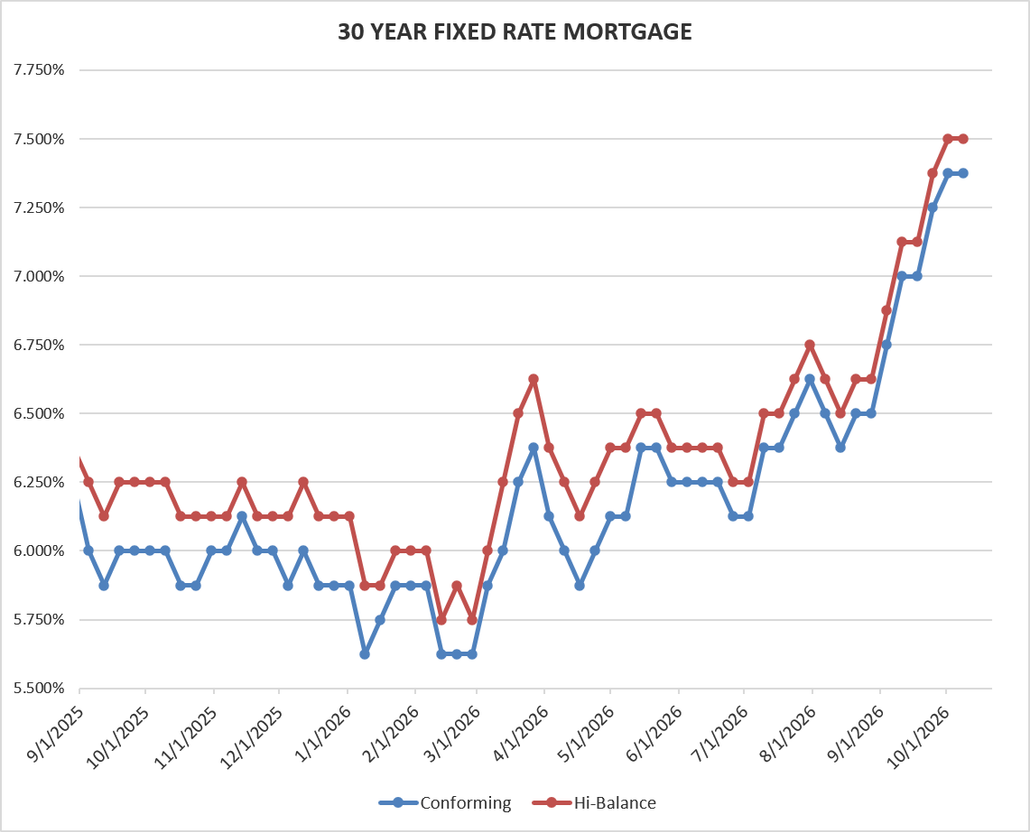
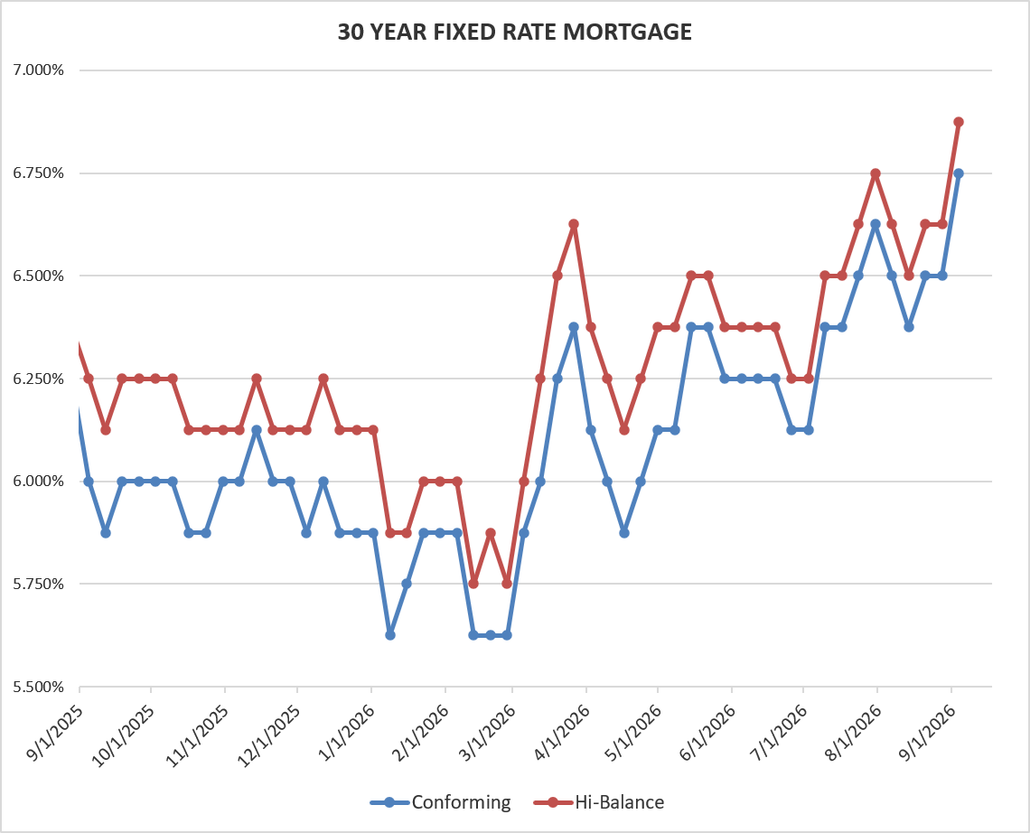
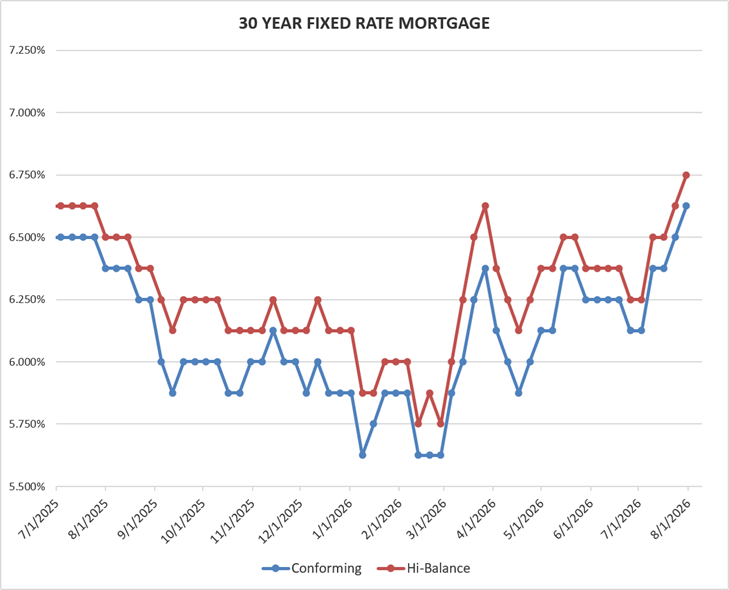
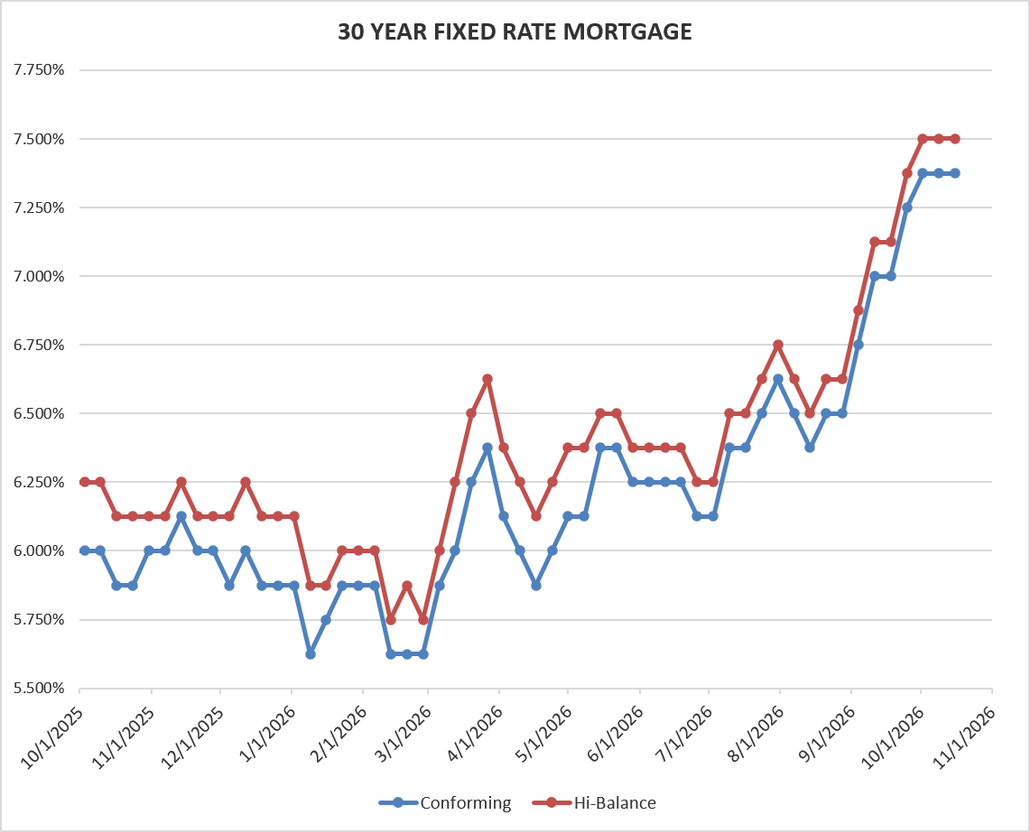
Rates for Friday October 16, 2026: Rates remain flat from last Friday, despite the inflationary CPI data. It could signal a ceiling on the current rate market. “Could.”

FIXED RATE MORTGAGES AT COST OF 1.25 POINTS LOCKED FOR 45 DAYS FOR PURCHASE TRANSACTIONS:

30-year conforming                              7.375%        Flat

30-year high-balance conforming        7.50%         Flat

Please note that these are base rates and adjustments may be added for condominiums, refinances, credit scores, loan to value, no impound account and period rate is locked. Rates are based on 20% down with 740 FICO score for purchase mortgages.
Baseball fans, taking away team loyalties, are not surprised the Dodgers lost to the Brewers for a chance to play in the World Series. They are surprised that Milwaukee swept Los Angeles, after being behind in every game. As I communicated with many Dodger fans, including my bleed-Dodger-blue daughter in New York, they know how we Phillies phans have felt watching too many games this season and in the playoffs.

Wait ‘til next year!

Do we need Prop 45?

Question of the week: Do we need Prop 45?

Answer: The last two Fridays we asked and answered Do we need Prop 37, and Do we need Prop 1? Both of the propositions are written to entice voter approval for more spending and regulations for “affordable” housing, and, in this writer’s opinion, neither proposition will have the intended results and we encouraged a “No” vote.

Proposition 45 is officially titled the “Expedited Environmental Review Process for Certain Projects Initiative.” If passed it will change the California Environmental Quality Act (CEQA) and permit streamlining of certain projects. Deemed “essential projects,” those impacted with include building projects for housing, clean energy, water supply, transportation, medical facilities, education infrastructure, wildfire risk reduction, and broadband internet access.

If Prop 45 does not pass the existing procedures and policies will remain in place for construction in the state.

As discussed in the WR&MU links above, and in earlier WR&MU’s Why isn’t more housing being built? and More costs that limit new housing construction… building new housing in the State of California is a large barrier to new construction, CEQA plays a fairly significant part in creating some, a lot, of those barriers.

The main results of the proposition, if passed, is that it accelerates construction for housing and infrastructure by enforcing strict timelines for public agencies and courts to complete environmental reviews and resolve legal challenges, thereby reducing the delays, which can take years, decades, that are too inherent in construction of major housing developments, water projects, renewable energy infrastructure and distribution and development of transit lines.

Time is money, and by reducing the amount of time it takes from plans to completion costs are exponentially lower for developers. Filing lawsuits and appeals to courts and bureaucratic departments are a primary tactic to slow down projects; with the hope the expenses and delays will ultimately kill developments.

Prop 45 will result in targeted remediation instead of wholesale cessation of development. Under the new policies put in place by Prop 45, if a court finds a CEQA violation in a project, the court can only halt the non-compliant portion of the project, whereas current law allows the court to shut down the entire project. This avoids cancelling a full project over local disputes and enables construction to continue within the guidelines of the court and CEQA ruling for a specific issue being eliminated or remediated.

Very importantly, and used as an argument against Prop 45, is that the proposition maintains existing state environmental quality regulations. Developers will be required to comply with existing environmental standards, these are not in any way amended or cancelled by the measure, what is changed is the administrative and litigation timelines that are so costly, and project killing, in the current system.

There will be higher costs for government agencies and the courts as they have to create frameworks for the expedited decision processes. However, will those administrative costs outweigh the savings, and benefits, for completing essential projects?

Opponents of the proposition are claiming that passing Prop 45 will open the door to unscrupulous development with loopholes and backroom deals (which by the way have been going on since the Pyramids—look at the number of elected officials and government administrators convicted every year for project approvals).

Another argument is that expedited court and admirative decisions will limit the ability of local communities and advocacy groups to evaluate potential hazard and provide public comments. The current system has no limit on how long opponents of any project can bring claims and issues, often delaying with one issue after another so each is taken individually, purposefully dragging out review processes and decisions, rather than presenting a list of issues at one time.

Ironically, opponents are stating the court and administrative costs will potentially exceed $100 million annually to process applications and litigation on expedited schedules. Missing from this argument is how quickly the state and local governments will receive revenue and benefits from the completed projects, and for public projects  that are expedited under Prop 45, the reduction in costs to taxpayers.

As you have already deduced, the answer to our question, “do we need Prop 45” is an emphatic “Yes.”

Have a question? Ask me!

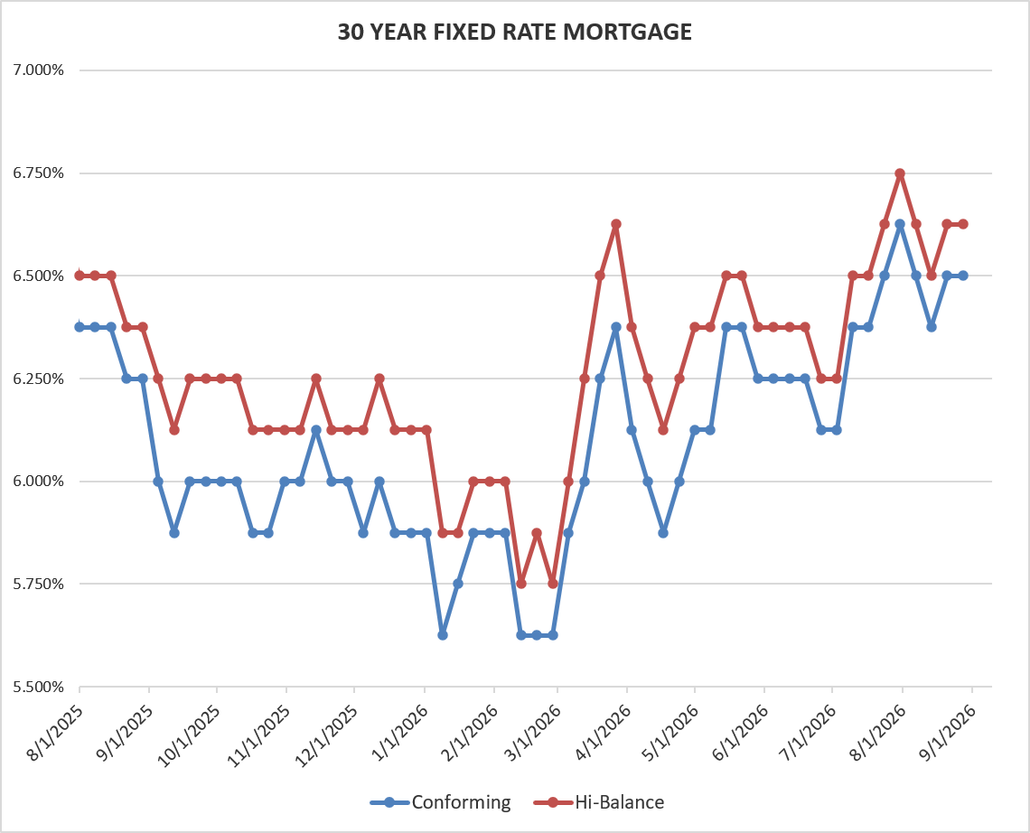
Rates for Friday October 9, 2026: Phew! We have a Friday where rates are the same as the week before. Is this a signal that rates will stay flat, possibly drop?, in the near future? That is the trillion dollar question.

FIXED RATE MORTGAGES AT COST OF 1.25 POINTS LOCKED FOR 45 DAYS FOR PURCHASE TRANSACTIONS:

30-year conforming                              7.375%        Flat

30-year high-balance conforming        7.50%         Flat

Please note that these are base rates and adjustments may be added for condominiums, refinances, credit scores, loan to value, no impound account and period rate is locked. Rates are based on 20% down with 740 FICO score for purchase mortgages.

I appreciate the inquiries and conversations the series on ballot propositions have generated. It is always dicey putting out opinions and recommendations on ballots, however since the three propositions covered directly impact housing I feel it is important to provide my opinion.

For those that care, note that Prop 45 is one of only four of the thirteen (!!) propositions on the ballot which I will be voting for, the other nine get an emphatic no. The four are 41, 42, 43, which limit ability for state and local government’s ability to increase taxes, and of course 45.

Study, research, consider implications, vote!

Do we need Prop 1?

Question of the week: Do we need Prop 1?

Answer: Last week we asked, and answered, Do we need Prop 37?, which if approved by voters will, among other things, enable the state to issue $25 billion in revenue bonds for down payment assistant program that consists of second-mortgages. If you missed the analysis from last week’s WR&MU, I’ll give you the result: No, we do not need Prop 37.

This week we look at another proposition on the November ballot in California that is intended to address affordable housing, down payment assistance and veterans home loans—as you might guess from the title of the Prop 1, the “Veterans and Affordable Housing Bond Act of 2026,” which was not put on the ballot by voter signatures but by the California Legislature via Senate Bill 417.

Like Prop 37, the Prop 1 will enable the issuing of more revenue bonds, in this case $11.25 billion.

Since are the lead in the title of the proposition, let’s look at that segment first. If passed Prop 1 will result in on bond, for $1.25 billion, that will go to the California Department of Veteran Affairs (CalVet). CalVet offers similar financing for veterans as the Veterans Administration in Washington, the big difference is that CalVet funds mortgages and the VA insures VA mortgages made by lenders.

The $1.25 billion bond will be used to fund CalVet mortgages and will be paid off by the veterans who receive the loans through their principal and interest payments. This portion of the proposition is taxpayer neutral.

The $10 billion is not. The principle and interest on this amount will be paid out of the state’s general fund and the proceeds to various programs.

The vast majority will go to subsidized housing for low-income residents, programs that focus on student housing, tribes and farm workers. These programs, according to the Legislative Analyst’s Office (LOA), will provide subsidies for up to 40,000 multi-family rental units, about 2500 units for farm workers, and about 1,200 beds for university students.

Before any interest is paid on the $10 billion, the cost per housing unit listed above will average about $240,000.  Two items to note “before interest” and building taxpayer subsidized housing in California is very expensive.

In regards to the first, the estimate is the interest on the bond will be $500 to $600 million per year for 25 years, assuming it is in the middle at $550 million, that $10 billion bond plus $13.75 billion in interest will cost $23.75 billion.

In regards to taxpayer subsidized housing, the RAND Corporation reported last year that publicly subsidized “affordable” housing in California costs 1.5 times that of market rate-built housing, and “more than four times the cost of market-rate housing in Texas.”

As discussed in August (Why isn’t more housing being built?), new construction by the private sector is severely impacted by codes, regulations, fees, and permits. The same is true for publicly funded housing, though often with more strings attached, such as labor and subcontractor mandates.

Economically, as discussed last week, down payment assistance and subsidy programs often lead to higher prices, squeezing more potential borrowers out of the market.

Sacramento, the counties, and city halls, have been unable to reconcile that their budgets indicate not a shortage of revenue, but an abundance of spending, that has resulted in hundreds of billions new taxes this century. Case in point in Los Angeles County, starting yesterday, the sales tax has increased to 11%.

By adding $23.75 billion to the budget over the next 25-years, Prop 1 will require other programs that have more positive impact on more California residents, or require even more taxes. As well, like Prop 37, Prop 1 will increase cost of housing and benefit the lucky few who are able to receive any of its so-called benefits.

More housing, at lower costs, can be had in California if politicians quit writing and passing legislation that results in higher costs, higher taxes, and more benefits to those receiving their political favors—see current abuses in homeless services, healthcare programs and other areas receiving billions of tax payer dollars.

Pass legislation that removes many of the permitting, regulations, fees, bureaucratic commissions and other hindrances to housing construction.

As with Prop 37, on Prop 1, just say no.

Have a question? Ask me!

Busy week for data crunchers with numbers coming out for incomes, spending, inflation, employment, and economic growth. Overall, the data in total is not positive or negative for rates, which could be positive if rates stabilize for a bit ahead of possibly turning down (possibly):

Personal income was up 0.2% in August, continuing a troubling trend of wages not increasing as fast as inflation.

Personal spending was also up in August 0.9%, much higher than the increase in wages, indicating either savings or credit was relied up for purchases.

Personal Consumption Expenditures (PCE), the Federal Reserve’s preferred gauge of inflation rose 0.3% in August and 3.4% year over year, a drop from July’s 3.7% annual growth. The primary data used by the Fed in the PCE report was the core rate (stripping out energy and food) rose 0.2% for the month and 3.00% from last August. A positive sign of moving towards the Fed’s 2% inflation target.

Second quarter GDP was revised from the last report of 1.5% to 2.2% growth, indicating the economy is growing at a moderate rate.

Closing the week, the Labor Department today released employment data for September and it cause a lot of red faces for those in the prediction game. The consensus forecast was for 90,000 jobs to be added to the economy in September, the data reported only 29,000 new jobs. Exacerbating the low new job total was the revision for new jobs in July and August being revised downward by 60,000 jobs.

Growing economy, slightly lower inflation, higher spending, slightly higher wages, few new jobs. Isolated some of the data is positive for rates, and some of the data is negative for rates.

What’s next….?

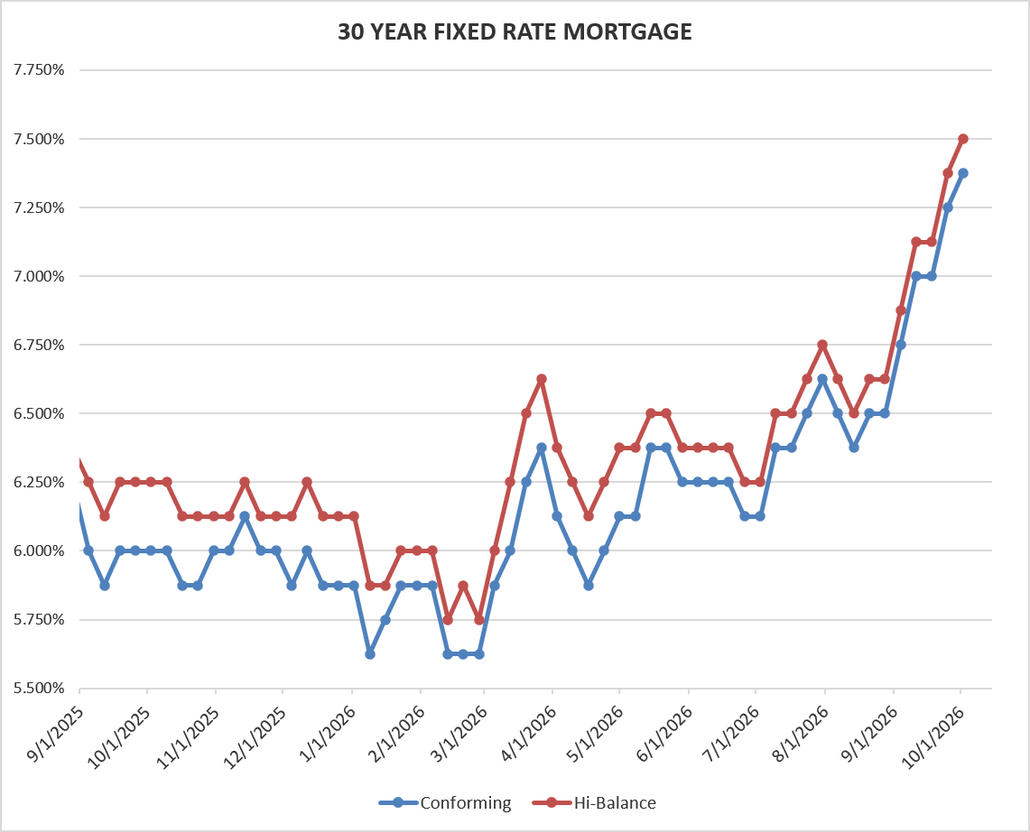
Rates for Friday October 2, 2026: Momentum has been for rates to continue to climb, but the momentum seems to be slowing. Nonetheless, rates are higher from last Friday—matching where we were at the end of September 2023—when they continued to climb to their high of 7.875% for conforming loans.

FIXED RATE MORTGAGES AT COST OF 1.25 POINTS LOCKED FOR 45 DAYS FOR PURCHASE TRANSACTIONS:

30-year conforming                              7.375%        Up 0.125%

30-year high-balance conforming        7.50%         Up 0.125%

Please note that these are base rates and adjustments may be added for condominiums, refinances, credit scores, loan to value, no impound account and period rate is locked. Rates are based on 20% down with 740 FICO score for purchase mortgages.

On April 28th, when the Phillies were 9-19 and 10 ½ games behind the Atlanta Braves for first place in their division, they fired their manager who had previously led them to the World Series (after replacing a fired manager mid-season) and hired Don Mattingly, former Yankee great, former Dodger manager, and top of my list of “should be in the Hall of Fame.” On that day I did not expect that my favorite team for over 50 years would make the playoffs.

Yes, a bit sad they did not beat the Braves so they could face the Dodgers in the next round of the playoffs. But, not disappointed due to the unexpected season they gave me.

Onto football…Go Birds.

Do we need Prop 37?

Question of the week: Do we need Prop 37?

Answer: No.

Officially the Middle-Class Homeownership and Family Home Construction Act on your November ballot, Prop 37 ostensibly will enable affordable homeownership to eligible Californians. 

Using “middle-class” in the title entices many voters to believe voting “yes” will enable their ability to purchase an “affordable” home. When examined closely, like many propositions and bills through the State Legislature, the details of what the Proposition will provide as a solution to lack of affordable housing show that the objective is nice, but the results will likely be lacking.

The Proposition will create yet another down payment assistance program via the California Housing Finance Agency (CalHFA, or “Chaffa” in the industry), this time with a second mortgage program which will be funded by $25 billion in revenue bonds.

The second mortgages will be offered at fixed-rates and cover up to 17% of the purchase price, enabling buyers to purchase with 3% down payments. This eliminates the need for mortgage insurance, either via the private sector (PMI), or federal (FHA mortgages).

Eligible properties are only new construction, or properties that are converted from non-residential to residential. Depending on the county and conforming loan limits, the sale price is capped at $1 million or $1.5 million—these will be adjusted annually when the conforming limits are adjusted.

Buyers must live in California for one year and cannot earn more than 200% of the Area Median Income (AMI).

The second mortgages are funded by $25 billion in revenue bonds and the buyers must pay the principal and interest plus program administration costs (to be determined after the Proposition is passed)—in addition to the principal and interest on the primary mortgage, property taxes, homeowner’s insurance and association fees if applicable.

Because the mortgages are backed by revenue bonds, there is not direct risk to taxpayers. But there is risk to those who purchase the bonds as they have no protection should borrowers default and go through foreclosure. The holders of the bonds will get any funds that are left through a foreclosure after the primary mortgage and other costs are paid through the foreclosure sale, or auction.

Prop 37 mandates that CalHFA keep interest costs for homebuyers “as low as possible’ while maintaining a self-sustaining pool. Essentially, the bonds will go to market, investors will bid on the bonds based on the inherent risk, and the other investment opportunities available.

“As low as possible” is what the market will absorb for highly-leveraged mortgage that gets paid after all other liens and costs are paid if there is a default. Consider that the cost to a lender when a loan goes through foreclosure is 25-40% depending on how many months behind the borrower is in payments, the condition of the property after the foreclosued homeowner, or his tenant, vacate the property, how many filings they go through before they can foreclose on the home, and then if they are able to sell on the open market or have to sell at auction. This math practically guarantees the second mortgage holder will not be paid at all, much less in full—absent an tremendous increase in sales price between purchase and foreclosure sale.

Given the current rates, a rate of 11.5% with a 30-year repayment may be generous, but there may be some foundations and nonprofits who may be willing to take the risk at that rate.

Let’s do some math…

For a family of four in Los Angeles County the Area Median Income is $108,100, to qualify a family can have up to $216,200.  For mortgage purposes we can safely loan up to 35% of their income for total house payment, or PITI—principal and interest on loans, property taxes and insurance. Thirty-five percent of $216,200 is $6305 per month, which supports a home purchase of $725,000 under this program.

Principal Interest at 7% on primary =            $3860

Principal Interest on 11.5% 2nd mortgage* =   1340

Estimate Property Taxes  =                                755

Estimated Property Insurance =                         240                    

Total PITI =                                                    $6195

*Estimating 10% administration cost

The down payment for the home will be 3% of $725,000, or $21,750, plus an estimated $15,000 – $20,000 more in closing costs depending on factors like pro-rated taxes, insurance, setting an impound account, etc.

By contrast, using FHA financing, the same buyers can purchase a $750,000 home with a total PITI of $6325, only $130 more per month, and they are not restricted to only purchasing new home construction.

In July the median home price in Los Angeles County was $946,950.

Regarding the new home construction, Prop 37 is written to get the backing of home builders, not only because new construction and conversion of property to residential from non-residential, but also because it provides protection from construction defect litigation and subsequent attorney fees.  They receive this protection if the agree to be “qualified builders,” accepting liabilities for labor violations by contractors and sub-contractors—the ubiquitous clause for unions. Other developers properties can qualify for the second mortgages, however they lose the litigation protection.

In short, Prop 37 will enable home buyers to purchase homes from developers who can build substandard properties and be shielded from litigation for lower prices than they would be qualified to purchase if they used currently available financing.

Just say No.

Have a question? Ask me!

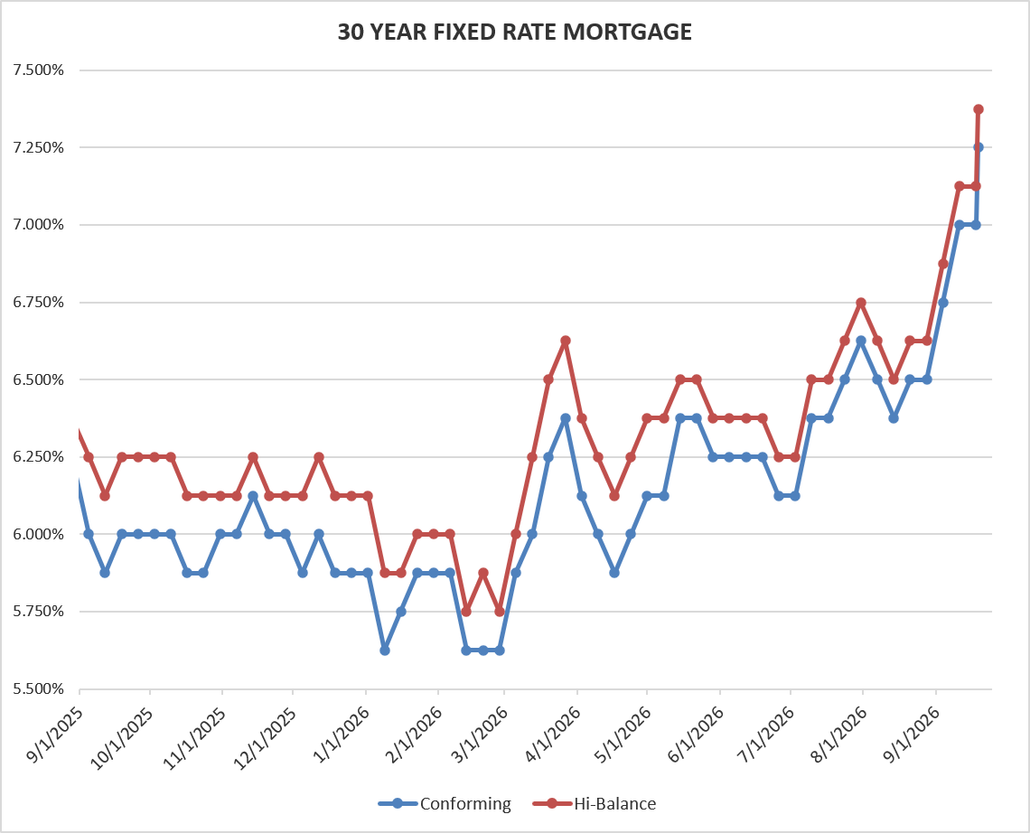
Rates for Friday September 25, 2026: Investors are very bullish on bonds and mortgages, as a result mortgage rates spike again this week, to their highest levels since October 2023.

FIXED RATE MORTGAGES AT COST OF 1.25 POINTS LOCKED FOR 45 DAYS FOR PURCHASE TRANSACTIONS:

30-year conforming                              7.25%          Up 0.25%

30-year high-balance conforming        7.375%       Up 0.25%

Please note that these are base rates and adjustments may be added for condominiums, refinances, credit scores, loan to value, no impound account and period rate is locked. Rates are based on 20% down with 740 FICO score for purchase mortgages.

We are preparing for a wet winter with El Nino predictions of heavy rainfall. Unfortunately, part of our house has a flat roof that once in a while has a leak we can patch up. After many patches and predictions of heavy rains, and several years since we have had the roof re-covered, we are undergoing a replacement and hoping it passes the “drip” test for many years!

How are you preparing?

What’s next?

Question of the week: What’s next?

Answer: In our last WR&MU, that went out September 9th, we discussed whether the Federal Reserve’s 2% target for inflation was realistic.

This week the Fed’s Open Market Committee, which sets it’s benchmark interest rate, unanimously indicated that the 2% rate target was a hard target and they will use the tools they have to reach it.

But can they?

Before we look forward, let’s take a look back. In the bullet points below where mortgage rate is listed, the rate is from our weekly chart for the 30-year conforming rate for 80% purchase 740 credit score and 1.25% cost.

Covid hits world in 2020, after world wide economy practically stops in early- mid-2020, the economy grows rapidly in recovery, growing at 4.6% rate in the 4th quarter. Mortgage rate February 2020 3.25%

Responding to the economic stoppage/slow down, the Fed reacts by cutting rates to near zero, and purchases assets to force rates down to stimulate the economy.

With rates dropping to historic lows, housing markets exploded and home prices spiked. At the same time, homeowners refinanced to rates and payments so low that they essentially become trapped in their houses, not being able to afford to sell and buy up, or down. Mortgage rates stay at or below 3% from August 2020 to January 2022.

By the end of 2020 the economy no longer needed stimulus as it was getting very “hot.” Congress passes $1.9 trillion American Rescue Plan, almost 9% of 2020 total GDP.

Extremely low rates, economy growing, 9% of GDP put into economy, leads to inflation rising steadily until it peaks in June 2022 at 7.2%. Mortgage rate starts June 2022 at 4.875% goes to 5.625%

The Fed, already with very low benchmark rate, lowered its rate to near zero in March 2020, dropping the rate 0.50% on the 4th and 1.00% on the 16th.

Despite GDP growing at a red-hot 6.2% in 2021, the Fed kept its rate near zero until March 2022 when it increased it to 0.25-0.50% as it started to react to inflation, which had climbed to 6.9%.

The Fed then started a regular rate increase until July 2023 when the rate reached 5.25-5.50%. and inflation had dropped to 3.4%. Mortgage rates have climbed to 7% in July 2023

The Fed rate remained steady until September 2024 when inflation was 2.4%, and began a series of rate decreases, ending in December 2025 when it dropped it’s rate to 3.5-3.75%. Mortgage rate drops to 5.625% in September 2024, end 2025 at 5.875%

In April 2025, President Trump announced global tariffs, throwing markets into confusion, and oil prices began to climb. Inflation went from 2.3% in April, to 4.1% in May 2026. Mortgage rates were 6.375% in April 2025, and 6.125% in May 2026.

The Fed reacted this week to the increase in inflation by raising its rate to 3.75-4.00%. Mortgage rate 7.00%

A lot of numbers and dates and data…but breaking it down, the Fed’s efforts to stimulate economy and then to depress inflation, seem to have had little to no impact.

Missing from the data above is the Federal Reserve’s balance sheet, what likely has a much bigger impact on interest rates. During, and following for a prolonged period of time, the Great Recession, the Fed purchased hundreds of billions, trillions, of dollars of U.S. Treasury debt and mortgages—thus controlling the interest rate markets and forcing them down. They retained the assets, for some periods using the proceeds from termed out, or paid off, bonds and mortgages, to purchase more of the same.

If the Fed sell off a large amount of Treasury bonds and mortgages, it instantly impacts interest rates—as opposed to raising and lowering its Fed funds rates, which has an indirect impact on rates, mostly by investors reacting to what may happen next.

What we have seen, is that pandemics, wars, tariffs, government spending, has a much greater impact on interest rates as these can create recessions (lower rates) or inflation (higher rates).

Inflation spiked at over 7%, and has dropped to under 4%, after reaching just over 2%.  During this time frame rates have gone from 7% to 7%, the Fed has raised its benchmark rate from near zero to 5.5% to 3.75% to 4.00%.

What impact has the Fed had through these cycles? Mostly emotional, or predictive, for investors, media and those looking for a simple indication of what is, or may, happen to the economy.

Back to our question of the week.

Rates will continue to remain elevated for quite some time. The Federal Reserve’s Open Market Committee’s decision to hike their rate this week was unanimous—the first unanimous decision for a rate hike in three years. As, or more, importantly, they were almost unanimous in their indication for another rate hike next month.

Mortgage rates will not drop significantly until inflation drops below 3.25%, possibly 3.0%. The primary factor that could cause this would be drop in oil and energy prices, which means a resolution to the conflict with Iran, and/or a steady and dependable supply of oil in significant amounts to offset the lack of supply that would normally be flowing through the Strait of Hormuz.

Second, would be a reduction in tariffs, in amount of cost and/or products impacted. Artificially raising prices, and/or restricting supply, which is the result of tariffs, not only increases the prices to consumers, but to manufacturers who depend on tariffed products for production. They must then raise prices, and/or cut production and labor.

Our dual-party political system creates a pendulum effect for policies and actions—for the last two to three decades, the arc of the pendulum has increased, creating more transitive change from party-in-power to party-in-power. Looking at time line above, both “sides” have had significant impact on the path that has led us to prolonged high interest rates, which have essentially killed the housing markets—and the mortgage industry.

What’s next? Likely more of the same as every two, and every four, years the controls of the pendulums changes resulting in over corrections.

Over the years I have tried to be somewhat optimistic as to “what’s next” and finding areas where we might find some opportunity for buyers and homeowners from which they can benefit from a mortgage. My optimism in this regard has been dampened by looking at the data, actions, and as importantly rhetoric, that impact our markets and economy.

Have a question? Ask me!

The overall number seems nice, retail sales increased by 1.2% in August, after dropping 0.6% in July. However, last Friday the Consumer Price Index was released that showed prices were up 0.4% in August, up 3.4% for the year, which means sales were up 0.8%–not terrible, but not great.

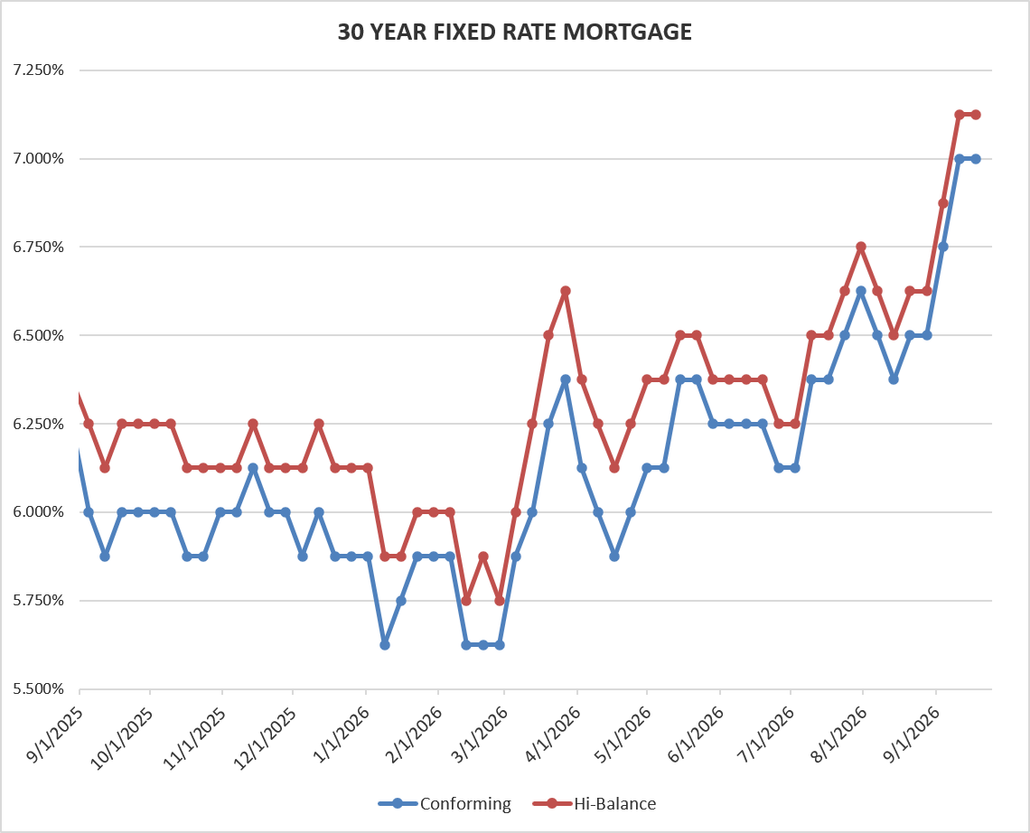
Rates for Friday September 18, 2026: Rates spiked last week, hitting their highest mark since November 2023, and then settled back down a little bit this Friday from last. Increase below will show flat, however last Friday rates were up 0.25% from the prior week jumping 0.50% from August 28th to September 11th.

FIXED RATE MORTGAGES AT COST OF 1.25 POINTS LOCKED FOR 45 DAYS FOR PURCHASE TRANSACTIONS:

30-year conforming                              7.00%          Flat

30-year high-balance conforming        7.125%       Flat

Please note that these are base rates and adjustments may be added for condominiums, refinances, credit scores, loan to value, no impound account and period rate is locked. Rates are based on 20% down with 740 FICO score for purchase mortgages.

I finished off a great summer last week with a very big “bucket list” check off. My freshman college roommate, Steve, whose strong, generational, affinity for the University of Michigan Wolverines, has football season tickets at “The Big House,” texted me in August with the inquiry “do you want to use my seats to see the Sooner in The Big House,” knowing my own very strong, generational affinity for the universal beloved, admired and respected Sooners of the University of Oklahoma. You know my answer (though it may have been PG-17 for language).

Very quickly our mutual friend, Chuck, who we met on our first day on campus in August 1980, who lives in Houston agreed to join me in Detroit for a great sports weekend. We saw the Tigers play the Rockies at Detroit Stadium (my fourth unique major league stadium this summer) on Friday night.

Saturday we were in Ann Arbor with 111,438 of our closest friends, all of about 20-25,000 were dressed in Michigan’s maize color scheme, watch the universally beloved, admired and respected Sooners lose to the home team. I didn’t even mind paying off a bet with Steve that required me to wear a bright maize colored hoody on my way home from Detroit via Denver Sunday morning—though I did explain to everyone Michigan fan who said “Go Blue” to me that I was wearing their team’s colors because I lost a bet, adding “Boomer Sooner.”

Despite the result of the game, it was one of the most fantastic sports experiences I have had in person—I put it right behind the epic Kirk Gibson homerun for the Dodgers in the 1988 World Series. Surrounded by an ocean of maize clad fans, chanting, singing, screaming to 115 decibels, or higher, in a close game cannot be properly conveyed in writing, on video or in any other manner besides experiencing.

After my travels the past 4-5 weeks Dennis’ Summer of ’26 ends with full heart, a bucket full of memories and a desire to stay at home with Leslie and Sammy for quite a while, reminiscing over the good fortune I have had to see and experience so many wonderful people, places and things.

Is the Federal Reserve’s 2% inflation target realistic?

Question of the week: Is the Federal Reserve’s 2% inflation target realistic?

CAUTION! My inner economist got away from me this morning and the following gets a bit (more than bit?) wonky. Nonetheless, I hope you will give it a read and let me know your thoughts.

Answer: Why is this a question for your weekly update that is focused on mortgages and real estate?

Great sub-question!

Mortgage rates are dependent on investors who decide which fixed rate of return assets they want to buy for their portfolios (these assets being bonds issued by government or private sector entities, and mortgages who behave like bonds as they have a fixed rate of return and defined periods of time, as well as institutional money markets, and certificates of deposits).

The rate of interest that banks pay depositors, and charge borrowers, is tied to the Federal Reserve and the amount of interest they announce as their federal funds rate, precisely the target range for the federal funds rate. This is the rate that banks charge each other for overnight loans to each other. They borrow from each other to ensure their mandated reserve requirements are met. While the exact rate of the over-night lending is not set, most banks followed the target range the Fed sets.

From this rate the Fed also sets a rate for interest on reserve balances, what it pays banks that place their reserves with the Fed. While the funds rate gets all the press, this, the IORB, is the main tool the Fed has for setting intertest rates.

One more rate that the Fed controls is the discount rate, what member banks pay the Fed to borrow directly from the Fed.

For reference, the current Fed funds rate, the “benchmark” is 3.5-3.75%, the IORB is 3.635% and the discount rate is 3.75%.

Investors look to the Federal Reserve as a primary indicator of future economic and market conditions, as such the make decisions on what and how much to buy for their portfolios based on the returns they expect, or need, in the future.

In short, after a long intro, the Federal Reserves inflation target is a primary indicator of decisions the Fed may make about interest rates that will also determine the cost, therefore the rates of returns, for assets such as bonds, and mortgages.

There are many other factors, such as government spending and borrowing, labor markets, economic growth, domestic or international events; however, the Federal Reserve is the only major factor that influences interest rates that has a fixed target objective, the 2% core inflation rate as determined by the Personal Consumption Expenditures index—currently at 3.3%.

In 2012, the Fed, under the chairmanship of Ben Bernanke, established the 2% target rate for inflation. Prior to the announcement, the Fed has a “preference” for 2% inflation, but no specific singular number.

Keep in mind that in the preceding years, as a reaction to the Great Recession, the Fed lowered its benchmark rate to 0% to stimulate economic activity and growth. To further lower rates for businesses and consumers, the Fed bought hundreds of billions of dollars of Treasury bills and bonds, as well as mortgages, called Quantitative Easing—dropping mortgage rates from just over 6% to 4% and below from January 2008 to December 2010.

There were many reasons given for the 2% hard target.

  • 2% inflation does not greatly interfere with household and business buying decisions
  • It provides protection against deflation, which can contribute to recessions and unemployment
  • It gives the Fed room to cut interest rates—something they could not do during the many variations of Quantitative Easing cycles it had recently employed
  • It gives a cushion for economic adjustments and measurement issues that show variances from month to month for various reasons
  • It creates a visible benchmark for expectations by investors, businesses, and lenders

So, the 2% number was not arbitrary, nor scientific, it was more of a compromise between being high enough to provide a buffer against deflation and recessions, and low enough that prices remain relatively stable.

Is 2% a realistic target number? Does it create false expectations and over-reactions by investors, lenders, businesses and household?

  • Arguments against the firm target of 2% are varied.
  • It leaves very limited room to cut interest rates during recessions. If inflation is 2% the federal funds rate is only about 3%, giving the Fed a 3% margin before it cannot cut rates further. A 3-4% target gives the Fed more room for fighting recession.
  • We have repeatedly seen the impact of the zero percent rate boundary, first during the Great Recession and again at the start of Covid. The Fed quickly hit the zero percent rate and had to resort to buying bonds and mortgages—actions which are inflationary.
  • A higher inflation rate makes wage adjustments easier for businesses. At 3% inflation a company can hold a wages flat, creating a 3% “real” wage reduction without having to cut wages. This helps labor markets and has the potential to reduce unemployment.
  • Very importantly, inflation indexes are imperfect; they are unable to accurately capture improvements in product quality or substitutions. Price indexes more often overstate inflation to the high side than the low side. If a 2% rate of inflation is overstated, true inflation is actually lower.
  • Finally, the 2% rate while arrived at through great deliberation, is still somewhat arbitrary—it was judgement not economic law (such as the law of supply and demand). Why is 2% good, safe inflation but 2.5% is not good and potentially harmful?

 My position is, why have a hard number target, why not use a range—as the Fed does when announcing the federal funds rate?

It is impossible to precisely control inflation. There are so many factors, beyond consumer demand, that impacts prices of all goods and services that are outside of the Fed’s control domestically and internationally—supply disruptions, weather, wars, tariffs, pandemics, earthquakes, social upheavals.

Small “misses” in the indexes when gathering and reporting data for inflation, employment, spending, earnings, are not accounted for, nor absorbable, in a fixed, hard, target for inflation.

A range enables the Fed to rebalance its dual mandate from Congress, to promote maximum employment, stable prices, and moderate long-term interest rates. All of the adjectives are subjective—except the Fed made one of them objective— “stable prices” has become 2% inflation. With a range the Fed has room to operate and changes it policies within their mandate to promote maximum employment with stable prices. If shooting for a hard target on inflation, should there not be a hard target on employment?

What are moderate rates? For years moderate rates were between 5-6%. Post Great Recession, moderate appears to have become less than 4%. Rates certainly are not “moderate” from the redefined definition of rates—which has severely hurt the mortgage and real estate markets. However, a lot of that hurt was due to the historically low rates during Covid. Homeowners who bought or refinanced into rates near 3% are not very likely to refinance to a rate more than twice as high, nor sell their home and buy a new one at a much higher price and rate. Had the low rates not caused the explosion in home prices, and real estate markets had traditionally long-term 4-5% annual growth, rates of 5-6% may be considered moderate and homes more affordable.

 How do we define “stable” prices? Since January 2024 the average of the core prices in the PCE index has been 3.15%, with the high being 3.5% in May 2026 and the low being 2.6% in April 2025—a spread of less than 1%. Does this variance over more than 30 months show prices as stable or unstable? Again, a subjective interpretation is required.

For comparison, the average for the index between January 2022 and January 2024 was 4.7% and the range was from a high of 5.6% in September 2022 and low of 3.1% in December 2023, a range of 2.5%. By any definition a sign of unstable prices and a need for the Fed to act to fulfill its mandate.

Finally, the argument against a stated range is that markets will treat the upper boundary of the range as the real target and in essence create a perceptual hard inflation target. If there is a range, how large should the range be, where should the top and bottom be set, how often should it be reviewed—all decisions would again be judgements.

There is no right or wrong answer, but plenty of opinions—unfortunately more based on political points of view and how data is interpreted by the various factions. I hope this mini-dissertation has given you something things to think about, and perhaps take different look at economic data, how it is presented, and the impact it may have on you, your family, and your business.

Have a question? Ask me!

Speaking of the Fed and the maximizing employment part of its mandate…the Labor Department announced today the employers added 162,000 jobs in August, after losing 23,000 jobs in July. Wall Street has once again missed on expectations as the consensus was 53,000 new jobs. The sector with the most jobs gained was leisure and hospitality, which added 59,000 workers—mainly in food and beverage services. Also adding to the numbers was a seasonal bump of 42,000 in the local government sector for education. The unemployment rate remained 4.1% for the prior month, indicating a balance between those starting to look for a job and those who stopped looking. Wages grew at a 0.3% for the month and were up 3.1% from last July—just under the core inflation rate 0f 3.3% used by the Fed. The data is neutral for any rate decision by the Fed and puts more impact on next week’s inflation data.

Rates for Friday September 4, 2026: Today’s data modified to the better rates from last Friday as mortgage rates spiked earlier in the week for several reasons, concern for oil prices with renewed conflict over the Strait of Hormuz, possible result of higher inflation, and heavy borrowing by the federal government. Rates hit their highest level since last May.

FIXED RATE MORTGAGES AT COST OF 1.25 POINTS LOCKED FOR 45 DAYS FOR PURCHASE TRANSACTIONS:

30-year conforming                              6.75%          Up 0.25%

30-year high-balance conforming        6.875%        Up 0.25%

Please note that these are base rates and adjustments may be added for condominiums, refinances, credit scores, loan to value, no impound account and period rate is locked. Rates are based on 20% down with 740 FICO score for purchase mortgages.

Leslie and I walk our dog together every morning.

Thirty-two years ago today she took about a 30-to-40-foot walk without me, but with her dad, across out backyard to join me in front of a minister to say our “I dos.”

I am excited to see where our future walks together lead us.

Program note—no WR&MU next Friday.

Can we increase the value of our home without spending a lot of money?

Question of the week: Can we increase the value of our home without spending a lot of money?

Answer: Yes!

This Wednesday the Rotary of Long Beach engaged in its 8th Annual Feeding the Future event. Every year for the past eight years we have collected, sourced, food and hygiene products for the food banks for Long Beach City College and Cal State Long Beach.

On Wednesday we were at LBCC, where about 50 Rotarians filled one-thousand drawstring backpacks—400 with food items and 600 with hygiene products.

As I was working, I thought about how much value we added to our community.

Rotary, Elks, Kiwanis, Lions, Optimist, Junior League, Assistance League; church organizations, Red Cross, Boys & Girls clubs, Salvation Army, food banks, YMCA/YWCA, youth sports, hospitals, museums, beach and park clean-up, senior centers, political campaigns, and many more organizations, groups and institutions have volunteer opportunities available—for all ages—that improve their communities.

Closer to home, homeowners associations and neighborhood groups add more direct community improvement that directly impact values. Our neighborhood association over the decades (today marks our 28th year in our home) has planted trees, organized emergency preparedness and response groups, street events to bring neighbors closer.

A great benefit of community involvement is the flexibility of how much, and when, you donate your time. Some retirees say they are busier in their retirement due to their community work than when they were working, and they are extremely fulfilled with their time and effort.

Thankfully, my mother, who was mentored by her mother, was very active in volunteering for politicians, PTA, youth sports, and other groups I never knew what they were, and passed down to another generation a feeling of duty, and the resulting fulfillment, of helping others.

I have spoken to many young adults about the three-legs on a stool that should be kept in balance. Family, work, community are those three legs. Two of the three get out of balance through our lives as we have demanding jobs and young children; but there is time for some community involvement that often can be one’s social engagement, working with  new friends for a common goal.

Community volunteers add intrinsic value to their communities by improving the lives of those who need assistance. As their lives improve, so does the overall community, as a community improves it becomes a more desirable place to raise families, which leads to more demand for housing, and therefore higher prices.

While home values are not the objective of community volunteering, it is a benefit that accrues over time.

Have a question? Ask me!

Chugging along is the take-away from the 2nd estimate for GDP for the second quarter. There was no revision to the initial estimate that the economy grew at 1.5% rate. Ho-hum news that had no impact on rates or markets.

Of greater import, was the data on inflation, consumer spending and personal income for July. The Personal Consumption Expenditures (PCE) index is the Federal Reserve’s preferred inflation gauge. After dropping 0.1% in June, it was up 0.2% in July; the core index (strip energy and food) was also up 0.2% (the core is the Fed’s primary data indicator for inflation). Year over year the main PCE index was up 3.7%, same as June, with the core rate up 3.3%. The core rate is well above the Fed’s target rate of 2.0%.

Households, overall, were not mathematically not impacted with the increase in prices as personal incomes rose 0.4% in the month, outpacing the 0.2% increase in prices (not “mathematically”, some/many households are certainly impacted). With consumer spending up 0.2%, and prices up 0.2%, the increase in spending was in-line with inflation, which indicates no growth inn sales for sellers of goods and services.

Rates for Friday August 28, 2026: Tracking rates from the last WR&MU on August 14th, rates are flat,  having increased last week and remaining the same this Friday from last. We are in a rate rut and absent elimination of tariffs by the United States, and also trading partners, or a major catastrophic event, not much can be seen on the horizon to create movement downward.

FIXED RATE MORTGAGES AT COST OF 1.25 POINTS LOCKED FOR 45 DAYS FOR PURCHASE TRANSACTIONS:

30-year conforming                              6.50%          Flat

30-year high-balance conforming        6.625%        Flat

Please note that these are base rates and adjustments may be added for condominiums, refinances, credit scores, loan to value, no impound account and period rate is locked. Rates are based on 20% down with 740 FICO score for purchase mortgages.

My apologies to fellow Southern Californians for bringing back very hot, very humid weather from my trip to the East Coast. Yes, I have that much impact on our meteorology!

Despite the weather, including some wonderful thunderstorms (I love them) and off and on deluges some days, the trip was wonderful. My passion for baseball was fed with seeing games with my daughters in Baltimore and my Phillies in the home park (my first time in this over twenty year old stadium, and my third home park for the Phillies dating to 1970). As well, spent a few days, and some time on a golf course, with friends from college.

An unexpected highlight, well I engineered it, was on the drive from Boston to Baltimore in a fifteen-foot U-Haul, was a stop at Walter’s. Walter’s is a hot dog stand in Mamaroneck, N.Y. that is across the school from my ninth grade high school. I pulled the U-Haul in, accompanied by my co-pilot, and daughter’s boyfriend, and had my first Walter’s dog since 1977.  Unfortunately, my slight detour caused a change in route that later led to a massive traffic jam through Lin-Manuel Miranda’s Washington Heights, resulting in our travelling fifteen miles in two hours.

Thank goodness we had the stamina and energy thanks to our Walter’s stop!

More costs that limit new housing construction…

Question of the week: More costs that limit new housing construction…

Answer: Last week we looked at the many costs that add up to make building new homes and units extremely expensive in California.

Last March we covered changes in California laws for property owners building accessory dwelling units (ADU) on their properties.

This week we combine the two, and perhaps add to some of the exasperation, frustration, and disbelief many of you expressed to me after reading last week’s WR&MU.

In the March 2025 WR&MU we covered the many changes made by the state legislature to make it easier for property owners to build ADUs. These changes were made to encourage ADU construction to provide more housing across the state. Easing of the requirements has spurred more ADU structures, increasing from almost 14,100 completed in 2022 to about 22,500 in 2025, an increase of 60%. Completed ADU construction, per the California Department of Housing and Community Development, was 38% of all single-family dwellings built last year.

But…

How many more would be submitted for permits and completed if a single part of the ADU legislation was changed, or preferably eliminate? ADUs of 750 square feet or less are exempt from local impact fees.

If your ADU is 751 square feet, or more; or if your property is big enough to build two 750 square foot ADUs, you are subject to fees that can total over $25,000. That changes the economics of your backyard unit you were intending to rent to college students or house your mother in-law.

There is a bill working its way through the legislature that will allay some fees, but still have some economic impact for those wanting to build ADUs that can comfortably house more than one or two occupants.

Senate Bill 1117 is moving its way through the legislature, as it stands now—rare is the bill that passes through committees and both houses of the legislature that does not have add-ons for various elected officials pet projects or donors—will enable local impact fees to be charged per square foot above 750 square feet of construction. A 751 square foot ADU will be charged for one-square foot in costs, a 950 square foot dwelling will be charged for 199 square feet.

This does alleviate a significant amount of fees that can be collected, however its is not zero and thus disincentivizes more available housing for more people.

If you, or someone you know, is considering building an ADU, contact me to discuss financing options.

To schedule an initial meeting by phone or Zoom, click here for my calendar, please feel free to forward to a friend or family member!

Have a question? Ask me!

July saw a slight dip in inflation from last July per the consumer price index. Overall prices were up 0.1% for the month, and up 3.4% year over year, down from June’s 3.5% annual inflation rate. Stripping out food and energy, the “core” index also dipped from June, from 2.6% to 2.5%. The core is the Federal Reserve’s preferred inflation measure, and the data supported the Fed standing pat on interest rates in the near future.

Retailers did not have a great July. Overall, retail sales in July were down 0.6% from June. Taking out auto and gas sales, the index showed a 0.2% drop. While these two items were a big contributor to the decrease in sale, the drop was much broader. Online/non-store sales dropped 2.2% for the month, countered by clothing sales up1.9%. Within the data is the retail “control group,” which not only excludes gas and autos, but also building materials and restaurants, this index dropped 0.4%, showing the decline in consumer buying was broader than autos and gas.

Taking a forest instead of trees look, year over year retail sales were up 3.5% from July 2025. Retail sales are calculated by dollars not in units, so adjusting for 3.5% inflation, sales were up 1.5% for the year in “real” dollars—a sign the economy has slowed but has not yet reversed. Overall, more data to support the consensus that the Fed will leave rates unchanged in the near future.

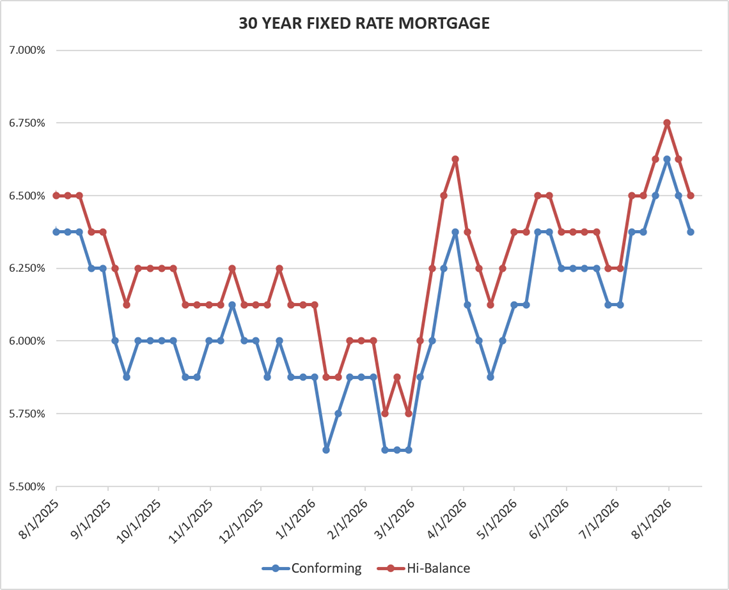
Rates for Friday August 14, 2026: After last week’s blip upward, rates are down from last Friday.

FIXED RATE MORTGAGES AT COST OF 1.25 POINTS LOCKED FOR 45 DAYS FOR PURCHASE TRANSACTIONS:

30-year conforming                              6.375%        Down 0.125%

30-year high-balance conforming        6.50%          Down 0.125%

Please note that these are base rates and adjustments may be added for condominiums, refinances, credit scores, loan to value, no impound account and period rate is locked. Rates are based on 20% down with 740 FICO score for purchase mortgages.

This is coming to you from Boston, where I am on the start of a trip that will have me going from Boston to Baltimore to Philadelphia to Fenwick Island, Delaware. Moving one daughter, seeing an aunt and uncle, seeing the other daughter to watch a Phillies game, then enjoying some time on the Delaware shore with friends from college.

Hoping my schedule will dodge the summer thunderstorms that are routine this time of year throughout the region on short notice.

Why isn’t more housing being built?

Question of the week: Why isn’t more housing being built?

Answer: Economics.

Long time readers of the WR&MU have seen supply and demand as a reason for housing costs, rates, prices. This week we introduce an economic factor that is the primary reason that restrains construction of new housing: return on investment.

With few exceptions, very few, builders of new housing, whether single family homes, condominiums, apartments, duplexes, expect to make a profit on their investment. There are many nonprofit organizations in Southern California, and throughout the state and nation, who build housing, almost all concentrating on affordable housing*.

*There are various definitions for “affordable housing.” In California, and under federal housing law, it generally means housing that costs not more than 30% of a household’s gross income within certain limits of area median income.  For example, a family of three has income of $6250 per month, maximum affordable housing is $1875 for rent. A family making $100,000 per year, would be limited to $2500 per month for PITI (principal, interest, taxes, insurance, HOA fees) for purchasing a home, which translates to approximately $280-290,000 purchase price with 5% down.

Habitat for Humanity is a national nonprofit that builds and rehabilitates affordable housing for first-time home buyers. In the Los Angeles, Long Beach area, Century Housing develops, owns and manages affordable and supportive housing, an example is their Villages at Cabrillo in Long Beach.

These entities are concentrating, for the most part, on entry level housing for families. What about those who earn too much to qualify for affordable housing, or are looking to move-up in their housing? This is where for profit developers are critical to expanding the amount of housing units in a community.

When the development is fully completed, all the units are sold or rented, the developer must have recouped, or on a path to recoup in a reasonable time frame, their total costs of development.

Obvious costs are land, architecture and engineering plans, building materials and labor. Beside property taxes, other fees to government entities or to entities that can provide required certifications can include:

  • Land use permits
    • Plan application and review fees
    • Building permits
    • CEQA environmental review (California Environmental Quality Act) for environmental impact reports
    • Traffic impact analysis
    • Transportation impact fees
    • School impact fees
    • Park impact fees
    • Fire impact fees
    • Water and sewer connection fees
    • Utility connections or placement
    • Habitat mitigation to protect endangered species or wetlands
    • Tree replacement or preservation
    • Geotechnical reports
    • Floodplain studies
    • Prevailing wage requirements
    • Accessibility requirements
    • Energy code compliance under Title 24 energy efficiency standards

Obtaining all these permits, inspections, approvals, certifications cost money, but also time. Time costs money to developers as while they wait to for each step of the process from start until they receive their coveted Certificate of Occupancy they are paying loan fees, insurance, property taxes and other carrying costs.

There are other “hidden” costs of construction in building codes, that can vary from city to city, county to county, state to state. California has some of the strictest building codes in the country. Some of these include:

  • Title 24 Energy and Climate requirements for solar energy, materials for windows, roofs, water heaters, electrical, HVAC, and lighting that are more expensive than industry standards in other parts of the country
    • Electric Vehicle charging in multifamily developments
    • EV capable conduits and electrical capacity for future chargers
    • Seismic structural requirements
    • Water conservation requirements
    • Indoor air quality requirements
    • Acoustic requirements

Many of these requirements sound great, but they add costs to construction, and certification and inspection fees.

Disclosure, I asked ChatGTP to compare the costs, excluding land, to build 2000 square foot home in Long Beach, Phoenix and Nashville. The response broke down several areas of costs, plans, permits and fees, site prep, utilities, construction labor and materials, landscaping, financing and insurance. The response estimated $700,000 for Long Beach, $540,000 for Phoenix, and $500,000 for Nashville.

As expected, labor and material costs were substantially more expensive in Long Beach, about 25-40%. Most other costs were higher for the Southern California builder by 5-10%. Permits and government fees were more than three times higher.

I input a similar comparison for a 25-unit apartment building with all the units being two-bedroom, two-bath. The analysis figured average 950 square feet, with total building being approximately 28,500 to 30,000 square feet. The total cost, and cost per unit, were significantly higher in Long Beach as large developments have more requirements that must be met than single family residences.

The overall cost was $4-5 million more in Long Beach than Phoenix and Nashville. As with the single home, government fees and permits were significantly higher, up to 50%.

A recent study by the RAND corporation found that California production cost per rentable square foot was 2.3 times more than in Texas. Cited as major factors in the cost difference between the two states were impact fees, $29,000 per unit to $1000 per unit, and substantially longer construction times.

Adding to construction delays in California is the very litigious environment in the state that enables individuals and groups to file suit to prevent construction, add additional “safeguards” for various pet projects, using different regulations or laws appealing to various government agents such as the Coastal Commission or Air Quality Management District.

Add the cost of land to the costs to build, and it is no surprise that more housing is not constructed in California, and the housing that is built is closer to the state’s $900,000 median sales price, than the affordable housing home price of $290,000.

Major home builders, such as Lennar, KB Homes, have profit margins of about 6-7%, and they have economies of scale in their favor. Single home developers do not benefit from economies of scale, and generally are looking for 10-15% on spec projects. Both large- and small-scale developers hope that cost overruns, market conditions, costs of repair post-close for warranty work, and external conditions such as weather, seismic or pandemic, impact their sales price, or ability to sell.

Developers of large housing complexes, such as 25-unit apartment buildings, require hirer rates of return as they typically intend to retain the building and have collect rents to recoup their building costs, as such their objective is 17-18%.

Per the National Association of Home Builders, its 2025 Cost of Doing Business Study showed the average net profit margin for single-family home builders was 8.7% of sales. In California, given the higher costs from land to labor to materials to compliance with regulations to permits and fees, it is not hard to understand why more homes are not being built.

Home prices remain, and will remain, highly elevated due to lack of supply in the market, more a case of current owners not up- or down-sizing than new homes being build. However, the number of new homes, or apartments, being brought to market every year will be constrained by the costs builders must pay to construct those new housing units and the impact on their return on investment.

Why isn’t more housing being built? It’s not worth it to the builders.

See below for another unexpected cost to building in the United States.

To schedule an initial meeting by phone or Zoom, click here for my calendar, please feel free to forward to a friend or family member!

Have a question? Ask me!

Surprise! Data on employment in July from the Department of Labor was significantly lower than expectations, causing markets to move. The Wall Street consensus for the economy adding 80,000 jobs in July, the data should the economy lost 23,000 jobs. Along with the job loss, earnings rose as a muted pace compared to June, up 0.1% for the month and 3.1% for the year. The unemployment rate dropped slightly, from 4.2% in June to 4.1% in July, but the drop was fewer people looking for work. The job loss was due to government jobs being cut, 53,000 government jobs were lost nationwide. In the private sector construction, up 22,000, and healthcare, up 25,000, where the winners. Leisure and hospitality shed 40,000 jobs in July. Overall, the report was rate friendly as it indicates slowing economy, which should slow inflation, which should lead to lower rates.

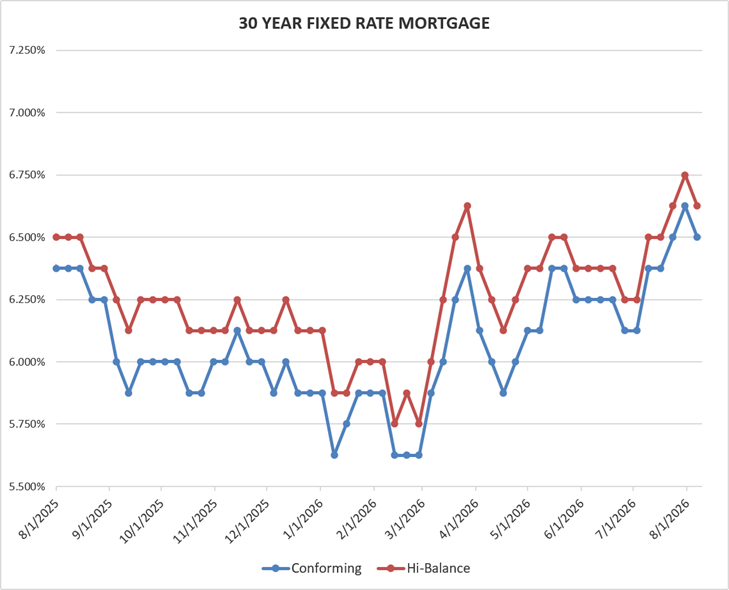
Rates for Friday August 7, 2026: After hitting a one-year peak last week, rates drift back down from last Friday.

FIXED RATE MORTGAGES AT COST OF 1.25 POINTS LOCKED FOR 45 DAYS FOR PURCHASE TRANSACTIONS:

30-year conforming                              6.50%          Up 0.125%

30-year high-balance conforming        6.625%        Up 0.125%

Please note that these are base rates and adjustments may be added for condominiums, refinances, credit scores, loan to value, no impound account and period rate is locked. Rates are based on 20% down with 740 FICO score for purchase mortgages.

I listen to several podcasts, one of my favorites is Malcolm Gladwell’s Revisionist History podcast. In May he released “The Great American Elevator Tragedy” as part of his Mistakes Series. In typical Gladwell fashion, his ties many issues and factors together, to show one reason why the cost of building new housing is so much more expensive in America than in Europe, and most of the world.

Going up?

Can I still sell or refinance my condo if the HOA has SB 326* issues?

Question of the week: Can I still sell or refinance my condo if the HOA has SB 326* issues?

*California Senate Bill SB 326 became law in 2019 and requires condominium homeowners associations to regularly inspect balconies and other exterior structures to ensure they are safe. The law was enacted after a balcony collapsed in Berkeley that killed six people.

Answer: Across the state, condo owners are being informed by the HOAs that SB 326 inspections have been informed that unsafe conditions have been found in their complexes that must be repaired.

Depending on the severity and scope of the repairs required, homeowners can, may, likely, be notified of special assessments. How much depends on the financial condition of the HOA, have they be prudent and budgeted reserves on an annual and continuous basis that can cover some, most, all of the required repairs?

Further, complexes across the state, and country, are having their insurance premiums increase dramatically, putting more financial obligations on owners. If there is increased liability for possible damage, or serious harm to occupants and visitors, due to unsafe structures, this may lead to higher premiums, or possible cancellation of coverage until corrections are made.

From a lending standpoint, complexes may be put on unapproved for lending lists by Fannie Mae, Freddie Mac, or individual lenders. This is a major issue for owners looking to sell, or refinance their units. Restricting the loan pool for buyers, reduces demand, which impacts values.

Even if a complex is on a do-not-lend list, buyers who perform due diligence will want to know when the complex performed its SB 326 inspection and its findings. If there are issues in the report that require correction, has the work been completed, if not what is the schedule and costs? And very importantly, is financing available.

Depending on the status of repairs and the overall financial condition of the HOA, there can be financing for a buyer’s purchase, or an owner’s refinance.

When I decided to continue in the mortgage industry after my partners and I closed Stratis Financial after 25-years, at the top of my needs list when researching lenders to work with was a very broad range of lenders and loan programs for me to present to my clients.  

Situations that arise, like clients needing a mortgage in a complex this is possibly impacted by SB 326, enables me, because the scope of lenders that United American Mortgage has as partners, to put together a financing package to purchase or refinance units in the complex, depending on the severity of any issues.

This breadth of available loan products enables me to work with clients who are self-employed, are asset heavy and income light, fit government programs, need reverse mortgages, commercial loans, investment properties or second homes.

Back to our question of the week, if you, or someone you know, owns a unit in a complex affected by SB 326 repair issues, yes financing for a potential buyer, or a refinance, may be available.

Regardless of your situation, if you are considering, or in need of, a mortgage, contact me to discuss your situation and options available.

To schedule an initial meeting by phone or Zoom, click here for my calendar, please feel free to forward to a friend or family member!

Have a question? Ask me!

Not surprisingly, the Fed left its benchmark rate unchanged after its meeting this week. The non-action was not a surprise, but investors raised eyebrows learning three members of the committee voted to increase the rate. Chair Warsh’s remarks were news making, not is what he said, but what he did not say. Unlike prior Fed Chairs, Warsh was more terse, less expansive in answering questions and less forward-looking and revealing about in regards to policy. This is going to be Warsh’s style, that investors will need to get used to—few, if any nuggets from his comments that can be used to decipher how they need to read economic tea leaves to predict actions by the Fed. This is by design as Warsh indicates he would like the markets to do more of the work in determining long-term rates and pricing future Fed actions, instead of relying on him, or Fed governors, to provide those nuggets forecasting actions. The markets reactions were not positive to having their clues and indications as to what to do taken away.

Yesterday was the end-of-the-month data economic data dump. Consumer spending in June was up 0.3% for the month, down from May’s 0.7% spike. Causing a bit of worrying, was personal incomes climbing 0.2%. With spending outpacing incomes, consumers either borrowed for purchases, or dipped into savings. The Personal Consumer Expenditures index, the Fed’s preferred inflation gauge, showed a decrease in prices of 0.1% from May to June, and a year-to-year decline from 4.1% in May to 3.7% in June. These indicators are positive for rates, for now.

The initial estimate for GDP in the second quarter showed economic growth slowing from 2.1% in the first quarter to 1.5% growth in the second quarter. Also, on its own, the slow growth is a positive for rates.

Rates for Friday July 31, 2026: Slowing spending, incomes and economic growth are historically favorable for lower rates. We are in historic times, and geopolitics is upsetting “normal” trends. Rates go up this week to their highest levels in over a year.

FIXED RATE MORTGAGES AT COST OF 1.25 POINTS LOCKED FOR 45 DAYS FOR PURCHASE TRANSACTIONS:

30-year conforming                              6.625%        Up 0.125%

30-year high-balance conforming        6.75%          Up 0.125%

Please note that these are base rates and adjustments may be added for condominiums, refinances, credit scores, loan to value, no impound account and period rate is locked. Rates are based on 20% down with 740 FICO score for purchase mortgages.

Do you use AI in your personal or professional roles? If so, what are the most often inquiries you make?

Professionally, I use different programs (mostly ChatGPT and CoPilot) to obtain data, confirm information, and at times perform quick math problems (amortize a loan payment, etc).

Personally, I use ChatGPT a lot for cooking and recipe ideas. I will list ingredients I want to work with, or a meal I have in mind, and ask for suggestions. It enables me to be creatives, but provides some guardrails to rein in what I thought I might do (Leslie appreciates the guardrails so dinner isn’t smoke salmon pate on grilled turkey burgers, with fried dandelion greens and a habanero radish crema on bun made of latkes).

And, a confession, looking up actors, writers, pop culture divas, for crossword puzzles…