


How do we time the market?
Question of the week: How do we time the market?
Answer: With luck.
It is impossible to perfectly time any market as to when to buy at the very bottom or sell at the very top. One reason is that the peak or bottom are usually not know until well after they have occurred as prices do not move in straight lines when grafted; they move in directions with reversals before continuing in a direction.
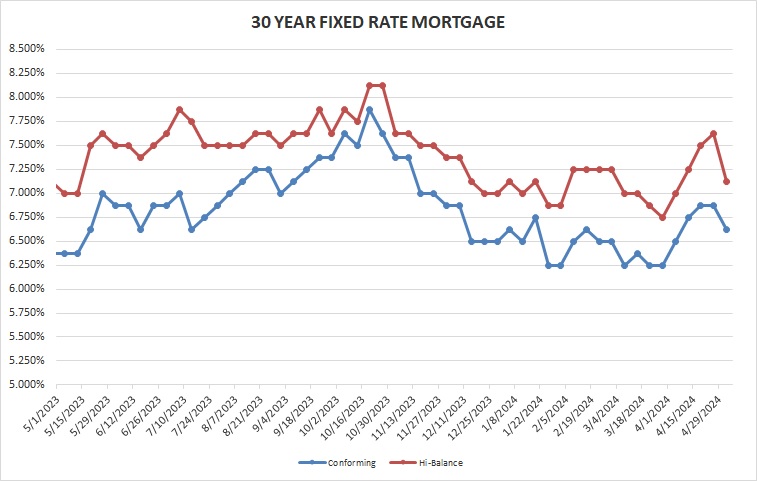
The mortgage rate chart provided in every WR&MU reflects this aspect of markets. As you can see, from May of last year until October of last year rates were gradually moving up. After October rates moved in a downward direction until February and March, when they started moving up again.
Was October the peak, or will the current trend of the last five to six weeks continue upward to reach or exceed October’s rates? Was late March the bottom, or is the dip in rates this week after climbing a run to “the bottom?” If the latter is true, how far down will they go before they go up again?
While many in the market for a new home are very interested in interest rates, home prices are likely more of a concern.
What if I buy and then prices drop? I feel I should wait about six months to see what prices are doing.
The underlying concern in this question is, “I don’t want to buy and then see my home value drop as the market drops.”
Which translates to, if I had waited, I could have gotten my home for a cheaper price.
Technically, and realistically, probably not as your current home would have been bought by someone else. That said, yes, if you waited and if prices had dropped you may have been able to purchase a somewhat comparable home in your neighborhood at a lower price.
No one wants to feel like they over-paid, or under-sold, something. This is especially true for a large ticket like your home. However, as discussed in the March 3rd WR&MU, if you wait and have mistimed the home price and/or mortgage rate markets, your cost of waiting can far exceed your cost of buying too soon.
We are seeing an uptick in families interested in purchasing homes, and this issue, timing, is a primary concern, which is why I am covering the topic again so soon after doing so in March.
Instead of making your decision as to when to purchase your new home through a filter of fear of missing out, make your decision through of filter of what homes and opportunities are available to us now.
Personally, I was told I over paid for our first home in 1994. Some agents told me I probably paid about 5% over market (about $10,000); however, the opportunity to purchase with little down payment and assuming a loan far outweighed the concern about perhaps over paying. When we sold that home in 1998 and purchased our current home, again a few agents felt we over paid for the home, again, by about 5%, about $15-17,000.
In 2024 with current home values, does it matter that we possibly paid a combined $25-27,000 too much for our homes? Absolutely not, as the equity we have built by taking advantage of opportunities far, far exceeds what we may have overpaid for homes twenty-six and thirty years ago.
If you see it, you like, and you can afford it, buy it. It’s a home, not a company’s stock or other investment.
To schedule an initial meeting by phone or Zoom, click here for my calendar, please feel free to forward to a friend or family member!
Have a question? Ask me!
As mentioned above, rates dropped this week from last, the reason was jobs data for April released today by the Labor Department. The consensus was the report would show the economy adding 240,000 jobs for the month, the realty was 175,000 new jobs. Historically, 175,000 new jobs in a month is somewhat normal; however since the economy has averaged 246,000 new jobs for the first four months of the year, April was a surprise. The primary sector responsible for the lower-than-expected gain was leisure and hospitality gaining only 5,000 jobs. For the past two years this sector has averaged 53,000 new jobs per month. The low hiring in April was surprising as the sector is still employing fewer workers than before the pandemic against factors such as a growing population and significantly increased travel and dining out.
Investors reacted very positively to the data, pushing prices higher for stocks and bonds, thereby pushing rates lower (higher prices mean lower rates). The Federal Reserve has put a significant amount of importance on the labor market in determining what to do with its benchmark interest rate, a greatly reduced number of new hires is supportive of the Fed lowering its rate. Whereas last week the feeling was that the Fed may not lower interest rates this year, today’s data has some thinking perhaps a summer rate decrease is on the table.
Rates for Friday May 3, 2024: The conforming rate has its biggest week to week drop since the end of January on the jobs data. One report does not a trend make, but investors are acting as if it does.
FIXED RATE MORTGAGES AT COST OF 1.25 POINTS LOCKED FOR 45 DAYS FOR PURCHASE TRANSACTIONS:
30-year conforming 6.625% Down 0.25%
30-year high-balance conforming 7.125% Up 0.50%
Please note that these are base rates and adjustments may be added for condominiums, refinances, credit scores, loan to value, no impound account and period rate is locked. Rates are based on 20% down with 740 FICO score for purchase mortgages.
Training, diet, treatment, technology have all been responsible for advancement in athletic achievement. The result has been a constant improvement in speed, strength, and agility for athletes to produce better results from their predecessors.
This is true across almost every sport. Except one.
The Kentucky Derby will have its 150th Run for the Roses. The record for the race is 1:59.4. The record was set in the 99th running of the Derby by Secretariat.
In the last fifty races the closest another horse has come to Secretariat’s record was in 2001 when Monarchos finished in 1:59.97. Monarchos was only the second horse to ever break the two-minute mark.
Secretariat had a historic, and miraculous, year in 1973. Not only did he win the Triple Crown that year, the first time in twenty-five years, but he not only set the race record for the Kentucky Derby, but he also set the records for the other two legs of the Crown in the Preakness Stakes and the Belmont Stakes. His race records in those two races also stand today.
When he captured the Triple Crown with the race at Belmont, he won the race by a staggering thirty-one lengths.
As race horses are specifically bred for speed, it is truly amazing that Secretariat still holds the most significant records in horse racing after half a century of improvements to athletic achievement.
The 2010 “Secretariat” is a wonderful movie, if you have not seen it, I highly recommend it. Writing this has me thinking I will probably watch it again sometime soon.
Have a great week,
Dennis
Past Weekly Rate & Market Updates can be found on my blog page at my website www.DennisCSmith.com/my-blog


