

Has the bottom passed for rates?
Question of the week: Has the bottom passed for rates?
Yes.
When the minutes from the Federal Reserve’s Open Market Committee (FOMC) December meeting were released on Wednesday, they pretty much sealed the deal that we will not be seeing any prolonged drop in rates for the near, nor medium, term and likely not for a very long time.
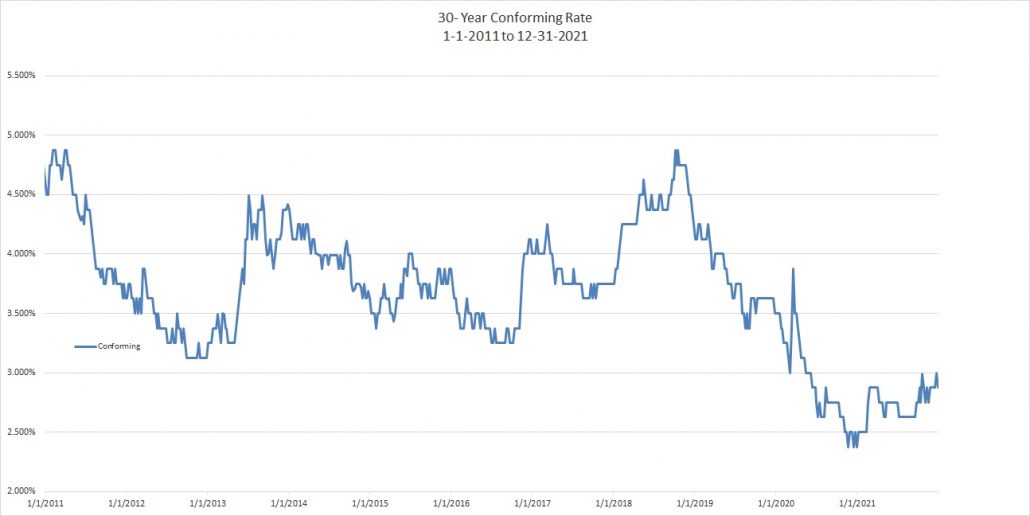
For the record, based on the data I present every week for mortgage rates, the lowest conforming rate in the pandemic market, and going back about thirty years, was 2.375%. This rate showed up in three of the WR&MUs charts, November 20, 2020, December 18, 2020 and January 1, 2021.
As you can see from the rather elementary chart below, from January 2011 through December 2021, the conforming rate has only spent about eighteen months below 3.00%, from June 2020 through December 2021. For the overwhelming amount of time over the past decade, the conforming rate has been over 3.5%, and that is where our market is quickly headed.
What was in the minutes from the FOMC* to cause the spike in rates this week? *The FOMC is the committee that sets the Federal Funds Rate, as well as the quantitative easing actions of buying and selling assets.
As mentioned in prior WR&MUs, for the past few months the Fed has talked about raising their benchmark interest rate, and stopping its purchase of U.S. Treasury debt and mortgages. Forecasting higher rates sometime in 2022 to combat the sharp rise in inflation, the Fed was letting the markets know, “get ready for a change in our actions.”
The minutes this week almost read as a panic session given had sedate and measured the language used in the released minutes. Some reports of the minutes said the members of the FOMC were “eager” to increase rates and/or not only stop buying bonds and mortgages, but to start selling those they have on their balance sheet. It is evident from the minutes that the Fed is accelerating its increasing the rate they control, and exert influence to increase rates in the markets and economy.
The question last month was when will the Fed begin to increase rates, with the expectation that when it began moving rates up, they would do so in historical measures of about 0.25% (one-quarter of one-percent) at a time, and once a quarter at most.
The FOMC minutes indicate that the increases will begin in the 2nd quarter of 2022. While no specific timing is indicated as to when the Fed may begin to start to sell assets from its balance sheet*, it appears this may also start to occur in the 2nd quarter. *Putting bonds and mortgages on the market will increase supply, which will lower prices, which will push rates higher.
Fed governors are no longer concerned about labor markets, feeling that they have achieved the goal of maximum employment. They are very concerned about inflation, and have changed their outlook expecting inflation to be higher than previously expected through 2023.
Economists consider a Fed Funds rate of 2.5% to be considered “neutral;” putting no pressure on rates to increase or decrease in a stable economy. The rate has been near zero since right after the pandemic started. If 2.5% is neutral, and the target, how fast will the Fed raise rates to reach that number?
It is important to remember that the Federal Reserve does not control mortgage rates, investors do. However, investors react to what they expect to happen in markets. The Fed is telling investors they should expect higher interest rates, investors will move their investments accordingly, which will result in higher interest rates.
One reason the Fed does announce its intentions for changes in policies is to give investors time to adjust their behavior and avoid a sudden shock to markets which could lead to large drops in prices and lead to a crash or major correction. If investors react such that rates increase enough to slow inflation faster than the Fed had intended, the Fed may change its timing and size of changes in rates.
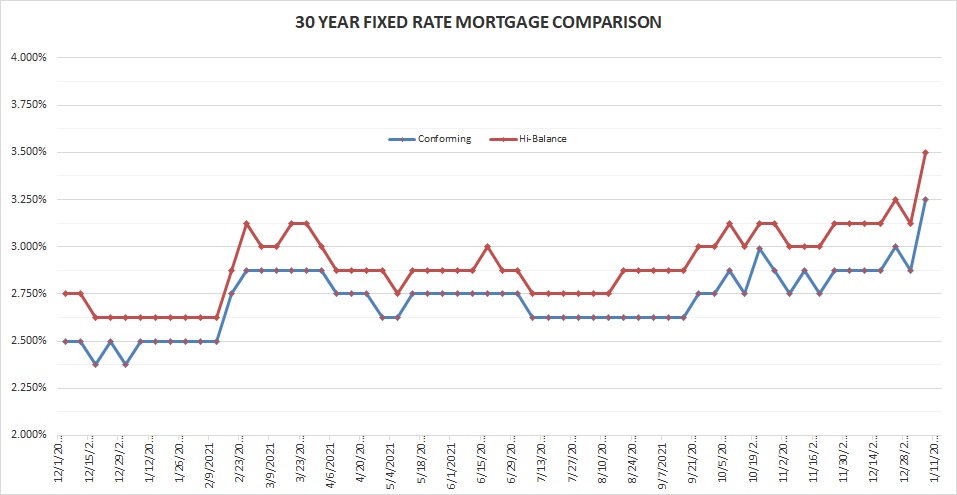
Looking forward, we will need to wait for the increase in rates from this week to pause and then see where our new range of rates will settle before the next move into a higher range. By “range” if you look at the charts, especially the one-year chart below, you can see that rates for 2021 were mostly in the range from 2.50% to 2.75% for the year.
Have a question? Ask me!
Jobs data for December were released today and the numbers for the month were rather tepid. Less then 200,000 jobs were added to the economy in December, less than expected, especially since there is typically an increase in hiring in December for seasonal work.
Wages increased 4.7% in 2021, the largest annual wage gain in decades. However, with inflation through November at 6.8%, and when price data is released next week for December expecting to show inflation to be at 7% or higher for the year, in real dollars workers took more than a 2% pay cut. Real dollars are defined as wages after inflation.
The economy added about 6.4 million jobs in 2021, and there are about 2.9 million fewer workers than in February 2020 just prior to the pandemic. Will those jobs come back? If they do, will they result in a slow down in wage increases? Or will inflation result in a slow down in consumer spending, which will lead to a slow down in the economy, leading to layoffs and possibly recession in late 2022 or early 2023?
If this is the route the economy takes, we can expect rates to flatten and then decline late in 2022 or early 2023, but decline from levels higher than today.
Rates for Friday January 7, 2022: Rates have their highest one week increase since the conforming rate went up 0.375% and the high balance rate went up 0.875% from Friday March 6 to March 13, 2020.
FIXED RATE MORTGAGES AT COST OF 1.25 POINTS LOCKED FOR 45 DAYS FOR PURCHASE TRANSACTIONS:
30 year conforming 3.25% Up 0.375%
30 year high-balance conforming 3.50% Up 0.375%
Please note that these are base rates and adjustments may be added for condominiums, refinances, credit scores, loan to value, no impound account and period rate is locked. Rates are based on 20% down with 740 FICO score for purchase mortgages.
Either later this evening, or sometime over the weekend I will begin a process that I do not look forward to, and enter with some trepidation.
For some time, I have needed to replace my smartphone; some time probably being about two years. It has been five years since I purchased my last phone. My Galaxy S7 is well past its prime, and I finally got tired of always making sure I was near a charger, and carrying a portable with me if necessary. After talking about doing so, I made it my New Year’s resolution, my only resolution, to upgrade to a current model. Purchase accomplished. Now the part I dread, setting up the new phone.
My kids tell me that transferring to a new phone is very simple, and I vaguely recall a seamless in 2016 when I last engaged in the endeavor. Knowing this, I still have anxiety about making the transition. Oh, and I still miss my Blackberry. I am a mobile device troglodyte!
Have a great week,
Dennis
Past Weekly Rate & Market Updates can be found on my blog page at my website www.DennisCSmith.com/my-blog


