About that property tax bill…
This week’s question of the week is a repeat from last October, however the topic is one I feel should be addressed every year for homeowners in California.
Question of the week: We just received our property tax bill…
Answer: Okay, okay this is not a question; it is the start of a question. There are several phrases to make it a question I will quickly go through this week:
…why is it lower than you estimated when we purchased our home earlier this year?
…why is it higher than last year since we are under Proposition 13?
…how much should we pay?
…why is it lower than you estimated when we purchased our home earlier this year?
If your property tax bill is significantly less than my estimates when we funded the loan to purchase your home then you will very likely receive a supplemental tax bill, if you have not received one already and the two bills added together, the tax bill you have just received from the County where your property is located and the supplemental tax bill, should be close to the estimate we used when you purchased your home.
In California, the fiscal year is from July 1st to June 30th. The tax bill property owners have received in the past week from their County Assessor has an option of paying half the bill by December 10th covering first half taxes from July 1st to December 31st and the other half by April 10th covering the second half taxes from January 1st to June 30th. The tax bill mailed in September or October is based on the prior tax bill as adjusted for Prop 13, or if there was a transfer the value on January 1st.
When you purchase a property the tax base for the property is adjusted based on your purchase price. Depending on when you purchased the property the new value may not be adjusted by the County Assessor before the tax rolls are set for the coming fiscal year. If this is the case the tax bill you have received reflects the prior assessed value plus and adjustments for Prop 13 (see below) or additional payments for taxes or bonds put in place by voters or local government. This is the primary reason your tax bill is probably lower than you anticipated, and why you will receive, or have received, a supplemental tax bill.
The supplemental tax bill covers the difference between the taxes on the tax bill and the taxes you should be paying from the date of the close of escrow on your property purchase to the end of the fiscal year, June 30th. Depending on the seller’s assessed value and your purchase price the supplemental bill can be very large, very small, or even “negative,” in which case you will receive a refund from the County.
Supplemental tax bills are only mailed a few times a year, so it may be some time after you closed your purchase before you receive your supplemental bill. Please note, if you have an impound account and your lender is collecting and paying your property taxes that your supplemental bill is not sent the supplemental tax bill, the payment is entirely your responsibility.
Confused? Let’s say you purchased a home for $650,000 and closed escrow on February 7th. Using our rule of thumb of your property taxes being 1.25% of the purchase price your annual taxes the first year of ownership should be $8,125 per year ($4062.50 for the first and second half tax bills). Your seller purchased the property in 2000 for $375,000 and their assessed value has risen through the years and their tax bill the year they sold the property was $5500. You just received your first property tax bill from your County Assessor and it shows you owe $5610 conveniently payable in two payments of $2805 each.
There is a difference in annual taxes between what you should be paying and what you are being billed of $2625. However, this will not be the amount of your supplemental tax bill as that is the annual property tax differential and you only owned the property since February 7th, not July 1st of the prior year. There are 143 days between February 7th and June 30th, and that is the period which the higher assessed value should be applied for property taxes. Therefore, your supplemental tax bill will be the annual property tax differential divided by 360 days multiplied by the number of days you owned the property between the sale date and end of the tax year:
$2625/360 = $7.29 per day x 143 days = $1042.71 as your supplemental bill.
Note that depending on your closing date you may receive more than one supplemental bill.
It can get pretty confusing, however most County Assessor websites have links where you can input your address, sales price and closing date and it will calculate your estimated supplemental tax bill.
…why is it higher than last year since we are under Proposition 13? Prop 13 was passed at the ballot box by California voters on June 6, 1978. There were three major items in the measure that immediately impacted property owners in 1978. First, it decreased assessed values by having all properties in California re-assessed to their assessed values in 1976. Second, it capped the assessed value of real property taxes by to the state at 1% of the ad valorem value of the property, i.e. the transaction value. Third, it limited increases to assessed values to an inflation index but not to exceed two percent (2.00%) per year.
It is the third factor that confuses many new or experienced property owners when they receive their property tax bill that the total is higher than what they paid the year before. Since property values are increasing your assessed value is increasing as well, but not more than two percent above the assessed value from the prior year.
Also surprised are those property owners who do not follow the news or politics. Their surprises come in the form of special assessments put on tax bills by either voters or elected officials in the form of bonds or taxes. For instance for our home in Long Beach we have nine such assessments that add 29% to our base tax rate of one-percent. Three of the assessments are local bonds for the Metro Water District, Long Beach Community College District and the Long Beach Unified School District; the other six are county measures and bonds for parks, flood control, sanitation, etcetera. Every city and county has different special assessments on their property tax bills that are added to the one-percent maximum taxable assessment from the state.
…how much should we pay?
Before I answer here is the disclaimer: I am not a tax professional or accountant, before you make any decision as to how much you should pay in property taxes this year consult your tax preparer.
In December 2017, the federal tax reform was enacted in Washington D.C. Part of the new tax act was capping the deduction for State And Local Taxes (SALT) to $10,000. This impacts residents and homeowners in several states, including California. Why bring this up? Some individuals or families may want to consider paying their first and second half property taxes in 2019 if they will not reach the $10,000 limit in SALT paid in 2019 and predict they may exceed it next year. Before making this decision consult with your tax preparer who can review your options and help you forecast next year’s income and possible tax liabilities for 2020.
Repeating my disclosure: I am not a tax professional. Before making any decisions regarding our taxes please consult with your tax preparer.
If you own property I strongly recommend you have two professionals assist you: a family law attorney to help you establish an estate plan with a trust and a professional tax preparer to ensure you are maximizing your tax opportunities as well as able to provide advice when needed.
If you have any questions on property taxes please do not hesitate to contact me and I will assist you the best I can.
If you, or someone you know, do not currently pay property taxes I am very willing and able to speak with you about how you can purchase property and become a homeowner!
Have a question? Ask me!
After last week’s busy economic calendar this week saw little in the way of major economic data that would have big impact on rates. What did have markets moving was announcement from Chinese government late Wednesday that China and the U.S. were very near a phase 1 agreement to rollback some tariffs. This made equity markets happy and bonds, mortgages sold to purchase stocks—stocks up, rates up. The news was called premature by the U.S. and was seen as a negotiating ploy by the Chinese to put pressure on the White House to take whatever China has on the table to announce a deal. Stocks sold, bonds and mortgages bought. So the see-saw in markets continues to go up and down based on rumors, announcements and tweets regarding the Sino-American trade dispute.
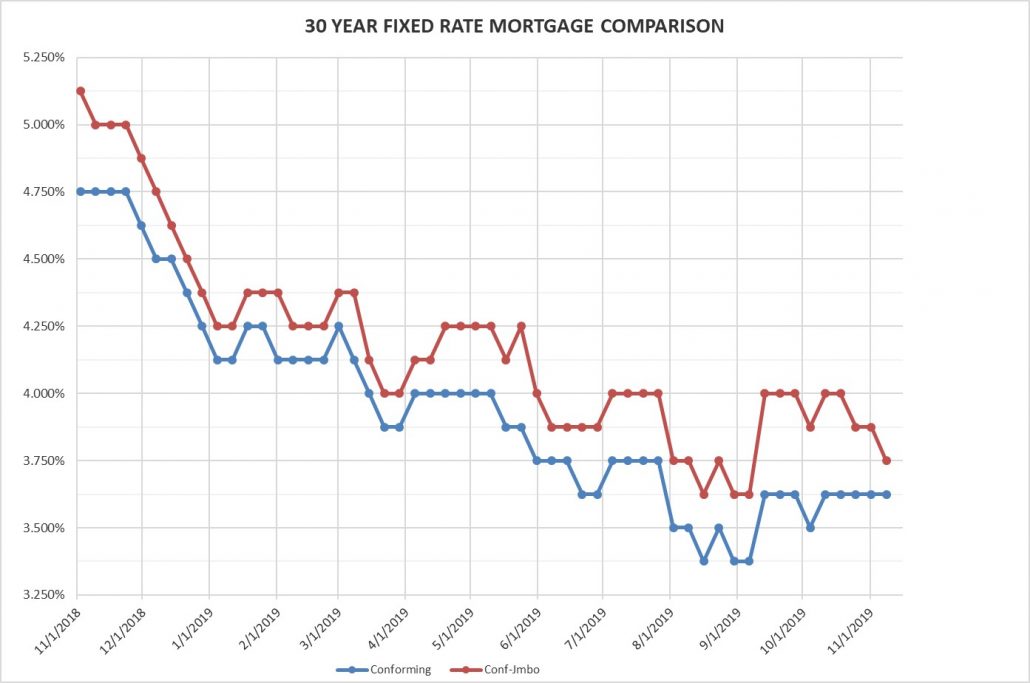
Rates for Friday November 8, 2019: After the inter- and intra-day ups and downs the conforming rate is flat for the fourth Friday in a row. The high-balance has dropped this week at two of our lenders. Why with some lenders but not others? Lenders have a bit of restriction on what percentage of their mortgages with Fannie Mae and Freddie Mac can be “high-balance” (over $484,350 and in LA and Orange Counties no higher than $726,525). When lenders are near the threshold they raise their rates on these loans, if they are not near their lending limit they lower their rates. The advantage Stratis Financial has is we can sift through several lenders to see who is offer what rates on any given day for any give product.
Rates and markets are still “edgy” to news and views, my advice is not to try to hit “the low,” but lock in your rate as soon as you are able.
FIXED RATE MORTGAGES AT COST OF 1.25 POINTS LOCKED FOR 45 DAYS:
30 year conforming 3.625% Flat
30 year high-balance conforming 3.75% Down 0.125%
Please note that these are base rates and adjustments may be added for condominiums, refinances, credit scores, loan to value, no impound account and period rate is locked. Rates are based on 20% down with 740 FICO score for purchase mortgages.
I don’t understand how when we travel to other time zones I almost instantly adapt to the new time, but when we change our clocks at home my rhythm gets messed up for several days. Maybe I should pretend I have travelled somewhere in the fall and spring when we shift our time pieces!
Have a great week,
Dennis
Past Weekly Rate & Market Updates can be found on my blog page at my website www.DennisCSmith.com/my-blog