
Why should we shop for our new home in the rain?
Question of the week: Why should we shop for our new home in the rain?
Answer: Unlike most of the country, Southern California—most of California, has rain only a few months of the year, usually between late October and early to mid-March. Rain can be extremely destructive to property over the long-term and the opportunity to see how a property is impacted by rain should be a major factor in your home buying decision.
Consider the home owner who looks at homes in early April and finds one they really like. The last substantial rain in the area was in late January and early February. The property had some issues in the prior rainy season. Some small leaks from the roof and a skylight resulted in water spots on the ceilings. Windows on the south side of the family room leaked and resulted in some damage to part of the molding. In the rear of the house the run-off from the gutters pools around the exterior walls as high as three to four inches and drains by seeping below the foundation.
The seller of the property painted the interior of the home, including the ceilings with the water spots. Took some putty and paint and patched the moldings on the windows. Washed the exterior walls and planted some flowers and large plants where the water pooled and showed evidence of water creep.
The couple purchases the home and after a very hot spring, summer and early fall an El Nino arrives and there is significant rain and wind from early January through February—not dissimilar to our weather this year. Early on they discover water dripping through the ceiling in the kitchen and dining room, water was coming in through the south side of the family room and the water was getting very high where the gutters drained so that they had to carve a trench into their back yard to release the pond that was developing.
In this case the seller knew about the issues and did not disclose them to their real estate agent nor the buyers. Their defense could be that it had not rained for some time as the prior winter was fairly dry so they are not liable for the problems with the rain and water damage.
Since the trouble spots were covered up the physical inspector hired by the buyers could not detect the issues as everything appeared normal and there is no way to adequately test for how a property will react when several inches of rain falls over a short period of time.
The buyers incur expenses to replace their roof, replace windows and install hardscape and drainage systems to ensure water is kept away from their home and drains properly. The good news is their home is in tip-top shape and ready for foul weather; the bad news of course is thousands, tens of thousands, of dollars needed to be spent right after they used their savings to purchase their new home.
Imagine if the buyers had been able to inspect that same home this weekend after the storms we have had come through in the past several weeks? Any water issues a home may have would be evident and potential buyers would have a very good idea of what corrective measures would need to be taken and have professionals estimate costs to cure the issues. Buyers could then have these costs in mind as they determine whether to make an offer or not and if they do so how the price may be impacted in consideration of future costs.
It is important for me to note that the scenario where a seller purposefully hides known defects is not the normal case of real estate transactions. The same couple could have purchased the same home and the home had no noticeable issues with rain water and weather, however after a long summer and possibly eight or nine months before the next rain the same issues could present themselves. Southern California weather takes its toll on buildings with the constant sun and dry weather.
While summer is the hot season for temperatures and also housing markets, looking at homes to purchase during the summer can be a detriment in the long term. I have always felt that in Southern California it is the wet and windy winters that are the best time to house hunt in order to see how your potential new home handles our worst weather.
If you are considering purchasing a new home please contact me so we can develop a strategy for your purchase and the best mortgage options and purchase price to acquire your new home.
Have a question? Ask me!
The economic data presented this week suggests rates should go lower. Long time readers of the WR&MU know that good economic news pushes rates up and not good news pushes rates down. News that puts upward pressure on rates are inflation over about 2%, strong retail sales, strong GDP growth and strong job market; the opposite of those actions on those factors generally leads to lower rates.
Prices were flat for consumers in January, literally with 0.0% increase in the Consumer Price Index. Held down by a drop in gasoline prices. Stripping out energy and food prices, called the core price index, prices increases 0.2% for the month and was up 2.2% year-over-year. The Producer Price Index did not fare as well, dropping 0.1% in January after a 0.2% drop in December. The news is positive for lower rates as higher inflation is healthier for the economy and growth.
Wages bucked the price trend, with “real” wages (adjusted for inflation) rose 0.2% in January and year over year are up 1.7%. Good news for the rank and file (excludes executives) whose wages are up over the past year by 2.1% . The stronger wage gains are not positive for rates as higher labor costs theoretically are passed on to consumers creating higher prices, known as wage inflation. Strong wage inflation puts upward pressure on rates.
With the government shutdown concluded we finally get retail sales data for December, and it is not positive. In fact, sales in December dropped 1.2%, the biggest decline since September 2009. There were numerous factors that could have contributed to the large decline, poor weather, the start of the shutdown, mummers of recession and a huge drop in gas station receipts (down 5.1%) due to lower prices. It appears, however, that the drop was attributed to other factors as well and it puts into question the strength of the economy in the 4th quarter. The biggest surprise in the report was a 3.9% drop in internet sales, but also dropping were sales across the board at restaurants, bars, apparel, home furnishings, virtually every consumer category. The news is very friendly for lower rates as consumer spending is 65-70% of our economy, a slow down in consumer spending opens the door for those mummers about recession.
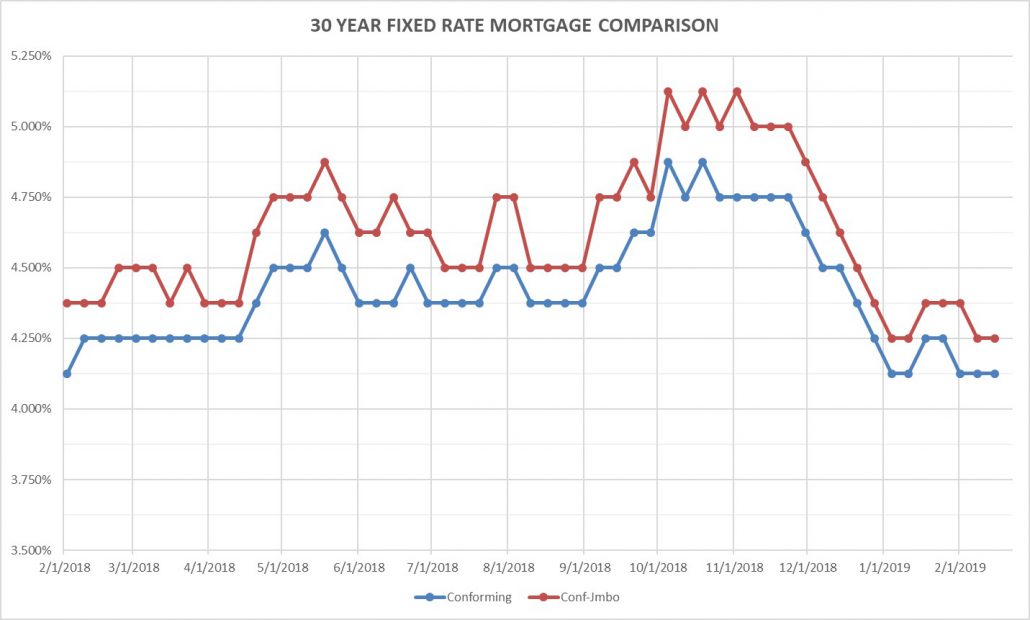
Rates for Friday February 15, 2019: There is a lot of information influencing markets, and while rates have been stable week to week they are ready to break out higher or lower. The ongoing trade negotiations with China, political fighting continuing in Washington over budgets and expenditures and the not great economic news all are influencing investors. Looking ahead rates should go lower based on data, but as we have seen over the past six to twelve months, data is not the primary driver in investor decisions that influence rates and markets.
FIXED RATE MORTGAGES AT COST OF 1.25 POINTS LOCKED FOR 45 DAYS:
30 year conforming 4.125 Flat
30 year high-balance conforming 4.25% Flat
Please note that these are base rates and adjustments may be added for condominiums, refinances, credit scores, loan to value, no impound account and period rate is locked. Rates are based on 20% down with 740 FICO score for purchase mortgages.
Continuing weather talk from above, I like the stormy winter (for California) weather. I can say that because I do not live in an area negatively impacted by mud-slides or blocked highways. It can interfere with weekend activities, but spending a Saturday or Sunday inside cozied up with sweatshirts, hot beverages and a good movie or book definitely has appeal.
Unfortunately, the rains are part of the California Trilogy of Tragedy which occurs when we have years of deluge and not drought. The rains cause tremendous abundance of undergrowth and grasses that die off in the summer dry weather and become tinder for the fall to start and spread wildfires which burn off all the ground cover and create barren landscapes that become mudslides the next rainy season. Rain, fire, mud, repeat.
Fires and mudslides in the middle of the wilderness are not tragedies, they are part of nature over the eons and millennia; when homes and developments are permitted in and immediately adjacent to wilderness areas the trilogy results in tragedy for towns and families. We will continue to see the cycles occur with loss of homes to fires or slides as long as local and state government issue permits for development collecting tax dollars in return.
Off my soap box.
Have a great week,
Dennis
Past Weekly Rate & Market Updates can be found on my blog page at my website www.DennisCSmith.com/my-blog