What has the biggest impact on mortgage rates?
Question of the week: What has the biggest impact on mortgage rates?
Answer: News.
Political news, geo-political news and economic news impacts interest rates.
Mortgage rates are the result of investors either buying or selling fixed rate financial instruments—i.e. bonds and investments that behave like bonds such as long-term mortgages, which are bundled and sold as Mortgage Backed Securities (MBS). Interest rates move inversely to the price of the bond, or MBS. If more investors are selling MBS then prices will drop, which will push mortgage rates up; if more investors are purchasing MBS then prices will rise, which will push mortgage rates down.
What determines whether investors will be buying or selling? Extrapolation, anticipation, historical behavior, expectation and speculation. If you knew that a certain piece of news would benefit DCSmith Industries creating more sales and revenue, you would buy stock with the expectation the value of the stock would rise, increasing your investment. If after you own the stock there is some news expected to come out, or that has just come out, that would be detrimental to DCSmith Industries harming revenue you would sell the stock to retain your gains.
Investors do exactly that, except for fixed rate investments the information processed to anticipate whether prices should go up or down on bonds and MBS is different than the information processed to forecast future prices for individual companies. News is the currency of investors when it comes to fixed rate investment. And good news is bad and bad news is good when it comes to higher or lower rates.
Generally speaking, investors have two choices. They can trade equities (stocks in individual companies) or fixed rate instruments—bonds, mortgages. Historically, if equity markets are rising in price, fixed rate investments are dropping in price because investors sell their fixed rate investments to purchase the equities. The opposite is also true, if investors are selling equities they will generally take the sale proceeds and purchase fixed rate investments.
Good news creates a positive economic environment that boosts growth, and therefore sales and revenue of companies. With the expectations that the growth will create more value for private companies, with higher dividends and stock prices, investors will increase purchase of equities causing prices to increase.
This activity will reduce the demand for bond and MBS, causing prices to drop and rates to increase. Further influencing the lower demand for these investments is that strong economic growth historically has led to central banks, like the Federal Reserve, will increase their rates to slow growth and keep inflation in control. If they know this is the reaction of the central bank when economies are showing strong growth, investors will react by being even more reticent to buy or continue to hold bonds since their prices should drop, reducing their profits or creating losses. If they anticipate prices dropping further, why should they buy?
At some point the rates of return on the long-term fixed investments become high enough, therefore the prices low enough, that investors will start to return to these investments, slowing rate increases and potentially reversing the trend.
Bad news has the reverse effect. Individual company stocks and equity markets in generally are typically a lot more volatile than fixed rate investments. This creates a situation where prices in equity markets can swing wildly day-to-day, or even within one day, as we have seen several times in recent history. Extremely bad news, such as the outbreak of armed conflict, will create an environment known as “flight to quality.” “Quality” is synonymous with “fixed rate investments.” If you purchase an investment that will pay you 4% of the purchase price every year for ten, fifteen, thirty years, you know exactly what you will be receiving for your investment—there is almost no risk if it is backed by the United States Treasury. This is known as a quality investment. Conversely, purchasing stock in an individual company has risks, no matter the history or strength of the company. Think of major U.S. corporations that seemingly would never go out of business or see its value drop considerably, Blockbuster and Kodak did not adapt to technology and investors who held onto their stock lost a lot of money; Pan Am and Eastern were very strong world-wide brands that are no longer a brand of any kind except historical; Woolworths, Arthur Anderson, Lehman Brothers…all these companies at one point, and for a long period of time, were leaders in their fields and industries but investors in these companies lost their investments—or most of them. Such is the risk to individual companies to bad economies, bad events and bad behavior by corporate leaders.
Because of the inherent risk in equities, when bad news occurs, or appears about to occur, we see the behavior of “flight to quality” with bond prices climbing and rates dropping.
Every week, in the section below this in the WR&MU I provide important news that impacts mortgage rates. If news is good, I comment the news is bad, or not good, for lower rates; if the news is not so good it should lead to lower rates. Historically, this has been the relationship between news and events and interest rates.
Historically is the key word as for the past several years our historical models and behavior have not always applied to the news, events and data that should put either upward or downward pressure on rates. As a result, despite the longest post-recession economic recovery in our nation’s history, rates are still significantly lower than they were pre-recession, and lower than several times during the recovery.
Just remember, if you are getting ready to borrow money for your new home, or to refinance your current one, bad news is good for you as it should lead to lower rates, and good news is bad. Selfishly, you are somewhat hopeful for some sort of bad news just before you lock your interest rate.
This explanation of what impacts mortgage rates and their rise or fall has been very general, there are many, many other issues, but I hope the generalization has been helpful.
Have a question? Ask me!
Good news or bad news? The first estimate of Gross Domestic Product growth for the second quarter of 2019 showed the economy grew at an annual pace of 2.1%. This growth was one-percent lower than the first quarter’s growth, but a bit higher than most economists predicted. Is the slowing growth good or bad news? On the one hand, it is good news as the quarter showed the spending by consumers in one quarter since 2017. On the other hand, it is not good news as holding down total economic growth was slowing in business growth as manufacturers and exporters invested less in fixed capital (buildings, tools, etc) as they took a wait-and-see approach to new investments as the trade talks and tension with China and other nations created uncertainty. Consumer spending is approximately 65-70% of our GDP, and the strong showing should have reflected growth of at least 3%; however the strong decline in business investment counter-acted the consumer—and appears to be the primary reason the Fed is looking to increase interest rates.
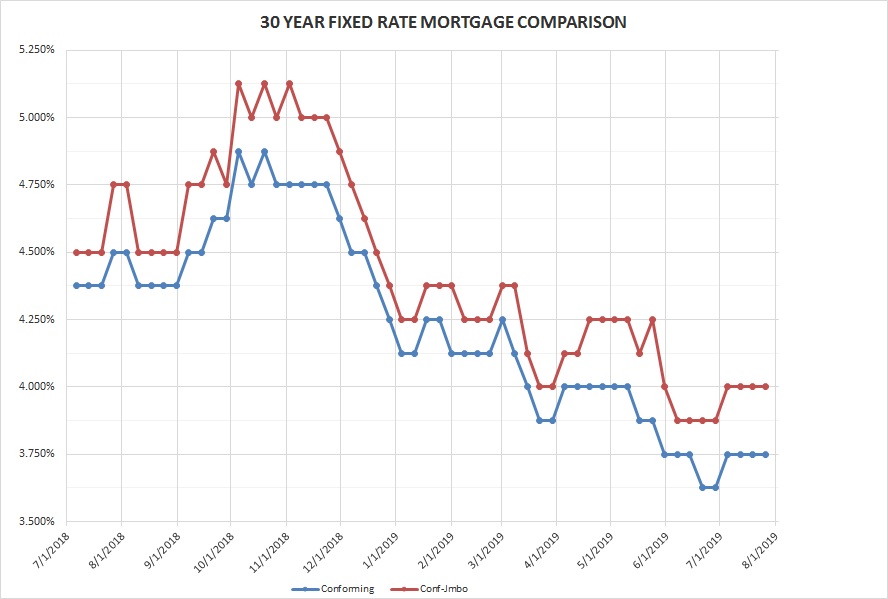
Rates for Friday July 26, 2019: The GDP news had little impact on rates today and we are flat for the third Friday in a row. If the Fed does raise interest rates next week, the increase is pretty much already priced into mortgage rates and the announcement should have little impact on rates.
FIXED RATE MORTGAGES AT COST OF 1.25 POINTS LOCKED FOR 45 DAYS:
30 year conforming 3.75% Flat
30 year high-balance conforming 4.00% Flat
Please note that these are base rates and adjustments may be added for condominiums, refinances, credit scores, loan to value, no impound account and period rate is locked. Rates are based on 20% down with 740 FICO score for purchase mortgages.
Our summer heat has finally arrived in Southern California, which means our pool is finally not too cold for me to take the occasional dip. I am no fan of cold water, which I consider to be anything below about 72-3 degrees. The “you’ll get used to it” line has never held true for me!
Stay cool, stay hydrated and make sure you have plentiful and fresh water for you pets.
Have a great week,
Dennis
Past Weekly Rate & Market Updates can be found on my blog page at my website www.DennisCSmith.com/my-blog