
Are we headed to another collapse in real estate?
Question of the week: Are we headed to another collapse in real estate?
Answer: In last week’s Weekly rate & Market Update I wrote that this week I would compare the real estate market prior to the collapse in the industry that led to the Great Recession with the current market. The impetus for the comparison is the slowdown in real estate sales in number of units sold and in some areas decline in prices, this has many wondering if we are heading to another major market “correction,” i.e. large drop in values for homeowners.
It is a valid question for many who experienced the market collapse that started in 2007 and continued for more than a year. The anxiety and fear of the future and other negative emotions many experienced are easily brought forth when it appears that a similar lead up may be occurring in our current economy and real estate markets.
For those who do not wish to read through my reasoning (which in typical fashion is a bit extensive) I will give you my answer to the question of the week: No.
No, we are not headed to another collapse in real estate.
There are several reasons why I do not see a significant decline in real estate on the horizon, defining “significant” as a decline in prices of more than 10% year over year.
The California Association of Realtors report on December 2018 sales notes that units sold declined for the eighth straight month, while active listings increased statewide for the ninth straight month. Statewide there was drop from December in the median price, but the median price was higher from the prior year. The data statewide and regionally throughout the state certainly shows a slowing real estate market. The question is how long and severe will such a slowing be?
Prior to the market collapse a decade ago the market went from hot and steamy to slowing, similar to what we have experienced over the past several years statewide and in Southern California, with prices increases up to 10% or more year over year in most regional markets and increasing total sales. The difference as to why the next steps will not mirror the collapse a decade ago is the basis of the run up in prices—the expanding of the balloon that eventually popped. No, not popped. Exploded.
Most real estate market slowdowns occur when price increases outpace the ability for consumers to afford to purchase homes in the markets they desire, which led to decreased demand. Eventually demand decreases to the point that sellers must lower their prices if they want to sell their homes. The amount of decline in the overall market depends on how many sellers need to sell and how far they are willing to drop the price of their homes to attract buyers.
Factored into the demand feature is not only the cost of the product, a home, but also the costs to obtain the home in terms of financing. If there were not thirty-year fixed rate mortgages with low down payment requirements available to finance homes our prices would be up to 90% less than they are today. Because of the increase in rates over the past year to cost to finance a new home purchase has exacerbated the increase in home prices putting a bigger damper on ability to purchase, which decreases demand. So not only are rising prices dampening demand, but increasing rates also kept buyers out of the market.
Having to pay more to finance an asset that also costs more reduces the amount of qualified buyers. Fewer buyers leads to less demand leads to softening prices. Simple economics.
If this is similar to what occurred starting in 2007, why should the result not be the same?
Three major reasons: Ability to finance, purpose of purchase and refinances.
The first reason, ability to finance, is by far the primary factor in the market collapse and the biggest reason our current market slowdown is in no way similar to the collapse. Last week in the WR&MU I discussed QM and non-QM mortgages, a distinction created by the Consumer Financial Protection Bureau in reaction to the part the mortgage industry played in the creation of the housing bubble and ultimate explosion.
Starting around 2000 Fannie Mae and Freddie Mac developed and continually refined Automated Underwriting Systems for loan approvals. As more and more data was available to Fannie and Freddie their AUS became looser and looser—meaning it became easier and easier to obtain loan approval for residential mortgages. By around 2003 lenders were guaranteed to have their conventional mortgages purchased by Fannie or Freddie is there was an AUS approval in the mortgage application file as long as the required documentation as listed by the AUS approval was in the file. After around 2003 the required documentation became less and less. Eventually, Fannie Mae and Freddie Mac were enabling mortgage fundings on the vast majority of loans funded in the country that today would be labelled as “Alternative,” or non-QM mortgages.
Example of less and less. In 2001 Susan and James purchase a $350,000 home with 10% down and a 90% conventional fixed rate mortgage. We run their information, credit report, monthly income, employment history, liquid assets and the sales price through the AUS for Fannie Mae. We receive a result of “approve-eligible,” meaning the loan is approved and eligible for purchase from Fannie Mae provided the conditions listed in the approval are met. The conditions in 2001 would call for proof of income as exhibited by most recent two years’ W2s and recent paystubs covering 30 days showing year to date income. Proof of down payment showing at least two months bank statements with any deposits that are significant and not from employers sourced and explained. Debt obligations and history as shown on a tri-merge credit report (Equifax, TransUnion and Experian). Value of property supported by a licensed appraiser providing a complete report including inspection of the property.
In 2006 Susan and James what to purchase a $550,000 home with no money down, obtaining a loan covering 80% of the price with a Fannie Mae loan and 20% with a Home Equity Line of Credit from the same lender. The lender guidelines for the HELOC are that they will accept whatever documentation is required by Fannie Mae’s AUS system. We interview the clients and obtain their income and assets, pull a credit report and have the purchase price. We upload the information to the AUS and receive and “approve-eligible.” The approval conditions require we perform a verbal verification of employment to ensure the borrowers are employed. Require that the funds required for closing are brought to escrow. Since the purchase price of the property is consistent with the values in Fannie Mae’s property valuation software for the zip code no appraisal is required.
In 2001 Susan and James with 10% down had to prove their income, funds for closing and their source and the value of the property is market value with an appraisal.
In 2006 Susan and James with no money down did not have to verify their income, funds for closing or that the purchase price was market value.
By 2006, Susan and James were a declining part of the market, they wanted a 30-year fixed rate mortgage. By 2006 a large portion of the market consisted of borrowers looking for adjustable rate mortgages so they could buy very expensive homes with very low mortgage payments—in the first year(s) of ownership. In the years of the bubble expansion more and more borrowers were purchasing and refinancing using adjustable rate mortgages.
In the run-up to the housing bubble explosion most borrowers did not go through any type of even quasi-rigorous approval process. Fannie and Freddie, and therefore lenders, were funding stated income, stated asset, stated value loans. Anyone with decent credit could buy a home. Many purchased homes with adjustable rate mortgages ignoring that in the future their payments would be higher.
The CFPB’s Quality Residential Mortgage (or QM) guidelines created the primary reason a future major real estate collapse is less likely because in the past ten years borrowers have had to prove income, verify assets and have the value confirmed by a licensed appraiser.* As well, many adjustable rate products are no longer available, and those that are available are very rarely used by home buyers. When you have a real estate market where the buyers are fully qualified to show they have the ability to make their mortgage payments your incidence of foreclosure will decline astronomically compared to a market where a significant portion of buyers were not adequately qualified to show they could make monthly mortgage payments.
*In recent years “property valuation waivers” have once again been issued by Fannie and Freddie through their AUS approvals. As well, as discussed last week, alternative mortgages are a growing sector of the market which depend more on assets than verifiable income for approvals. While growing, this segment of the market is a very small percentage of the total market.
Reason number one the current market is not mirroring the exploded market: Almost everyone who has purchased a home in the last ten years has the ability to make the mortgage payments as long as they are employed.
A not insignificant portion of the market were not buying “homes,” they were buying investments and doing so with very little or no down payments.
Because financing was easy the market became crowded with home buyers. More demand leads to higher prices. As prices climbed and qualifying became easier, and cost to enter the market dropped, more buyers entered the market and many began chasing home purchases so they could cash in, buying a home then reselling in a short period of time and purchasing a more expensive home, and repeating the process.
Then the perfect storm hit. With prices rising demand began to slow. On Wall Street, investors discovered that the mortgages they were buying were not as high a quality as they were told; the mortgages were not underwritten to high standards to show borrowers’ ability to repay, but rather were very risky. Investors stopped buying mortgages. Lenders started going out of business. Inventory climbed. As inventory climbed prices started to decline and homeowners found themselves with property in which they owed more than the property was worth. They could barely make their mortgage payments. Why struggle to pay a loan for a property that is worth less than you owe? Homeowners walked away from their properties, creating a flood of foreclosures and banks putting homes on the market at lower and lower prices.
Boom.
Reason number two our current market will not continue to mirror the collapsed market, there is a strong emotional connection to the property, it is a home not an investment. If there is a decline in value, while concerning, it will not create a reason to sell because the homeowner has a long term plan and still have equity in their property.
The third reason, refinances, were no small contributor to the market collapse. As prices rose many homeowners took advantage of their increased equity by refinancing, under the same easy qualifying guidelines, to pull out their equity either with cash-out refinances with fixed or adjustable rate mortgages, and/or with Home Equity Lines of Credit. Some homeowners engaged in multiple cash-out transactions from the early 2000’s into 2007, pulling hundreds of thousands of dollars in cash from their properties. What happened when prices dropped and they owed a lot more than the value of their property? Yet more inventory on the market pushing prices down more and more.
The real estate market that has grown over the past decade has done so due to very solid fundamentals. Buyers have had down payments, a stake in the property. They have financed their purchases with mainly 30-year fixed rate mortgages that they have shown are within their ability to pay based on their income, debt obligations and history of making credit payments. They have purchased homes for their families for the long term, not short term investments intended to create profit.
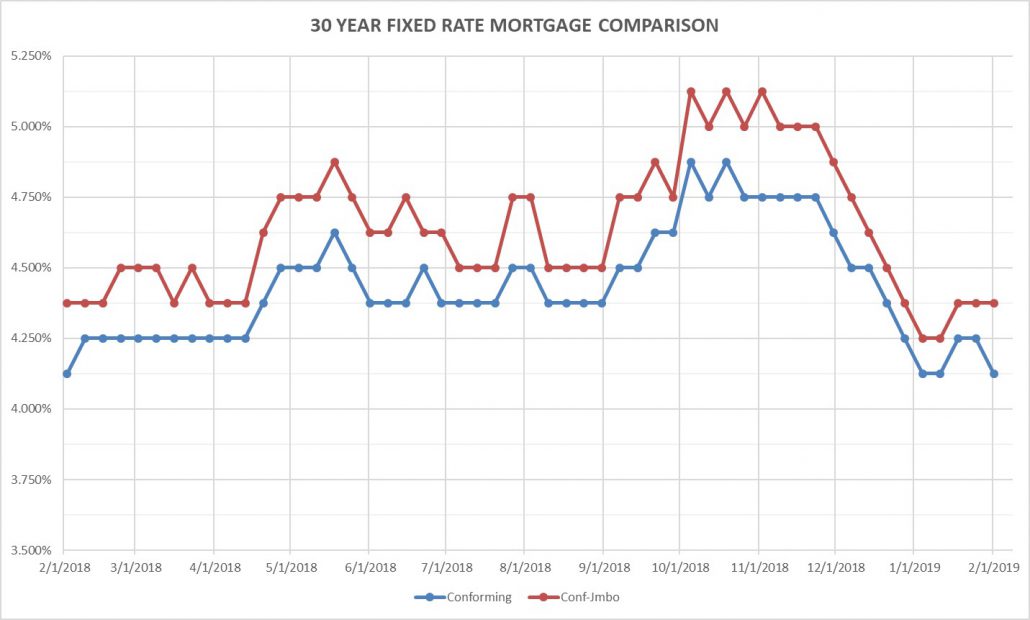
As well, the underlying interest rates for most homeowners are very low. From 2005 to 2006 conventional fixed rates climbed as high as 6.5%. Since 2010 the highest the conforming fixed rate has been is 5.125% in the first week of January 2010, dropping to 3.125% in the last quarter of 2012 and reaching a high of 4.875% for two weeks in October 2018.
Our housing stock is owned by homeowners who can qualify for their mortgage payments, have mortgages with very low fixed rates, have equity in their property—in most cases significant equity, and are staying in their homes for the most part until a life changing event like having children, kids graduating from high school, change in jobs or retirement.
After price run-ups all markets will have periods of no to negative growth, i.e. prices flatten or drop. We are experiencing this in the current market. Will it lead to another collapse? Because of the very strong fundamentals of homeowners the answer is “No.”
The greatest risk to the real estate market is the overall economy and job and income loss. Should we experience very high amount of unemployment in the region, state and country that can, and will, impact the real estate markets. But even then I cannot foresee any type of collapse in prices near what we experienced a decade ago.
Have a question? Ask me!
No bump now or maybe later. This week the Federal Reserve Open Market Committee had a meeting, this is the group that raises and lowers the Fed’s rate charged to member banks to borrow money. It was not a big surprise that the FOMC did not raise rates. What did catch everyone off guard were statements by Fed Chair Jerome Powell at a press conference. Powell’s comments indicated that the Fed may not increase rates two or three times in 2019 as previously intimated. This alone would be enough have investors believe low/er rates are in store for 2019, add in his comments about the Fed’s balance sheets and belief becomes reality.
Looking to help stimulate economic growth after the Great Recession, the Fed purchased over three trillion dollars of fixed rate assets comprised of U.S. Treasury bonds and conventional mortgages from Fannie Mae and Freddie Mac. In 2018 the Fed announced that it would be selling these assets from its balance sheet in systematic, “automatic” as described by the Fed, way. This news, and subsequent going to market with billions of dollars of fixed rate assets to sell put upward pressure on rates. The news from the Fed that it would be looking to curtail sales in the future was welcomed by investors and resulted in stocks climbing and rates decreasing.
The direction was reversed on labor news released today. As reported by the Department of Labor payrolls increased by 304,000 workers in January and job growth continues to be very strong. The headline unemployment rate edged up to 4.0%, mainly due to filings by some federal workers during the shutdown, aided by more individuals entering the market looking for work. Wages and salaries continue to increase as well, not surprising as employers seek more employees—supply and demand works for wages as it does for home prices. Overall the news is mortgage rate unfriendly as higher labor costs should lead to higher inflation, which should lead to higher rates. For the time being inflation is within the range of 2%, the Fed’s target.
Rates for Friday February 1, 2019: Even with a bit of an uptick today following the jobs data the conforming rate is down slightly from last Friday with high balance rates remaining flat for the week.
FIXED RATE MORTGAGES AT COST OF 1.25 POINTS LOCKED FOR 45 DAYS:
30 year conforming 4.125% Down 0.125%
30 year high-balance conforming 4.375% Flat
Please note that these are base rates and adjustments may be added for condominiums, refinances, credit scores, loan to value, no impound account and period rate is locked. Rates are based on 20% down with 740 FICO score for purchase mortgages.
Anyone send any selfies playing golf, strolling on the beach or enjoying a beautiful sunset earlier this week to friends and family in the Midwest or East Coast? It is weeks like this that make the “weather tax” to live in Southern California worth the cost.
Once again, the New England Patriots are in the Super Bowl, entrenching themselves in the most reviled professional team in the country for those not living north of Connecticut. Love them or hate them an objective view must be that they are perhaps the greatest spots dynasty in American history during the Belichick-Brady era. Unlike the Yankees or Celtics of yore who controlled their players throughout their careers and contracts, the Patriots like other teams in the NFL must create a new team every year due to players leaving through free agency and looking for replacements through free agency and the draft. Despite all the roster change over, like many teams face, owner Robert Kraft has provided outstanding leadership to enable the team to be by far the most successful over the past seventeen plus years.
Perhaps the Rams can duplicate what my favorite team, the Eagles, did last year and beat the Patriots. I am of the opinion that they will not but that is why they play the game. Brady is 5-3 in Super Bowls, his only three losses coming to NFC East teams, the Giants twice and the Eagles last year. One thing about Patriot Super Bowl games, they are always close. Of their nine games with Brady at QB the largest point spread is eight points, last year and three games have been decided by only three.
Enjoy the game and have a great week,
Dennis
Past Weekly Rate & Market Updates can be found on my blog page at my website www.DennisCSmith.com/my-blog