We are thinking of purchasing a home with solar panels, any concerns we should have?
Question of the week: We are thinking of purchasing a home with solar panels, any concerns we should have?
Answer: Concerns? Maybe. Awareness? Yes.
There are, to my knowledge, three different solar panel options for solar panels on a home in California: homeowner owns the panels, homeowner leases the panels, homeowner has panels and pays for the energy from a third party—a power purchase agreement (PPA).
Depending on the type option is on the home you are buying, or if you are selling, there are different concerns that a lender will have that will need to be satisfied for final loan approval.
Panels are purchased and owned by homeowner
If the solar panels are owned by the homeowner the lender has no concerns. Most solar panels are affixed to the property and their value can be included in the appraised value, if they are owned and not leased.
To be included in the value of the property, the appraiser needs to have comparable properties that have sold with solar panels and can show they have sold for a higher value than similar properties without solar panels. If you spend $20,000 on a solar system and put your home on the market, you should not expect the value of your home to be worth $20,000 more than a comparable home that has sold without the panels. Buying a home with solar panels that will have ownership transfer to you through the sale, i.e. they are not leased, you will very likely be purchasing the panels at a discount due to the limited value they add to the property compared the cost to purchase and install them.
Since they are owned by the homeowner and will be transferred to the new buyer, it is important that you check with your home owner’s insurance carrier to determine how the panels will be covered should they be damaged, and what type of damage is covered. As mentioned, it is likely the entire cost of the panels will not be added to the value of the home for sale, however if the need to be replaced due to severe damage how much of the replacement cost new is covered by your insurance? What is the impact on your deductible and premium?
Finally, when you own the solar power system you benefit from any tax breaks or other financial incentives available for installing the system.
Leased solar panels
When residential solar panels are leased from a third-party lenders concerns start to increase. With a leased solar energy contract the homeowner pays a fixed cost on a monthly basis and the provider guarantees the delivery of a certain amount of power on a monthly basis.
First, because they are not owned by the homeowner they are not considered in the value of the property by an appraiser. This policy is specifically mentioned in the Fannie Mae Seller’s Guide—the underwriting Bible followed by most loan programs.
Second, because a third party owns, and therefore has significant control, over the panels, which are affixed to the lender’s collateral, there are several items in the lease concerning liability, damage and removal of the panels that must meet the lender’s guidelines. Essentially, the lease must state that the company that owns the panel is liable for any damage that occurs through maintenance or removal of panels.
Third, the buyer must qualify for the lease payment unless certain conditions are spelled out in the lease regarding fixed cost of the energy provided and guarantees as to how much power will be provided.
Fourth, the property must have access to an alternative source of electricity, i.e. the local provider for the community such as Southern California Edison or PG&E, etc.
Fifth, the company owning the solar panels is not named as a loss payee on the homeowner’s insurance policy. If the solar company requires the homeowner provide insurance it is generally on a separate policy from the master policy.
Regarding the sale of a home with leased solar panels, the home buyer will have to be approved by the company that holds the lease to assume the remaining terms of the contract. This approval process typically has a cost that can be negotiated between the buyer and seller to see who will pay the fee. The fee is paid upfront, before the approval is generated.
If there is time left on the lease and the buyer does not like the contract and wants it discontinued before purchasing the property there will be a cost to the owner to cancel the lease. Usually this cost is the remaining value of the contract, if the lease is three years into a fifteen year lease the buyout is twelve years of payments. The solar company will also need to remove the panels and before closing the buyer will need to ensure the panels were removed, any damage caused due to the removal has been properly repaired and the property has been connected to the local utility that is the source for electricity.
Since you do not own the solar power system and tax breaks or other financial incentives will go to the company that owns the system you are leasing.
Power Purchase Agreement (PPA)
A PPA is very similar to a solar lease agreement, with the exception of instead of paying “rent” for the system you are paying a fixed amount per kilowatt for the power generated by the system.
All the guidelines stated above for a leased solar power system apply to a PPA system. Including the company owning the solar panels receives any tax breaks and other financial incentives.
In California, Sacramento has mandated that power companies have 33% of their retail sales of energy to consumers be from renewable sources (solar, wind, geothermal, etc). There are other goals and objectives to increase this percentage beyond 33% in the future with the ultimate objective of 100% of electricity provided in the state be from renewable sources. The current mandate and objectives for the future, if fulfilled, will greatly increase the cost of energy to consumers. This is a primary factor for my consideration to purchase a solar panel system for our home, fix our costs for electricity to protect against future costs which will likely be significantly higher than today.
If you are considering putting panels on your home factors to consider should include how long you intend to be in the property, how much control you wish to have over the power system for your home, future impact on the ability to sell your home, and of course the total cost versus potential savings over what period of time.
Have a question? Ask me!
Still strong or getting weaker? That is the question after the Labor Department released it jobs report for April showing only 75,000 new jobs were added to the economy for the month. The speculation on the significantly lower number of job additions than prior months range from employers slowing growth as they are concerned about the impact of the trade tensions created by the Trump Administration, to scarcity of labor to fill many positions, to the hiring slowdown being a harbinger for economic slowing across the economy. All of these factors could be positive for mortgage rates.
Survey says….speculation is rampant that the Federal Reserve will ease rates at either its June meeting (a 30% chance per the speculators) or at its July meeting (70% chance per speculation) and today’s jobs report reinforces the speculation. The reasoning being that the Fed sees the economy slowing and wants to provide a boost by lowering rates. Counter-intuitively, such a move will likely have the impact on pushing mortgage rates up as it the move would fuel stock prices increasing, pulling funds from fixed rate investments to equities, which would increase the return bonds (and mortgages) would need to provide to attract investors.
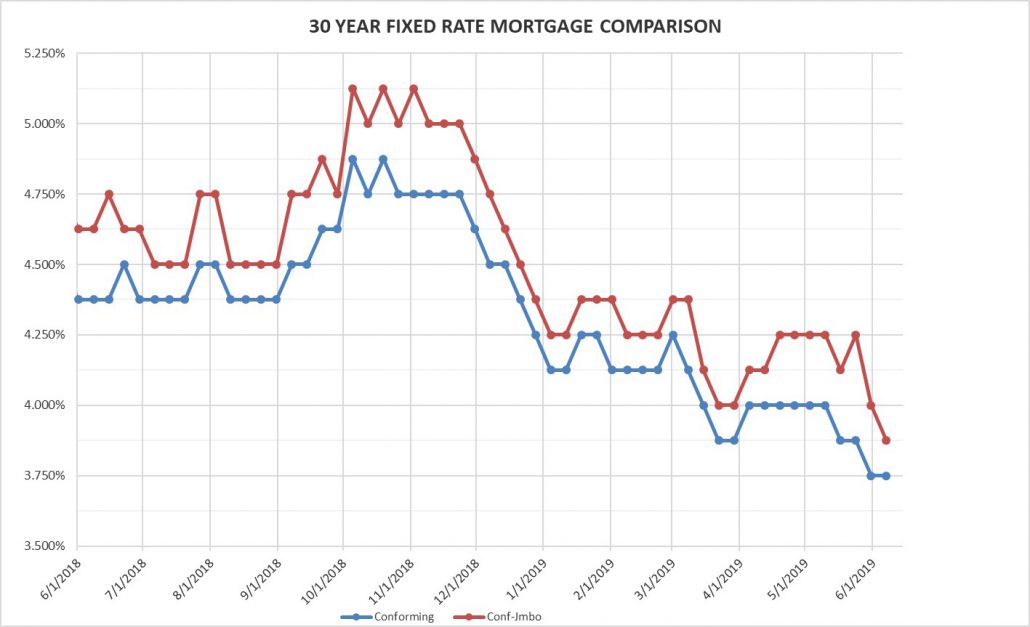
Rates for Friday June 7, 2019: Markets are choppy as investors swing from fixed investments, such as bonds and mortgages, to stocks, day to day based on data, speculation and tweets. We are at our lowest rates in about 18 months and it feels like we are at or very near the bottom. Those waiting for lower rates may want to stop waiting
FIXED RATE MORTGAGES AT COST OF 1.25 POINTS LOCKED FOR 45 DAYS:
30 year conforming 3.75% Flat
30 year high-balance conforming 3.875% Down 0.125%
Please note that these are base rates and adjustments may be added for condominiums, refinances, credit scores, loan to value, no impound account and period rate is locked. Rates are based on 20% down with 740 FICO score for purchase mortgages.
On Tuesday, for the second year in a row I had the opportunity to present to two classes at Long Beach Poly High School. The class is AP Chemistry and is taught by Mr. Gillette. Once the AP test is completed there is not much to fill the class schedule for the remainder of the year so Mr. Gillette likes to bring in some “real world” education for his students. My topic is what it takes to purchase a home, but is actually financial literacy covering credit, debt, income, saving and long-term consequences—positive and negative. With many/most of the kids on the verge of taking on debt for the first time in the form of student loans it is a timely conversation with them about how debt works and how it has long term impact on their lives.
It has been my belief that financial literacy should be a mandatory class, or part of a class, for every high school student. Understanding how debt works, the power of putting money aside for savings and retirement and the relationship between income and education would increase the level of personal responsibility across communities and decrease the level of dependence.
From my experience interacting with high school seniors on the topic the last two years, they appreciate the information, ask great questions and will benefit, hopefully, moving forward into adulthood and being responsible for their own financial decisions. Expanding such education throughout school districts can only be a benefit for society.
Have a great week,
Dennis
Past Weekly Rate & Market Updates can be found on my blog page at my website www.DennisCSmith.com/my-blog