Posts

Does it make sense to buy housing for our kids in college?

Question of the week:  Does it make sense to buy housing for our kids in college?

Answer:  Great question, and one we get asked a lot as families start to plan on the next school year with their already in college kids or have kids graduating high school.

As with most money questions the answer is, “do the math.”

As the parent of one college student and one about to be college student I know the high costs schools charge for dorm rooms and food plans. Were our two children in the same city we would be giving a serious look at the option of purchasing housing near campus.

There are three types of residential mortgage transactions, owner-occupied, non-owner occupied and second home.

Owner-occupied is self-explanatory, the borrower intends to occupy the property as their primary residence. Owner-occupied programs have the best rates and terms.

Non-owner occupied is the industry term for investment, or rental property. Because there is higher risk to lenders for investment property loans these programs have higher down payment requirements, more challenging underwriting guidelines and higher rates and costs.

Second homes, or vacation homes, are treated very similarly to owner-occupied programs in regards to the rates and terms. Location is a factor; it needs to make sense the property is one you will be using as a second home and not trying to make it look like a second home so you can get more favorable terms and rent it out. For example if you live in Seal Beach and are buying a “vacation home” in Fontana….hard to sell to an underwriter.

If you wanted to purchase student housing for your student what are your options?

You do not want to purchase the property as non-owner occupied because of the higher down payment and rates required.

Can you all it a second home? Will you be using the property for at least two weeks a year? You might be able to make a stretch that you can stay there in the summer or while visiting your student.

Is it owner-occupied? You won’t be living there, but…you student is over 18 years of age and therefore able to execute contracts, such as a mortgage. Yes, it is owner-occupied by putting your child on the loan and title to the property. You as parents are “non-occupant co-borrowers,” your child is the owner occupant and we are able to fund an owner-occupied mortgage.

Let’s do the math. The housing and mandatory dining plan option at your child’s college is about $2000 per month for September through May, or $18,000. In the immediate area near campus are some two bedroom condos selling for about $350,000 (obviously you child is going to school out of state).

Because we are owner-occupied you can purchase the property with only 10% down (or less, but we will use 10%), for a loan of $315,000. Assuming a rate of 3.25% with 10% down your monthly housing costs including HOA dues and mortgage insurance will be right around $2000 per month—the same as the housing and meal plan at the college.

But Dennis, the college costs are only for nine months, totaling $18,000, and the cost for the off-campus housing is for twelve months and will cost $24,000. Correct, but two items to consider. First, the housing and dining plan cost at the college is not fixed, those costs will go up. Second, you have an extra bedroom or two that can be rented out to other students.

Students are used to sharing rooms. Your student has two friends share the second bedroom and rents to them for $600, $700 each, your housing costs for your student has dropped to $600-800 per month for nine months. Your annual housing costs are nine months at $800 = $7200, plus three months at $2000 (assuming no summer student rental) = $6000, total is $13,200. You save $4800, deduct food costs and you are still ahead.

Other factors to consider. Your student is the landlord and part-owner of the property. S/he is learning responsibility and personal finance lessons. You own property in a college town that is highly rentable, when you student graduates is s/he does not stay in the same area you can rent the property to other students and work out a income-expense plan with your student. As some point in the future perhaps you sell the unit, get back your original investment and you child has funds for down payment on their own home.

Depending on where your kids are going to school and the cost of housing in the immediate area it might make very good economic sense to purchase student housing with your son or daughter on the loan and property instead of entering into a series of leases with the college or university.

If you want to run numbers on such a situation for your family please give me a call.

Have a question? Ask me!

No surprise in today’s announcement on retail sales in April. Well a little surprise as the 16.4% drop was more than the 12.5% drop that was expected. The news had little to no impact on mortgage rates as investors have already priced a recession and bad economic news into the market.

Rates for Friday May 15, 2020:  Conforming rates continue to dip down for purchase transactions, high-balance rates have bumped up a little bit today as the mortgage market continues to shy away from high-balance and other products that are not 30 year fixed conforming purchases. Repeating what I have said for the past several weeks, these rates are for purchase transactions, rates for refinances vary, please call for your particular situation and need.

FIXED RATE MORTGAGES AT COST OF 1.25 POINTS LOCKED FOR 45 DAYS:

30 year conforming                                            3.00%   Down 0.125%

30 year high-balance conforming                  3.5%      Up 0.125%

Please note that these are base rates and adjustments may be added for condominiums, refinances, credit scores, loan to value, no impound account and period rate is locked. Rates are based on 20% down with 740 FICO score for purchase mortgages.
Are you taking advantage of the slowly opening world around you? Beach, golf course, park, store…where have you visited for the first time since February? I am not, and have never been, a beach guy but am happy for those who do enjoy the beach and can go take walks, surf and enjoy themselves without fear of the law coming down on them. Having golf courses open however fills me with great joy, and then frustration when I hack away and chase the little ball around…

Have a great week,

Dennis

Past Weekly Rate & Market Updates can be found on my blog page at my website www.DennisCSmith.com/my-blog

What is a Home Warranty Plan?

Question of the week:  What is a Home Warranty Plan?

Over the past few weeks I have had several questions regarding the various insurances involved in a real estate transaction. I have decided the best way to address the questions for the next several weeks to have a series on insurance in the Weekly Rate and Market Update, this series will cover home warranty, homeowners’, title, mortgage, and finally mortgage life/disability insurances.

Answer:  In Section 7, Part D, subsection 10 of the California Association of Realtors Residential Purchase Agreement and Joint Escrow Instructions (aka the Offer) the buyer has the option of checking whether, as part of the terms of the offer to purchase the property, the buyer or seller shall pay costs not to exceed a certain amount for a one-year home warranty plan. The section also contains a place for the buyer to indicate which company shall issue the plan and what additional coverage beyond “normal” the warranty may cover, such as air conditioning or pool equipment. If the buyer does not complete this section the next clause on the purchase agreement form is checked, which is an acknowledgement that the buyer is waiving the purchase of a home warranty plan.

As a side note, congratulations to the home warranty industry for have their product embedded into the contract used for almost every residential purchase in the state.

Back to our question, what is a home warranty plan? It is essentially an insurance policy that covers a lot of things a homeowners’ policy will not cover if something needs repair or replacement. Appliance, electrical and plumbing systems, if there is an issue and you have a home warranty plan, contact the carrier, let them know the issue and they will send someone out to repair or fix the issue.

From dripping sinks and clogged pipes, to burned out water heaters, to faulty central heating and air, if you have a home warranty plan in place the chances are you are covered for repair or replacement. Most plans will not cover roofs and leaks from above or below, nor flooring, walls or built-ins like cabinets.

The cost of the plan depends on the service call fee you choose for a professional to come out and either fix or replace the issue. This is like a co-pay for health insurance. The lower your co-payments per visit to a medical professional the higher your premium will be; the same for home warranty plans, the higher your service call fee the lower your annual, or monthly, fee will be for the plan.

It is important to note that you do not need to be purchasing a home to obtain a home warranty plan. Nor do most home warranty companies require a home inspection prior to issue a coverage plan. If you have lived in your home for two, five, fifteen years or longer you can obtain a home warranty plan that covers your appliances and systems.

It is important to note that the professionals who are dispatched to inspect and correct your issue are contracted to the home warranty company, you cannot choose a local plumber or electrician that you have worked with before to correct the issue and then bill the home warranty company.

Over the years I have had clients rave about having home warranty coverage and those who have had poor experiences due to the quality of the service professionals dispatched for issues needing fixing.

Before purchasing a plan I suggest you do some research. Contact your real estate professional and ask which companies that have generated positive or negative experiences with clients. Go on-line and research the various companies available and search for reviews—keeping in mind most people bothering to post reviews on-line tend to do so to vent about a negative experience. What are the prices, service call fees and coverages for the different plans from different companies, and what do you feel you need for your home?

One final note, home warranty plans are not just for owner-occupied homes, if you have a rental property there are coverages available to cover the wear and tear that occurs over time and use.

Next week we will discuss homeowners’ insurance and what it covers.

Have a question? Ask me!

Rate cut no surprise. On Wednesday, the Federal Reserve Open Market Committee (FOMC) voted to cut its benchmark interest rate by one-quarter of one percent (0.25%). This action was expected and had been priced into all the financial markets weeks ago. Most rate moves by the Fed are expected so it is the details of the meetings that are market movers as investors try to anticipate the Fed’s next move by what was news comes out of the FOMC meetings.

What we may have learned from the information released Wednesday is that the FOMC is divided. The vote to lower rates was not only not unanimous but had three dissenting votes; the first time in three years there have been three “no” votes for the committee. Two of the negative voters did so because they felt there should be no change in rates; the third voted “no” because he felt that the 0.25% rate cut was not enough and the cut should have been 0.50%. What does this mean for future actions by the Fed? Complicating the answer is that seven of the twelve members of the FOMC say they anticipate one more rate decrease this year. Since that would be a majority of the voting members the expectation is for one more rate cut. This meets expectations from earlier in the year, three rate cuts between August and December, and a future rate cut is pretty much priced into rates.

Rates for Friday September 20, 2019: This was another volatile week for mortgage rates as the Mortgage Backed Securities (MBS) prices fluctuated quite a bit every day—especially on Wednesday following the Fed announcement. Over all for the we end up very close to where we were last Friday despite a spike in rates on Monday that slowly disappeared through the week. The charts show that MBS prices may be approaching an interim high (higher prices mean lower rates), which portends a possible up tick in rates again in the next few days. The market is volatile, my advice is do not float your rate, lock it when you can through your escrow period.

FIXED RATE MORTGAGES AT COST OF 1.25 POINTS LOCKED FOR 45 DAYS:

30 year conforming                                            3.625%     Flat

30 year high-balance conforming                    4.00%       Flat

Please note that these are base rates and adjustments may be added for condominiums, refinances, credit scores, loan to value, no impound account and period rate is locked. Rates are based on 20% down with 740 FICO score for purchase mortgages.

My personal note this week is a challenge. On the one hand I acknowledge our oldest turned twenty yesterday—I guess that makes sense since Leslie and I just celebrated our 25th, but while I recognize her as being 20 I still see the little girl and probably always will.

On the other hand, after I finish writing the WR&MU this week and post it to my webpage, Facebook and LinkedIn I will be attending a funeral for an incredible woman who has done so much for our community, mostly behind the scenes and without wanting much attention for what she has done. The everyday role models are the ones that I want for my daughters. Not the Oprahs, or Michelles, or Taylors, but the strong women who live and work in our community who take the time from themselves and their families to help others. That was Connie who will be mourned and celebrated later today. She was always smiling, and raising her hand to say, “I can help with that.” And she did help, a lot. So many people in our community are just that much better off because Connie rose her hand, and they never know this is the case or her name.

The wonder, beauty and experience of life is the juxtapositions of joy and heartache amongst other emotions and experiences.

Call or visit someone you haven’t seen or spoken to in a while, say hello and say thank you for being them and letting you be you.

Have a great week,

Dennis

Past Weekly Rate & Market Updates can be found on my blog page at my website www.DennisCSmith.com/my-blog

We are thinking of purchasing a home with solar panels, any concerns we should have?

Question of the week:  We are thinking of purchasing a home with solar panels, any concerns we should have?

Answer:  Concerns? Maybe. Awareness? Yes.

There are, to my knowledge, three different solar panel options for solar panels on a home in California: homeowner owns the panels, homeowner leases the panels, homeowner has panels and pays for the energy from a third party—a power purchase agreement (PPA).

Depending on the type option is on the home you are buying, or if you are selling, there are different concerns that a lender will have that will need to be satisfied for final loan approval.

Panels are purchased and owned by homeowner

If the solar panels are owned by the homeowner the lender has no concerns. Most solar panels are affixed to the property and their value can be included in the appraised value, if they are owned and not leased.

To be included in the value of the property, the appraiser needs to have comparable properties that have sold with solar panels and can show they have sold for a higher value than similar properties without solar panels. If you spend $20,000 on a solar system and put your home on the market, you should not expect the value of your home to be worth $20,000 more than a comparable home that has sold without the panels. Buying a home with solar panels that will have ownership transfer to you through the sale, i.e. they are not leased, you will very likely be purchasing the panels at a discount due to the limited value they add to the property compared the cost to purchase and install them.

Since they are owned by the homeowner and will be transferred to the new buyer, it is important that you check with your home owner’s insurance carrier to determine how the panels will be covered should they be damaged, and what type of damage is covered. As mentioned, it is likely the entire cost of the panels will not be added to the value of the home for sale, however if the need to be replaced due to severe damage how much of the replacement cost new is covered by your insurance? What is the impact on your deductible and premium?

Finally, when you own the solar power system you benefit from any tax breaks or other financial incentives available for installing the system.

Leased solar panels

When residential solar panels are leased from a third-party lenders concerns start to increase. With a leased solar energy contract the homeowner pays a fixed cost on a monthly basis and the provider guarantees the delivery of a certain amount of power on a monthly basis.

First, because they are not owned by the homeowner they are not considered in the value of the property by an appraiser. This policy is specifically mentioned in the Fannie Mae Seller’s Guide—the underwriting Bible followed by most loan programs. 

Second, because a third party owns, and therefore has significant control, over the panels, which are affixed to the lender’s collateral, there are several items in the lease concerning liability, damage and removal of the panels that must meet the lender’s guidelines. Essentially, the lease must state that the company that owns the panel is liable for any damage that occurs through maintenance or removal of panels.

Third, the buyer must qualify for the lease payment unless certain conditions are spelled out in the lease regarding fixed cost of the energy provided and guarantees as to how much power will be provided.

Fourth, the property must have access to an alternative source of electricity, i.e. the local provider for the community such as Southern California Edison or PG&E, etc.

Fifth, the company owning the solar panels is not named as a loss payee on the homeowner’s insurance policy. If the solar company requires the homeowner provide insurance it is generally on a separate policy from the master policy.

Regarding the sale of a home with leased solar panels, the home buyer will have to be approved by the company that holds the lease to assume the remaining terms of the contract. This approval process typically has a cost that can be negotiated between the buyer and seller to see who will pay the fee. The fee is paid upfront, before the approval is generated.

If there is time left on the lease and the buyer does not like the contract and wants it discontinued before purchasing the property there will be a cost to the owner to cancel the lease. Usually this cost is the remaining value of the contract, if the lease is three years into a fifteen year lease the buyout is twelve years of payments. The solar company will also need to remove the panels and before closing the buyer will need to ensure the panels were removed, any damage caused due to the removal has been properly repaired and the property has been connected to the local utility that is the source for electricity.

Since you do not own the solar power system and tax breaks or other financial incentives will go to the company that owns the system you are leasing.

Power Purchase Agreement (PPA)

A PPA is very similar to a solar lease agreement, with the exception of instead of paying “rent” for the system you are paying a fixed amount per kilowatt for the power generated by the system.

All the guidelines stated above for a leased solar power system apply to a PPA system. Including the company owning the solar panels receives any tax breaks and other financial incentives.

In California, Sacramento has mandated that power companies have 33% of their retail sales of energy to consumers be from renewable sources (solar, wind, geothermal, etc). There are other goals and objectives to increase this percentage beyond 33% in the future with the ultimate objective of 100% of electricity provided in the state be from renewable sources. The current mandate and objectives for the future, if fulfilled, will greatly increase the cost of energy to consumers. This is a primary factor for my consideration to purchase a solar panel system for our home, fix our costs for electricity to protect against future costs which will likely be significantly higher than today.

If you are considering putting panels on your home factors to consider should include how long you intend to be in the property, how much control you wish to have over the power system for your home, future impact on the ability to sell your home, and of course the total cost versus potential savings over what period of time.

Have a question? Ask me!

Still strong or getting weaker? That is the question after the Labor Department released it jobs report for April showing only 75,000 new jobs were added to the economy for the month. The speculation on the significantly lower number of job additions than prior months range from employers slowing growth as they are concerned about the impact of the trade tensions created by the Trump Administration, to scarcity of labor to fill many positions, to the hiring slowdown being a harbinger for economic slowing across the economy. All of these factors could be positive for mortgage rates.

Survey says….speculation is rampant that the Federal Reserve will ease rates at either its June meeting (a 30% chance per the speculators) or at its July meeting (70% chance per speculation) and today’s jobs report reinforces the speculation. The reasoning being that the Fed sees the economy slowing and wants to provide a boost by lowering rates. Counter-intuitively, such a move will likely have the impact on pushing mortgage rates up as it the move would fuel stock prices increasing, pulling funds from fixed rate investments to equities, which would increase the return bonds (and mortgages) would need to provide to attract investors.

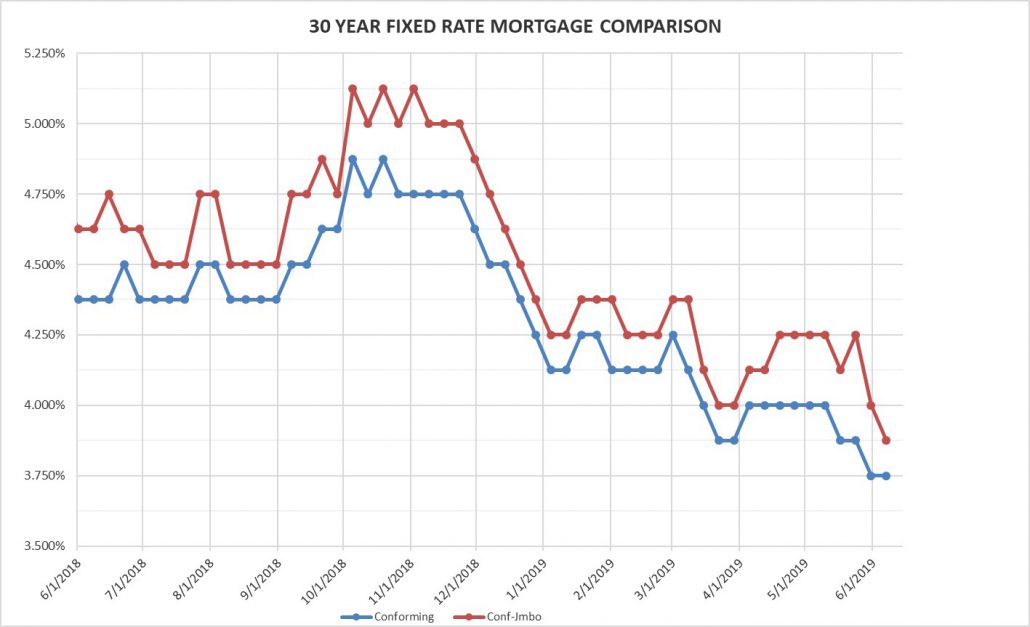
Rates for Friday June 7, 2019: Markets are choppy as investors swing from fixed investments, such as bonds and mortgages, to stocks, day to day based on data, speculation and tweets. We are at our lowest rates in about 18 months and it feels like we are at or very near the bottom. Those waiting for lower rates may want to stop waiting

FIXED RATE MORTGAGES AT COST OF 1.25 POINTS LOCKED FOR 45 DAYS:

30 year conforming                                            3.75%        Flat

30 year high-balance conforming                    3.875%      Down 0.125%

Please note that these are base rates and adjustments may be added for condominiums, refinances, credit scores, loan to value, no impound account and period rate is locked. Rates are based on 20% down with 740 FICO score for purchase mortgages.

On Tuesday, for the second year in a row I had the opportunity to present to two classes at Long Beach Poly High School. The class is AP Chemistry and is taught by Mr. Gillette. Once the AP test is completed there is not much to fill the class schedule for the remainder of the year so Mr. Gillette likes to bring in some “real world” education for his students. My topic is what it takes to purchase a home, but is actually financial literacy covering credit, debt, income, saving and long-term consequences—positive and negative. With many/most of the kids on the verge of taking on debt for the first time in the form of student loans it is a timely conversation with them about how debt works and how it has long term impact on their lives.

It has been my belief that financial literacy should be a mandatory class, or part of a class, for every high school student. Understanding how debt works, the power of putting money aside for savings and retirement and the relationship between income and education would increase the level of personal responsibility across communities and decrease the level of dependence.

From my experience interacting with high school seniors on the topic the last two years, they appreciate the information, ask great questions and will benefit, hopefully, moving forward into adulthood and being responsible for their own financial decisions. Expanding such education throughout school districts can only be a benefit for society.

Have a great week,

Dennis

Past Weekly Rate & Market Updates can be found on my blog page at my website www.DennisCSmith.com/my-blog

1-25-19: What are the different types of mortgages available?

Question of the week:  What are the different types of mortgages available?

Answer:  In the years immediately following the real estate and mortgage market meltdowns many mortgage products left the market. In the last few years many of the products that were available for home buyers and owners prior to 2008 have returned presenting more options for financing residential real estate, and enabling those who are unable to qualify for traditional mortgages.

In response to the collapse of the real estate markets the Dodd-Frank Act was put into law. Dodd-Frank has a regulation for mortgage lenders that created “qualified mortgages,” or QM loans. There are several factors that go into a mortgage being eligible for the QM designation, the primary being that borrowers must show income and the ability to make the monthly mortgage payments. Having funds available to pay off the mortgage is not evidence of ability to repay the mortgage, unless using a certain formula income from the asset account(s) generate income that would enable qualification.

If a lender funds non-QM mortgages they must have “skin in the game,” this is had by the mandate that lenders must retain at least 5% of such mortgages. All conventional mortgages are sold in secondary markets, which is what Fannie Mae and Freddie Mac, where they become security for Mortgage Backed Securities (MBS). Most jumbo loans are sold by lenders to investors who create their own investment vehicles backed by the mortgages. Government loans, VA and FHA, are sold by lenders to Ginnie Mae, who like Fannie and Freddie, bundle the mortgages and sell them to investors.

Conventional mortgages and most “jumbo” mortgages meet the QM criteria as they are underwritten to the guidelines established by Fannie Mae and Freddie Mac. Also meeting the QM standards are VA and FHA mortgages using underwriting guidelines established by the VA and HUD respectively. One of the reasoning behind the QM policy is that investors in mortgage backed securities of conventional or government mortgages investors know the quality of the investment. The primary reason for the mortgage market collapse was the tremendous percentage of mortgages in the Fannie and Freddie MBS pools were funded without income verification, nor asset verification and for many no appraisal of the property used as collateral. With the QM rule investors have reasonable certainty that all the borrowers of the mortgages in their MBS investments have shown ability to repay their mortgages.

Here is a quick comparison of the mortgage options available in today’s markets:

Conventional mortgages can have relatively high loan to values, depending on loan amount and ability to qualify as high as 97% of the property value with several options for mortgage insurance.

FHA mortgages have a minimum down payment of 3.5% and have mandatory mortgage insurance regardless of the loan-to-value. The underwriting guidelines for FHA mortgages are a bit more lenient for qualifying than conventional mortgages.

VA mortgages are for eligible veterans, either active duty or discharged from the service (unless discharge was dishonorable). Veterans who qualify can purchase their home with no money down and the loan limit for purchases can far exceed the limits for conventional or FHA mortgages. The mortgages have a “funding fee” added to the loan amount, which is VA’s version of mortgage insurance.

Non-conforming, or jumbo, mortgages mirror conventional mortgages in many respects, however most will not fund mortgages above 90% of the value of the property and have tighter underwriting guidelines for qualifying.

Non-QM, or Alternative, mortgages have many variations to provide mortgages for borrowers with poor credit scores, borrowers with high debt-to-income ratios, self-employed borrowers with low income on their tax returns are some of the most common applicants for Alternative mortgages. Lenders in this section of the market have products that use deposits into business or personal accounts to calculate income, statements from accountants to accompany tax returns to explain losses or other criteria. Because of the more relaxed underwriting standards, and the retention rules for non-QM products, rates on these mortgages are higher than those on QM mortgages.

It is estimated that $5-6 billion of non-QM mortgages were funded in 2018 for residential borrowers and predicted that the total volume will increase considerably in 2019.

Too often we meet with clients who are able to purchase, or refinance, their home using alternative mortgage products but the bank or mortgage professional they were working with did not have such products available, encouraging them to obtain a co-signer, obtain more funds or otherwise try to fit into the products they have available. Because we work with many lenders, in the QM and non-QM spaces, we often have the ability to help them with their purchase or refinance.

If you, or someone you know, is in need of a mortgage to purchase or refinance their home please contact me to go through all their mortgage options to help them find the best financing for their ability to qualify.

Have a question? Ask me!

Home sales are cooling off. The California Association of Realtors have released sales data for December and every major market in the state except San Francisco had a drop in sales from December 2017. Locally, Los Angeles County saw a drop in sales from November of 3% and from last December of 16.3%; the median sales price in December was $588,140 in the county up 6.2% from the prior month and 1.8% for the year. In Orange County sales tumbled 15.5% for the month and 18.3% for the year with the median price in December of $785,000, off 1.3% from November and 0.1% from the prior year. Nationwide real estate sales are at a three year low. Historically December is a slower month for home sales so a dip from November is not surprising. Are these numbers a “dip” or are they foreshadowing a decline in the market that will last for….how long? Next week I will compare the current real estate market to that leading up to the 2007-8 start to the collapse that led to the Great Recession.

Rates for Friday January 25, 2019: Rates are steady from last Friday, though some movement up and down during the short week. So far, the federal government shutdown has not impacted the economy. Unlike if 800,000 workers in the private sector were laid off, the furloughed federal employees will go back to work and cash flow shortages for federal workers and vendors will be back filled; because of this any negative impact on the overall economy is short termed. It appears that there is some movement in Washington to settle differences and re-open the government and I am optimistic the normal dysfunction in our nation’s capital will return.

FIXED RATE MORTGAGES AT COST OF 1.25 POINTS LOCKED FOR 45 DAYS:

30 year high-balance conforming                    4.375%     Flat     

30 year conforming                                            4.25%       Flat

Please note that these are base rates and adjustments may be added for condominiums, refinances, credit scores, loan to value, no impound account and period rate is locked. Rates are based on 20% down with 740 FICO score for purchase mortgages.

Those who know me will not be surprised by this statement: I love pie. And cookies, but pie holds a bit of a higher place because it is usually not as readily available as a cache of thin mints in the freezer. Thankfully my oldest also loves pie and over the years she and I have made many runs to the best pie purveyor in Long Beach, Jongewaard’s Bake-N-Broil. For the past several years we have gone to Bake-N-Broil on January 23rd to celebrate National Pie Day.

With her attending university in Boston I knew I would be spending National Pie Day alone. Thankfully for this first year I was likely to be without my pie-buddy on 1/23 Winter Storm Harper hit the Northeast. Why thankful? Late Friday night JetBlue sent her an email that her flight to Boston on Sunday morning was cancelled. By the time we go through to get her a seat back to school the only available flight was a red-eye leaving Tuesday, January 22nd. So though it was a day early we were able to celebrate National Pie Day together—she had lemon lush and I had French apple. Thank you Harper for letting me continue a tradition. (She plays in the pep band for BU and let me know that at the basketball game on Pie Day they had free pie available—she got a slice of Boston Cream Pie. I’m so proud.)

Have a great week,

Dennis

Past Weekly Rate & Market Updates can be found on my blog page at my website www.DennisCSmith.com/my-blog

1-18-19: Will the federal government shutdown impact the timing of my loan approval?

Question of the week:  Will the federal government shutdown impact the timing of my loan approval?

Answer:  No, well very, extremely likely no.

Unless you are in a rural area and obtaining a USDA or perhaps waiting for FHA to approve a condominium complex in which you are purchasing or refinancing one of the units.

At the start of the shutdown there was some delay for borrowers with properties in areas that required flood insurance, which is available only through the National Flood Insurance Program, however Congress passed legislation and the President signed into law a bill authorizing the program to May 2019 so the policies could be written.

For the vast majority of mortgages for residential mortgages there is minimal interaction with the federal government during the loan process.

One requirement for many mortgages is verification of your income by a review of your tax transcripts as filed with the IRS (to see why we need this form here is the WR&MU from April 2018 on the subject. For this process, we use IRS Form 4506-T, during a government shutdown the requests for a copy of your returns are not processed. Having experienced such delays in the past, in recent years lenders have eased the burden by allowing some work arounds to the Form 4506-T requirement, typically a copy of the cancelled check or other proof you paid taxes owed on the tax returns provided, or a copy of a bank statement showing the deposit of your refund that matches the refund on your tax returns provided.

Government insured loans, such as VA or FHA, are not impacted by the shutdown as the processing and underwriting is performed by private companies and not government agencies. While Fannie Mae and Freddie Mac are quasi-government agencies they are operated as private companies and are unaffected by the shutdown.

The primary area of impact during government shutdowns, once flood insurance is authorized, are inquiries for loan issues in which a response is required from either VA or FHA. It is very rare that a situation arises in which a lender will require a response from either of the agencies in order to approve a loan, but they do arise from time to time and any such cases arising during the shutdown will likely face delays until someone is available to reply.

In a broader view, the impact of the shutdown on mortgages is the impact it may have on the economy and subsequent impact on interest rates. Fundamentally, if there is an impact on rates it would be for rates to decline. A very prolonged shutdown could result in negative economic impact and regular readers of the WR&MU know that poor economic performance usually leads to lower interest rates.

If you are concerned that the government shutdown will impact your current loan in process, or a home mortgage you are contemplate, do not be concerned.

Have a question? Ask me!

With the government shutdown some key economic data that could impact mortgage rates is not being release. This week we would have had retail sales data for December, a key piece of information for gauging economic activity since consumer spending comprises 65-70% of the nation’s economy. With no data on how the Christmas shopping season went for retailers investors are left to speculate whether the 4th quarter GDP data will show 2018 ended strong and total growth over 3% or slowed down with growth being under 3%. The lack of information had no impact on rates as investors looked to other bits of news to guide their decisions.

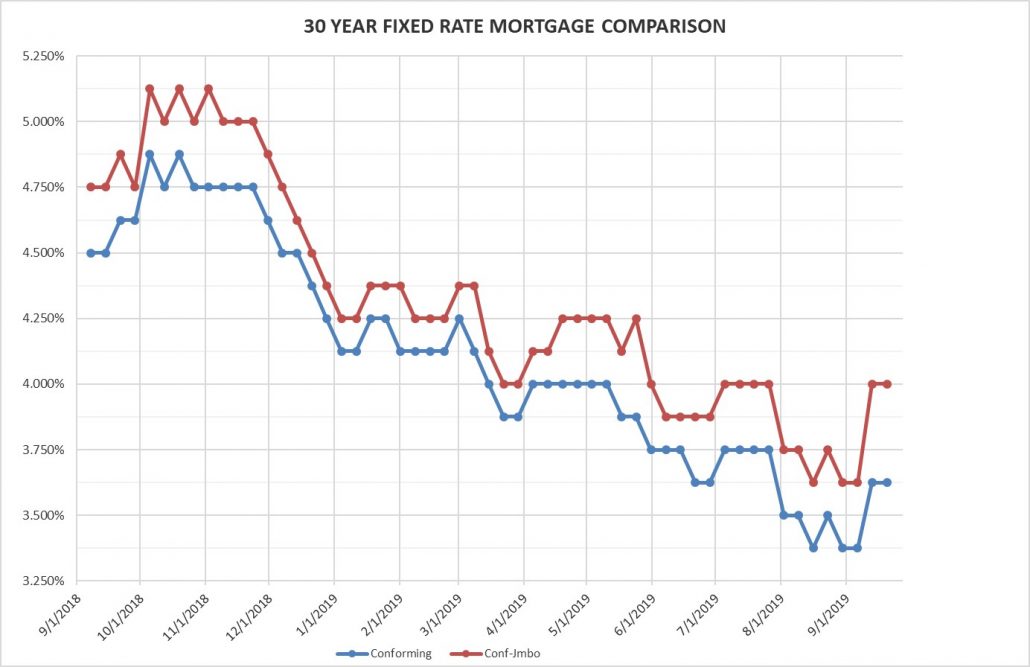
Rates for Friday January 18, 2019: Stocks and bonds are in their traditional relationship, if stocks go up so do rates, if stocks go down so do rates. Stocks climbed this week, much of the increase on speculation that the trade dispute with China is cooling down and on rumors the United States may lower some tariffs. Investors fled their prior “flight to safety” of bonds and invested their sales proceeds in stocks. After thirteen weeks of rates being flat or down from the previous Friday we see mortgage rates tick up this week—the first Friday to Friday increase in rates since October 19th.

FIXED RATE MORTGAGES AT COST OF 1.25 POINTS LOCKED FOR 45 DAYS:

30 year conforming                                            4.25%      Up 0.125%

30 year high-balance conforming                    4.375%     Up 0.125%      

Please note that these are base rates and adjustments may be added for condominiums, refinances, credit scores, loan to value, no impound account and period rate is locked. Rates are based on 20% down with 740 FICO score for purchase mortgages.

After four weeks it is time for our daughter to return to Boston to finish her freshman year. Always a bit of a weather nut, looking at the national weather maps in the paper every day, something I got from my dad, I am much more so concerning weather in the Northeast these past five months. My weather-nerdness has us on somewhat of a concerned profile as a very big winter storm is on track to hit the Boston area late Saturday and into Sunday—include her 2:30 landing time at Logan Airport. Part of going to school back east, or anywhere that winter weather is not 50 degrees and some rain, is dealing with weather delays at the airport.

Not all lessons are learned in the classroom. Our plan tomorrow is to spend a bit of time at the bookstore to get some “old fashioned” books in case her Kindle runs out of juice.

Have a great week,

Dennis

Past Weekly Rate & Market Updates can be found on my blog page at my website www.DennisCSmith.com/my-blog

11-23-18: What are the options for those who lost homes, or had them severally damaged, in the California wildfires?

Last week I ended the question of the week section (what was the cost of waiting) stating I would answer the natural follow-up question, what will be the cost of waiting, or is there one, for families waiting to purchase until later in 2019 or even 2020. Because of the wildfires in California that have destroyed thousands of homes I have chosen to address a very critical issue for those homeowners, knowing that we have clients, families, friends who are either directly impacted, or have family and /or friends who are impacted with lost or severely damaged homes. Next week I will look at what I feel may be the cost of waiting to purchase a new home.


Question of the week:  What are the options for those who lost homes, or had them severally damaged, in the California wildfires?


 Answer:  Earlies this week I was speaking with a friend whose son and daughter in-law lost their home in Paradise, California in the Camp fire. In our conversation, I went through several different options his son and daughter in-law should consider regarding their family’s future.


The very first thing that should happen is the affected family needs to contact the lender and home insurer and let them know that your home was lost in the fire. You need to ask the lender for payment abatement or suspension while you work your options and ability to make payment. Chances are high many people in the affected areas that lost their homes have also lost the ability to generate income depending on whether their place of employment was lost to the fire, their ability to get to work or other factors. Stay in communication with the lender regarding the monthly payments. Ask if the call is being recorded and if so how you can refer to it later if needed. Keep records of every phone conversation, who you spoke to, what time, what was the conversation about, did the lender make any statements to you regarding the issue. Always request an email from the lender summarizing the conversation and confirming what may have been agreed to, if no email received call back quickly and repeatedly until you do receive the written communication.


With property tax payments due by December 10th a similar conversation should be had with the local county assessor. If the lender has been collecting tax payments confirm with the lender if they will be paying the taxes—at this point they probably already have.


Once the mortgage payment has been figured out time to move onto your insurance company.


Since you have a mortgage your home was insured. The first question you need answered is, how much will our insurance cover? The required coverage for lenders is either the entire loan amount owed, or the replacement cost of the dwelling.


The location of your home, the cost of construction in the area, and the cost of the home will determine whether your insurance policy will cover the cost to rebuild your home or your loan amount; for most developed properties in California the policy will cover replacement costs and not the loan amount. Because dirt is expensive in California the price is impacted, but because dirt does not burn it is not required to be insured.


The lender requirement of replacement cost will be determined by the appraisal which contains on a section where the appraiser calculates “replacement cost new.” This is the amount that must be covered by an insurance policy. For instance, I have a client who is refinancing a mortgage for $550,000 for a property appraised at $800,000; the replacement cost for the structure is $245,000, this is the amount of coverage we must show on the policy to close the transaction.


In Paradise the numbers are smaller, but the policy is generally the same. If the market value of the property is $250,000 the cost to replace may be $145,000 and the outstanding mortgage balance around $200,000.


This difference between mortgage amount and policy coverage is very important to those whose homes have been destroyed or severely damaged when considering, what do we do now?


It is important to note that the lender is a “loss payee” on the homeowner’s policy, meaning that any insurance check is made payable to the homeowner and the lender, both must agree what to do with the money before both parties endorse the payment.


Let’s take the case above, property value before the fire was about $250,000 with an outstanding balance of $200,000 and the insurance policy covers rebuilding the home for $145,000.


The first option is to work with the lender and insurance company to determine the mechanics of what happens if you choose to rebuild your home. Does your policy cover either mortgage payments until you can move back into your rebuilt home? Does it cover housing costs if you need to rent? What is the process regarding contractors, is than approved list you must use, or if you choose a contractor is approval required? How much time do you have to rebuild your home?


Before deciding to rebuild there are several factors to consider. Because there are thousands of homes in the region that have to be rebuilt, what will the actual cost to rebuild be given a limited supply of contractors versus the large demand for their services. What about the cost of building materials? How long will it take before a contractor will be able to take on your rebuilding job? What about designs, engineering, permits? Will there be a building moratorium for political purposes as state, county and local authorities determine if building requirements will be changed that impact costs of construction?


If all those questions are answered to your satisfaction next consider the future of the town and region. What if only one in two, one in five, one in ten, homeowners decide to rebuild? What will be the value of your home? Will it be significantly less than the loan amount? What will the neighborhood and town be like? What about schools and stores? The town will be significantly different, but how and will it be a  place where you and your family will want to live?


Once you have this information then you ask the question, what if we decide not to rebuild our home? The answer is that you will likely need to assign the amount covered by the policy over to the lender who will apply it to your mortgage balance. Since the amount of the insurance pay-out is less than the mortgage balance you will still have, in this case, about $55,000. What next? You can ask the mortgage to be recast, meaning if you still have about 25 years left on the loan the lender will amortize the $55,000 for 25 years at your current rate to determine your new payment. If your rate is 4.00% the payment would be $290 per month. You can have the county re-assess your property to lower your tax liability and determine the minimum insurance cost required by the lender.


Once you have the cost to retain what will be a vacant parcel of land you can decide if you want to retain the property for any future development. Or if you want to contact the lender and inform them you have no intention of keeping the property and would like to deed the property to the lender. This will result in a foreclosure on your credit record, which will impact your ability to obtain a traditional mortgage for several years, but you will not be making payments on a property that may or may not be of significant value in the future.


For many families, walking away will be the best answer for their family, selecting what they see not as the best option, but the least worst option. The more people who make this decision the more negative the impact on families who decide they want to try to rebuild as property values, already negative impacted by the devastation to the town, will drop further. As well, property taxes will drop significantly negatively impacting city and county services.


Other factors impacting any decision are will there be assistance that may come from government agencies? Will it be sufficient for you to rebuild or to re-locate? Can you continue at your job and therefore need to stay in the area? What will be your cost of housing with all the other families in the area needing housing as well?


There may be other options I have not yet considered; my primary advice is to not rush into any decisions. Speak to different people you trust and have no stake in the outcome of whatever decision you make. A very big challenge will be to make your decision with as little emotion as possible.  Consider the possible long-term consequences of any decisions you make. Decisions should be made on what likely can happen, not necessarily what you would like to happen. Consider the impact of the decisions your neighbors and others in your town may be making and how those decisions will impact you.


Finally, be selfish. Your decisions need to be what is best for you and your family. No one else is going to make your housing payment, you will be the ones residing in wherever you choose to make your home, either where it was before or in a new location. Your financial future is going to be impacted, which will in turn impact the quality of life for your family for year to come so be as clinical as you can through the process.


CAUTIONARY NOTE Unfortunately disasters bring out scam artists and thieves. People posing as contractors with real or fake credentials will be contacting families to collect deposits to build homes and never be seen again. Real, or fake, attorneys or others will be offering consulting services and collect fees without providing any services. Be very careful before signing any contracts, or entering into agreements. Double, triple check backgrounds and services provided. Affected families will be looking for any good news and charlatans tend to be excellent actors able to prey on those in a weakened state. Be careful.


If I can be of any help with questions or what-ifs please do not hesitate to contact me.


To help the Red Cross help those in need click here: Red Cross Donations


Have a question? Ask me!


Rates for Friday November 23, 2018:  A slow week this week with the Thanksgiving holiday with little news impacting rates. A bit of softening in rates from last Friday but not enough for any change week over week. Rates are a bit steady and this should continue next week as well depending on how well the U.S. Treasury auctions go next week as the government sells over $110 billion in bonds. If the auctions go well rates should remain steady, if they do not go well rates will bump up a bit.


FIXED RATE MORTGAGES AT COST OF 1.25 POINTS LOCKED FOR 45 DAYS:

30 year conforming                                               4.75%       Flat

30 year high-balance conforming                       5.00%      Flat


Please note that these are base rates and adjustments may be added for condominiums, refinances, credit scores, loan to value, no impound account and period rate is locked. Rates are based on 20% down with 740 FICO score for purchase mortgages.

We were without our oldest for the first time ever on Thanksgiving, she made the bus ride from Boston to Portland, Maine to spend a few days with family friends. Yesterday morning the temperature difference with wind chill was about 65 degrees, glad she has winter clothes. Absence makes the heart grow fonder and we missed her presence and my apple pie did not turn out well as hers do.


With friends and family at our table we had a wonderful day and evening and I hope you did as well.


Have a great week,


Dennis


Past Weekly Rate & Market Updates can be found on my blog page at my website www.DennisCSmith.com

11-9-18 What kinds of loans do you and your company handle?

Question of the week:  What kinds of loans do you and your company handle?


 Answer:  This is a common question I am asked when meeting people, be it in a casual social setting or with professionals in other industries.


The broad answer is: almost any mortgage on residential property for one to four units in the State of California.


More specifically Stratis Financial excels at working with our clients to fund the following types of mortgages:


Conventional:  By far the most mortgages funded every year for residential mortgages in the United States. Broadly referred to as “conventional,” these are mortgages that are underwritten and approved to the guidelines as set forth by Fannie Mae and/or Freddie Mac. Once mortgages approved under these guidelines are funded they are sold by the lender in bundles of tens of millions of dollars to either Fannie or Freddie. While very similar with their guidelines, each of these agencies have some slight differentiation that dictates a loan can only be approved under one of their guidelines or the other. For instance in many instances Freddie Mac may only require the most recent year of Federal income tax returns for income verification for a self-employed borrower, whereas the guideline for Fannie Mae is two years of tax returns.


Conventional mortgages have two different loan tiers, labeled conventional and high-balance, which have different loan amounts, pricing and some different guidelines for qualifying and approval. These are the loans I put in the WR&MU rate quotes below. The maximum loan for single family residences for 2018 is $453,100, the maximum loan limit for “high-cost areas,” aka high-balance loans, for 2018 is $679,650. It is important to note that while Los Angeles and Orange County are considered high-cost areas, other counties in Southern California are not and have varying maximum loan amounts; for instance the maximum loan amount for Fannie or Freddie in Riverside County is $453,100 and in San Diego $649,850 in 2018.


The loan limits are established by the Federal Housing Finance Agency (FHFA) and can be adjusted annually. New loan limits for 2019 have not yet been announced, usually the loan limits for the following year are published in late November—you can be sure I will have the new limit announcement in the WR&MU the Friday we are made aware if the limits are changed.


Conforming mortgages can be used for one to four unit properties for primary residence, second homes and investment properties, different guidelines will apply depending on property use. As well fixed and adjustable rate programs are available.


Jumbo: Also referred to as non-conforming. These loans vary greatly from lender to lender as far as underwriting guidelines, loan amounts and pricing. Many lenders will start their jumbo loan programs at $453,101—just over the conforming limit—and go to several million dollars. The higher your loan amount the lower the loan to value you will have to have. For instance a lender may fund a loan up to one million dollars with a maximum loan to value (LTV) of 80%, another lender may fund up to $1.5 million with a maximum LTV of 80%. With a low LTV, say 60%, some lenders may have maximum loans of two million dollars, others may go up to ten million, or higher.


Most lenders in our market do not retain their jumbo mortgages but sell them to investors after funding, it is the investors who create the guidelines and determine the loan limits. Because different lenders use different jumbo investors we are able to fit specific criteria for clients to the jumbo programs available through different lenders.


A rule of thumb for jumbo loans is that the underwriting guidelines are stricter, how much stricter depends on the investors. As an example, one program may require any income to show it has been paid on a monthly basis for six months or more, say for payments from a retirement account, whereas another lender may use the annual distribution from the account, or show that an automatic payment has been set up. Reserve requirements, property features, income calculations, and other quirky guidelines differ from lender to lender and from Fannie and Freddie that may help one borrower or hurt another.


Another rule of thumb is that jumbo loans are higher priced than conforming; however this is not always the case. Not infrequently we will find a jumbo program that has a lower rate than other lenders high-balance conforming rates, when this is the case we ensure that the clients meet the more restrictive guidelines of the jumbo program and if so we lock them in at the lower rate and fund the jumbo mortgage. It makes no difference to the borrower that they do not have a Fannie Mae or Freddie Mac loan, especially if they are able to save money on a lower interest rate or cost of the mortgage.


Jumbo mortgages can be used for one to four unit properties for primary residence, second homes and investment properties, depending on investor, different guidelines will apply depending on property use. As well fixed and adjustable rate programs are available.


FHA: The original 30 year fixed rate mortgage for homeowners in the United States. The Federal Housing Administration was created in 1934 as part of the National  Housing Act that established the Department of Housing and Urban Development (HUD) as part of President Franklin D. Roosevelt’s New Deal agencies, also referred to as his Alphabet Soup. The New Deal Agencies were created by Roosevelt as part of his plan to pull the nation out of the Great Depression and besides HUD and FHA included the Securities and Exchange Commission (SEC), National Labor Relations Board (NLRB) and many other more specific purpose agencies such as the Tennessee Valley Authority (TVA) and national agencies like the Public Works Administration (PWA).


Homeownership prior to the Depression was very low and most homeowners had short term mortgages held by banks. The terms of the mortgages were very much in favor of the lenders and as a result foreclosure was relatively easy and could occur quickly, often with only one missed payment. The Depression caused a significant percentage of homeowners to lose their homes and farms to foreclosure.


The purpose of FHA was to insure mortgages funded by banks and lenders to encourage and enable lending to potential homeowners. It created 30 year mortgages, which resulted in lower monthly mortgage payments and established guidelines that made foreclosure a more difficult process for lenders to enable homeowners to recover from a brief set-back and retain their homes.


FHA still does not fund or purchase mortgages, instead the agency insures mortgages against default provided the mortgages follow the underwriting guidelines established by the agency.


Guidelines for FHA mortgages are generally more lenient than for conforming or jumbo mortgage products, especially for down payment requirements, income to debt ratios for qualifying and use of co-borrowers and gifts for assisting in qualifying. Looser guidelines mean riskier loans, but because the mortgages are fully backed by the United States government lenders are willing to make these loans at rates very near, often below, conforming lending rates.


The insurance the mortgages are paid by the borrower in two manners. There is the upfront mortgage insurance premium that is added to the loan amount at closing, plus a monthly mortgage insurance payment that is paid for the life of the loan. This adds to the cost of the loan, which depending on the rate markets could cause it to be more expensive than a conforming mortgage, however due to the looser guidelines it is often the best opportunity for many families to purchase or refinance their home.


It is important to note that the loan limits for FHA mirror those of Fannie Mae and Freddie Mac.


FHA mortgages can be used for one to four unit properties for primary residence, second homes and investment properties, depending on investor, different guidelines will apply depending on property use. As well fixed and adjustable rate programs are available.


VA: Congress passed the Servicemen’s Readjustment Act of 1944 and signed into law by Roosevelt. The law is more commonly known as the G.I. Bill and among the many benefits included in the Act was the establishment of the VA loan to enable active duty members of the military and qualified veterans to purchase homes with no down payment.


Like the FHA, the Veterans’ Administration does not fund mortgages but does insure them, which is why lenders will provide mortgages to those eligible with no down payment. The insurance, known as the funding fee, is added to the loan amount which would result in a loan above the value of the property, or if agreed upon the seller may pay the funding fee for the borrower. Due to the ability to finance the funding fee over the period of the loan a VA mortgage of the same amount and interest rate will have a lower monthly payment than a FHA mortgage.


There are similarities to FHA in guidelines for VA loans; however the biggest difference in the qualifying guidelines is that VA is not dependent on the debt-to-income ratio for loan approval. Residual income is the underlying guideline for VA loan qualifying. Instead of having a hard debt-to-income ratio of 50% of your gross income for total housing payment and debt obligations, the VA uses a minimum residual income amount for qualifying if necessary.


For instance in qualifying for a mortgage the applicant may have a debt-to-income of 55%, above most loans qualifying limit. However using residual income calculations the new housing payment including taxes and insurance, federal and state withholdings and payment for debt obligations, including but not limited to car and student loans, credit cards, alimony and/or child support are added up and subtracted from the applicant’s gross income. Depending on the amount of residual income the veteran can be approved. The amount of residual income required depends on the where the property is located and the number of family members; a single veteran purchasing in eastern Georgia will have a $441 residual income requirement whereas family of four in Southern California will have a $1003 requirement.


There are some criteria to be eligible for a VA loan, primarily the veteran must be honorably discharged from the service. There is a calculation for the maximum eligible loan amount based upon the entitlement available to the applicant from the VA. If a veteran has not used any of his or her entitlements the maximum loan amount, if qualified, could exceed one million dollars—there would be a down payment required, but significantly less than what would be required for FHA, conventional or jumbo loans for the same property.


VA loans are only available for the purchase or refinance of the veteran’s primary residence. In some instances a second property can be purchased using a VA mortgage, but it is a rare set of circumstances that would allow this.


VA loans can be used to purchase 2-4 unit properties as well as single family residences as long as the veteran will be occupying one of the units. Different guidelines may apply regarding loan amount calculations. As well fixed and adjustable rate programs are available.


Non-Qualified Mortgage: Also known as Non-QM, non-traditional, asset-based, or hard money, these loans practically disappeared following the passage of Dodd-Frank in 2010. The Wall Street Reform and Consumer Protection Act, commonly known as it Dodd-Frank after its sponsors Senator Christopher Dodd and Representative Barney Frank, was enacted following the 2008 housing and mortgage market melt downs.


One of the provisions of the law is that residential mortgages must meet certain guidelines to be considered a “qualified residential mortgage”. Among the qualifications are that the borrower must show evidence of income to support repaying of the mortgage; note not cash or assets, but evidence of income, the loans not be amortized for more than 30 years, do not have total points and fees in excess of 3% of the loan amount and cannot have interest only or negative amortization features.


These guidelines was in response primarily to the proliferation of no-income-verification mortgages that were funded by banks and lenders and either held in private portfolios or for the bulk of such mortgages purchased by Fannie or Freddie. The other factors such as negative amortization and interest only features in loans certainly contributed to the ease of credit that created the market collapses, but were secondary to the stated income mortgages as the primary cause.


If a lender funds mortgages that do not meet the guidelines of the qualified mortgage (QM) rule then the lender must retain at least 5% of the loans they sell into the secondary markets. This 5% rule creates a risk-retention factor for lenders in the Non-QM sector, or mandating they have some skin in the game.


Over the past few years we have seen an exponential growth in the number of Non-QM programs and lenders in the market offering loans using bank statements or other methods to determine ability to qualify for mortgages. Qualifying income is not the only reason these products are utilized for residential borrowers, others include issues with credit, subject property or chain of title and ownership history that do not meet the guidelines for conforming or jumbo products available. These loans are often part of a long term plan of obtaining funds for the purchase or refinance of a property with the intention to replace with a conventional or jumbo mortgage with more favorable rates or terms in the future.


Due to the considerably looser underwriting guidelines and the retention requirements for the loans these mortgage products have higher interest rates than conforming and jumbo mortgages.


Non-QM mortgages can be used for one to four unit properties for primary residence, second homes and investment properties, depending on investor, different guidelines will apply depending on property use. As well fixed and adjustable rate programs are available.


Stratis Financial has many other mortgage and home loan products available depending on the needs of property owners. If we do not offer a product, or I feel we are not competitive with a product, I routinely refer out to other lenders who have those products and meet the service levels we require for our clients.


What is your mortgage need? If you are uncertain please give me a call to discuss your needs and we can determine the options available for you.


Have a question? Ask me!


A few economic bits of news this week that investors key off of when making decisions which could impact mortgage rates. Consumers charged less in September than in August but borrowed more. For the fifth month out of the last eight, credit card use declined, which can be of some concern if the reduced credit card purchases result in lower consumer spending—which accounts for 65-70% of our nation’s economic activity. Total consumer debt continues to grow, at a slower rate than prior months but still growing, however much of the borrowing is for long term purchases such as vehicles and homes. The other somewhat significant piece of news was the release of the Producer Price Index for October.  If investors digested their news like many individuals do, i.e. just read the headlines without reading the details, they would have sold, sold and sold mortgages and bonds today causing interest rates to spike. The headline was that wholesale prices jumped in October for the highest increase in the PPI since 2012, climbing 0.6% for the month. Reading into the data we see that the increase was primarily due to higher gas prices. When the “core” rate of wholesale inflation is examined, with gas and food stripped out of the index, the rate of increase drops to 0.2% for the month, which is what investors expected.  Year over year the wholesale inflation rate is 2.9%, up 2.6% from September.


The Federal Reserve met this week. As expected there was no change in interest rates, what most followers of the Fed were interest in was the statement following the meeting regarding policy and future expectations. The statement on the economy was pretty much the same as it has been, mentioning the positive job growth and economic growth and that the Fed expects to gradually increase the federal funds rate in the future. Absent some major change in the economy from its current path, or a major non-economic event, we can expect the Fed to increase rates by one-quarter of one percent (0.25%) in December and then three times in 2019.


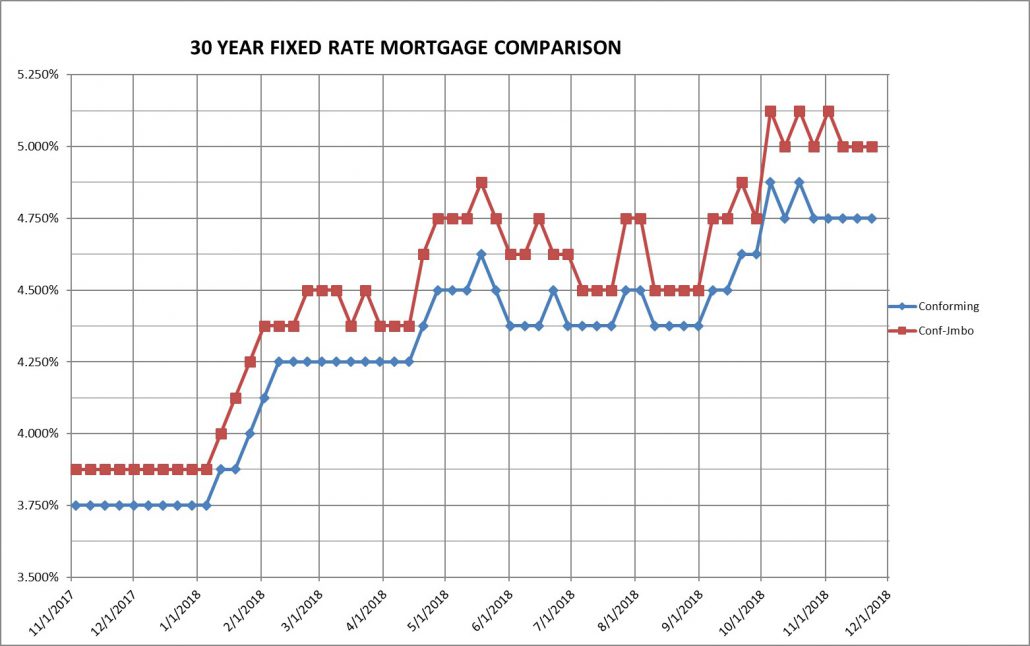
Rates for Friday November 9, 2018: Mortgage rates bounced around a bit this week but we finish with the conforming rate being flat from last Friday and the high-balance rate declining one-eighth (0.125%). Rates have been within a tight range of one-eighth of a percent for the past six weeks, any news positive or negative could prompt a break out of to higher or lower rates. In other words we continue to have a volatile somewhat unstable rate market.


FIXED RATE MORTGAGES AT COST OF 1.25 POINTS LOCKED FOR 45 DAYS:

30 year conforming                                            4.75%       Flat

30 year high-balance conforming                   5.00%      Up 0.125%


Please note that these are base rates and adjustments may be added for condominiums, refinances, credit scores, loan to value, no impound account and period rate is locked. Rates are based on 20% down with 740 FICO score for purchase mortgages.


Another milestone in the Smith household as our youngest passed her driver’s test and drove herself to school on Tuesday instead of taking the bus. It also has resulted in the big car shuffle as she took my 2006 Pilot, I am now in the 2010 Odyssey and Leslie moves into what was our oldest daughter’s 2001 Infinity until we decide it is time to get her a more recently manufactured set of wheels. We’re not real big on buying new cars in our family on a very frequent basis.


Have a great week, and drive carefully—especially around Bixby Knolls!


Dennis


Past Weekly Rate & Market Updates can be found on my blog page at my website www.DennisCSmith.com

9-28-18: Are there any Propositions on the November ballot that are real estate related?

Question of the week:  Are there any Propositions on the November ballot that are real estate related?


 Answer:  With the election just over month away, and your absentee ballot available in ten days, and the onslaught of television ads just starting, now is a good time to review some of the propositions on your ballot.


A brief bio break before I get into the ballot measures. I have a Bachelor of Arts in Economics and Political Studies from Pitzer College (1984) and have continued to be a student of both disciplines. My philosophy is that economics is the foundation of most personal, organizational and political decisions—if you cannot afford it you cannot do it, and if  you do the long-term consequences will generally not be positive. With that out of the way let’s look at the real estate related propositions on your November ballot.


There are four ballot measures that in some way involve real estate in California, Props 1, 2, 5 and 10. Here is a brief description of each and my position (if you are so inclined to care).


Proposition 1: Affordable Housing Bond If passed this measure authorizes the state to borrow $4 billion in bonds for affordable housing. The funds would be broken into different areas of expenditure with the largest amount being for the building and renovating of rental units. Other funds would be used to provide home loan assistance to Veterans, housing construction in densely populated areas, down payment assistance programs for low and moderate income potential homebuyers and housing development for agricultural workers.


Understanding that more affordable housing is needed in the state I do not feel adding $4 billion in bond payments to our budget and cycling the money through state and local bureaucracies is the way to provide more affordable housing. Supply and demand create prices, some of these funds are targeted in a manner to increase demand, which increases prices, and other funds are targeted to rather ambiguous objectives that appear to expand the power of the government in the market place. I feel that local ordinances and applying tax benefits to developers and property owners would be a more efficient way to create more affordable housing. Dumping government funds into a market has never been shown as a way to lower market prices. I will be voting No on Prop 1. I expect this measure to pass given the lack of a unified opposition and the funds coming into the “Yes” side of the ballot.


Proposition 2: Mental Health Housing If passed this measure authorizes the state to re-allocate funds currently directed to county mental health services across the state to fund supportive housing for those suffering mental illness. With a directive and the funding the state can make strides in providing long-term solutions to mental illness sufferers and provide blueprint for counties to help with their homeless problems. Across levels of government funds have been allocated for the homeless with no impact on the problem—it seems to be getting worse. By creating housing for the mentally ill that includes on site social services and medical services this proposition is the best solution I have seen proposed so far at any level to start to make a dent in the issue. I will be voting Yes on Prop 2. I expect this measure to pass given its purpose and how much the issue has been one of top concern to most of the state’s residents.


Proposition 5: Residential Property Tax Portability If passed this measure would expand the current property tax transfer rules of Props 60 and 90. Under current rules if homeowner over 55 sells their current residence and purchases a new residence of lower value the homeowner can transfer their current tax base to their new home. The portability of the current tax base is limited as only a few counties in the state allow those otherwise eligible to transfer their current tax base into their county (i.e. homeowner selling Orange County could not transfer tax to new home in Shasta County). As well the current laws allow only a one-time transfer.


If Prop 5 is passed the one-time transfer limit is eliminated and the purchase price of your new home does not eliminate your ability to transfer your tax base to lower your taxes if your new home costs more than the home you sold—your tax base will go up but not to market value. As well if you purchase a home for lower value than the home you sold your tax base will be lower than your current tax base. Here are two examples to hopefully clarify how the measure will work if passed.


Buying more expensive home:  A couple that qualifies for the property tax transfer owns a home in Los Angeles County they purchased many years ago for $110,000. Today the taxable value is $200,000 and their base tax is $2200 per year ($200,000 x 1.1% state property tax rate). They sell their home for $600,000 and purchase a new home in San Luis Obispo County for $700,000. Their new property tax base is calculated by subtracting the sales price from their prior home from the sales price of the new home and adding the result to the tax base from their prior home:


New home price minus prior home sales price: $700,000 – $600,000 = $100,000

Price differential plus prior home tax base: $100,000 + $200,000 = $300,000


The new tax base is $300,000, for annual property tax base of $3300 ($300,000 x 1.1%). Without Prop 5 the tax base would be $7700 per year (market value $700,000 x 1.1%), the homeowners are saving $4400 per year.


Buying less expensive home: This gets a little more complicated as the new tax base is reduced by a percentage based on the difference between the old property value and the new property value. Same couple sells same home for $600,000 with $200,000 tax base. They purchase a new home in San Luis Obispo County for $450,000.


New home price divided by prior home sales price: $450,000 ÷ $600,000 = 75%

Old tax base times price differential percentage: $200,000 x 75% = $150,000


The new tax base is $150,000 for annual taxes of $1650 per year, a savings of $550 per year over what they are currently paying.


I think the best tax law in America is California’s Prop 13. We pay some of the highest income and sales taxes in the country, but homeowners have the best property tax protection from the state of any state in the country. Prop 5 makes the Prop 13 even more generous to homeowners over the age of 55. Because of the over-generosity of Prop 5 I will vote No. If Prop 5 were to mirror Prop 60 and only eliminate the inability to transfer tax bases over any county lines in the state and enable more than one transfer, particularly in cases of divorce or spouse who have passed away, I would vote for Prop 5. As it is written with homeowners purchasing a new home and being able to lower their tax base to me is not equitable to the counties, state or other tax payers and is not needed. And most importantly, if Prop 5 does pass I see it as a strong rallying issue for those who want to eliminate Prop 13 or severely alter it so that higher property taxes result in the future. I expect this measure to fail.


Word has it that the California Association of Realtors is already working on a revision to Prop 5 for the 2020 ballot should the measure fail this year. I hope they do as I would like to see the current Prop 60 benefits available to be transferred across county lines. Were I to be asked to craft a revised proposition I would make the changes I suggest changing the calculation on purchase a new home for a higher price to increase the tax base from formula in Prop 5, eliminate ability to lower tax base by purchasing a new lower priced home, eliminated unlimited ability to transfer the tax base but enable additional transfers due to divorce and/or spousal death, and finally I would raise the age of eligibility to 60 from 55.


Proposition 10: Local Rent Control Initiative If passed this measure will roll back a 1995 law that limited the use of rent control in California (Costa-Hawkins) and enable greater ability for local government to pass, and/or expand, rent control in their jurisdictions. Costa-Hawkins disallowed cities from enacting rent control on properties first occupied in 1995 and single family dwellings (including condos and townhomes). If passed Prop 10 would enable rent control on all rental units, including single family dwellings—and room rentals inside a single family dwelling.


Any rent control imposed by government on landlords benefits a very narrow group of residents: those already renting. Wherever rent control has been enacted rental prices are higher than similar geographically nearby markets. Rental units are scarce in rent control communities as tenants do not move to preserve their low housing cost. Because of the scarcity of available units with a rent control unit does come on the market the landlord is able to get premium rent for the unit since there is little competition. Over time as each generation of rent controlled tenants vacate units the rents in the market climb disproportionate to the surrounding markets.


According to a spokesman from the California Business Roundtable there are currently 12,000 rental units across the state approved for construction. Every project is on hold until after the November election. Should Prop 10 pass the projects will not start building as the investors/builders do not want their investments to be restricted from market returns by local governments enacting rent control. I will vote No on Prop 10. I expect this measure to fail.


There have been many great benefits to Californians as a result of the ballot initiative process, ad many great detriments as well. It is our duty to study the issues, and candidates, presented and understand both sides before casting our ballots. I hope the above comments on the propositions involving real estate provide you with a decent perspective and spur you on to study these and the other propositions more thoroughly.


Have a question? Ask me!


A busy week for mortgage rate impacting news. First, and most expected, the Fed increased it Fed Funds Rate by 0.25%, as expected. The immediate result was the prime rate, and therefore rates on Home Equity Lines of Credit, also increase 0.25%. Prime rate is now at 5.25%, up one percent from one year ago. The Fed announcement also indicated it is sticking to schedule of one more increase in rates this year and three next year. The news is mortgage rate neutral since the rate increase was expected and the Fed did not announce they anticipate more increases than previously announced.


Second quarter Gross Domestic Product went through its third and final evaluation and there was no revision made to the prior revision putting the growth for the quarter at 4.2% annualized. With no change to the growth number there was no impact on mortgages.


Last Friday of the month gives us important data on consumers as personal income, consumer consumption and inflation data are released. Good news on all fronts for mortgage rates as personal income matched last month’s increase of 0.3% and the core inflation rate dropped from 0.4% in August to flat this month—meaning those higher wages will go further. Consumer increased spending by 0.3%, lower growth than previous months but still the sixth month in a row of positive spending growth and the eleventh of the past twelve months and 3.8% overall gain in spending from last year. Overall the news should be somewhat negative for rates as it shows economic strength is continuing and should continue through the third and fourth quarters absent some catastrophic event.


Rates for Friday September 28, 2018: Intra-week rates had a bounce up and then down and the result is the conforming rate is flat from last Friday and the high-balance rate is down slightly for the week. Many analysists are hinting at a possible decline, very small decline, in rates in the next week or so; however, this analysist is not convinced of the underlying factors that would make a such a prediction a strong one.


FIXED RATE MORTGAGES AT COST OF 1.25 POINTS LOCKED FOR 45 DAYS:

30 year conforming                                            4.625%    Flat

30 year high-balance conforming                      4.75%     Down 0.125%


Please note that these are base rates and adjustments may be added for condominiums, refinances, credit scores, loan to value, no impound account and period rate is locked. Rates are based on 20% down with 740 FICO score for purchase mortgages.


I have a pretty strong background in politics and economics, which perhaps comes through in my WR&MU. My mom grew up in a very politically connected household in Sacramento. Her father was an attorney and lobbyist and her mother was socially active in political circles. My mother continued the family behavior. When my sister, brother and I were growing up we did so with campaign pins and bumper stickers, meet-and-greets with candidates and seeing our mom very briefly on the television from the 1968 Republican National Convention in Miami.


Growing up my goal was to become and attorney like my grandfather and both uncles and I majored in economics and political studies in college. My study habits my last few semesters were not great so I put law school on hold to get some discipline. I started earning money, found the mortgage industry and law school was permanently in the rearview mirror. However, my interest in the two disciplines that comprised my major has never left me and I continue to study and read history, economics and political books, articles and journals. For those wondering, the basis of my personal philosophy is that economics is the overwhelming factor that influences politics and therefore history, be it within a family (microeconomics) or nation (macroeconomics). As I often say, take care of the economics and most other issues sort themselves out.


Whatever your interest I hope you are able to spend personal time daily, weekly, monthly to indulge in your interest and continue to expand your scope of knowledge and understanding.


Have a great week,


Dennis

9-7-18: Should we pay extra on our mortgage?

Question of the week:  Should we pay extra on our mortgage?


 Answer:  This is a question we answer every few years and it has come up a few times over the past few weeks with different clients as they consider paying extra on their mortgage every month or year to pay it off faster. It is natural to want to pay off debt, get rid of the monthly payment and quit paying a lender interest are the main two reasons.


But is paying off your mortgage early the best financial move for you? Here are several items to consider before you commit to paying off your mortgage ahead of schedule.


Are you maxing out your contributions to your retirement account? Most Americans are underfunded for their retirement, many of whom own homes. Instead of paying additional principal down on your mortgage I suggest putting it into your retirement account instead for several reasons. First, the money you put into retirement is usually deducted from your taxes (an exception can be if you contribute to a Roth IRA account), whereas the money you pay down on your mortgage is not. Most homeowners in California will have combined state and federal tax rates around 33% of adjusted gross income. If you contribute the $18,500 maximum to a 401(k) ($24,500 if over 50) that is a tax savings of about $6000, pay the same amount down on your mortgage and there is zero tax savings—in fact you will have negative tax savings because…


The government pays for part of your mortgage due to the mortgage deduction allowed on state and federal income taxes. You can deduct the amount you pay on your mortgage interest directly from your income for both federal and California state income taxes (there are limits, for married couple $1 million if mortgage used to purchase home was put in place prior to 12/16/17 or you were in contract to purchase home prior to that day; if your current mortgage was a refinance or put in place after 12/16/17 the new limit is interest up to a $850,000 balance). So if you have a $500,000 mortgage with an interest rate of 4% you can deduct $20,000 from your income, saving approximately $6500 in taxes. If you pay down $18,500 on your mortgage you lose approximately $250 in tax savings since your interest payments are lower. Paying down $18,500 on your mortgage instead of putting it into your 401(k) can cost you over $6000 in tax savings.


If you are maxing out your retirement contributions, how are you on saving for your children’s college education? As the parent of college freshman and a future college freshman, and someone who has looked at thousands of clients financial statements, I can attest that college expenses have far outpaced most families abilities to save for those expenses. Having gone on several college tours the last few years one common theme from the financial aid offices was that the general threshold for receiving direct aid (i.e. tuition reduction in form of grant from school) is income around $70-80,000, which is great if you live in some parts of the country but not too far above the median income in most parts of California. So unless your children have exceptional talents in some endeavor plan on needing quite a bit of money if you wish to contribute to your children’s college finances. Putting additional money into a 529 College Savings account or other savings instead of paying down your mortgage might be a better allocation of funds. By doing this you are essentially “borrowing” at whatever your mortgage rate is today for use in the future instead of potentially borrowing in the future at what may/probably will be a higher rate.


Speaking of your mortgage’s interest rate, is it lower than other debt you have? Credit card debt, auto loans, your own student loans? If you are maxing out your retirement contributions, you do not have to worry about future college expenses but have consumer debt it makes more sense to pay off that higher interest, non-tax deductible debt before paying off your mortgage. It not only makes more sense but it is very good math.


Are you planning on selling your home in the future, before the current term of your mortgage is completed and before your over-payment plan would pay off the mortgage? If so you should consider putting the additional funds into savings, investments, even cash. Your home is not worth more, or less, depending on your mortgage balance. Your home’s value is determined by location, size, condition, etc, not by the amount of debt secured by the home. Paying $40,000 down on your mortgage over say five years and then selling it with a $400,000 mortgage balance was a loss of opportunity for those funds to work for you with compound interest and/or dividend reinvestment. There is no compound equity or equity reinvestment in your personal residence, it will be worth what the market dictates when it comes time to sell. Yes, your net proceeds from the sale will be $40,000 more than if you have not paid down the mortgage. At a 4% return on the extra $666 per month you pay on the mortgage over five years would result in over $44,000, 10% more than your net proceeds gain from paying that money into the mortgage.


One final consideration, it costs money to get money back out of your home. If you have $100,000 equity and want to access some of it you will either need to refinance, obtain 2nd loan or HELOC, or sell the property, each of which has costs. What if you pay down your mortgage and need money in the future for home improvements, medical emergency or other unexpected life event?


All these are factors, and there are more, that you should consider before paying extra down on your mortgage. There are some factors that more strongly support paying off your mortgage early than other, primarily looking at your current income, your projected retirement date and your projected income during retirement. Or you have a property that is a rental with a low enough balance that you can use rental income to accelerate the payoff of the mortgage, again looking at some of the factors above, to have a free and clear investment that gives you more options in the future, such as selling and carrying a large mortgage to defer capital gains and continue to receive income.


As with most/all of our questions of the week, before we can answer the question we need answers to more questions—and this particularly the case this week. If you are considering accelerating the principal reduction on your mortgage, please do not hesitate to contact me to discuss your options.


Have a question? Ask me!


With the center of the news universe seemingly being in the Senate Judiciary Committee hearing room this week, you may need to look a few pages into your daily paper tomorrow to find the employment data released today, or any other news for that matter. The Labor Department announced today that 201,000 jobs were created in August, 204,000 in the private sector. The front-line unemployment rate remained at 3.9%. These pieces of data are positive, but not a big impact on rates as the news was in-line with expectations. What did have a strong impact on rates was the average hourly earnings data which showed an increase of 0.4% in August following the 0.3% gain in July. This puts the annual rate of pay increases at 2.9%, up from 2.7%, the highest rate of increase since June 2009, the month the recession ended. With the consumer price index measuring inflation at 2.9% the average American worker’s income is keeping pace with inflation. The wage data puts upward pressure on rates and more than reinforces future rate hikes from the Fed.


Rates for Friday September 7, 2018: After holding on last week following the strong GDP data, rates could not continue to hold following today’s labor market news. More workers getting more pay leads to more spending leads to higher prices which leads to higher interest rates. Today rates popped up on the labor news after remaining flat from Friday to Friday for the past three weeks. Not surprising, the surprise to me is they had not increased sooner. Lock your rate when you can as higher rates are lot more likely in the future.


FIXED RATE MORTGAGES AT COST OF 1.25 POINTS LOCKED FOR 45 DAYS:

30 year conforming                                            4.50%             Up 0.125%

30 year high-balance conforming                      4.75%      Up 0.125%


Please note that these are base rates and adjustments may be added for condominiums, refinances, credit scores, loan to value, no impound account and period rate is locked. Rates are based on 20% down with 740 FICO score for purchase mortgages.


With age comes experience and practicality. When our fifteen year old refrigerator decided to quit last Wednesday, Leslie and I looked at each other and said, “happy anniversary,” knowing a new fridge was going to be our 24th wedding anniversary present to each other. And sure enough this Tuesday, our anniversary date, a new one was delivered. Not to be completely unromantic I placed a bottle of nice vodka inside the present for her to enjoy. Somehow I don’t think I get away with a kitchen appliance and bottle of vodka for number twenty-five next year….


Have a great week,


Dennis

7-27-18: What is primary factor that could slow the housing market and cause a drop in prices?

Question of the week:  What do you see as primary factor that could slow the housing market and cause a drop in prices?


Answer:  In addressing this question I will be using the Southern California market as the “housing market” since that is where the majority of the Weekly Rate & Market Update live.


The most basic principle of economics is that of supply and demand determine price. If supply is greater than demand prices drop, if demand is greater than supply prices rise.


The past several years we have seen demand greater than supply and as a result prices have risen. During this period the number of sales has also increased. With prices and transactions increasing we have seen increasing inventory hitting the market but demand increasing faster than the inventory available for sale.


The most recent data show home prices continuing to grow, but the number of transactions decreasing. Demand still is higher than supply, but supply is shrinking. Will this lead to even higher prices, or is it an indicator that the market will slow and the total number of sales and prices will decline? This is the multi-billion dollar question, literally.


Over the past several weeks I have been in several discussions with professionals in the real estate, mortgage, accounting, commercial lending and financial services industries with the primary topic being, what is the threat to housing markets, what will cause the market to slow and put downward pressure on rates.


Demand will remain high for some time, which puts a nice floor under the market to absorb supply. Supply will remain tight for some time absent some major economic event, such as very high unemployment. With these factors prices should be strong. So where is the threat.


There is a difference between demand for a product and ability to purchase a product. Instead of demand we will say “desire.” There will remain a high desire to purchase homes by families, this becomes demand when their ability matches their desire.


There are two ways to purchase a home, with a loan or without a loan. Those able to purchase homes in Southern California without a loan are not overly prevalent, much more so in the very high end of the market, but those transactions have limited, if any, impact on the overall market. Therefore, the real estate market for the overwhelming majority of buyers and sellers is dependent on home buyers being able to obtain a mortgage for their purchase.


Qualifying for a mortgage has three main components, known as the three C’s: Credit, Capacity, and Cash. Credit is how much you owe, what your payments are and your history of making those payments. Capacity is your ability to repay the mortgage, i.e. income. Cash is how much money you have for down payment which determines the loan amount.


Every borrower is limited by one of these factors when determining the maximum sales price and mortgage for which they qualify.


While there are those who desire to purchase a home who have less than good credit, there are not enough of them to impact the housing market.


With increasing prices, which means higher loan amounts, and higher rates it takes more income today to qualify for the median priced home than it did last year, or the year before, or the year before, or… However, we have found that most of our clients have incomes sufficient to qualify for the home price they feel comfortable purchasing. While necessary income to qualify is a damper on the housing market due to prices and rates increasing, we have not seen it as a strong barrier for most families entering the market.


This brings us to cash. It is my feeling, and supported by many in my conversations, that cash for down payment is becoming the primary barrier to home ownership for many families. Further, part of this barrier is self-imposed.  What does that mean?


There has always been, and likely will always be, a very negative sentiment about mortgage insurance. For those not aware of mortgage insurance, it is a cost added to mortgages that are greater than 80% loan to value. As a result of this sentiment most families feel they need to have 20% of the purchase price to purchase a home. While they are working to save the 20% prices are increasing on homes they could have purchased with mortgage insurance.


Two families, the Bakers and the Fryerrs, each make $100,000 a year in 2016.  The median priced home in LA County is about $500,000 so $100,000 is needed for 20% down payment. Both families worked hard to save and both had saved $50,000. The Bakers decide they want to continue to save until they get to the 20% down number and figure by really cutting their expenses they could do this by June 2018.


The Fryers decides to purchase a home, and because they have only 10% down pay mortgage insurance. They purchase the median priced home for $500,000, get a $450,000 mortgage with an interest rate of 3.375% and pay $1990 for the mortgage $110 per month in mortgage insurance for a total of $2100.


Even with rising income and rising prices the Bakers meet their savings objective of 20% down payment and purchase the median priced home in June 2018. They pay $585,000 for the home put $117,000 down and get a $468,000 mortgage at 4.5% with a payment $2370 per month for their mortgage.


Due to the rising prices and their declining mortgage balance and that they have made twenty-four consecutive mortgage payments on time the Fryers are eligible to remove their mortgage insurance payment and lower their monthly payment by $110 per month to $1990.


By not waiting until they saved 20% for the down payment the Fryers have almost tripled their initial down payment in equity and have a house payment that is almost $400 per month lower than the Bakers and paying about $1000 less per year in property taxes.


So, what is the issue with mortgage insurance?


It takes a lot of money to purchase a home in California, especially in most Southern California areas. Even 10% down can be a very large percentage of your total gross income, 20% down may exceed your gross income. Because of this cash is the biggest barrier to homeownership in the region. However, those willing to pay some form of mortgage insurance can get in with as low as 3.5% down for FHA mortgages, or depending on the price 5% or 10% down for non-FHA mortgages (if you are a Vet you can purchase with zero down).


Those who have been waiting for to save higher down payments have lost tens, hundreds of thousands of dollars in equity while chasing higher prices.


While I see cash to close as the biggest barrier to home ownership, I know there are options to lower that barrier. As well, I do not see the housing market undergoing an extreme correction due to this barrier, but it could slow down the number of sales and cause home prices to slow or decline slightly in the medium to long term.


Do you, a family or friend have savings in your bank, investment or retirement accounts and want to purchase a home but feel you do not have enough money saved to do so? Call me to go through your options for purchasing your new home.


Have a question? Ask me!


It’s summer, it’s hot and so was the economy in the second quarter. Today the Gross Domestic Product for April through June was released and while it was lower than expectations it still showed 4.1% growth, almost double the 1st quarter growth. Leading the way was the consumer as spending jumped 4% in the quarter, mostly on services. Shrinking inventories kept the growth under 5%, however the low inventories are a positive for 3rd quarter growth as those inventories will need to be replaced causing economic activity. This is the first quarter with over 4% growth in the third quarter of 2014. In the report this morning was a 3% growth in the price index, which was above expectations. The report is negative for mortgage rates due to the combined strong economic growth and increase in prices. While the mortgage markets have built in rate hikes of 0.25% by the Federal Reserve in September and December, more reports showing economic growth and prices similar to today’s reports will push mortgage rates even higher.


Rates for Friday July 27, 2018:  While mortgage markets had no impact to today’s GDP numbers since they had been anticipated, the same cannot be said for Japanese credit markets. Earlier in the week speculation was out that the Japanese central bank was going to alter its policy and push up interest rates in Japan. If true this would impact U.S. credit markets and to get ahead of the actual news investors sold off American long term debt, like mortgages. The sell-off resulted in rates jumping on the speculation. The Japanese central bank meets on Monday and Tuesday and investors have held their position on long term debt to see what, if any, policy changes will be made. Should the speculation be true most of the impact has already been priced into our markets, if the announcement is no change we could see rates dip back down next week. For this Friday rates are up for the week, more so on the high-balance products than the conforming products, rates are at five week highs.


FIXED RATE MORTGAGES AT COST OF 1.25 POINTS LOCKED FOR 45 DAYS:

30 year conforming                                            4.50%                         Up 0.125%

30 year high-balance conforming                      4.75%               Up 0.25%


Please note that these are base rates and adjustments may be added for condominiums, refinances, credit scores, loan to value, no impound account and period rate is locked. Rates are based on 20% down with 740 FICO score for purchase mortgages.


On Sunday we visited the King Tut exhibit at the California Science Center. I highly recommend the exhibit, especially if you are a bit of a history geek like I am (okay, I’m more than a bit). We went early and it was not very crowded, though it did become more so towards the end as Leslie and I read everything, much to the chagrin of the 18 year old, and those mostly walking through caught up to us. The detail and workmanship on many of the pieces from 3,000 years ago is fantastic. Another bonus is the air conditioning!


Making the day even better was a short drive to Phillipes, the Original in its 110th year for some French dipped beef sandwiches—they invented it you have to have it!


Have a great week,


Dennis