How do unemployment benefits and proceeds from the Payroll Protection Program (PPP) impact mortgage qualifying?
Question of the week: How do unemployment benefits and proceeds from the Payroll Protection Program (PPP) impact mortgage qualifying?
Answer: Approximately 26 million Americans are receiving unemployment benefits (UB). Earlier this month when the CARE Act went into effect $350 billion was allocated for businesses under the Payroll Protection Program (PPP), and this week a supplemental bill allocated another $310 billion for the program.
While these programs are doing a lot to help people today, what is the longer-term impact of receiving those funds, and from a mortgage perspective what is the positive or negative if you apply for a mortgage in the future?
For purposes of this conversation I will be using Fannie Mae underwriting guidelines as they are the basis for most other mortgage programs.
As a rule, income used for mortgage qualifying is income that appears on your tax return, i.e. taxable income. There are some exceptions, but income not on your tax return is not going to be used to qualify for your loan.
Unemployment benefits are taxable at both the state and federal level. Does this mean that you can use these benefits for mortgage qualifying? Yes, no, maybe.
Income must be of a “constant and continuing nature” to be used for qualifying. Constant is defined as having been received for two years and continuing means it will be received for at least three more years. Like most guidelines there are some exceptions to this guideline, for instant spousal support has to be shown as being received for six months before it can be used to qualify.
For UB Fannie Mae will use the income of it is “seasonal.” For instance I have had educators who are not paid every summer and claim file for UB. We presented a history of receiving the income and it is allowed for income qualifying.
As for currently receiving UB, Fannie it cannot be used unless it is seasonal, but…. “Unemployment compensation may be used in qualifying a borrower for a high LTV refinance loan whether it is seasonal or non-seasonal.” While this is a Fannie guidelines most lenders will have an “overlay” in which there underwriting guidelines supersede Fannie’s. In prepping for this week’s update I contacted a few of our lenders and they indicated it is very unlikely they would include a current recipient of UB that are non-seasonal as income.
What if you receive UB now, go back to work in a few months and then apply for a mortgage? There is a very likely chance your income will be used to qualify for a mortgage. The gap in employment is easily explained as job loss due to the Covid-19 pandemic, you are back at work and earning again.
Having UB in your income history is not a factor to automatically deny income or a loan. What is the history before the UB income and what is your current income are what is important.
To recap, while unemployment benefits are taxable income, unless you can prove it is seasonal income current recipients will not be able to use the income to qualify for a mortgage.
Onto the second part of our question, is than an impact for small businesses that receive loans from the Payroll Protection Program?
No. There is no benefit, but there could be a negative.
The purpose of the PPP is to enable businesses to retain their employees and payroll through the C-19 pandemic. Businesses can receive up to two and a half times their monthly payroll (calculated as the average for the prior twelve months with some modifications) for the period from February 15, 2020 to June 30, 2020 in the form of a loan. If the business can show that the funds were allocated properly to retain employees and the business operations (a percentage can go for office space costs, etc) then the loan can be forgiven in total or in part.
Loans that are forgiven are considered taxable income. Under the CARE Act and its follow up there is a provision that the IRS will not tax amounts forgiven under the PPP. Further, the IRS code prohibits taking deductions against forgiven income to prevent double-dipping on tax savings. However, not only did Congress amend the tax code to have PPP forgiveness tax free, but also to enable deductions of expenses covered by the PPP, i.e. payroll and benefits to employees.
PLEASE NOTE Because the IRS will not be taxing the forgiveness as income does not mean the states will exempt the PPP loan forgiveness from their tax codes.
Many/most state have what is called “IRC conformity,” which means the state tax code conforms to the Internal Revenue Code of the federal government.
Now it gets a little murkier. Many states, about twenty, have a “rolling conformity,” which means their state tax codes automatically rolls with the changes in the IRC unless the state passes a law to exempt parts of the IRC and establishes separate tax codes for those exemptions.
Many states, also about twenty, have “static conformity,” which means their state codes conform to very large parts of the IRC as it was written in the past, but not at the moment. These states must update their codes on an annual basis to conform with the IRC, so they are always at least a year behind.
California is a static-conformity state. California has not voted to have its state tax code conform with the IRC since 2015. Why? California did not want its tax code impacted by the Tax Cuts and Jobs Act of 2017. For California businesses to have PPP loan forgiveness not taxes by the State of California Sacramento must pass a bill specifically stating the State will adopt the IRC on PPP forgiveness into the tax code. Depending on how you hold your business (C-Corp, S-Corp, Sole Proprietorship, etc) your tax on PPP loan forgiveness can be up to 12.3%.
From a mortgage qualifying perspective there is no benefit from the PPP in regards to income. If the loan is forgiven it will not be used as income.
There can be however a detriment depending on whether all, part or none of the PPP loan is forgiven and you are required to repay the loan. The detriment is that the loan payments will be on your tax returns and decrease your net income. While the rate on the PPP loans is a very low 1%, the balance must be repaid over a two-year term. If you received a $20,000 PPP loan and none of it was forgiven then you will have $20,000 as a liability on your balance sheet and any amounts paid in a tax year will reduce your income. This reduces the amount of income you have for mortgage qualifying.
It will be interesting as the pandemic isolation orders roll through the economy to see what, if any, mortgage guidelines are adapted regarding income qualifications. My feeling is that there will be very little, or no, changes as income verification has been very consistent up until the early 2000’s when Fannie and Freddie loosened up income requirements and began mass approval of mortgages without verifying income and again after the housing market meltdown and subsequent passage of the Dodd-Frank Act in 2010.
Have a question? Ask me!
Part of the CARE Act required mortgage servicers of Fannie and Freddie mortgages to grant loan deferments, or forbearances, to borrowers impacted by the Covid-19 pandemic. Essentially telling loan servicers they have to enable borrowers to miss payments. What was not in the CARE Act is a mechanism by which the servicers of mortgages do not have to pay Fannie and Freddie the principal and interest on the loans granted deferments due to federal law.
The Federal Housing Finance Authority (FHFA) sort of helped the issue this week by aligning Fannie Mae’s collection of loan payments from mortgage servicers with Freddie Mac’s collection policy. FHFA announced that mortgage servicers need to advance only four months of payments on mortgages payments missed by borrowers in forbearance due to Covid-19 deferrals, after four months the servicers are under no obligation to advance scheduled payments. While this is some help to servicers it does not go far enough to retain liquidity in the mortgage industry, especially for smaller entities.
The Mortgage Bankers Association has called for a federally backed liquidity facility to enable loan servicers access to funds to bridge their collection of mortgage payments and payments that must be sent to Fannie and Freddie. This would ease the cash-flow problems of servicers, enabling them to fund more mortgages to help families able to refinance to lower their payments or purchase their new homes. With Congress on a spending spree it seems reasonable that a major part of our economy would receive some assistance to borrow funds to enable mortgages to continue to be funded. “Reasonable” and legislative bodies are not always thought of in the same sentence without a prefix, “un-.”
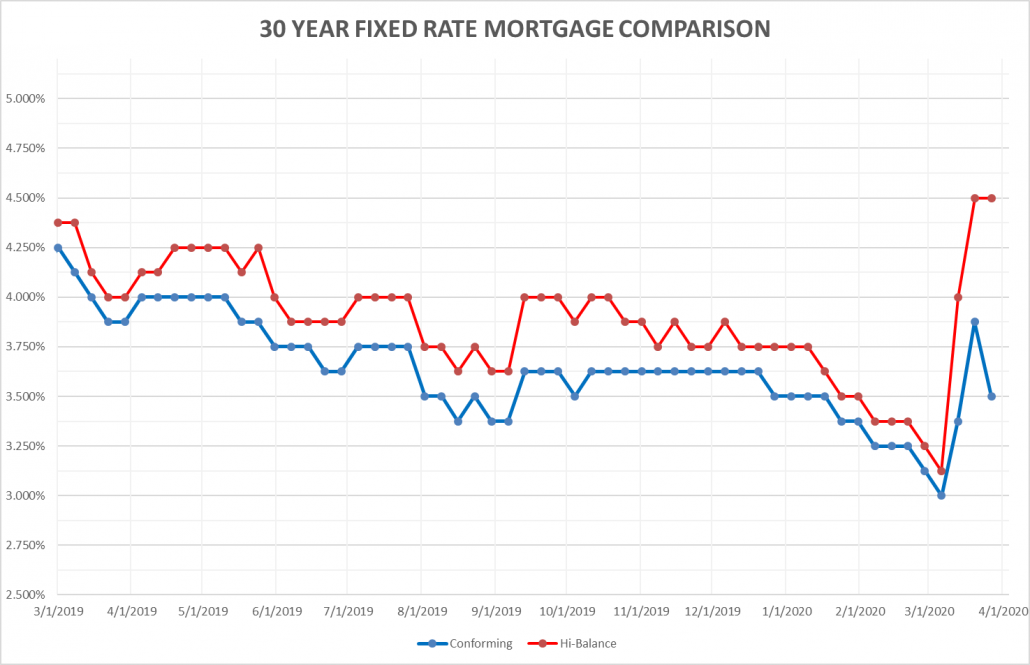
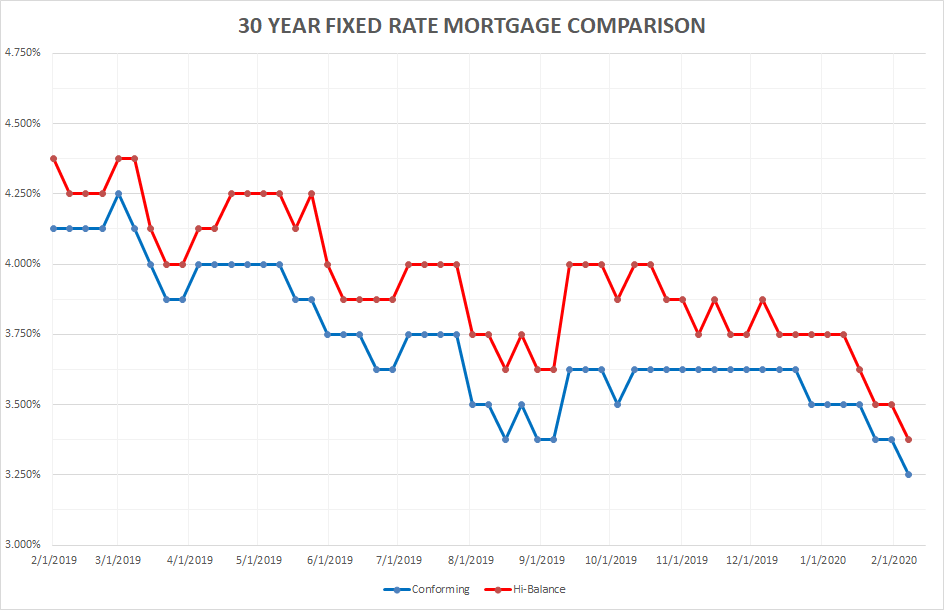
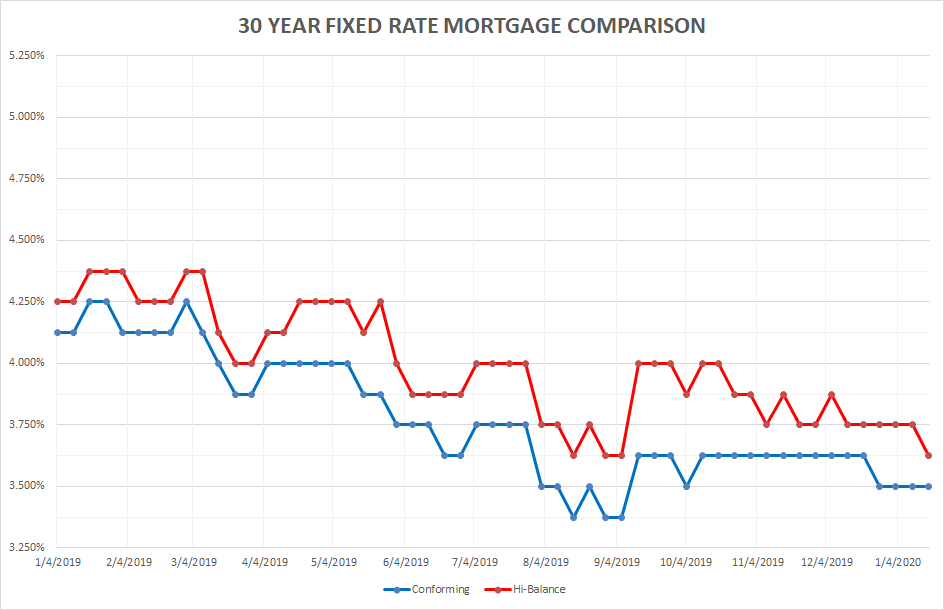
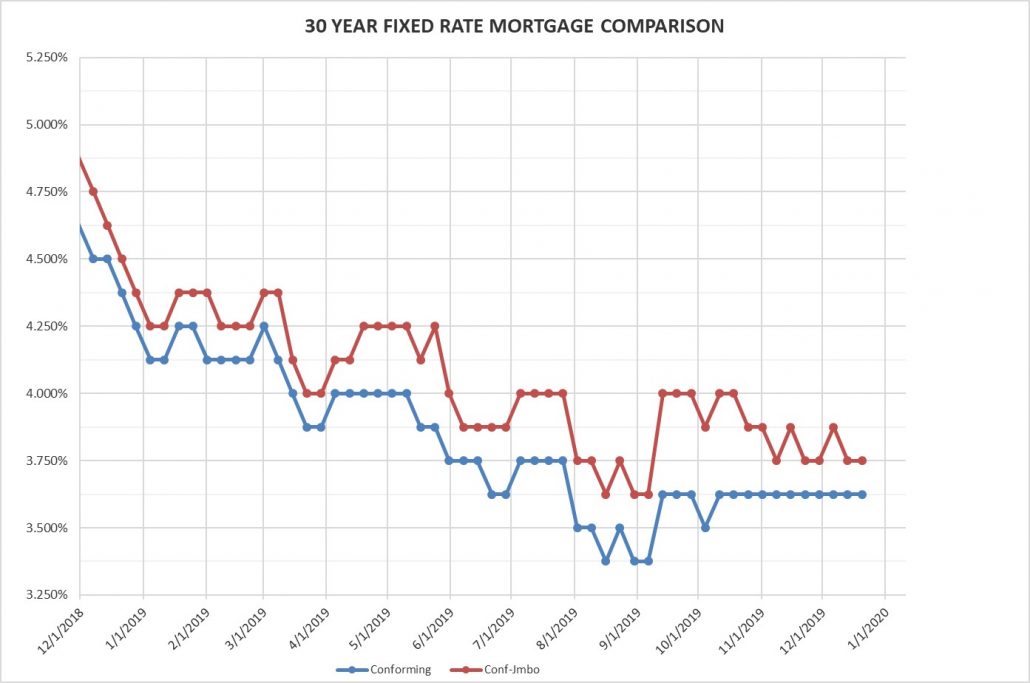
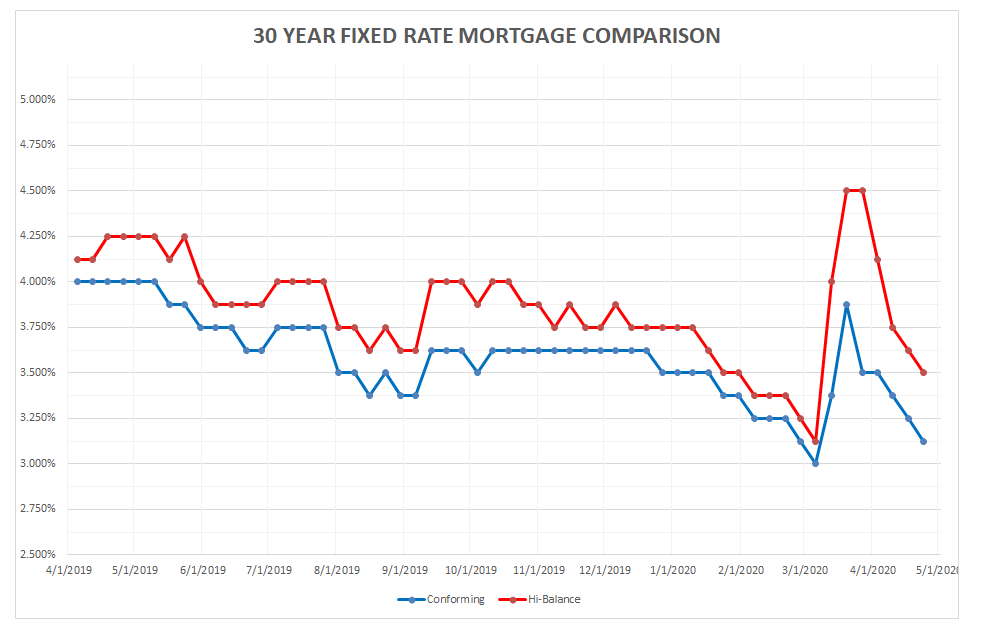
Rates for Friday April 24, 2020: The gap remains between 30-year fixed “vanilla” mortgages and other products. It will likely last until liquidity issues in the secondary markets are settled and investors develop a taste for a bit more risk. In the meantime, rates slip down again this week for purchase transactions. Note, rates below are for purchases, refinance rates differ.
FIXED RATE MORTGAGES AT COST OF 1.25 POINTS LOCKED FOR 45 DAYS:
30 year conforming 3.125% Down 0.125%
30 year high-balance conforming 3.50% Down 0.125%
Please note that these are base rates and adjustments may be added for condominiums, refinances, credit scores, loan to value, no impound account and period rate is locked. Rates are based on 20% down with 740 FICO score for purchase mortgages.
Last Friday I received a nice email from Jeanine, long-time reader of the WR&MU and Realtor. She wrote in reply to my closing statement to the effect that from decay comes growth.
She wrote that there is a flower that only grows and blooms out of the ashes of wild fires. “I am hopeful ‘out of the ashes flowers,” she wrote, “ will be a metaphor for our continued concern for each other after we emerge from isolation.”
What a great message, and I and most everyone share this hope with Jeanine.
I did what we all do these days and Googled Jeanine’s “out of ashes flowers” and discovered the flower only grows in California, and only grows after wild fires. It is the Fire Poppy.
Thank you Jeanine for your bringing the Fire Poppy to my attention and your nice note, and thank you to everyone who sends me comment, questions, suggestions and just checks in after receiving the Weekly Rate & Market Update!
Have a great week,
Dennis
Past Weekly Rate & Market Updates can be found on my blog page at my website www.DennisCSmith.com/my-blog