


What happened this week? Another in the on-going COVID-19 series on rates and the economy.
Question of the week: What happened this week?
Answer: A lot….
The headline news was the Senate passed a $2 trillion stimulus package earlier this week, and after I started writing this installment of the Weekly Rate & Market Update the House has passed the legislation and sent to the White House for President Trump’s signature.
The page 3, 4 or 5 news that impacts mortgage rates is the Federal Reserve announcement on Monday that it would purchase unlimited amounts of Mortgage Backed Securities. (Quick note to new readers, Mortgage Backed Securities—MBS—are the financial instruments that your mortgage becomes and are what decide the rates in the mortgage markets. Scroll through past posts of the WR&MU on at my website to read more about MBS and their relationship to rates I am working on updating page for an easy link to archived updates, in the meantime type Mortgage Backed Securities in the search box on the upper right.)
Back to our story, we left off with the Fed announcing it would purchase an unlimited number of MBS. This would seem to be good news for mortgage rates. Observant readers would note the word, “seem.”
Our industry has many great analysts that provide information and insight to those of us slogging it out in the fields on a daily basis. One such expert, who might be the most read and respected and if not the most in the top three to five, is Barry Habib.
Barry’s articles are geared to industry professionals, as such they can get a little bit in the weeds, however even then he is able to simplify the complicated. Yesterday Barry published such an article, “Mortgage Crisis and Fed Unintended Consequences.” It has been by far the most shared article I have seen in my career. I received it no less than five times from others in the industry, another five or more times in communicating with others they have mentioned the piece and it has been shared all over social media.
For the past few weeks I have been writing about rates going up, paradoxically to many. I have written, “there are a number of reasons, but one is…” picking some of the easier to understand issues impacting rates. In his article Habib goes into detail as to how the mortgage market works and how the actions by the Fed are having the impact of increasing rates due to harming lenders’ liquidity, profits and pipelines. The short, and very simplistic summation, is centered around servicing of mortgages and the loss of servicing revenue due to the rate markets and the added costs of acquiring new mortgages. Essentially, when a lender acquires a mortgage it takes about three years for them to recoup the acquisition costs through the fees they earn servicing the loan after they have sold it to Fannie or Freddie. When the rates drop so rapidly from where they were three, five, seven months ago, lenders lose a large segment of their servicing portfolio that has not yet turned profitable.
Further complicating the mortgage industry is the Fed actions harming lenders as they try to hedge their pipelines and losing as the Fed pushing MBS prices higher turns hedges into risks.
In a very, very, simplified nutshell, the Fed in trying to stabilize rates and thinking it is providing liquidity to the mortgage market is harming the market based adjustments for lenders; essentially disrupting the flow of funds in the circular pattern of funding borrowers, selling loans in the secondary market for funds to lend again, collecting servicing fees to offset origination costs, and starting the cycle again.
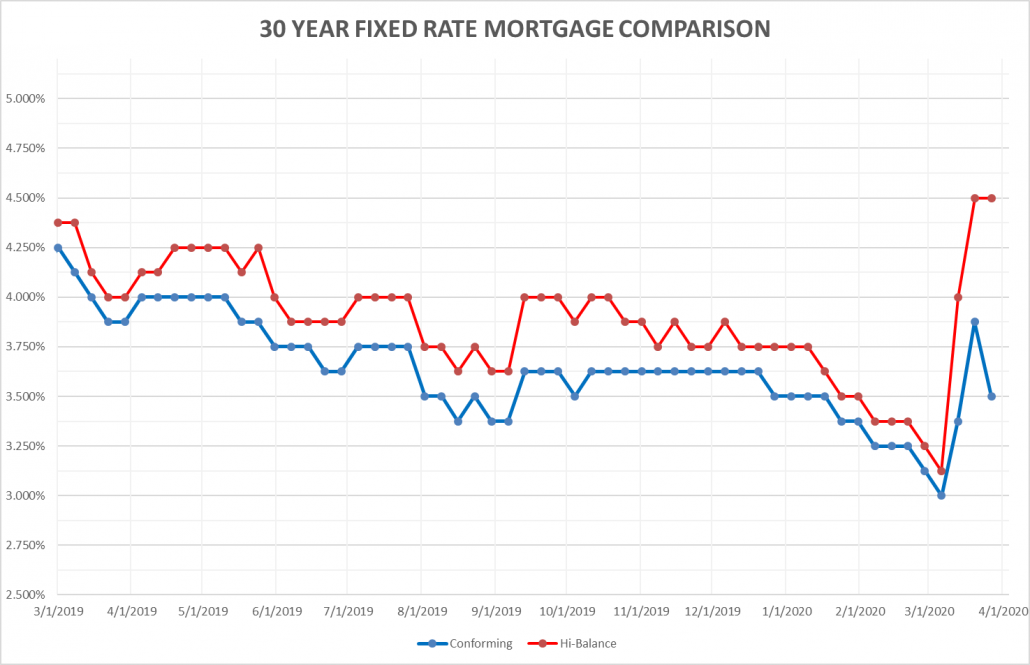
The current state of the mortgage market is that the non-QM (rather than get complicated these are loans that are not traditional, fully income verified mortgages) and jumbo mortgage products have dried up. For conventional mortgages, almost any mortgage that is not a 30 year fixed rate conforming purchase there is a premium added by lenders, which increases the rates for those products.
We do have some lenders that have concentrated on the purchase market, meaning they are offering significantly lower rates for purchase transactions than they are offering on refinances. As well, many are moving to not accepting rate locks until they have approved a loan submission package.
All this will sort out as the markets find “normal.” In the meantime we can expect choppy waters for non-conforming mortgages in the near future. Hopefully, near is very near and not a bit further near and lenders are able to sustain their pipelines.
In the meantime, we are dealing with historic markets and spreads within and between different products and lenders.
Have a question? Ask me!
In economic news, February data is showing that it was a positive month for economic growth and progress. Key indicators were all positive, durable goods orders, personal income, consumer spending and core inflation numbers all supported continued GDP growth for the 1st quarter. In normal times, personal income growing significantly higher than both expenditures and inflation would be a positive to push rates higher. In normal times.
Most economic news from last month is somewhat irrelevant at this point. Highlighting the point is that jobless claims for the week grew from 282,000 to 3.28 million for the week ending March 21st. It is the most claims ever filed in one week, over four and a half times higher than the prior record set in October 1982. Reading through various reports, it appears many employers were laying off workers ahead of Congress passing legislation on employer obligations for workers out on sick leave due to COVID-19 and other factors that caused employment attorneys advising employers to lay off workers despite wanting to try to keep them on.
Rates for Friday March 27 2020: Rates continue to be volatile, as mentioned above. Rates below are quoted for 45 day locks for purchases only, refinance rates will vary.
FIXED RATE MORTGAGES AT COST OF 1.25 POINTS LOCKED FOR 45 DAYS:
30 year conforming 3.50% Down 0.375%
30 year high-balance conforming 4.50% Flat
Please note that these are base rates and adjustments may be added for condominiums, refinances, credit scores, loan to value, no impound account and period rate is locked. Rates are based on 20% down with 740 FICO score for purchase mortgages.
Community physical health is directly tied to community economic health. Studies for decades have shown that disease and illness impact those in lower economic circumstances than those in higher economic circumstances due to poor eating habits and opportunities, stress and other external conditions caused by lack of prosperity. When is the “when” we must get to so that our nation’s workers and businesses can begin to engage in economic activity to recover from the dramatic drop in commerce, revenue and most importantly, wages?
The very big debate and decisions our nation must face is the “when?” When will the economic well-being of the nation become more vital than the physical health of an undetermined number of the nation? It is a moral question; it is a health question and it is a question that impacts today and the next decade or more. Not assisting in any debate on the “when” question is the extreme emotional element that comes into play whenever discussions involve people’s morals, values and ethics. How that conversation is had will be as important as to the answer and actions.
Back on the home front we have work, classes, yoga, workouts and of course some movie and binge show watching taking up our media devices. As well, I have been able to read more frequently than my normal routine of at least half an hour three times a day. I hope your family is getting along as well as ours during this period of confinement for most of you!
Thank you to those who replied in the positive to my inquiry about interest in “lunch and learn” about loans, economics, etc. I am working up a session on how money moves and will get out an announcement on time and date—likely on Tuesday mid-dayish.
Have a great week,
Dennis
Past Weekly Rate & Market Updates can be found on my blog page at my website www.DennisCSmith.com/my-blog


