


Is there a tax advantage to owning rental property outside of California?
Question of the week: Is there a tax advantage to owning rental property outside of California?
DISCLAIMER: I am not an accountant, CPA, or licensed tax preparer. Please consult with your accounting/tax professional for your particular situation.
Answer: No.
After last week’s WR&MU regarding possibly retaining your home in California if you live out of state, it seems appropriate to cover investment property owned, and sold, out of state.
In 2015 the U.S. Supreme Court ruled that two states cannot tax the same income. This was a big case for the Northeast as it is not uncommon for people to live in one state and work in another due to the proximity of major cities to other states. Consider Washington D.C. which is on the border of Maryland and Virginia, New York City has workers that regularly commute from Connecticut and New Jersey, and Philadelphia that draws workers from New Jersey and Delaware.
Prior to the Supreme Court decision, someone who lived in New Jersey and worked in New York City would pay city, county and state income taxes for each of the tax jurisdictions where they worked and lived.
After the ruling, most states altered their income tax laws to tax residents’ income earned out of state by off-setting the taxes they had paid on their out-of-state income against their in-state income.
If you live in California and have taxable income of $150,000, this puts you in the 9.3% tax bracket. You own investment property in Arizona that nets taxable income of $25,000 per year; this income is taxes at 2.59% in Arizona.
In addition to your federal income and State of California tax returns, you will need to file a non-resident tax return in Arizona.
On the Arizona return you will file $25,000 net income from the property and pay $647.50 in income taxes ($25,000 x 2.59%).
On your California return you would file your return showing the $25,000 net taxable income, and the $647.50 paid to Arizona. Your income tax payable to California would be $1677.50:
$25,000 income x 9.39% CA tax rate = $2325.00
CA tax $2325 – AZ tax paid $647.50 = $1677.50
Your total taxes would be the same as if you owned a rental property in California that had net taxable income of $25,000.
Another wrinkle for investment property owners is selling investment property in California executing a 1031 tax differed exchange with the purchase of an investment property in another state.
A 1031 exchange enables an investor to sell an investment property and transferring the net proceeds to the purchase of another property. This enables the property owner to differ the capital gains on the sale of the property to a future sale. There is no limit on how many times you can execute a 1031 exchange transferring capital gains to another investment. Note this is over-simplified and should not be used as a basis for your decision to exchange property to differ capital gains; consult your tax professional.
In 2015, you sold a property in Long Beach, California that was initially your primary residence you had purchased in 2008 and converted to a rental property in 2012. At the time of the conversion in 2012 the property was worth $400,000. The property sells in 2015 for $750,000, your net proceeds after paying off the mortgage and closing costs are $400,000. Going through the required process, you transfer the $400,000 to a duplex in Denver that you purchase for $800,000.
In 2025 you sell the Denver property for $1,200,000.
Each year you have included the Denver property on your California income tax return, to report the income and taxes paid in Colorado, as well to show that you have not sold the property
When you sell the property in 2022, you decide to take the proceeds, i.e. you are not executing another 1031 exchange.
Because you are taking the proceeds, California is going to “claw back” the capital gains tax owed on the gains realized in California between when you converted the property to a rental and sold it to transfer the proceeds to purchase the property in Denver. The basic calculation is to deduct the cost basis from the net proceeds. In this case $750,000 less $400,000 is non-adjusted capital gains subject to tax in California.
There are many reasons people have for purchasing rental properties in other states, know that by doing so you are not avoiding the California State Franchise Tax Board by doing so.
One more time, all the above is for purposes of providing examples in a broad and general sense. Tax laws, both federal and state, are very complex and to properly calculate your tax obligations it is strongly suggested your work with a tax professional to prepare your returns. None of the above statements should be used as a basis for you to prepare taxes or make decisions that have tax implications, they are intended to provide basic information and a basis for questions and discussions you may want to have with your tax preparer before making any final decisions to buy, sell, exchange real estate.
Have a question? Ask me!
A very busy week for journalists who cover the economy. Data on economic growth, inflation, personal income and spending, and jobs were all released. Let’s take a look:
- Gross Domestic Product grew 3% in the 2nd quarter, up from a 0.5% contraction in the 1st quarter. The growth was not as good as it sounds as it was only positive because of a tremendous drop in our trade deficit.
- Last quarter GDP was negatively impacted by a surge in imports (added to GDP), this quarter, GDP was boosted by 5% due to a significant drop in imports. If trade was neutral GDP for the quarter would be -2%.
- Combining 1st and 2nd quarter data, GDP grew by 1.25% in the first half of the year, below average for economic growth.
- For the quarter consumer spending, 65-70% of our economy, grew 1.4%, up from the first quarters anemic 0.5% growth. Much of the spending increase was due to Americans buying more cars to avoid tariffs, these one-off purchases are not sustainable to GDP growth.
- The rate of inflation dropped from 3.7% in the first quarter to 2.1% in the second quarter.
- GDP data shows that the worst of the trade wars may be behind us, what they do not show is what shape the economy is in moving forward to support sustained growth, or if it will slow.
- The Personal Consumption Expenditures, the preferred inflation gauge for the Federal Reserve, decreased very slightly from May to June, dropping from 0.320% to 0.256%; if rounded to 3.0 and 3.0 there was no change.
- Year over year PCE rose 2.6% in June, higher than May’s yearly increase of 2.4%.
- More importantly for the Fed, the core rate (energy and food stripped out of data) remained well above the Fed’s 2.00% target, growing 2.8% year over year.
- Personal incomes kept pace with inflation, also increasing 0.3% in June. Personal spending also increased 0.3%, essentially flat in unit sales from May to June as the data is on dollars in sales—which increased the same amount as prices.
- To quote MarketWatch, the labor market is eroding. Only 73,000 jobs were added to the economy in July and the unemployment rate increased from 4.1% to 4.2%. Compounding the poor new-hires data was revision of jobs numbers for gains in May and June to almost zero.
- A bright spot in the report was despite the pittance of new hires, for those working hourly wages increased 0.3%, keeping pace with inflation.
No data was the other news this week. No data as the Fed, as expected, did not raise its benchmark interest rate at its meeting on Wednesday. That announcement was expected, what was not expected was that two of the voting governors voted against the others and voted for a rate reduction. Part of this could be political, knowing that President Trump will be replacing current Federal Reserve Chair Jerome Powell when his term is up next year and perhaps showing Trump, they are willing to follow his lead on what to do with rates.
Going into Friday’s Labor Department report, economic data supported the Fed’s decision to not lower rates, and put a little pressure on perhaps increasing rates if inflation continued its upward pace. However, Fed Chair Powell has often stated that they were closely watching labor markets in their decision making. No job growth and rising unemployment can be major factor in whether the Fed does cut rates in September.
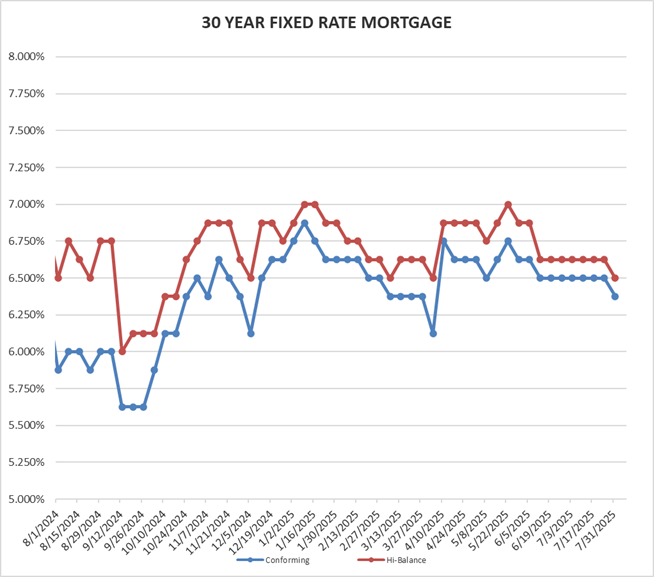
Rates for Friday August 1, 2025: Rates were headed lower early in the week, however Trump’s tariff declarations yesterday and today’s jobs report clawed back some of the gain. That said, rates go down week to week to the lowest they have been since early April.
FIXED RATE MORTGAGES AT COST OF 1.25 POINTS LOCKED FOR 45 DAYS:
30 year conforming 6.375% Down 0.125%
30 year high-balance conforming 6.50% Down 0.125%
Please note that these are base rates and adjustments may be added for condominiums, refinances, credit scores, loan to value, no impound account and period rate is locked. Rates are based on 20% down with 740 FICO score for purchase mortgages.
One of the biggest agonies of technology is replacement technology. I went through a lengthy and frustrating process of converting a new laptop from my steadily dying 5-year old laptop that served me well (as have all the Lenovo ThinkPads I have had over the years).
The frustration was loading Outlook. The unit came with Windows 11, as well as update Office software. After many attempts to sign in, giving up several times after being in a one-hour plus wait line to “live chat” with someone from Microsoft, you can’t call anyone anymore. Friendly tech-guru Steve quickly let me know to download “classic” Outlook and get rid of the “new-improved” version Microsoft has in their bundles.
Lo and behold instant success. Hearing from other IT folks as I download industry specific software, their first comments were “download classic Outlook, don’t use the new one.”
If you are getting a new computer, load the classic Outlook for seamless transfer of your accounts and data!


