


We requested and received a forbearance; can we get a new mortgage to purchase or refinance?
Question of the week: We requested and received a forbearance; can we get a new mortgage to purchase or refinance?
Answer: Yes, maybe.
As regular readers of the WR&MU are aware there are different types of mortgages which have different guidelines. The overwhelming mortgages funded in America are “conventional,” or “conforming” mortgages. These are loans that are purchased from lenders by Fannie Mae and Freddie Mac, aka the GSE’s (Government Sponsored Entities). Because they are the buyers, they set the rules that lenders must adhere to when underwriting and approving loans if they wish to sell to the GSEs.
With a few slight differences between the two, both Fannie and Freddie are enabling lenders to approve new mortgages for applicants who taken a forbearance due to Covid-19 financial hardship provided certain criteria are met—this applies to both refinance and purchase mortgages.
If the borrower has resolved missed payments and are reinstated on their original note payment, they are eligible. The source of the funds to bring pay the missed payments must be documented if the reinstatement occurred after the loan application, but before the loan funds. Loan proceeds from a refinance cannot be used to reinstate any loan in forbearance.
If a borrower has outstanding payments that were, or will be, resolved through a loss mitigation program with their current lender they must have made at least three consecutive timely payments in the immediate months prior to and including the funding of the new loan. For example, if you currently have a mortgage in forbearance due to Covid-19 financial hardship and are closing in September you must show the payments for July, August and September were all made in a timely manner.
“Timely payments” is defined as the payment being made in the month the payment is due, this means if your August payment is processed by the lender by August 31st it is considered timely.
If the borrower is in a repayment plan, the plan need not be completed to obtain loan approval as long as the three timely payments guideline is met.
Many families who have taken a forbearance are concerned about their credit history. We have yet to see any mortgage that has been in, or is actively in, forbearance due to Covid-19 showing any late payments on the credit report. This means credit scores and ratings have not been affected by those families in this situation.
If requested and received a forbearance under the CARES Act guidelines due to Covid-19 financial hardship and have made your most recent payments on time you are likely eligible for a new purchase or refinance mortgage.
If you, or someone you know, is in this situation and interested in a new mortgage please contact me to review your specific situation and ability to qualify.
Have a question? Ask me!
Plenty of economic news this week. Consumer spending, about 65-70% of our economy, increased for the third month in a row in July, up 1.9%. The increase was smaller than the big jump in May as economies acrossed the nation opened up, and smaller than the increase in June, which was moderate after local and state businesses shut down businesses that had opened in May. The re-closings slowed the momentum of May and June in the economy, but the increase in July spending is a positive sign for future growth. Incomes increased in July by 0.4%, this increase is being mostly attributed to the Paycheck Protection Plan loans provided to businesses. Another positive sign is the annualized inflation through July increased to 1%. Ordinarily positive economic information puts upward pressure on rates, but all this news was shrugged off by investors.
What was rate moving was the statement released by the Federal Reserve’s Open Market Committee (FOMC), which is the body that makes decisions as to whether the Fed will raise or lower its benchmark interest rate. In a surprise announcement the FOMC announced significant changes to its policy strategy. It should be noted the Fed’s mandate has been to maintain stable prices while achieving maximum sustainable employment; i.e. keep prices as low as possible while have as many people working as possible.
There is an acre of weeds I could crawl through regarding the announcement and implications but will just go through the nearest small patch (edit: I couldn’t help myself and went to a bigger patch of weeds to drag you through, those not interested in some economic analysis may want to jump ahead).
In 2012 the Fed’s approved policy has been to use its monetary policy to have inflation be at, or very near, a benchmark of 2% and a stable job market. The policy was based on an economic theorem learned by myself and every other study of economics that there is an inverse relationship between inflation and unemployment, as inflation increases unemployment decreases. The policy announcement yesterday was an acknowledge by the Fed that this relationship no longer exists as it did in the past.
To meet its mandates, the Fed has used its fed-funds rates as a brake or accelerator, raising or lowering the rate to calm inflation or create inflation depending on the need. On Wednesday the FOMC announcement was an acknowledgement that the Fed does not have, and has not had for some time, the ability to control the economy by simply raising and lowering rates and that concentrating on inflation is not good monetary policy.
In this light the FOMC has indicated that it will retain a very low rate policy for some time into the future, and that while 2% inflation is an objective, one that has rarely been met in recent years, it will seek to achieve and average of 2% inflation over time. This means that if inflation is below 2% for a while it will let it run, when it is over 2% for a time it will let it run, the result will be fewer changes in interest rates by the FOMC.
Regarding the maximum level of sustainable employment, the statement said that the goal is not directly measurable and changes over time. Meaning it will concentrate less on week-to-week, month-to-month changes in employment and take a broader view when making policy decisions.
Most importantly, to me, the Fed has added as a strategy a stable financial system. This statement seems so obvious to me that I was surprised that it had not long been the foundation for the Federal Reserve, “…sustainably achieving maximum employment and price stability depends on a stable financial system.” You would think they learned this in 2008.
The reaction to the announcement was an immediate jump in Treasury and mortgage rates. Why? Because these are long term investments and the Fed saying that it would allow inflation to go above 2%, as much as it can allow or control inflation, it indicates higher rates in the future. Imagine being and investor and purchasing a 10-year Treasury note, or a 30-year mortgage, at today’s rates and in five years rates are higher? Your investment is worth a lot less as someone can spend the same amount of money and get a higher return.
I personally like the Fed’s new policy and feel that a stable financial system should be the primary focus to ensure the smooth flow of funds throughout our economy, enabling commerce as well as ensuring the safety of deposits for families, retirees, investors and companies.
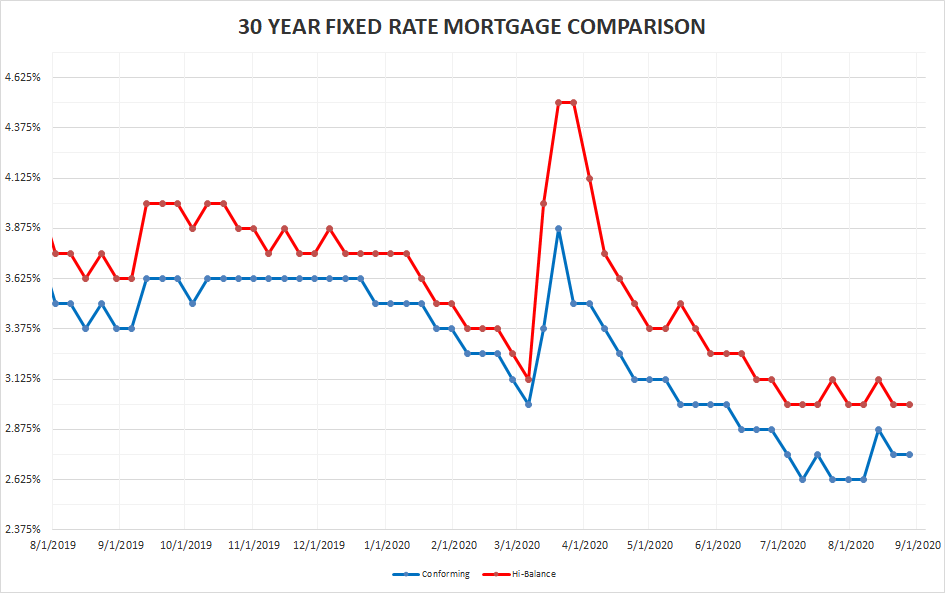
Rates for Friday August 28, 2020: Despite the bump earlier in the week rates are flat from last week. Refinance rates have drifted down a bit after the GSE’s have pushed to December 1st their 0.5% (one-half of one percent) Adverse Market Fee on refinances. Diligent readers will recall this fee was imposed a few weeks ago to go into effect for loans funded after August 31st. Had the date remained it would have costs lenders hundreds of millions of dollars on loans currently locked in their pipelines for funding in September.
The rate spread for cash-out, no point, higher loan-to-value and other factors for refinances still are historically higher than normal. Call for details and quotes as rates can vary significantly depending on the situation.
FIXED RATE MORTGAGES AT COST OF 1.25 POINTS LOCKED FOR 45 DAYS:
30 year conforming 2.75% Flat
30 year high-balance conforming 3.00% Flat
Please note that these are base rates and adjustments may be added for condominiums, refinances, credit scores, loan to value, no impound account and period rate is locked. Rates are based on 20% down with 740 FICO score for purchase mortgages.
Adding to the list of “get me out of 2020” are natural disasters impacting much of the nation. Currently lenders are suspending closing, or requiring additional verification that properties are unaffected in Iowa (severe storms and flooding), portions of California (wildfires), Texas and Louisiana (Hurricane Laura). Some things are immune to coronaviruses, stay-at home polices and governments closing businesses, primarily Mother Nature and the devastation She can create.
We all have been impacted in some way, some less and some more than others, but most of us have faced little of what is facing the families in the midst of picking up their lives after disasters have hit their homes, neighborhoods and communities. Whatever the amount you can afford right now, I encourage you to make a contribution to the Red Cross Disaster Relief Fund. The workers and volunteer for the Red Cross provide tremendous support, comfort and service to those impacted, despite going through their own trials and tribulations in the pandemic. Give a buck, or more.
Have a great week,
Dennis
Past Weekly Rate & Market Updates can be found on my blog page at my website www.DennisCSmith.com/my-blog


