


Is the housing market going to tank?
Question of the week: Is the housing market going to tank?
Answer: Lately I have been asked this question with a little softer language, for instance, “are housing prices going to fall?” However, friend Maria was a bit more, let’s say direct, in her choice of words.
My response was, “it depends on what your definition of ‘tank’ is.”
Let’s look at some data.
The California Association of Realtors monthly housing update for July shows that sales of single-family homes statewide were down 14.4% from June and 31.1% from July 2021. The median sales price in July ($833,910) was down 3.5% from June and up 2.8% from July 2021.
More locally, in Los Angeles County sales were down 26.4% from June and 32.4% from last July, the median price ($846,320) dropped 1.6% in June, but up 4.5% from last July. Across the County border to the south, Orange County saw a 16.3% decline in sales month-to-month and a 38.8% decline year-to-year, with the median price ($1,231,000) down 2.7% from June and up 12.9% from a year ago.
With the surge in sales and prices due to the historically low interest rates during the pandemic, seeing a decline in purchase activity is not a surprise, nor is a softening of prices. Taking a look back, in July 2020 the number of sales statewide was up 28.8% from July 2019, July 2021 saw a drop in sales of 1.6%; while sales are down from last year, statewide, by 14.4%, they are still up almost 13% from 2019.
The decline in sales in 2021 was due to a lack of inventory. Rates were still very low, however, homebuyers had little options on the market to try to purchase. In July 2021 the unsold inventory index was 1.9 months (how long inventory would last if no new listings came to market), in July 2022 the index rose to 3.3 months. Historically, a normal market will have an index of 3-4 months; an index in this range will support slowly increasing prices that track somewhat with the economy. The extremely low index during the pandemic resulted in they buying frenzy, all-cash buyers, and homes selling well over their listed prices.
In July the sales price to list price ratio in Southern California was at 100%, meaning buyers were paying what the seller was asking. During the pandemic market the statewide average the ratio was close to 104% ( a home listed at $700,000 would sell for $728,000).
Recapping, sales are down month-to-month and year-to-year, sales prices are down month-to-month and year-to-year, inventory on the market is up month-to-month and year-to-year.
Nationwide the trends are similar, sales are down, prices are dropping but still well ahead of pre-pandemic prices. The graphs tracking sales are inverse to graphs tracking interest rates, which is no surprise—higher rates have cooled real estate markets across all sectors, single family, condos, multi-family, commercial, industrial, office, all are showing similar trends.
Back to our question of the week, do these statistics mean that the real estate market is “tanking?” No, not at this time. What I see in the data is that the market is normalizing. Buyers have more inventory to choose from, so supply is getting into line with demand. Fewer buyers in the market because of higher rates is lowering the number of potential buyers for sellers, demand is getting in line with supply.
What would signify that the market is tanking? Inventory increase to over four to five months, sale price to listing price ratios dropping below 90%, and most importantly an increase in foreclosures that result in a significant supply of homes going to market from lenders and banks. We are a long way from any of these occurring.
What can cause these factors to occur? Labor markets. If our nation undergoes a significant recession that sees lay-offs and shrinking of the workforce, especially in the middle-income sector, we will see a surge in properties on the market as out of work families, who still have equity, put their homes on the market to get funds to pay rent somewhere. Demand will drop as well as fewer families will have the ability to qualify to purchase homes.
Last month’s jobs data showed that this scenario is not yet on the horizon.
In the meantime, with the housing market normalizing, even with higher rates, it is a good times for families interest in buying to start the process of discovering their purchasing power and how the transition of from a seller’s market can create options for lowering your interest rate on your purchase. Securing the home now and potentially refinancing later could save you money if you wait to “time the market” and miss.
Have a question? Ask me!
July was a good month for retailers. The Commerce Department released data for July sales this week, which showed sales in July equaled those in June—flat, 0% change. This is good news? Yes, due to a drop in sales of gasoline (1.8%) and auto sales (1.6%) from the prior month total retail sales were pulled down. Taking out gas and autos, retail sales climbed 0.7% in July. Further good news, since the cost of living was flat from June to July, the increase in sales numbers are unaffected by inflation. Though with gas prices dropping 11% nationwide, the decline in gas sales as part of the overall data was definitely an impact.
With retail sales across most sectors increasing, the positive outlook is the data doesn’t support an extended recession, or a deep one. The data is not positive for rates as it increasing purchasing activity also supports higher prices, i.e. inflation, outside of energy costs.
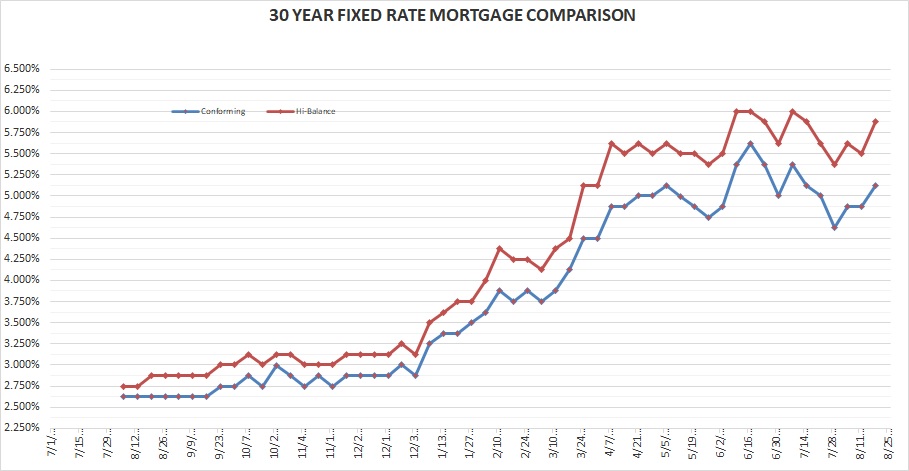
Rates for Friday August 19, 2022: Rates spike this week as investors were not pleased with comments from various Federal Reserve governors regarding their hawkish stance on inflation and likely raising rates by 0.75% again next month; many were thinking the Fed may go with a lower 0.50% rate increase with inflation slowing last month. As we close the week everything is down, stocks, Treasuries (higher rates) and mortgages.
FIXED RATE MORTGAGES AT COST OF 1.25 POINTS LOCKED FOR 45 DAYS FOR PURCHASE TRANSACTIONS:
30-year conforming 5.125% Up 0.25%
30-year high-balance conforming 5.875% Up 0.375%
Please note that these are base rates and adjustments may be added for condominiums, refinances, credit scores, loan to value, no impound account and period rate is locked. Rates are based on 20% down with 740 FICO score for purchase mortgages.
It’s been several years for us, so I can’t remember if we liked the kids going back to school or didn’t like it because we missed them being around. Just kidding! For those parents in the transition from summer to school schedules I wish you well. I am jealous that the state has pushed back the start times for schools to begin their days, especially those with high schoolers starting no earlier than 8:30 a.m. and not having to get teenagers out of bed in the near dawn hours.
Have a great week,
Dennis
Past Weekly Rate & Market Updates can be found on my blog page at my website www.DennisCSmith.com/my-blog


