


Why get a reverse mortgage?
Question of the week: Why get a reverse mortgage?
Answer: Because it is a financial tool that may benefit you more than a traditional mortgage with monthly payments.
For several years I have been saying that reverse mortgages (RM for the remainder of the WR&MU) are the most misunderstood financial tool available to consumers.
Before we get into whether you should get a RM, let’s go through some basics of the product. At the end of the Question of the Week section there will be an example of the mechanics of reverse mortgages.
- First and foremost, and most importantly, the lender cannot take your home as long as you are living in the property.* More on this below
- You can use a RM to purchase or refinance your primary residence, note this does not include second, or vacation, homes; though proceeds from a RM may be used to purchase a vacation home.
- Eligible properties are 1-4 units, as long as you occupy one unit, condominiums, and certain manufactured homes depending on requirements from lender.
- The most common RMs are HECM (Home Equity Conversion Mortgage), which are government insured by the Federal Housing Administration, yes, the same entity responsible for FHA mortgages used by millions to purchase or refinance their homes. To be eligible for a HECM you must be 62 years old or older.
- Other RMs in the market have a minimum age of 55, these products are not insured by FHA and have different guidelines and features.
- For HECM products there is an equity line feature, as well the amount of the available funds on the equity line increases over time. This feature is flexible depending on what funding options you select at closing. Some borrowers obtain a RM and have an amount of funds available they may draw on in the future, with no proceeds being disbursed at closing. For example, they obtain a $450,000 HECM with no funds paid to them at closing. Over the life of the loan the they can draw on the equity line, either in lump sums or regular payments.
- For the life of the loan, you do not need to make payments on the mortgage, but you must make payments for taxes, insurance, homeowners association fees, etc. While you are not required to make payments on the RM, you may do so.
- Some RMs have higher closing costs and more features, other RMs have lower closing costs and fewer features. Some RMs have adjustable rates, other RMs have fixed rates. It is important that you understand the options available and compare features, rates and costs.
- All potential borrowers must go through counselling about RMs, the benefits, the costs, the risks, the options. This counselling is done by a third party who is not affiliated with the loan originator or any lender. The cost is paid at the time of counseling and costs up to about $250, though may vary. A final and complete application for a RM cannot start until seven days after the counseling is completed. This allows time for the borrower to do more research and make a decision.
- Loan amounts are determined by value of the property, age of the youngest borrower, and the current interest rate and fees on the RM.
- The loan is due when the home is no longer the primary residence for any borrowers; i.e. when relocate to a senior facility, purchase or rent another home as primary residence, borrowers have died.
- Homes with RMs can inherited. Depending on the value of the property and the balance on the RM, heirs can retain the property provided the RM is paid off, either with a refinance. This must be done within one year of the passing of the borrower on the RM. (Side note, over the years we have assisted may clients with refinances to pay out other beneficiaries to retain a home with a RM and the parents have passed away.)
*This is the most misunderstood aspect of RMs. A lender cannot kick a borrower out of the home. A lender cannot prevent an heir from obtaining the property as long as the RM is paid in full. Depending on the value of the property and the balance on the RM, the heirs may choose to deed the property to the lender.
Here are some issues that come up when discussing RMs options with clients.
- A lender can foreclose on a home with a RM. Keep in mind a foreclosure occurs after the lender files a notice of default, meaning the borrower has violated one or more closes of the Note; if the default is cured there is no foreclosure. Here are the factors that can lead to default.
- Homeowner does not pay property taxes or other required expenses such as insurance or homeowners association fees.
- Property is no longer primary residence.
- Borrower dies, as mentioned above, while this will trigger a notice of default calling the loan due, there are time frames heirs have to retain the home by paying off the balance due.
- Borrower does not use the home as primary residence for more then twelve consecutive months, i.e., relocates to a senior care facility.
- If your loan balance is higher than the value of the home the lender cannot make you pay the loan balance down. If the lender does foreclose and the loan balance is higher than the proceeds from the foreclosure the lender cannot come after you for any balance due.
- Scenario: Senior purchased a home twenty years ago in a retirement community in Beaumont. The balance on the RM is $350,000. The property is worth $340,000. The homeowner wants to relocate to a senior facility. Contacts the lender and deeds the property to the lender. The lender sells the property and after expenses nets approximately $300,000. The lender cannot file any claims or suits against the borrower for the $50,000 difference between the loan balance and the proceeds following the sale.
- If you do turn the property back to the bank it will have negative impact on your credit. In scenario above, if the senior is no longer going to purchasing property, automobiles or otherwise access new credit the impact of a negative rating on the credit report is negligible.
- The rates on RMs are higher than rates on traditional mortgages. This is due to the lender not receiving any interest payments until the loan is paid off, plus the risk that they may have a property that is worth less than the amount they loaned plus accumulated interest.
- A very common reason eligible borrowers do not obtain RMs is because they are concerned with losing equity in their home due to the increasing balance of the RM for accruing interest. Interestingly, this is often more a concern for the potential borrower’s children worried about inheritance than the borrower. Yes, the loan balance is increasing, but in most markets, especially in coastal Southern California, home values are increasing as well. With the calculations involved to determine the amount of the loan at funding, and any potential equity line, the math is whether or not the RM balance is increasing faster than the value of the property, and at what rate.
Many people have a difficult time understanding how a reverse mortgage works because they have imprinted in their consciousness that when you get a loan you make monthly payments until it is paid off. Perhaps the easiest explanation is it is an interest only mortgage, but you don’t pay the interest until the loan is paid off.
You and your spouse are both 68 years old are down-sizing, you sell your home for $900,000 and pay off your $350,000 mortgage. After costs of sale, you have about $500,000. The home in Palm Desert you are buying costs $750,000. Your income is social security payments for you and your spouse and accessing funds from your IRAs.
Option 1, you purchase the property with $450,000 down using a traditional 30-year fixed mortgage of $300,000 with an interest rate of 5% for a monthly payment of $1610 per month. As well you have association dues of $300 per month, your monthly housing expense is about $2000 monthly before real estate taxes. With your housing costs and other expenses, plus enjoying your retirement you need to pull about $2000 per month out of your IRAs, which is taxed as ordinary income.
Option 2, you purchase the property with a reverse mortgage. Based on your ages you are eligible for a $360,000 mortgage and put $390,000 down. Your monthly payment for the mortgage is zero, your housing costs is your $400 per month for HOA fees and estimated insurance. You to pay housing and other expenses, plus enjoying your retirement you pull about $400 per month from your IRAs.
In this scenario, there is a difference of almost $20,000 per year that is not accessed as taxable income from retirement accounts. Estimating federal and state taxes to be about 30%, that is an additional $6000 per year, or $500 per month, you will pay in taxes due to having the traditional mortgage.
As well, while your mortgage balance is decreasing with the traditional mortgage, so are your IRA balances from the additional withdraws to pay the higher housing expense, and taxes. Further, by removing the additional funds you are also removing the funds from growth in the markets, dividend and interest reinvestment.
You are widowed and have lived in your home for over 30-years, you have no mortgage. Your property value is $750,000. You are experiencing difficulties and rather then move to a senior assisted living facility want to have in-home care where someone cooks and cleans for you, as well a nursing professional come to check on you on a regular basis. Estimated cost for this care is $6000 per month. Based on your age and the value of your home you can obtain a HECM line of credit for about $380,000 (about $220,000 the first year and an additional $160,000 added in the second year), that will then increase about 4% per year thereafter.
Accessing $6000 per month to pay for the care you obtain $72,000 per year, tax free, to cover the costs. After five years you owe about $460,000 on the mortgage (remember the line of credit increased annually). During this time your home value has increased an average of 3% per year to about $870,000. You are 83 and it is time for you to move into an assisted living facility. The RM enabled you to age in your home for five more years, after which you sell your home, and net approximately $460,000 to pay for your assisted living and medical needs until no longer needed.
As you can see, in these scenarios, while the RM balances do grow and reduce equity, they are enabling the preservation of liquid assets, enabling stay-at-home aging, with little to no risk to the homeowner.
I used “you” for my examples, however most of those receiving the WR&MU are not in the viable age range for reverse mortgages; substitute “your parents” for “you” to see how your family may benefit from this useful financial tool. Especially with rising rates and inflation putting more pressure on older homeowners looking to downsize or maintain qualify of life and lifestyle.
Have a question? Ask me!
Quite a week for economic news and financial markets. On Wednesday the roller coasters left their stations after the Federal Reserve announced it hiked it benchmark Fed funds rate by 0.50% (one-half of one percent), the largest single increase since 2000. In comments Fed Chair Jerome Powell said that other increases of 0.50% were on the table this year, but that it was unlikely a 0.75% increase would be made. The increase put the funds rate at 0.75-1.00% (prior to the Fed increases this year the rate was 0.00-.025%), with a target of 2.5% or higher by the end of the year.
Not only is the Fed raising rates by increasing its rate, but it will push rates further by selling off Treasury debt and mortgages on its balance sheet. Whereas the Fed’s purchase of these assets is known as quantitative easing, selling the assets is called quantitative tightening. The Fed balance sheet has grown to $9 trillion with its quantitative easing during the pandemic and its objective is to lower the amount by around $3 trillion. This will start on June 1st when the Fed looks to sell almost $50 billion per month for three months and then almost $100 million per month until it meets its target.
Pushing more units into a market lowers prices, when prices go lower for units that are interest bearing, such as Treasury bills and mortgages, rates go higher. The Fed will be competing with the United States government, and Fannie Mae and Freddie Mac, as it sells off its assets. The purpose behind the Fed’s move is to reduce inflation. By taking money out of the economy, the theory goes, there will be less purchasing of goods and services, which will reduce inflation due to lower demand. For more on inflation, recession, interest rates see last week’s WR&MU What are inflation and stagnation?
Today’s jobs report supported the Fed’s action, as it showed that the economy added over 400,000 jobs for the twelfth month in a row, a total of 428,000 in April. Wages increased at an annual rate of 5.5%, however with inflation at 8.5% real wages shrank by 3%. While the number of those employed increased, the size of the labor force shrank, the participation is 62.2% down from 62.4% and one percent lower than pre-pandemic. This is exhibited by the 11 million job openings in the economy and only 5 million searching for work. What does this mean? When you have twice as much demand as supply, if you want to fill your demand you have to be willing to pay more for what you want, or need. Wage pressures are getting stronger and stronger as employers face the challenge of filling positions, incurring higher operating costs and having to increase prices to cover the costs. How much before consumers stop buying—thereby reversing the climb in prices? This is the question to which employers, consumers, investors, and the Fed wish they had an answer.
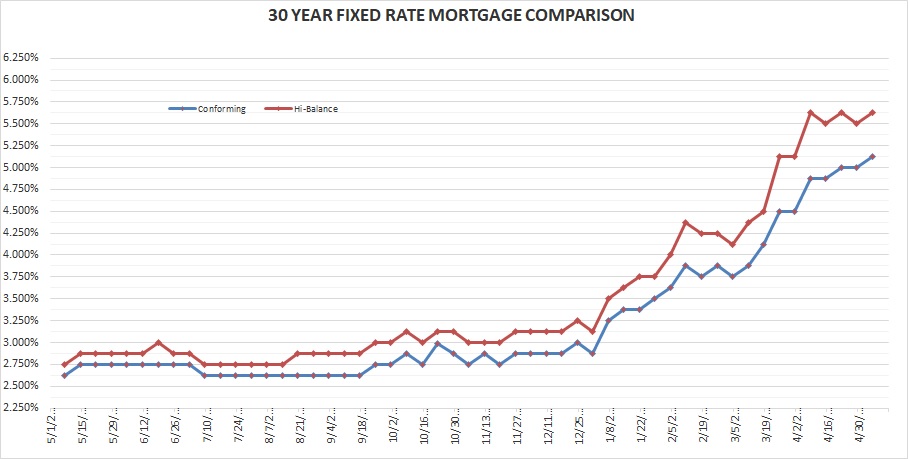
Rates for Friday May 6, 2022: After the Fed announcement on Wednesday markets spiked, which means rates dipped. Waking up Thursday investors reading their tea leaves by analyzing the Fed actions and statements of possible future actions, and looking at economic data, they felt that they would rather hold cash in an economy with 8.5% inflation (meaning the value of cash declines by 8.5%) than hold equities in private companies, or debt issued by the government or homeowners through their mortgages. End result is rates pushed higher in the last two days to push rates higher from last Friday.
FIXED RATE MORTGAGES AT COST OF 1.25 POINTS LOCKED FOR 45 DAYS FOR PURCHASE TRANSACTIONS:
30-year conforming 5.125% Flat
30-year high-balance conforming 5.625% Up 0.125%
Please note that these are base rates and adjustments may be added for condominiums, refinances, credit scores, loan to value, no impound account and period rate is locked. Rates are based on 20% down with 740 FICO score for purchase mortgages.
It has been twenty-two years since Leslie’s first Mother’s Day. Her delayed present, and mine, is that in a few weeks we will see both our girls back East as we attend our oldest daughter’s graduation. Looking back over the two plus decades, our daughters can unequivocally say they have a wonderful mother. She is supportive, honest, questioning, smart, funny and very loving to each of them in the way that each of them needs. Her husband[DS1] is so very fortunate that his wife is such a wonderful mom.
Happy Mother’s Day Moms!
Dennis
Past Weekly Rate & Market Updates can be found on my blog page at my website www.DennisCSmith.com/my-blog
[DS1]om


