


How do you describe your job?
Question of the week: How do you describe your job?
Answer: For the past couple of years Mr. Gillette, who teaches AP Chemistry at Long Beach Poly High School would invite me to speak with his AP students in one of the classes between their AP test and the end of the school year. The talk is mostly about credit and debt and how the decisions they make in the next several years can impact their ability to purchase a home in the future. We discuss college loans, car loans, how debt-to-income ratios work, the costs of deferring interest on their college debt until after they graduate.
At the beginning of the class I give a quick two sentence introduction, which is basically, “I’m Dennis Smith and I am a mortgage broker. I help families buy their homes by providing the loans they need, just like many of you need loans to go to college, most families need loans to buy homes.”
Last week I was talking to my friend Randy who is looking at purchasing a new home with his wife. In the course of our conversation I thought of a better description for what I do. Essentially, I am a loan detective.
I read a lot, and tend to be a serial reader whereby I will read about specific subject, or books from a particular author, or a series, for several months. This summer I started to read the series by Michael Connelly with Hermonious “Harry” Bosch as the main character. Many are familiar with Bosch from the series available through Amazon Prime (great series by the way, and terrific books). He is a homicide detective with the LAPD and each season of the television series and each book is a different murder that needs to be solved.
Maybe because I am well into the Bosch series, the thought about how my job is not dissimilar to a detective’s came to mind.
For Bosch to see someone he arrests be convicted he must collect evidence and work with the District Attorney’s office so that when the case goes to trial before a judge and jury it can be proven beyond a reasonable doubt that the defendant is guilty of the crimes for which s/he is charged.
For me, I must collect evidence, working with my processor so that when your file goes to a lender, we are showing beyond a reasonable doubt that you are qualified for the loan for which you are applying.
We are not collecting blood and DNA samples, though at times it appears our process and requirements seem that way. Rather we are collecting financial data to cover credit history, credit obligations, assets, ability to repay the mortgage, and the collateral for the mortgage.
While our justice system is based on the foundation that all accused are innocent until proven guilty, the mortgage lending system is the opposite in that in essence you are guilty and we have to prove your innocence. Proving innocence is more difficult than guilt—how do you were home alone reading a book at 10:30 Thursday night?
Lenders create underwriting policies and guidelines (most, or all, of which are created by Fannie Mae and Freddie Mac) and underwriters use these policies when review mortgage applications, similar to a jury reviewing the facts presented at trial to determine guilt or innocence under the laws, or guidelines, of the city, state or federal codes.
What do we investigate and how?
For credit verification, are investigating the risk you present based on your credit history, plus the amount of debt you currently have, and how much you must pay per month on that debt; most of this information is available from a credit report. This data is put through algorithms which result in your credit scores for each of the major credit bureaus, which are intended to measure credit risk for anyone extending credit at this moment.
Your credit score (middle of the three scores) is the primary factor in qualifying, if it is below a certain number you are not qualified for certain programs. As well, the score is a main determinant in pricing the rate and costs of your mortgage.
The credit report can also show any public records you may have such as tax liens, judgements for uncollected debts, or bankruptcy filings. If any of public records show on your report, we will need to investigate further to determine the current and future impact on your ability to repay a mortgage. In the instances of bankruptcy filings, the dates involved will determine when you will be eligible for certain mortgage programs.
However, the report only shows the debt you have that have been reported to the credit agencies, or had public records filed as a result. Credit obligations are also investigated based on bank statements, paystubs and taxes. If a recurring payment is showing on your bank statements, we will need to investigate to determine why you have this recurring payment. If it is to an individual is it someone doing house work or gardening, or is it a payment for support that is court ordered that we were not made aware of during the application interview? Is it a payment on a mortgage for a property you own and the seller carried back the mortgage?
Tax returns can show debt obligations for mortgages on commercial property that you own, these loans typically do not report to credit agencies. Or a private loan to the individual who sold you the business you own.
Paystubs can show a garnishment for wages to pay a debt, either to a company or to an individual due to lapse in payments for spousal or child support.
Debt-to-income ratios (DTI) are a critical qualifying factor for mortgages. Note that debt is listed first, so investigation of your monthly payment obligations is critical to ensuring you qualify for the mortgage for which you are applying, hence the thorough investigation to ensure we know all your obligations before we send the file to underwriting.
For asset verification, we are investigating that you have enough funds for down payment, closing costs, and/or reserves if required. As has been mentioned several times over the years in the WR&MU, asset verification has become one of the biggest sticking points we have had in loan approvals for the past several years; let me amend that, pre-Covid pandemic it has been the biggest sticking point.
For most families, asset verification is simple. They have salaried positions and all their income is from W2 wages. Their salaries are automatically deposited into their checking account, perhaps a portion is also deposited into a savings account. The only deposits into their checking and savings accounts for the past several months (or two statements), have either been from the employers, or transfers between the two accounts. They have enough funds in the accounts to cover the funds needed for their transaction, be it purchase or refinance. The only recurring payments they have match up with their housing cost to their landlord or lender showing on their credit report, and other credit payments as shown on their credit report.
For others it can become a bit more complicated, and results in a more in-depth investigation before we can send the file to underwriting. Any large deposits, typically defined as larger than 50% of your monthly qualifying income, must be sourced and explained. Often when we are requesting information on a large deposit we are asked, “why would the lender care?”
There are a few reasons, primarily, the lender wants to ensure that the large deposit is not a loan which would represent another monthly payment we would need to include in your DTI ratios. If the deposit represents a gift from a family member, or other qualified gift donor per mortgage guidelines, we need to track the funds from the donor’s account, and also complete a gift letter in which donor states the funds are a gift and not expected to be repaid.
Another reason to that large deposits need to be tracked is due to anti-money laundering regulations imposed on all financial institutions via the Bank Secrecy Act. Real estate transactions are a primary vehicle for money laundering and the federal government has, in a way, deputized brokers and lenders to report suspicious activity.
Too often our final loan approval is held up as we wait for asset verification from clients with large deposits. If you have had, or are going to have, a large deposit that is not from your employer or from another account under your control, be prepared to show us where the funds came from and why you are receiving them. If you sell a car, have a bill of sale and copy of the transfer of title, if you are paid back a loan from your brother in-law, have a copy of a note he signed plus the cancelled check from when you lent him the money. Keep records showing the transaction and the source of unusual, and legal, transactions and be prepared to show them.
For ability to repay, we are investigating your income. Essentially, if you do not pay taxes on the income it cannot be utilized for mortgage qualifying. There primary exception to this guideline is if we are using asset-depletion to calculate income, in which case our asset verification will be a bit more detailed.
Income comes in many forms, salary and wages, bonuses, commissions, self-employment, distributions from corporations, dividends, capital gains, distributions from qualified accounts, annuities, rents, spousal and/or child support, retirement pensions or social security, are all eligible for mortgage qualification. How they are verified vary from simple paystubs and W2s, to tax returns for individuals and corporations with supporting letters from tax preparers and CPA’s,
From a lender’s perspective, income is the riskiest part of the decision to make a loan. All that can be verified, for most people who do not have a guaranteed contract with the Los Angeles Dodgers or other organization for the next five years, is the income you are currently receiving and the income you have received in the past one to two years that indicates the income has been constant. What lenders are trying to determine is that the income you have is constant, and that it can reasonably be determined that it will be continuing for at least the next three to five years.
Using the family above with the only deposits into their bank accounts being from their employers, they are the easiest to qualify as we use their current paystubs and W2’s to show their salaries.
If there is bonus income it gets trickier. Does the bonus happen every year? Is it the same amount? Is it in a contract? Is it likely to occur in the future? How much was the bonus last year? The year before? Is the bonus increasing each year or declining? If you are paid salary plus commissions, we must answer these questions, plus see if you write off any expenses against your commissions.
For most non-W2 earnings, especially commissions and bonuses, the guidelines state the income used to qualify must be a two year average and if the bonus or commission income is declining either must use the lowest year (hence no average), or may be declined to be used if it appears tenuous the bonus or commission may continue.
The same guidelines are used for self-employed individuals (though many programs now have allowances for only the most recent year’s tax returns to be used). Lenders want to ensure that your income is stable and not declining, thereby decreasing the risk that you may not be able to pay your mortgage in the future.
In the age of C-19 the income verification has become even more intense as your employment must be verified not only before we submit to underwriting, but again just before loan documents are drawn, and again a day or so later before the loan is funded.
If you are self-employed, new guidelines are bank statements for the months prior to funding and a year-to-date profit-and-loss statement to the end of the month before funding that matches up with the bank statements.
If you have tenant income the guideline is to provide rental agreements and bank statements showing the deposits matching the agreements.
For those who feel the mortgage investigative process is too thorough, I ask, “imagine my cousin, who you will never meet, in Tulsa is asking you to lend him $400,000 so he can buy a house. What would you want to know before you wrote him a check?” You would want to know all of the above, and perhaps a bit more.
To ensure your loan is approved you need a good detective to research your finances and cover the issues an underwriter is looking to uncover. You need someone who can prove your innocence, that’s what I do, Dennis Smith, Mortgage Approval Detective.
Have a question? Ask me!
Employment continues to grow, but at a slower pace. After June’s surge in employment, July saw a large increase in new workers but at a much slower pace. Spikes in positive Covid-19 tests in several states, especially California, Texas and Florida, the three most populous, led to shutting down some sectors of their economies, put a damper on companies bringing workers back. Gaining back some jobs is a positive, July was the third month in a row with positive growth, as well the unemployment rate also declined for the third month in a row, to 10.2% from 11.1%. Keep in mind this rate does not include those not looking for employment. Ordinarily a surge in jobs would lead to higher rates, but “ordinary” reactions to economic news is suspended for the time being.
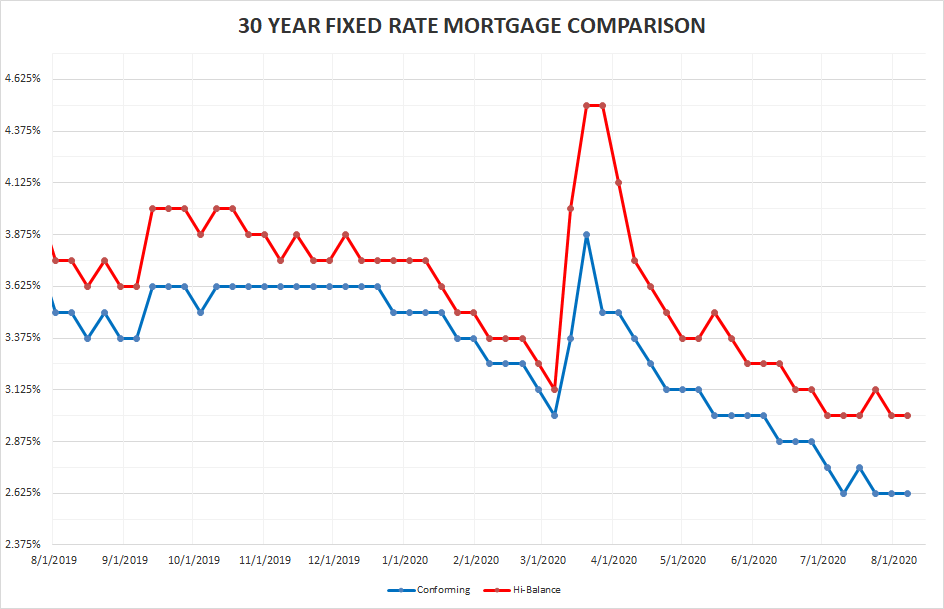
Rates for Friday August 7, 2020: Rates continue to remain flat from the prior week. While the data suggests rates could perhaps be lower, lenders are not in a rush to lower rates given they are operating beyond capacity already.
The rate spread for cash-out, no point, higher loan-to-value and other factors for refinances still are historically higher than normal. Call for details and quotes as rates can vary significantly depending on the situation.
FIXED RATE MORTGAGES AT COST OF 1.25 POINTS LOCKED FOR 45 DAYS:
30 year conforming 2.625% Flat
30 year high-balance conforming 3.00% Flat
Please note that these are base rates and adjustments may be added for condominiums, refinances, credit scores, loan to value, no impound account and period rate is locked. Rates are based on 20% down with 740 FICO score for purchase mortgages.
I have always enjoyed detective stories, fiction and non-fiction. When I was a kid I never got into the Hardy Boys, nor Nancy Drew. But I think I read every book that had been published until I was in 5th or 6th grade. Harriet the Spy, The Mixed-Up Files of Mrs. Basil E. Frankweiler were also favorites, the latter I re-read a few years ago. One summer my serial reading habit had me read the entire collection of Sherlock Holmes stories and novels by Sir Arthur Conan Doyle; Sherlock’s “When you have eliminated all which is impossible, then whatever remains, however improbably, must be the truth,” seems to be a theme for mortgage underwriting as well.
I hope you have had an enjoyable summer reading list, which started in March…
Have a great week,
Dennis
Past Weekly Rate & Market Updates can be found on my blog page at my website www.DennisCSmith.com/my-blog


