


How will buying and selling real estate change after the Covid-19 pandemic?
Question of the week: How will buying and selling real estate change after Covid-19 pandemic?
Answer: The coronavirus pandemic has impacted every industry and business, and few, if any, businesses will return completely to how they conducted their business prior to February 2020. The biggest impact is the explosion of technology taking the place of in person meetings and exchange of documents. Grandmothers are using Zoom to see their grandkids, legal documents are signed with e-signatures and dinner is being ordered on mobile phones.
What about real estate, what will be the lasting changes for buyers and sellers as a result of practices put in place during the pandemic?
Here are my thoughts on the question.
Open houses may not come back. The primary purpose of open houses is not to sell that particular home, but to market the agent in the neighborhood and to acquire buyers for other homes. Yes, some homes are sold to buyers who walk into an open house following the signs from the major road on their way home from bottomless mimosa brunch. Are sellers going to want to abandon their homes for several hours on Saturdays and Sundays so strangers can tramp through their home? Our current real estate market is very hot for sellers with properties across the region at all price points below about $1.5 million selling with multiple offers and above listed prices. No open houses, multiple offers. When the market slows down there will be pressure for sellers to let agents hold open houses, but will the sellers agree in post-pandemic markets?
In-line with the reduction in open houses is a likely reduction in broker-tours. Every market, and most sub-markets, have a day of the week for broker-tours. This is an opportunity for agents to open up a home they have recently listed for other real estate agents to come by and see the property. While the focus of these openings is to provide agents information about the property so they can see if it may be of interest to one of their clients, it is not unusual for neighbors and members of the public to stop by as well. Should broker-tours continue post-pandemic its seems to me they will likely require those coming to view the home show evidence they are in the real estate industry to reduce the traffic through the home.
There will be reduction in the number of showings. Pre-pandemic a listed property can have hundreds of people go through the home. Some serious buyers, some “looky-loos,” some neighbors and many agents. I expect the volume of traffic through a listed home to decrease dramatically.
Historically, for those purchasing investment property, buyers wrote offers with a clause “subject to inspection.” Because investment property owners do not want to subject their tenants to multiple disruptions so potential buyers could see their living units, they would only allow potential buyers to see the inside of properties once the buyer and seller had agreed to price and terms. Variations of the “subject to inspection” clause will appear in the owner-occupied housing market.
In the current market many sellers are requiring that potential buyers who want to view their property provide a pre-approval letter prior to having access to their homes. This cuts down on the “looky-loos” who tend to look at properties but rarely write offers or get serious about purchasing a new home. As well, this step lets the seller know those looking at their property are capable of purchasing it should they like what they see.
Pre-pandemic, agents wanting to show their potential buyer a home looked at the showing instructions on the Multiple Listing Service, not infrequently the instructions were, “go direct between Xa.m. and Yp.m. seller at work.” Other instructions were to make appointments with sellers or listing agent. In general, it was fairly easy to show a home on short notice. Current guidelines are that every showing must have an appointment to avoid multiple showings at the same time.
Zoom your home. This step is already in place and in use in some markets. The last several years has seen many agents having professional videos made for their listings, highlighting the home and it amenities. It seems logical that we see the transition in the residential market to buyers and sellers negotiating a sales price and terms before the buyer physically sees the inside of the home. After researching and driving the neighborhood, viewing a video of the home, the buyer will make an offer “subject to inspection.” When an agreement is made the sell will allow access for the buyers to view their home to ensure it is the right fit for them (see my esoteric thoughts on this subject in the WR&MU in July.)
One trend in the current market is the increase in millennials entering the housing market. This trend is for a couple of reasons, one is that they are entering the traditional age for purchasing a first home, second is Covid-19 stay-at-home policies having them look for more space than an apartment or small rental home, and third is with rates where they are mortgage payments are close, or possibly less than what they are paying in rent in some areas. Regardless of the reason, they are a significant segment of the home buying market. The millennial generation grew up with the internet, have been using screens for their entertainment, communication and information for all, or almost all, of their lives. While for us older folks it may seem strange to use a video of a home to decide if we want to buy it, for millennials it is the norm. Agents wanting to capture the millennial market are already using videos posted on social media to capture clients. Look for this to expand for older generations as well.
Be prepared to gear up. Current guidelines require potential buyers to wear masks and booties when viewing properties. While there will likely be a reduction in the use of masks in public as the Covid-19 virus wains and a viable vaccination is produced, the requirement for masks in private homes for sale may not. This is especially the case should the home be the residence of elderly owners, or those with medical conditions.
For post-pandemic real estate sales, expect the changes that have occurred due to the pandemic to remain. A bit looser in some instances, but overall expect that most sellers will want more control over the number of people going through their homes.
Have a question? Ask me!
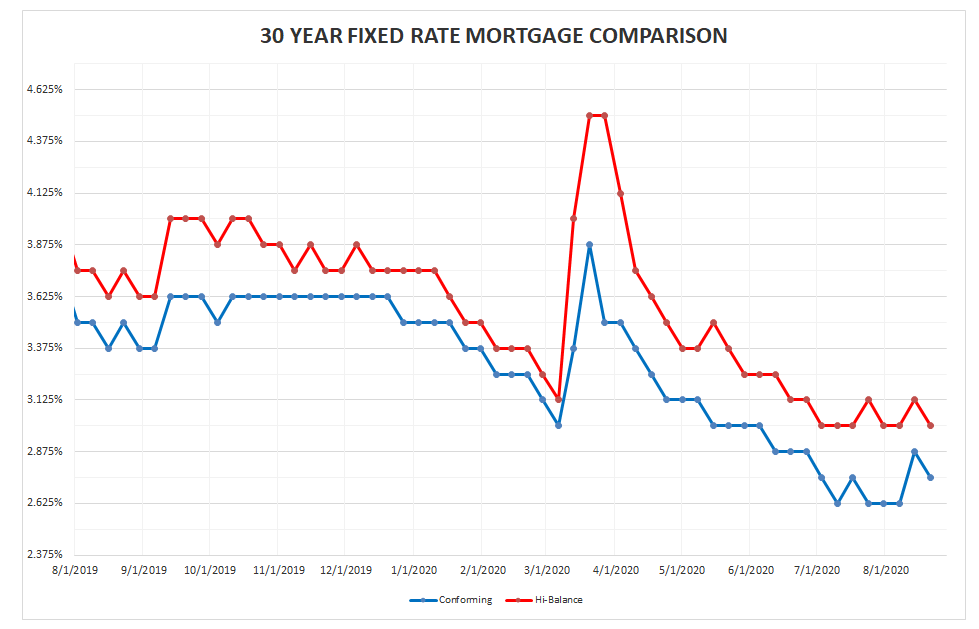
Rates for Friday August 21 2020: Minutes released this week from the Federal Reserve Open Market Committee put a little softness in the rate markets as they predicted a slower economy for the rest of the year due to the pandemic. They noted challenges for employers, especially in manufacturing, to hire employees despite the high unemployment rate. As a result, rates have receded from last week’s slight bump.
Refinance rates are higher than purchase rates, please call for details and quotes as rates can vary significantly depending on the situation.
FIXED RATE MORTGAGES AT COST OF 1.25 POINTS LOCKED FOR 45 DAYS:
30 year conforming 2.75% Down 0.125%
30 year high-balance conforming 3.00% Down 0.125%
Please note that these are base rates and adjustments may be added for condominiums, refinances, credit scores, loan to value, no impound account and period rate is locked. Rates are based on 20% down with 740 FICO score for purchase mortgages.
With the heat wave we are experiencing in Southern California combined with the number of people working from home due to the pandemic combined with many homes in the region still not having air conditioning what do you think will be the work load for companies that install air conditioning?
It is a lot different to come home to a hot home in the evening, open doors and windows, turn on fans and cool off a house into the night than to work throughout the day with a fan two feet from you blowing not so cool air as you work on a laptop that is getting hotter and hotter through the day. One’s mind wanders to the cost of installing a cooling system, the additional costs on electric bills and “why didn’t we do this before?”
Have a great week,
Dennis
Past Weekly Rate & Market Updates can be found on my blog page at my website www.DennisCSmith.com/my-blog


