


Should we borrower from 401(k) to buy our home?
Question of the week: Should we borrower from 401(k) to buy our home?
Answer: Maybe.
Most 401(k) plans allow for funds to be borrowed for certain life events or emergencies, including purchasing a home. Typically, the guidelines for company plans enable employees to borrow up to half their balance—though some do cap the maximum amount available.
When you borrow from your employer sponsored retirement plan you pay yourself back, with interest. Plans can have different interest rates that are charged, you cannot determine the rate yourself, the prime rate is generally used as the basis for the rate at the time it is executed.
The interest you pay on your loan is paid into your retirement account not to a third party or the plan administrator. Essentially you are paying yourself for the money you borrow.
The term for the loan to be paid off can vary, and often you can pick the term you like from those being offered, say 3- 5-7- or 10-years. Each pay period funds will be withheld in your check to make the loan payment. Note, you can also continue to make contributions to your retirement account with the outstanding loan.
Funds for the loan are created by selling holdings in your account.
If your employment from the employer is terminated, either willfully or unwilfully, the balance on the loan must be paid off, unless the employer allows you to continue to have your account remain in the employer’s plan and to make loan payments. If the loan is not paid off the balance of the loan is considered the same as if you took a distribution; the balance is taxed as ordinary income and if under 59 ½ the 10% penalty is added.
The benefits of using a loan from your retirement account for the purchase of your home are, as stated above, you pay interest to yourself, the payments are automatically deducted from your paycheck, and very importantly, most loan programs do not count the payment on the loan against your for mortgage qualifying.
The detriments of using your 401(k) are the loan payments are after-tax dollars, unlike your contributions to your account that are pre-tax. As well, when you take the funds out of your account later in life, i.e. during retirement, the payments are taxed again as ordinary income—so you are double taxes on the payments, on the income earned to make the payments, and as income when the funds are withdrawn in the future. Besides the potential tax liabilities on the payments, unpaid loan balance and future distributions, some consider taking funds out of the market which are compounding with interest and dividend re-investment a detriment.
This latter issue has had some homebuyers balking at borrowing from the 401(k) because of our natural inclination to want to pay as little as possible in taxes. The decision that needs to be made when considering a 401(k) loan is whether you consider the cost of the taxes on the funds needed to purchase your home are greater than the benefits you will receive with homeownership. Among those benefits are tax deductions for interest paid on your mortgage and property taxes (subject to the $10,000 limit for State And Local Taxes for federal returns), as well as the accumulation of equity during the time of your homeownership.
When you consider that as a renter your housing costs will continue to increase, usually on an annual basis, purchasing a home with a somewhat fixed cost year over year, property taxes and homeowner’s insurance being the variables, that benefit alone should tilt the balance to borrowing the funds to purchase your home.
Finally, keep in mind as well, that purchasing a home when interest rates are high can lead to lowering your housing cost in the future when/if rates drop.
Okay, that wasn’t “finally.” NOTE for first-time buyers, you can withdrawal up to $10,000 without penalty for the purchase of your home. Note “without penalty,” this applies to those who are younger than 59 ½ years old who must pay a 10% penalty on the amount withdrawn, on top of the income tax that is applicable. For the younger folks who take advantage of the $10,000 withdrawal they save $1000 in the penalty tax.
First-time buyers are those you have not owned a principal residence in the previous two years, this includes your spouse.
Finally, finally, the IRS has a 60-day rollover rule during which you can withdrawal funds from a retirement account and the amount is not taxed if you replace the funds into the account within sixty days—to the day. We have used this method for obtaining funds for purchasing a new home for clients who are expecting a large bonus, or funds from the sale of their current home or other asset, or funds from a gift or inheritance, within the 60-day period. This is a rather risky method however as if something happens and house does not close, the company delays the bonus, or other funds do not come through or are less than anticipated, there can be a significant tax hit depending on how much you have withdrawn.
To go through the options of using your retirement account for the purchase of your new home please give me a call.
To schedule an initial meeting by phone or Zoom, click here for my calendar, please feel free to forward to a friend or family member!
Have a question? Ask me!
Consumer confidence is consistent, consistent in going down as it has for the fifth month in a row in April to the lowest level since May 2020. There was only a slight drop in consumers views on the economy, but there was a very large drop in the “expectations index.” This index measures how people think the economy will look six months from now. The 54.4 level is the lowest since October 2011; note that it is significantly below the 80-point level that usually signals a recession ahead. For the first time in five years income expectations turn negative. Negative expectations for income generally tights consumer spending, which slows the economy, which can lead to recession.
Tariffs imposed by President Trump result in GDP shrinking for the first time in three years. The trade deficit between the United States and other nations is a primary factor in Trump’s tariff policy, or theory as not sure what policy actually is with almost daily changes. The tremendous jump in the trade deficit is the primary reason the economy shrank by 0.3% in the 1st quarter of 2025. Businesses went on a spending spree to bring in the foreign goods they need before the tariffs went into effect; the result was the trade deficit cutting 4.8% off GDP.
Consumer spending climbed in March, mainly due to the purchase of new cars and other big-ticket items that are imported to avoid higher prices due to tariffs. The 0.7% monthly increase was driven by a 57% increase in spending for automobiles—the most cars purchased in the past four years. Consumer spending drives the economy, but even the large increase in March, the spending could not off-set the impact of tariffs and the trade deficit. Or rather, the trade deficit was in large part driven by increases in consumer spending.
The job market is still strong. Unemployment is still low, and incomes are rising as employers offer more to attract and retain workers. March saw personal incomes increase 0.5% from the month before, resulting in a $116.8 billion increase in personal income.
The Personal Consumption Expenditures index, the preferred inflation gauge for the Federal Reserve, showed inflation slowed in March. The PCE index was flat in March, after showing prices increasing 0.4% in February. Year over year prices are up 2.3%–inching toward the 2.0% inflation target for the Federal Reserve.
April’s jobs report was higher than expected. Today the Labor Department released employment data for April showing 177,000 new jobs created in the month, well above the 133,000 expected. The report also showed that the unemployment rate remained at 4.2% for the month. It needs to be noted that the report data was collected one week after Trump initial tariff announcement, so many employers who adjusted hiring, and lay-offs, due to the tariffs may not have done so at the time of the report. Likely showing a trend, we may see in coming months, the manufacturing industry was flat in the month. The continuing strength in the jobs market gives the Federal Reserve a good reason to not move interest rates in the near future.
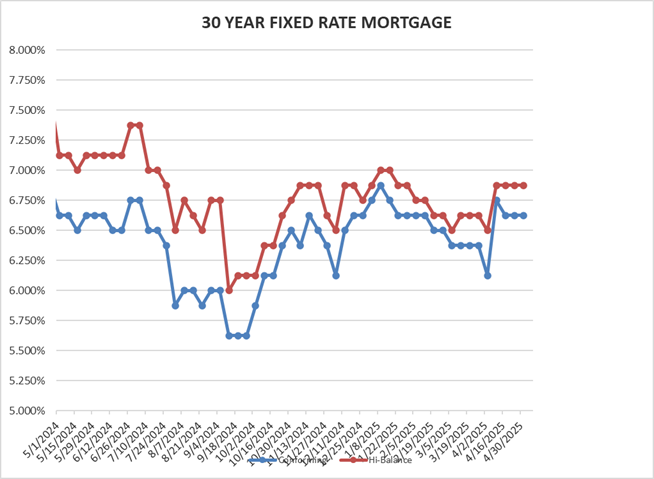
Rates for Friday May 2, 2025: Uncertainty remains the description for markets and expectations for what’s next. Despite the tumult pushing markets up and down daily, rates remain flat from last Friday.
FIXED RATE MORTGAGES AT COST OF 1.25 POINTS LOCKED FOR 45 DAYS FOR PURCHASE TRANSACTIONS:
30-year conforming 6.625% Flat
30-year high-balance conforming 6.875% Flat
Please note that these are base rates and adjustments may be added for condominiums, refinances, credit scores, loan to value, no impound account and period rate is locked. Rates are based on 20% down with 740 FICO score for purchase mortgages.
Anyone mixing some mint juleps tomorrow for a Kentucky Derby party? How about just for yourself? Can we only have this delicious cocktail only on the first Saturday in May? Is it like egg nog at Christmas time and not appropriate out of season?
No is the appropriate answer to the last two questions.


